Reblog> Days numbered for barcodes (according to Reuters)

A sort of interesting story from Reuters on an apparent growing demand for information by consumers that they suggest may lead to the demise of the low-fi barcode in favour of QR [really?! still trotting out that old nag?] and RFID… so, nothing people like Bruce Sterling haven’t been saying for quite a while but sort of interesting how it’s couched…

Days numbered for barcodes as shoppers demand more data

BERLIN | 

Barcodes are seen on a package in London August 27, 2015. REUTERS/Russell Boyce
Barcodes are seen on a package in London August 27, 2015. REUTERS/RUSSELL BOYCE

Growing demand for more information about the products we buy could mean the end of the simple barcode – the blocks of black and white stripes that adorn most objects for sale and are scanned five billion times a day.

First used on a pack of Wrigley’s Juicy Fruit chewing gum in 1974 in a store in Ohio, barcodes have revolutionized the retail world, allowing cashiers to ring up products much faster and more accurately, while also streamlining logistics.

But shoppers are now demanding far greater transparency about products, and store owners need more information to help with stock taking, product recalls and to fight fakes. The basic barcode is just not up to the job.

That could mean a costly upheaval for retailers and brands to change packaging and invest in new systems and scanners. But it should also bring benefits as more data helps them manage the flow of goods better.

“The barcode did a great job, but it is now time for succession,” said Capgemini consultant Kees Jacobs, who is working with the world’s top retailers and food manufacturers to try to agree new global standards for labels and product data.

“The current barcode is not sufficient to be the carrier of much more granular information that is needed,” Jacobs said.

The most ubiquitous barcodes allow an eight to 14 digit number to be read by a laser scanner. For example, barcode 4-003994-111000 identifies a box as being a 375 gram pack of Kellogg’s Corn Flakes.

However, that number does not directly capture any other information that might interest a shopper – such as ingredients, allergens or country of origin – nor does it provide a retailer with useful details such as the batch number or sell-by date.

That data is usually printed on the pack, but consumers increasingly want to read it online, or with a smartphone app such as one that measures calories. Retailers want data that can be scanned for tasks such as quickly locating faulty goods for recall or about-to-expire products for mark downs.

SUSTAINABLE AND SAFE?

GS1, the non-profit organization that assigns the unique numbers in barcodes, has developed a double-layered barcode it calls the “data bar” which can carry some extra details such as expiry date, quantity, batch or lot number.

That has allowed German retailer Metro (MEOG.DE) to launch PRO Trace, a smartphone app that shows, for example, that a filet of salmon on sale at a store in Berlin on Aug. 25 was caught at the Bremnes Seashore fish farm off the coast of Norway on Aug. 17 and processed in Germany on Aug. 21.

The app also displays a map highlighting the fishing area of the catch and a detailed description of the Atlantic salmon.

Metro says the app helps customers at its cash-and-carry stores such as professional chefs from hotels and restaurants, as they can now embellish their menus with information about the exact origin of pricey delicacies such as wagyu beef.

“We are the only ones in Germany that can do this for fresh fish. It’s about trust. Our customers challenge us to offer sustainable and safe products,” said Lena vom Stein, a corporate responsibility project manager at Metro.

Metro set up the tracking scheme to help it comply with European Union regulations aimed at stemming overfishing and started making the data available to customers in 2012. It now extends to meat, and fresh fruit and vegetables will follow.

Other retailers are also opening up, often supplementing the barcode with a pixilated square known as a quick response (QR) code. It can store dozens more data points and can be scanned by a smartphone camera to lead to a web page, but can still not be read by the majority of store scanners.

Dutch retailer Albert Heijn (AHLN.AS) recently introduced “Check Origin” QR labels on locally-grown radishes and blueberries. Scan the sticker on a mobile phone and it plays a film that rewinds to show the journey from the shelf back to the packing factory, then back to the farmer’s field.

Such tools are likely to fuel demands for more transparency. A GS1 survey found consumers are most interested in nutritional and ingredient information, details on allergens, organic certification, environmental impact and ethical standards.

HARMONIZING DATA

Making such a wealth of data accessible via codes that can be scanned is only part of the problem. A bigger challenge is gathering, storing and standardizing the information in the first place.

Fiona Wheatley, sustainable development manager at British retailer Marks and Spencer (MKS.L), says keeping tabs on all the company’s suppliers can be a daunting task.

“Your ability to give your customers more confidence that they can rely upon is proving to be increasingly challenging,” she said, adding that M&S relies on certification schemes such as Fairtrade to help audit smallholder farmers.

David Linich, supply chain expert at consultants Deloitte, advises retailers to find ways to work together to monitor the thousands of producers they buy from: “If you go it alone it can be really burdensome, really cost prohibitive.”

The Consumer Goods Forum (CGF), a global network of some 400 retailers and manufacturers from 70 countries, is coordinating efforts to harmonize product data and labeling.

Most firms accept that more transparency is needed after scares such as the 2013 scandal about horsemeat being sold as beef in Europe, but it is still proving hard to persuade them to share data that many see as commercially sensitive.

Capgemini’s Jacobs, who is working on the CGF project, hopes pilot schemes to standardize digital information, like one between rival retailers in Belgium including Delhaize (DELB.BR), Carrefour (CARR.PA) and Colruyt (COLR.BR), could be the precursors to new global data standards.

GS1 already holds data from 30,000 companies on some 18 million products that its industry members share with each other behind the scenes to smooth logistics.

It is trying to persuade its members to let consumers access more of this information, while keeping some of it confidential, such as detailed pricing and stock levels.

Malcolm Bowden, president of global solutions at GS1, predicts agreement could come quickest – within a year – on sharing nutrition data as there are already broadly accepted standards, and calorie and allergen apps are proliferating.

“The will is there. It has to happen. Like any major change, big companies have to have time to think through the implications,” he said.

GS1 is also working to create identifier numbers for individual farms and is trying to harmonize standards on sustainability data, such as a measure of water efficiency for detergents and washing powders currently being piloted.

But making such a wealth of data available will sound the death knell for the barcode. Only a QR code can carry that much information without taking up too much space on packaging.

Longer term, more products could carry wireless tags such as the RFID labels that are being widely rolled out across the fashion industry. These tiny tags, which can be embedded in an object and, unlike a barcode or QR code, do not need to be within the line of the sight of a reader, were long too expensive for everyday goods but their price is falling fast.

Bowden predicts different systems will probably have to coexist for the next decade or so as retailers and logistics providers gradually upgrade their scanning systems.

“I am convinced we will have a day where pretty much all information about all products will be available to all consumers,” he said.

(Editing by David Clarke)
French Conseil National du Numérique report published [video intro]

I’ve been following tweets from the Conseil National du Numérique for a little while, which have been interesting [with the hashtag #ambitionnumérique] – their “Ambition Numérique” (roughly: ‘Digital Goals’) report for the prime minister is now published and there’s a swish video intro for it (below).

It’s an interesting report because of the level of consultation the CNM attempted, with anyone ostensibly able to offer comment through an online consultation process and lots of other ‘stakeholders’ approached directly, with four big meetings held in Lille, Strasbourg, Bordeaux, and Nantes.


The video is worth a watch just to get a sense of how one of the G8 is approaching issues such as identity, neutrality, public services, privacy and work in relation to a growing digital economy. Although, none of what is said is particularly surprising. IT is sort of interesting that it is coming from a (sort of) ‘state actor’…


Le numérique nous concerne tous ! Les grands… by cnnumeriquefr

You can switch on the English subtitles by pressing the [cc] button and selecting “English”.

There’s also a press release in English here.

Reblog> 40 reasons why you should blog about your research

A post from about a year ago on Sociological Imagination – seen via Stuart Elden…

I particularly agree with:

  1. It’s a great way of making connections & finding potential collaborators.
  2. It can provide an archive of your thoughts, ideas and reactions which can later be incorporated into more formal work.
  3. It makes it easier for people to find your published work and increases the likelihood they will read and cite it.
  4. Its informality and immediate accessibility can help make writing part of your everyday life rather than being a source of stress and anxiety.
  5. Its a great way to promote events and call for papers. Particularly if you blog regularly and your blog is connected to Twitter.
  6. It helps ensure you can continue to develop strands of thought which, for now, don’t have any practical implications but might at some point in the future.
  7. It encourages you to reflexively interrogate and organise your work, drawing out emergent themes and placing isolated snippets of commentary into shared categories.

Reblog> New paper: Anticipatory Logics of the Global Smart City Imaginary by @jimmerricks

Over on the programmable city website there’s news of a new paper by Jim Merricks White on the anticipatory logics of smart cities… I have previous here so it’ll be an interesting read!

New paper: Anticipatory Logics of the Global Smart City Imaginary

Jim White’s paper, ‘Anticipatory Logics of the Global Smart City Imaginary’, is available for download on the Social Science Research Network as Programmable City Working Paper 8.

Abstract

The smart city encompasses a broad range of technological innovations which might be applied to any city for a broad range of reasons. In this article, I make a distinction between local efforts to effect the urban landscape, and a global smart city imaginary which those efforts draw upon and help sustain. While attention has been given to the malleability of the smart city concept at this global scale, there remains little effort to interrogate the way that the future is used to sanction specific solutions. Through a critical engagement with smart city marketing materials, industry documents and consultancy reports, I explore how the future is recruited, rearranged and represented as a rationalisation for technological intervention in the present. This is done across three recurring crises: massive demographic shifts and subsequent resource pressure; global climate change; and the conflicting demands of fiscal austerity and the desire of many cities to attract foreign direct investment and highly-skilled workers. In revealing how crises are pre-empted, precautioned and prepared for, I argue that the smart city imaginary normalises a style and scale of response deemed appropriate under liberal capitalism.

Keywords: smart cities, the urban age, anticipation, risk

[pdf download]

BBC’s “Future-proofing” radio programme on blockchain – pretty good!

I happened to be driving at around 8ish last night and the car radio was by default on Radio 4 so I caught a bit of the latest programme in the ‘FutureProofing‘ series. Ordinarily such things tend to annoy me, cos I am grumpy, but listening to the programme about block chain last night I confess I was rather impressed. Timandra Harkness and Leo Johnson present an interesting account.

Blockchain is a difficult thing to explain and harder still to attempt to articulate how it might be used, beyond the libertarian goals of particular uses of crypto-currencies. The programme last night excelled in this regard covering lots of interesting angles. They end up having an interesting debate about politics and government.

There’s some interesting interviewees too:

Janina Lowisz (‘blockchain girl’) – ‘ambassador for bitnation‘

Mike Hearn – software developer & bitcoin advocate

Nathaniel Popper –journalist, author of ‘digital gold’

Susanne Tarkowski Tempelhof – CEO of bitnation

Steven Lukes – Prof. of Sociology at NYU

Vinay Gupta – of the Ethereum (blockchain) project

Silicon Valley’s libertarian capitalism and Burning Man

I’m a fan of Fred Turner’s work – especially his book From Counterculture to Cyberculture that charts the shift from hippy-like communalism to libertarian cyberculture by Stewart Brand and a few other Californian countercultural torch-bearers associated with the Whole Earth enterprise.

In the book Turner outlines the ways in which the rhetorics of a kind of collectivised, networked utopian society became a rationale for a non-hierarchical way of living using internet technologies and a basis for offering strategic business advice about how these new technologies would ‘disrupt’ the status quo of contemporary life (and thus are a business opportunity). The book is, of course, more nuanced than that and it is well-worth a read!

In a separate journal article, around the same time, Turner charts out how a similar logic underlies the Burning Man festival and how this resonates with the core beliefs of those at the top of Google. Peer production and re-finding the social value of your labour using the kinds of communal working models that came out of the counter/cyber- culture nexus emerges as a key value at Burning Man, as people make and share and gain notoriety & kudos accordingly. But the article sort of paints too-rosy a picture of the benevolence and horizontalism of Burning Man.

For, we can also see how the ethos of peer production and forms of free labour has been something that Google has exploited from day one (they don’t make ‘content’, they index it and sell adverts alongside it back to us, who make it). And as the Valley millionaires increasingly use Burning Man as the highlight of their social calendar, and do not sully their own hands in ‘contributing’ to the festival but employ others to do so, we can see how that exploitation spreads…

In a recent article in Jacobin Keith Spencer compellingly articulates how this exploitation of forms of communalism is the basis for the creation of a wealthy elite constructing themselves as the benevolent harbingers of a different kind of society.

Burning Man foreshadows a future social model that is particularly appealing to the wealthy: a libertarian oligarchy, where people of all classes and identities coexist, yet social welfare and the commons exist solely on a charitable basis.

Its worth reading all of the above, but definitely read Spencer’s piece in Jacobin.

IEEE story: “Computer Scientists Find Bias in Algorithms”

The IEEE Spectrum website reports ‘Computer Scientists Find Bias in Algorithms‘ [no! really?!], which makes me chuckle after (finally) recently getting down some thoughts about how we variously talk about and may study the things we call algorithms.

The following excerpt demonstrates the ways in which a particular understanding of acceptable knowledge (i.e. ‘science’, to the exclusion of other ways of knowing the world) and a kind of anthropomorphic slip reveal how even the idea of ‘bias’ here is firmly situated in a particular discursive regime:

Understanding how an algorithm becomes biased is fascinating, says Venkatasubramanian. The bias is germinated innocently enough within a simple processing system, and develops in a carefully controlled setting. But the self-improving nature of learning algorithms raises concern. Venkatasubramanian and his colleagues wonder whether we can ever trust the fairness of algorithms. To that end, they have begun stockpiling relevant information about where and how they go wrong. He also hopes that the study will help lawmakers understand how algorithms and big data should be treated in a legal case.

Many people believe that an algorithm is just a code, but that view is no longer valid, says Venkatasubramanian. “An algorithm has experiences, just as a person comes into life and has experiences.”

Amazon as the exemplar of authoritarian employment..?

Just a quick post to park two related things here on the blog in order to return to them…

First: this story on Fusion:

The Amazon Way: Why the data-driven workplace is a nightmare  which describes a corporate culture driven by personal and collective analytics that overrule any consideration of hard-to-measure or qualitative considerations… and how that is prosecuted through a hellish kind of managerialism.

Second: This list/story on The Grauniad:

Why the workplace of 2016 could echo Orwell’s 1984 which essentially lists any and all kinds of personal surveillance technologies–currently marketed as ‘quantified self’ and other kinds of self-knowledge tools–and packages them up into some kind of nightmare version of the Amazon managerialism explored above.

What’s interesting? I think its interesting how a particular version/vision of the future of work plays out between these stories that strays close to a form of technological determinism and exemplifies an influential way that ideas about work, and how it may change, are being discussed.

Reblog> A litmus test for the internet of things

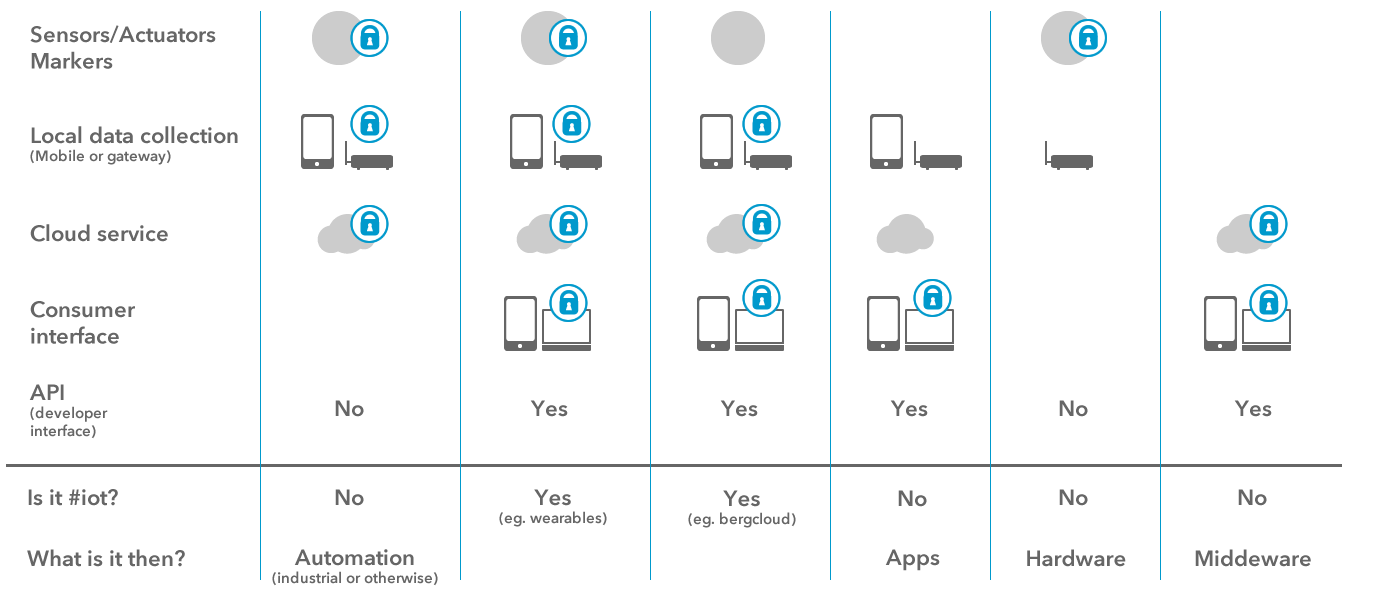
Alexandra Deschamps-Sensino blogged this really interesting ‘test’ to check if something is part of the IoT, or not – and what is it if not..?

I don’t have time to write about this now, but it resonates with the ThingTank project by Chris Speed et al. that I blogged about a little while ago…

A litmus test for the internet of things

It’s taken me about 2 months to work out how to show the differences between products that companies say are iot and those that possibly aren’t. I suspect I actually need to explain it but I’d rather have a good conversation on Twitter about it so I can tweak things accordingly.

For clarity, a lock means it’s proprietary.
No lock means it’s open source.
Absence of means its not provided by the company directly.

designswarm_iotlitmustest2

Reblog> CounterText: call for papers

Interesting CFP via Edinburgh Press blog...

CounterText
Call for Papers
Special Issue: Explorations in Electronic Literature
Edited by Mario Aquilina and Ivan Callus

An entire epoch of so-called literature, if not all of it cannot survive a certain technological regime of telecommunications.
– Jacques Derrida, The Post Card

Is literature surviving? Is it not still electrifying? Might electronic literature be one form of its survival? Does electronic literature mark another stage in the evolution of literature or does it open a new, unprecedented paradigm for the concept of the ‘literary’? This special issue investigates electronic literature’s challenges to established conceptions of literature and literariness. The following will be irrepressible questions. How should authorship, creation and originality be rethought? Can we still speak of ‘literature’ when the letter becomes only one element in works which are characterised by kinetic, visual, ludic, and sensory dynamics? Can we think of the electronic (post-)literary also as an electronic post-letter? And how might this be countertextual?

The apocalyptic threat to literature implied in Derrida’s comment on ‘a certain technological regime of telecommunications’ has not come to pass, nor might we be expecting it to. There can be no doubt, however, that computing technologies and code (the digital affordances enabling electronic literature) can prompt fevered speculation on literature’s evolving futures and platforms. As a result literary criticism, too, changes. Long traditions of aesthetic, thematic and formal discussions of literature are brought into question by electronic literature, as is the meaning of reading more generally (never mind close reading).

However, discussions of electronic literature countenancing technological determinism risk ignoring genealogies of electronic literature founded in long traditions of combinatorics and generative (not quite algorithmic) rules. Is electronic literature, then, a manifestation of a potential always already within the literary rather than simply a technology-determined transformation in the literary? And if it is so, how do we conceive the temporal relation and notional continuities between electronic literature and print literature, for example? Do we speak of supplementation, supplantation, renovation, complementarity, convergence? All these terms seem unsatisfying – but why?

The editors of this special issue of CounterText welcome articles with a focus related to these and related points that explore the connections between electronic literature and the concepts of ‘literature’ and ‘literariness’. The following list indicates some other possible points of discussion:

  • E-lit and new understandings of literary ‘value’.
  • The humanist affinities of e-lit.
  • E-lit and communal understanding of the literary.
  • E-Lit and the expectation of originality.
  • E-lit as a literature of the fragment.
  • E-lit and the problem of the total work.
  • Precursors of the electronic post-literary.
  • The space of e-lit: where does e-lit happen?
  • E-lit and literary criticism and theory.
  • E-lit as literary criticism and theory.
  • The role of the letter in e-lit.
  • Code and literariness.
  • Literariness and digital affordances.
  • E-lit as a space where literature meets other art forms.

Potential contributors to the special issue may email the Guest editor, Mario Aquilina (mario.aquilina@um.edu.mt), or Ivan Callus (ivan.callus@um.edu.mt) for further information. They may also wish to refer to the journal’s site for information about CounterText‘s style sheet (http://www.euppublishing.com/journal/count).

Submissions are to be sent as an email attachment to countertext@um.edu.mt by 14thDecember 2015. Notice of acceptance/refusal will be given by February 2016. Final manuscripts incorporating editorial suggestions and changes will then have to be submitted by 28th March 2016.