How do geographers address technology? Some thoughts…

A while ago I was asked to provide an overview of how geographers look at technology, it came along at the same time that I was beginning to sketch out ideas for a new final year option module (imaginatively titled “Geographies of Technology”) that I’ll be delivering in the Spring term for our stage three students, so I bashed something out. This is a revised version of what I came up with and I’ve stuck a sort of ‘indicative reading’ list on the end that is by no means complete.

I just wanted to share this cos it interests me and it may be of some small help to someone else… I’m interested in what other people think and welcome feedback. Like I say, this is a bunch of notes not a detailed overview, so please do feel free to offer comments.

*

Geography, specifically, has addressed technology in a few different ways, but it may be useful to broadly think about geographies of technology as falling into these approaches:

1) Political economies of technology / economic geographies of innovation & technology:

You can go back to Marx of course here but in geography it can be suggested to range from Doreen Massey’s work in the on science parks and ‘high tech’, through the work of people like Michael Storper and Annalee Saxenian on regional/global economies of innovation, Matthew Zook’s work on the internet itself as an economic object (i.e. things like the DNS) and Mark Graham’s more recent work on IT and development. My colleagues David Harvey and Nicola Thomas have both worked on the geographies of regional creative industries and ‘creative clusters’, such as craft guilds. Ian Cook et al. has/have studied the commodity and logistics networks around the things we buy.  Likewise, there’s work by Andrew Leyshon on technology in the music industry, Nigel Thrift’s ‘knowing capitalism’ driven by ICTs, and Andrew Barry’s excellent book on the Baku–Tbilisi–Ceyhan oil pipeline (this relates to theme 4 on infrastructures too). From a more cultural geography angle, Ben Anderson and I have both written about nanotechnology and ubiquitous computing, respectively, in relation to the kinds of futures their development processes try to invoke and spatial imaginaries they produce.

2) The technologies of government/ government as technology

One might broadly argue that much of the work, inspired by Foucault, in geography around biopolitics and governmentality concerns the technologies of government and, indeed, the ways that government is a technology. Notable here is work on calculation by Stuart Elden, Andrew Barry’s book Political Machines, work on financialisation and insurance and risk by Michael Pryke and Shaun French, work on emergencies by Ben Anderson, and work on the use of biometrics and surveillance technologies in the policing of borders, of events and of everyday life by Louise Amoore, Francisco Klauser, Ruben Rose-Redwood and many others. There’s a lot of work on governmentality in particular that might be considered ‘technological’ in some way.

3) Technology as a mediation/producer of spatial experience:

Mostly cultural geography but also political, ranging from Stephen Graham’s excellent work on software and urban infrastructures, Rob Kitchin and Martin Dodge’s prolific writing partnership on Code/space, as well as Kitchin’s more recent work through the ‘programmable city‘ project, Paul Adams’ and Ken Hillis’ respective work on the visuality of digital media, Mike Batty’s proposition of ‘virtual geography’, through the work of Robyn Longhurst on mothering with Skype, and on to the critical GIS work by the likes of Matthew Wilson on location based services and Muki Haklay’s work on geographical technologies of citizen science. There’s work on the technologies of play by James Ash and Tara Woodyer. There’s work on architecture and buildings by number of people, including, of course, Loretta Lees as well as Jane Jacobs Donald McNeill and others. Gillian Rose has offered a fantastic overview of how to address the technologies of image capture and presentation as well as the technologies of visualisation and she has recently been thinking about the challenge of ‘digital objects’ to (‘new’) cultural geography.

4) Technology (as) infrastructures

Again, we can look at a range of urban and political geographies of infrastructures and, indeed, plenty of work that doesn’t call itself geography that nevertheless offers geographical readings of technology infrastructures/ infrastructures of technology. So, one can, of course look to a huge range of work in Transport Geographies here. Stephen Graham’s work on urban and communications, again, is important here. Followthethings.com can also be seen as a project inherently about infrastructures. The recently published Infrastructural Lives, edited by Graham and Colin McFarlane is an excellent resource. It’s worth noting the influential piece by Susan Lee Star and Karen Ruhleder has been widely cited in geography. There’s an awful lot!

5) Technology as prosthesis / technology as a form of relation:

Theoretical work in cultural geography predominates here. So, James Ash’s, heavily philosophical, work; John Murdoch’s work using ANT and some of the STS inflected work in geography like Nick Bingham, Gail Davies, and Steve Hinchliffe; and others. There’s quite a bit of work around post-humanism in geography that is relevant here too. One can look to a theme issue on post-humanism and work on post-phenomenology to explore more of this.

6) The technologies of geography

There has been quite a bit of work on the technologies of geography – how geographical knowledge(s) get produced, how we derive data, and what kinds of things it becomes possible to say about what geography is, have all been addressed, mostly through the lens of geographical information systems. Here the AAG centenary volume on Geography and Technology offers an overview of such work. Likewise, there’s plenty of critical discussion of GIS by the likes of Crampton, Elwood and Leszczynski amongst others out there too. There is some work that also addresses similar questions from different angles, such as how transcription plays a part in geographical ‘data’, as well as the use of video ethnography methods.

Very rough list of some reading

Adams, Paul C., 1997, “Cyberspace and virtual places” Geographical Review 87 (2), pp. 155-171.
Adams, Paul C., 2005 The Boundless Self: Communication in Physical and Virtual Spaces. Syracuse University Press, Syracuse, NY.
Adams, Paul C., 2011, “A taxonomy for communication geography” Progress in Human Geography 35 (1), pp. 37-57.
Anderson, Ben, 2007, “Hope for nanotechnology: anticipatory knowledge and the governance of affect” Area 39 (2), pp. 156-165.
Ash, James, 2009, “Emerging spatialities of the screen: video games and the reconfiguration of spatial awareness” Environment and Planning A 41 (9), pp. 2105-2124.
Ash, James, 2010, “Teleplastic technologies: charting practices of orientation and navigation in videogaming” Transactions of the Institute of British Geographers 35 (3), pp. 414-430.
Ash, James, 2012, “Attention, videogames and the retentional economies of affective amplification” Theory, Culture & Society 29 (6), pp. 3-26.
Ash, James, 2013, “Technologies of captivation: videogames and the attunement of affect” Body and Society 19 pp. 27-51.
Ash, James, 2013, “Rethinking Affective Atmospheres: technology, perturbation and space times of the non-human” Geoforum 49 pp. 20-28.
Ash, James, Gallacher, Lesley Annw, 2011, “Cultural Geography and Videogames” Geography Compass 5 (6), pp. 351-368.
Barry, Andrew, 2001 Political Machines: Governing a technological society. Athlone, London.
Barry, Andrew, 2006, “Technological Zones” European Journal of Social Theory 9 (2), pp. 239-253.
Batty, Michael, 1997, “Virtual geography” Futures 29 (4/5), pp. 337-352.
Bingham, Nick, 1996, “Object-ions: From technological determinism towards geographies of relations” Environment and Planning D: Society and Space 14 (6), pp. 635-657.
Bingham, Nick, 1999, “The governance of cyberspace: politics, technology and global restructuring by Brian D Loeder (ed)” Transactions of the Institute of British Geographers 24 (2), pp. 249-251.
Bingham, Nick, 2001, “Digital places: living with geographic information technologies” Ecumene 8 (2), pp. 227-229.
Bingham, Nick, 2008, “Slowing things down: Lessons from the GM controversy” Geoforum 39 (1), pp. 111-122.
Bingham, Nick, Valentine, Gill, Holloway, Sarah, 1999, “Where do you want to tomorrow? Connecting children and the Internet” Environment and Planning D: Society & Space 17 (6), pp. 655-672.
Bingham, Nick, Valentine, Gill, Holloway, Sarah, 2001, “Life around the screen: reframing young people’s use of the internet”. In: Watson, N., Cunningham-Burley, S. (Eds.) Reframing Bodies. Palgrave Macmillan, London, pp. 228-243.
Brunn, Stanley D., Cutter, Susan L., Harrington Jr., Susan L. (Eds.), 2004 Geography and Technology. Kluwer Academic Publishers, Dordrecht.
Crang, Michael, Crosbie, Tracie, Graham, Stephen, 2007, “Technology, time-space, and the remediation of neighbourhood life” Environment and Planning A 39 pp. 2405-2422.
Crang, Michael, Graham, Stephen, 2007, “Sentient Cities: Ambient intelligence and the politics of urban space” Information, Communication and Society 10 (6), pp. 789-817.
Davies, Gail, 2003, “A geography of monsters?” Geoforum 34 (4), pp. 409-412.
DeLyser, Dydia, Sheehan, Rebecca, Curtis, Andrew, 2004, “eBay and research in historical geography” Journal of Historical Geography 30 (4), pp. 764-782.
Dodge, Martin, 2001, “Cybergeography” environment and Planning B: Planning and Design 28 (1), pp. 1-2.
Dodge, Martin, Kitchin, Rob, 2005, “Code and the transduction of space” Annals of the Association of American Geographers 95 pp. 162-180.
Dodge, Martin, Kitchin, Rob, 2013, “Crowdsourced cartography” Environment and Planning A 45 (1), pp. 19-36.
Dodge, Martin, Kitchin, Rob, Zook, Matthew, 2009, “How does software make space? Exploring some geographical dimensions of pervasive computing and software studies” Environment and Planning A 41 (6), pp. 1283-1293.
Elwood, Sarah, Leszczynski, Agnieszka, 2013, “New spatial media, new knowledge politics” Transactions of the Institute of British Geographers 38 pp. 544-559.
Gabrys, Jennifer, 2011 Digital Rubbish: A natural history of electronics. University of Michigan Press, Ann Arbor, MI.
Graham, Mark, 2008, “Warped Geographies of Development: The Internet and Theories of Economic Development” Geography Compass 2 (3), pp. 771-789.
Graham, Stephen, 1998, “The end of geography or the explosion of place? Conceptualising space, place and information technology” Progress in Human Geography 22 (2), pp. 165-185.
Graham, Stephen, 2005, “Software-sorted geographies” Progress in Human Geography 29 (5), pp. 562-580.
Graham, Stephen, Marvin, Simon, 2001 Splintering Urbanism: Networked Infrastructures, Technological Mobilities
and the Urban Condition. Routledge, London.
Graham, Stephen, Thrift, Nigel, 2007, “Out of order – Understanding repair and maintenance” Theory Culture & Society 24 (3), pp. 1-25.
Hinchliffe, Steve, 1996, “Technology, power and space – the means and ends of geographies of technology” Environment and Planning D: Society and Space 14 (6), pp. 659-682.
Hinchliffe, Steve, Bingham, Nick, 2008, “Securing life: the emerging practices of biosecurity” Environment and Planning A 40 (7), pp. 1537-1551.
Kinsley, Samuel, 2010, “Representing ‘things to come’: feeling the visions of future technologies” Environment and Planning A 42 (11), pp. 2771-2790.
Kinsley, Samuel, 2014, “The matter of ‘virtual’ geographies” Progress in Human Geography 38 (3), pp. 364-384.
Kitchin, Rob, 2011, “The programmable city” environment and Planning B: Planning and Design 38 (6), pp. 945-951.
Kitchin, Rob, 2014, “The real-time city? Big data and smart urbanism” GeoJournal 79 pp. 1-14.
Kitchin, Rob, Dodge, Martin, 2011 Code/Space: Software and Everyday Life. MIT Press, Cambridge, MA.
Kneale, James, 1999, “The virtual realities of technology and fiction: Reading William Gibson’s cyberspace”. In: Crang, M., Crang, P., May, J. (Eds.) Virtual Geographies: Bodies, spaces, relations. Routledge, London, pp. 205-221.
Laurier, Eric, 1999, “Geographies of talk: ‘Max left a message for you'” Area 31 (1), pp. 36-45.
Longhurst, Robyn, 2009, “YouTube: a new space of birth” Feminist Review 93 pp. 46-63.
Longhurst, Robyn, 2013, “Using Skype to mother: bodies, emotions, visuality, and screens” Environment and Planning D: Society & Space 31 (4), pp. 664-679.
Madge, Clare, O’Connor, Henrietta, 2002, “On-line with e-mums: exploring the Internet as a medium for research” Area 34 (1), pp. 92-102.
Madge, Clare, O’Connor, Henrietta, 2004, “Online Methods in Geography Educational Research” Journal of Geography in Higher Education 28 (1), pp. 143-152.
Massey, Doreen, 1992 High-Tech Fantasies: Science Parks in Society, Science and Space. Routledge, London.
Mitchell, William J., 2003 Me++ The cyborg self and the networked city. MIT Press, Cambridge, MA.
Murakami Wood, David, 2008, “Towards Spatial Protocol: The topologies of the pervasive surveillance society”. In: Aurigi, A., De Cindio, F. (Eds.) Augmented Urban Spaces: Articulating the physical and electronic city. Ashgate, Aldershot, UK and Burlington, VT, pp. 93-106.
Murdoch, Jonathan, 1997, “Towards a geography of heterogenous associations” Progress in Human Geography 21 (3), pp. 321-337.
Murdoch, Jonathan, 1998, “The Spaces of Actor-Network Theory” Geoforum 29 (4), pp. 357-374.
Pickerill, Jennifer, 2007, “‘Autonomy online’: Indymedia and practices of alter-globalization” Environment and Planning A 39 pp. 2668-2684.
Rose, Gillian, 2015, “Rethinking the geographies of cultural ‘objects’ through digital technologies: Interface, network and friction” Progress in Human Geography In Press.
Rose-Redwood, Reuben, 2006, “Governmentality, geography, and the geo-coded world” Progress in Human Geography 30 (4), pp. 469-486.
Rose-Redwood, Reuben, 2012, “With numbers in place: security, territory and the production of calculable space” Annals of the Association of American Geographers 102 (2), pp. 295-319.
Saxenian, AnnaLee, 1994 Regional advantage: culture and competition in Silicon Valley and Route 128. Harvard University Press, Cambridge, MA.
Saxenian, AnnaLee, 2002, “Brain Circulation: How high-skill immigration makes everyone better off” The Brookings Review 20 (1), pp. 28-31.
Shields, Rob, 2003 The Virtual. Routledge, London.
Star, Susan Leigh, Ruhleder, Karen, 1996, “Steps towards an ecology of infrastructure: Design and access for large information spaces” Information Systems Research 7 (1), pp. 111-134.
Storper, Michael, Walker, Richard, 1989 The capitalist imperative: Territory, technology, and industrial growth. Wiley, London.
Thrift, Nigel, 2003, “Closer to the machine? Intelligent environments, new forms of possession and the rise of the supertoy” Cultural Geographies 10 (4), pp. 389-407.
Thrift, Nigel, 2004, “Remembering the technological unconscious by foregrounding knowledges of position” Environment and Planning D: Society and Space 22 (1), pp. 175-190.
Thrift, Nigel, 2004, “Electric animals – New models of everyday life?” Cultural Studies 18 (2-3), pp. 461-482.
Thrift, Nigel, 2005, “From born to made: technology, biology and space” Transactions of the Institute of British Geographers 30 (4), pp. 463-476.
Thrift, Nigel, 2006, “Re-inventing invention: new tendencies in capitalist commodification” Economy and Society 35 (2), pp. 279-306.
Valentine, Gill, Holloway, Sarah, 2002, “Cyberkids? Exploring children’s identities and social networks in on-line and off-line worlds” Annals of the Association of American Geographers 92 (2), pp. 302-319.
Wilson, Matthew, 2011, “Data matter(s): legitimacy, coding, and qualifications-of-life” Environment and Planning D: Society & Space 29 (5), pp. 857-872.
Wilson, Matthew, 2012, “Location-based services, conspicuous mobility and the location-aware future” Geoforum 43 (6), pp. 1266-1275.
Zook, Matthew, 2008 The geography of the internet industry: Venture capital, dot-coms, and local knowledge. John Wiley & Sons, New York.
Zook, Matthew, Dodge, Martin, Aoyama, Yuko, Townsend, Anthony, 2004, “New Digital Geographies: Information, Communication, and Place”. In: Brunn, S. D., Cutter, S. L., Harrington Jr., S. L. (Eds.) Geography and Technology. Kluwer, Dordrecht, NL, pp. 155-178.

Some thoughts about how ‘algorithms’ are talked about & what it might mean to study them

A while ago, in a grump, I tweeted something along the lines of “I’m fairly convinced that most social scientists who write about algorithms do not understand what that term means”… Provocative I know, but I was, like I said, in a grump. Rob Kitchin tweeted me back saying that he looked forward to the blogpost – well here it is – finally.

I’m afraid its not going to be a well-structured and in-depth analysis of what one may or may not mean by the word algorithm because, well, other people have already done that. What I want to offer here is an expression of the anxiety that lay behind my grumpy tweet and means of mitigating that. So, this is a post that uses other people’s work to address:

  • what is an algorithm?
  • how/should we analyse/study them?

To be totally open from the start, my principle sources here are:

So, what do we mean when we use the word ‘algorithm’?

To begin with a straight-forward answer from Paul Ford:

“Algorithm” is a word writers invoke to sound smart about technology. Journalists tend to talk about “Facebook’s algorithm” or a “Google algorithm,” which is usually inaccurate. They mean “software.”

Algorithms don’t require computers any more than geometry does. An algorithm solves a problem, and a great algorithm gets a name. Dijkstra’s algorithm, after the famed computer scientist Edsger Dijkstra, finds the shortest path in a graph. By the way, “graph” here doesn’t mean  but rather 

Or, as Rob Kitchin notes in his working paper it is (following Kowalski) “logic+control“, such that (citing Miyazaki) the term denotes a form of:

specific step-by-step method of performing written elementary arithmetic… [and] came to describe any method of systematic or automatic calculation.

This answers a simple definitional question: “what is an algorithm?” but doesn’t quite answer the question I’ve posed: “what do we mean when we use the word algorithm?”, which Ford gestures towards when suggesting journos (and one might include a lot of academics here) use the word ‘algorithm’ when they mean ‘software’. As Gillespie notes

there is a sense that the technical communities, the social scientists, and the broader public are using the word in different ways

There isn’t a single/singular meaning of the word then (of course!) and after decades of post-structuralism that really shouldn’t be a surprise… nevertheless there is a kind of discursive politics being performed when we (geographers, social scientists etc etc) invoke the term and idea of an ‘algorithm’, and we perhaps need to reflect upon that a little more than we do. I may be wrong, perhaps we just need to let the signifier/signified relation flex and evolve – my main motivation for addressing this question is that I think we do already have useful words that address what is being suggested in the use of the word ‘algorithm’ – amongst these words are: code, function (as in software function), policy, programme, protocol (e.g. Ã  la Alexander Galloway), rule and software.

What is salient about the technical definition of an algorithm to how we might use the word more broadly is the sense of a (logical) model of inferred relations between things formally defined in code that is developed through iteration towards a particular end. As Gillespie notes:

Engineers choose between them based on values such as how quickly they return the result, the load they impose on the system’s available memory, perhaps their computational elegance. The embedded values that make a sociological difference are probably more about the problem being solved, the way it has been modeled, the goal chosen, and the way that goal has been operationalised.

What quickly takes us away from simply thinking about a function defined in code is that the programmes or scripts upon which the algorithms are founded need to be validated in some way – to test their effectiveness, and this involves using test data (another word that has become fashionable). The selection of the data also necessarily has embedded assumptions, values and workarounds which, as Gillespie goes on to suggest: “may also be of much more importance to our sociological concerns than the algorithm learning from it.” The code that represents the algorithm is instantiated either within a software programme – a collection of instructions, operations, functions etc. etc. – that is bundled together as what we used to call an ‘application’ or it might exist in a ‘script’ of code that gets pulled into use as and when – for example: in the context of a website. As Gillespie argues:

these exhaustively trained and finely tuned algorithms are instantiated inside of what we might call an application, which actually performs the functions we’re concerned with. For algorithm designers, the algorithm is the conceptual sequence of steps, which should be expressible in any computer language, or in human or logical language. They are instantiated in code, running on servers somewhere, attended to by other helper applications (Geiger 2014), triggered when a query comes in or an image is scanned. I find it easiest the think about the difference between the “book” in your hand and the “story” within it. These applications embody values as well, outside of their reliance on a particular algorithm.

This is often missed when algorithms are invoked, all-too-quickly, in the discussion of contemporary phenomena that involve the use of computing in some way. Like Kitchin says in his working paper:

As a consequence, how algorithms are most often understood is very narrowly framed and lacking in critical reflection.

Indeed, I’d go further, there’s a weird sense in which some discussions of ‘algorithms’ connote the dystopian sci-fi of The Matrix, or The Terminator. Ian Bogost has gone so far as to suggest that this is a form of ‘worship’ of the idea of an ‘algorithm’, suggesting

algorithms hold a special station in the new technological temple because computers have become our favorite idols.


And as Gillespie noted in an earlier piece:

there is an important tension emerging between what we expect these algorithms to be, and what they in fact are

Yet, as with production of religious texts, there are people making decisions every step of the way in the production of software. On top of that, there were decisions made by people in all of the steps of the development and production of the other technologies and infrastructures upon which that software rely.

What we mean when we use the word ‘algorithm’ is, as Gillespie argues (much better than I), a synecdoche: “when we settle uncritically on this shiny, alluring term, we risk reifying the processes that constitute it. All the classic problems we face when trying to unpack a technology, the term packs for us”.

Calling the complex sociotechnical assemblage an “algorithm” avoids the need for the kind of expertise that could parse and understand the different elements; a reporter may not need to know the relationship between model, training data, thresholds, and application in order to call into question the impact of that “algorithm” in a specific instance. It also acknowledges that, when designed well, an algorithm is meant to function seamlessly as a tool; perhaps it can, in practice, be understood as a singular entity. Even algorithm designers, in their own discourse, shift between the more precise meaning, and using the term more broadly in this way.

How should we study algorithms?

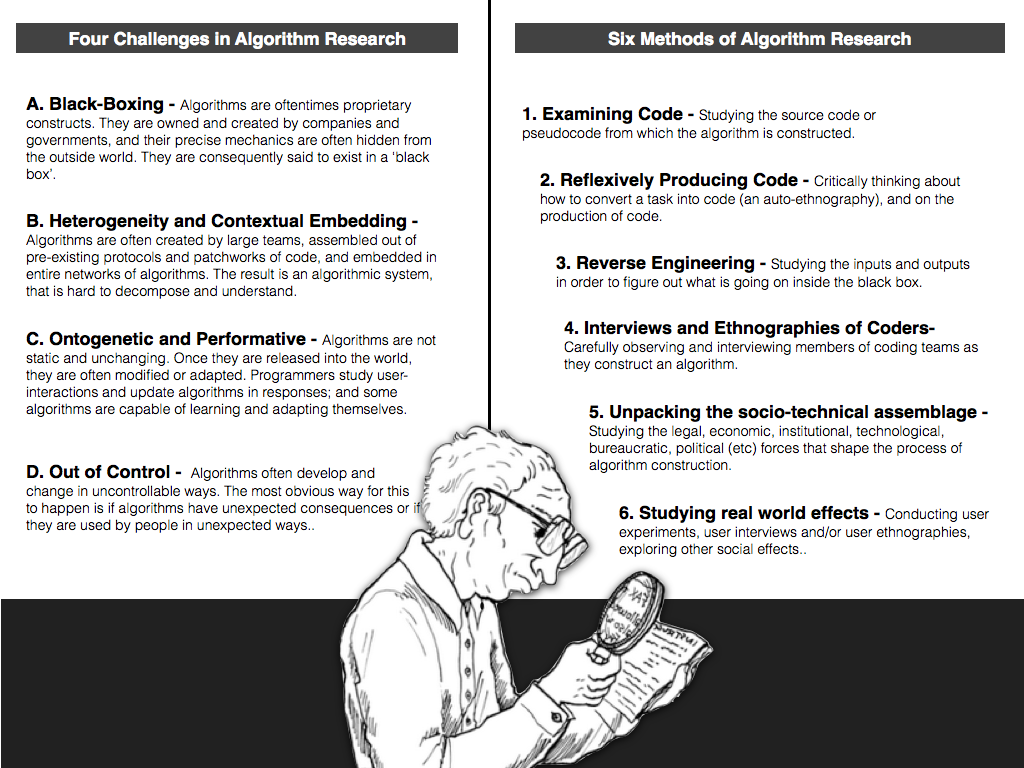
Here, I’m not totally sure I can add much to what Kitchin has written in his working paper. This has been adroitly summarised by John Danaher on his blog, and he produced this brilliant graphic:

The challenges and methods for studying algorithms


We need to be alive to the challenge that most software we may be interested in is proprietary, although not always and we can look to repositories like GitHub for plenty of open source code, and so it may actually prove impossible to gain access to the code itself –– and here we’d really want the code of the whole programme, and perhaps the training data too. Likewise, software like any complex endeavour may well be the result of collective authorship and maintained by lots of different people. So there are complex sets of relations between people, laws, protocols, standards and many other considerations to negotiate – they are contextually embedded. Furthermore, the programmes we’re calling algorithms here actually have a hand in producing the world within which they exist –– they may bring new kinds of entities and relationships into existence, they may formulate new and different forms of spatial relation and understanding. In this sense they are ontogenetic and performative. Added to this, once ‘in the wild’ this performativity can render the kinds of outcomes of a programme unexpected and peculiar, especially once it is fed all sorts of data, adapted and adopted in unexpected ways.

How can we go about studying these kinds of socio-technical systems then? Well, rather than treat as discrete the six techniques offered by Kitchin (summarised above) – I’d argue we need to combine most of these. Even so, it may prove extremely difficult to actually gain access to code. Further, even if one might reflexively produce code and/or attempt to reverse engineer software –– some systems are the product of companies with such extensive resources that it may well prove near-impossible to do so. Where social scientists might find more traction and actually be able to make a more valuable contribution is, as Kitchin suggests, looking t the full sociotechnical assemblage. We can look at the wider institutional, legal and political apparatuses (the dispositifs) and we can certainly look at the various kinds of relation the assemblages make and how they are enrolled in performing the world they inhabit.

Make no mistake – this kinds of research is necessarily hard. I’m not sure I can imagine papers in geography journals that tie the a/b testing logs of experiments in how a given system works and commit logs to version control systems (even if you could access them!) to particular forms of experience and/or their political consequences… but it might be worth a go. Perhaps this difficulty is why we see (and I am as guilty as any of this) papers written in abstract terms, focusing on the (social) theoretical ways we can talk about these sociotechnical systems in broad terms.

Like Bogost, I can see a kind of pseudo-theological romancing of the ‘algorithm’ and the agency of software in much of what is written about it, and its sort of easy to see why – it is so abundant and yet relatively hidden. We see effects but do not see the systems that produce them:

Algorithms aren’t gods. We need not believe that they rule the world in order to admit that they influence it, sometimes profoundly. Let’s bring algorithms down to earth again.

The algorithm as synecdoche is a kind of ‘talisman’, as Gillespie argues, that reveals something of what Stiegler calls our ‘originary technicity’ – the sense in which we (humans) have always already been bound up in technology and its the forgetting and then remembering of this that forges our ongoing reconstitution (transindividuation) of ourselves.

So, I’d like to end with Kitchin’s argument:

it is clear that much more critical thinking and empirical research needs to be conducted with respect to algorithms [and the software and sociotechnical systems in which they are necessarily embedded] and their work.

Addendum:

It is worth noting that both Gillespie and Kitchin draw on another paper that is very much worth reading by Nick Seaver, who reminded me of this on Twitter, take a look:

“Knowing Algorithms“, presented at Media in Transition 8, Cambridge, MA, April 2013 [revised 2014].

For these companies you, walking down the street, are a data point

I’ve been collecting the promotional videos of various companies that surveil ‘public’ spaces to garner information that, using the logics applied to web analytics, they see as valuable commercial intelligence.

The rationale that is common throughout is that the aggregate crowd on the street, in a shopping centre, or in any form of apparently ‘public’ space are fair game for surveillance measurement and in turn address (albeit by their commercial partners – retailers etc. etc.). In fact, this is merely a technical or perhaps social problem – not a political one. It’s a technical problem for them because as the chap from Placemeter says “it’s all data” and its ‘waiting’ to be harvested. It’s a social problem for them only insofar as it’s about improving ‘services’ for us as consumers (not as citizens, as families or any other part of our skein of identity). It is NOT a political problem for them – it’s not an issue of who has the right to the city, who has a right to privacy or what might constitute reasonable expectations of any of those things. It certainly is never couched in terms of there needing to be governance of these activities – at least in these kinds of videos.

So, the videos are interesting artefacts of the formulation of what pervasive media/ubiquitous computing and smart cities look like and how they are performed…

A reasonable article about Placemeter is in/on the Guardian Cities section.

In Certain Places…

In Certain Places logoIn Certain Places is a programme of artistic interventions and events, led by curators Elaine Speight and Professor Charles Quick with the support of associate Rachel Bartholomew, in the School of Art, Design and Fashion at the University of Central Lancashire. Based in the City of Preston, in the North West of England, the project examines how artists can contribute to the form and functions of a place, by exploring new approaches to art, culture and urban development.


In Certain Places, whom I happen to follow on Twitter, have a new blog – looking forward to seeing what gets posted. The first post is about the recent Nordic Geographers conference, in which several of my colleagues participated.

Reblog> Data and the City Workshop (31/08-01/09)

The Programmable City project team are running a(nother!) interesting workshop/event at the end of the month, just before the RGS annual conference. See the details below:

Data and the City Workshop

The Programmable City Project is hosting a two day workshop on the relations between data and the city.  The Data and the City Workshop will take place on August 31st and September 1st 2015 and will bring together 20 invited experts in the field and the ProgCity team.  A description of the workshop and the agenda are below with links to some of the papers to be presented that are already available online…

Read more in the original post – including the schedule.

New journal: “Digital Literacy Studies”

David Cooper tweeted a link to an interesting new open access journal called “Digital Literacy Studies“, published through Penn State University Libraries. Here’s the info from their page:

Digital Literary Studies

Digital Literary Studies is an international peer-reviewed interdisciplinary publication with a focus on those aspects of Digital Humanities primarily concerned with literary studies.

Digital Literary Studies publishes scholarly articles on research concerned with computational approaches to literary analysis/criticism, or critical/literary approaches to electronic literature, digital media, and textual resources.

In addition to longer, more traditionally-formed articles, this journal publishes positional papers and articles with a shorter experimental focus, as well as reviews of books and electronic literature. Contributors may also submit curated electronic texts for peer-review, as well as thoroughly-documented hermeneutical methods and tools. Any digital project with a literary focus, whether that be a digital edition, tool, or otherwise, may be considered for peer-review.

I’ve highlighted a bit above to point out that they welcome experimental shorter contributions too.

‘Wide’, not ‘big’, data

Saw this article a while ago on the NetworkWorld website, not sure if it’s a more broadly adopted concept – but the idea of ‘wide’ data appeals. Can’t remember if Rob Kitchin addresses it in his excellent book The Data Revolution… will have to check!

(I’m blogging this so I can finally close the tab in my browser!)

Why businesses should focus on wide data, not big data

In these heady days of big data, a lot of organizations treat data collection like a Pokémon game: Gotta catch it all. But Dane Atkinson, CEO of cross-platform marketing analytics specialist SumAll says most organizations need to think wide, not big, when it comes to data.

“The real impact of data always comes from the intersection of different data sets,” Atkinson says. “You don’t get into the earth shattering discoveries until you start to link disparate data sets.”

This idea of ‘wide’ data is what some marketing people have called ‘horizontals’ – the ability to stitch together different kinds of data to create a particular kind of value proposition (see Irene Ng’s book on this…)

Reblog> Reading list on the digital divide/digital inclusion

This looks like a really helpful resource over on the Social Media Collective blog –– although I’m sure Mark Graham may want to add to it… 🙂

Reading list on the digital divide/digital inclusion

We compiled a bibliography on the digital divide (including gender gaps) and ICTD. Please let us know if we missed anything interesting and we would be glad to add it!

1. Allen, Steven G. 2001. “Technology and the Wage Structure.” Journal of Labor Economics 19:440-483.

2. Anderson, B. 2005. “The value of mixed-method longitudinal panel studies in ICT research.” Information, Communication & Society 8:343-367.

3. Anderson, Ben. 2008. “The Social Impact of Broadband Household Internet Access.” Information, Communication & Society 11:5-24.

See the other 191 references on the Social Media Collective blog.

Reblog> New paper: Data-driven, networked urbanism

This looks good –– added to my ‘to read’ pile 🙂

New paper: Data-driven, networked urbanism

A new paper, ‘Data-driven, networked urbanism’, has been published by Rob Kitchin as Programmable City Working Paper 14.  The paper has been prepared for the Data and the City workshop to be held at Maynooth University Aug 31th-Sept 1st.

Abstract
For as long as data have been generated about cities various kinds of data-informed urbanism have been occurring.  In this paper, I argue that a new era is presently unfolding wherein data-informed urbanism is increasingly being complemented and replaced by data-driven, networked urbanism.  Cities are becoming ever more instrumented and networked, their systems interlinked and integrated, and vast troves of big urban data are being generated and used to manage and control urban life in real-time. Data-driven, networked urbanism, I contend, is the key mode of production for what have widely been termed smart cities.  In this paper I provide a critical overview of data-driven, networked urbanism and smart cities focusing in particular on the relationship between data and the city (rather than network infrastructure or computational or urban issues), and critically examine a number of urban data issues including: the politics of urban data; data ownership, data control, data coverage and access; data security and data integrity; data protection and privacy, dataveillance, and data uses such as social sorting and anticipatory governance; and technical data issues such as data quality, veracity of data models and data analytics, and data integration and interoperability.  I conclude that whilst data-driven, networked urbanism purports to produce a commonsensical, pragmatic, neutral, apolitical, evidence-based form of responsive urban governance, it is nonetheless selective, crafted, flawed, normative and politically-inflected.  Consequently, whilst data-driven, networked urbanism provides a set of solutions for urban problems, it does so within limitations and in the service of particular interests.

Key words: big data, data analytics, governance, smart cities, urban data, urban informatics, urban science

Download PDF