Reblog> So what about Politics?–Call for contributions (iMAL Brussels, Nov. 3/4, 2017)

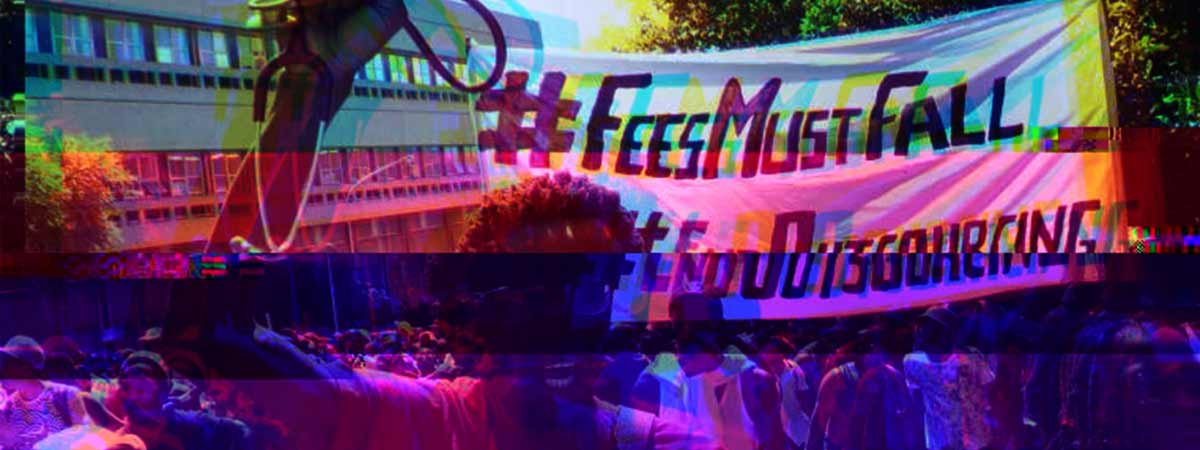
south african students protest with hashtag banners

From INC.

So what about Politics?–Call for contributions (iMAL Brussels, Nov. 3/4, 2017)

“If the past 10 years have been about discovering post-institutional social models on the Web, then the next 10 years will be about applying them to the real world.” Chris Anderson, 2010, www.wired.com)

So, what about politics? (November 3/4 2017 @  iMAL, Brussels)  looks at initiatives that could be seen as the avant-garde of a new political era. In a critical period of crisis in our political systems, we welcome artists, activists, academics, and everyone using innovative technological tools to reclaim political processes or to shape new forms of organisation, from local collectives to global movements.

As  Rebecca Solnit says, “It’s equally true that democracy is flourishing in bold new ways in grassroots movements globally”, and “There is far more politics than the mainstream of elections and governments, more in the margins where hope is most at home.” How does this apply to the margins of our technological imagination? Which tools and practices are being dreamed of, tested and explored?

What is the impact of today’s Internet-inspired post-institutional thinking on the practice of political action? For this we focus on tactics, tools and visions of grassroots initiatives, as well as on changing government policies and strategies.

iMAL wants to invite its guests to look beyond the often-perceived neutrality of technology and unveil underlying narratives. The symposium revolves around questions such as: What are the politics of a P2P society? How can we perceive a network as a real “distributed agora”? What can we learn from artist- or activist-led experiments focusing on collectivity and political agency? And most important: What are the concrete tools and initiatives today that really try to facilitate and use new forms of agency such as liquid democracy, e-governance, civic intelligence, platform cooperativism and autonomous self-organisation?

OPEN CALL: Digital culture and technology. But what about politics?

This is an open call for contributions by artists, activists, technologists, designers, researchers, citizen initiatives, collectives or groups to the symposium ‘So, what about politics?’. The event will be held on November 3-4, 2017 in Brussels at iMAL, the Brussels-based center for digital cultures and technology.

Send your proposal to SoWhatAboutPolitics@imal.org
Deadline: September 1st, 2017

This Open Call is not restricted to specific kinds of contributions. You can send us proposals for a lecture, workshop, performance, installation”¦ Day 1 of the symposium will be focusing on lectures and presentations. Day 2 is reserved for participatory activities such as Open Assembly Lab or Workshops.Proposals will be selected according to their relevance and feasibility (logistics, budget).

The symposium is curated by Bram Crevits in collaboration with Yves Bernard (iMAL.org). This event is organised by iMAL (Brussels center for Digital Cultures and Technology) in collaboration with the Institute of Network Cultures (Amsterdam), Medialab Prado (Madrid) and KASK/School of Arts (Ghent).

After the symposium Blockchain.Fact.Fiction.Future in 2016, So what about Politics? continues our exploration of how society can be improved with the digital world. So what about Politics? is supported by Saison des Cultures Numériques 2017, Ministery of Culture (Fédération Wallonie-Bruxelles).

Past event > Technology’s Limits: Automation, Invention, Labour, and the Exhausted Environment

Glitched image of a mural of Prometheus giving humans' fire in Freiberg

This looks like it was a fascinating event…

Workshop hosted by the Digital Life Research Program 

An abstract artwork of a light background with brown and red rectangles of various sizes.

Artwork by Stephen Scrivener Opens in a new window

Event Details

Date: Friday March 10, 2017
Time: 10am – 4.30pm
Venue: EB.G.21, Parramatta South campus

Among its many political preoccupations, 2016 was marked by an obsessive concern with the new powers of the machine to erase human labour and employment. Science fiction dystopias – among them, the French Trepalium and the Brazilian 3% – saddled older anxieties about a world without work to a more novel recognition of resource depletion and scarcity. Academic publishing houses, conference organisers, funding agencies and the press have responded with a deluge of content covering algorithms, automation and the Anthropocene. Meanwhile, a less conspicuous narrative about the decline of innovation has resurfaced with claims that the rate of fundamental new technology inventions is slowing and jeopardising long term global productivity returns. What happens when technology hits its limits? Velocity and volume excite machinic economies, but do little to confront some of the core problems and challenges facing planetary labour and life today.

This workshop brings together leading Australian scholars of technology and society with contemporary German and French reflections on the prevailing discourses of technology’s limits. Since the 1990s, Bernard Stiegler has been a leading philosopher and critic of technology, and in his recent book Automatic Society he directly tackles problems of automation and algorithms for the distribution of financial and social resources to populations increasingly bereft of economic capital and political agency. Building upon Frankfurt School critical theory and Kittlerian media theory, contemporary German critique intersects with similar questions by combining investigations of epistemology, history and the technical. The Australian take on these European developments is simultaneously appreciative and critical, though often oriented toward more regional conditions that arise in part due to different economic, cultural and political relations with Asia.

The morning session of the workshop will introduce current theoretical European work on technology. Daniel Ross will develop a critical introduction to Bernard Stiegler, whose recent work in Automatic Society and In the Disruption continues to mount a wide-ranging and provocative critique of technology. Armin Beverungen will then offer an overview of his research on algorithmic management and high-frequency trading, with Ned Rossiter introducing logistical media as technologies of automation and labour control. In the afternoon, Gay Hawkins will outline her theoretical interest in nonhuman and technical objects and their irreducible role in making humans and ecologies. A key empirical example will be the history of plastic and the emergence of its technical agency and capacity to reconfigure life. Nicholas Carah will follow with a discussion of his latest work on algorithms, brand management and media engineering. The workshop will close with an audience-driven panel session and discussion. These interventions will be held in conjunction with a close reading of the key texts below.

Register

Attendance numbers will be limited so please register in advance. No registration fee required.

RSVP by 7 March on Eventbrite Opens in a new window

Speakers

  • Armin Beverungen
    Junior Director at the Digital Cultures Research Lab (DCRL) at Leuphana Universität Lüneburg & Visiting Fellow, Institute for Culture and Society, Western Sydney University
  • Nicholas Carah
    Author of Brand Machines, Sensory Media and Calculative Culture (2016)
  • Gay Hawkins
    Author of Plastic Water: The Social and Material Life of Bottled Water (2015)
  • Liam Magee
    Author of Interwoven Cities (2016)
  • Nicole Pepperell
    Author of Dissembling Capital (forthcoming, 2017)
  • Daniel Ross
    Translator of Bernard Stiegler’s Automatic Society (2016) and numerous other works
  • Ned Rossiter
    Author of Software, Infrastructure, Labor: A Media Theory of Logistical Nightmares (2016).

Co-chairs: Liam Magee and Ned Rossiter, co-convenors of the Institute for Culture and Society’s Digital Life research program.

Recommended Readings

Frank Pasquale (2017), Duped by the Automated Public Sphere Opens in a new window
Lee Rainer and Janna Anderson [Pew Research Center] (2017), Code-Dependent: Pros and Cons of the Algorithm Age Opens in a new window
Bernard Stiegler (2012), Die Aufklärung in the Age of Philosophical Engineering (opens in a new window)
Bernard Stiegler (2015), Escaping the Anthropocene Opens in a new window
Bernard Stiegler (2015), On Automatic Society Opens in a new window
Sonia Sodha [The Guardian] (2017), Is Finland’s basic universal income a solution to automation, fewer jobs and lower wages? Opens in a new window

Related Readings

Bruce Braun (2014), A New Urban Dispositif? Governing Life in an Age of Climate Change Opens in a new window
Nick Dyer-Witheford (2013), Contemporary Schools of Thought and the Problem of Labour Algorithms (opens in a new window)
Victor Galaz (2015), A Manifesto for Algorithms in the Environment Opens in a new window
Victor Galaz et al. (2017), The Biosphere Code Opens in a new window
Orit Halpern (2015), Cloudy Architectures Opens in a new window
Erich Hörl (2014), Prostheses of Desire: On Bernard Stiegler’s New Critique of Projection Opens in a new window
Yuk Hui (2015), Algorithmic Catastrophe: The Revenge of Contingency (opens in a new window)
International Labour Organisation (2016), ASEAN in Transformation Opens in a new window
Lilly Irani (2015), The Cultural Work of Microwork Opens in a new window
MIT Technology Review (2012), The Future of Work Opens in a new window
Cathy O’Neill (2016), How Algorithms Rule Our Working Lives Opens in a new window
Elaine Ou (2017), Working for an Algorithm Might Be an Improvement (opens in a new window)
The Guardian (2016), Robot Factories Could Threaten Jobs of Millions of Garment Workers Opens in a new window
Tommaso Venturini, Pablo Jensen, Bruno Latour (2015), Fill in the Gap. A New Alliance for Social and Natural Sciences Opens in a new window

Agenda

  • 10:00 –10:10: Liam Magee, Ned Rossiter: Welcome and Introduction
  • 10:10–11:10: Daniel Ross
  • 11:10–11:30: Q&A
  • 11:30–11:45: Coffee
  • 11:45–1:00: Armin Beverungen, Ned Rossiter
  • 1:00–2:00: Lunch
  • 2:00–3:15: Gay Hawkins, Nicholas Carah
  • 3:15–4:15: Panel discussion responding to automation: Dan / Gay / Nicholas / Armin / Nicole – Liam & Ned to chair
  • 4:15–4:30: Closing thoughts, future actions

65% of future non-existent jobs (which doesn’t exist) 70% of jobs automated (just not yet)

Twiki the robot from Buck Rogers

The future of work is the work of imagination. We are, repeatedly, and have been for a while, bombarded with (pseudo-)facts about what the future of work will bring. These are, of course, part of well-known, long-standing, narratives about ‘innovation’, ‘growth’, technological advance and, of course, ‘automation’.

Martin shared a good post by , on his site Long View on Education, about some persistent kinds of story around the nature of work our schools are preparing children for, or not. Here’s  an abridged, and selective, version of the story…

“The top 10 in demand jobs in 2010 did not exist in 2004. We are currently preparing students for jobs that don’t exist yet, using technologies that haven’t been invented, in order to solve problems we don’t even know are problems yet.”

Shift Happens videos (2007).

People repeat the claim again and again, but in slightly different forms. Sometimes they remove the dates and change the numbers; 65% is now in fashion. Respected academics who study education, such as Linda Darling-Hammond (1:30), have picked up and continue to repeat a mutated form of the factoid, as has the World Economic Forum and the OECD.

[…]

“By one popular estimate 65% of children entering primary schools  today will ultimately work in new job types and  functions that currently don’t yet exist. Technological  trends such as the Fourth Industrial Revolution will  create many new cross-functional roles for which  employees will need both technical and social and analytical skills. Most existing education systems at all levels provide highly siloed training and continue a  number of 20th century practices that are hindering  progress on today’s talent and labour market issues.  “¦  Businesses should work closely with governments,  education providers and others to imagine what a true 21st century curriculum might look like.”

The WeF Future of Jobs report

[…]

Cathy Davidson (May 2017) explains up how she came to the factoid:

“I first read this figure in futurist Jim Carroll’s book, Ready, Set, Done (2007). I tracked his citation down to an Australian website where the “65%” figure was quoted with some visuals and categories of new jobs that hadn’t existed before. “Genetic counseling” was the one I cited in the book.

After Now You See It appeared, that 65% figure kept being quoted so I attempted to contact the authors of the study to be able to learn more about their findings but with no luck.  By then, the site was down and even the Innovation Council of Australia had been closed by a new government.”

The BBC radio programme More or Less picks up the story from here, demonstrating how it most likely has no factual basis derived from any identifiable source (there never was an Innovation Council of Australia, for example).

Davidson sort of defends this through dissimulation, in an interview for More or Less, by saying she believes that 100% of jobs have been affected by ‘the digital era we now live in’.

As Audrey Watters has highlighted, statistics like this and the appeal for a ‘disruption’ of education by the tech sector to teach ‘the skills of the future’ etc. can be reasonably interpreted as a marketing smoke screen – ‘the best way to predict the future is to issue a press release’.

An allied claim, that fall within the same oeuvre as the “65%” of not-existing jobs (or should that be non-existent?), is the various statistics for the automation of job roles, with varying timescales. A canonical example, from another “thought leader” (excuse me while I just puke in this bin), is from WIRED maven Kevin Kelly:

There are an awful lot of variations on this theme, focusing on particular countries, especially the USA, or particular sectors, or calculating likelihoods for particular kinds of jobs and so on and so on. This is, of course, big business in and of itself – firms like Deloitte, McKinsey and others sell this bullshit to anyone willing to pay.

What should we make of all this..?

There are a few interpretations we can make of this genre of ‘foresight’. Alongside several other academics I have written about particular ways of communicating possible futures, making them malleable-yet-certain in some way, as a ‘politics of anticipation‘. This politics has various implications, some banal some perhaps more troubling.

First, you might say it’s a perfectly understandable tendency, of pretty much all of us, to try and lend some certainty to the future. So, in our adolescent know-it-all way, we are all wont to lend our speculations some authority, and statistics, however spurious, is a key tool for such a task.

Second, and perhaps allied to the first, is the sense in which methods for speculation become formalised and normative – they’re integrated into various parts of institutional life. So, it becomes normal to talk about speculative (spurious?!) statistics about a future of work, education etc. in the same tone, with the same seriousness, and the same confidence as statistics about a firm’s current inventory, or last year’s GDP trends. Of course, all statistics, all facts, have conditions and degrees of error and so if the calculation of trends for past events is open to change, the rationale might be, perhaps future trends are just as reliable (there’s all sorts of critique available here but I’m not going to delve into that). In this way, consultancies can package up ‘foresight’ as a product/service that can be sold to others. “Futures” are, of course, readily commodified.

Third, an ideological critique might be that it is precisely these forms of storytelling about the redundancy or insufficiency of the labour force that allows those with the large concentrations of capital to accrue more by demeaning the nature of work itself and privatising profits upwards. If we are repeatedly told that the work that generates the good and services that move through our economy is worth less – because it can be automated, because it is ‘out-dated’, because there are other kinds of superior ‘skilled’ work – then it perhaps becomes easier to suppress wage growth, to chip away at labour rights and render work more precarious. Gloomy I know. However, some data (oh no! statistics!) Doxtdator has in his blogpost (and the kinds of data David Harvey uses in his books, such as The Engima of Captial) could be seen as backing up such arguments. For example (source):


These sorts of graphs, tell a different story about yesterday’s future – which didn’t lead to families reaping the rewards of automation and increased productivity by profiting from a share in increased leisure time (following JM Keynes), but rather delivered the profits of these trends to the “1%” (or even the “0.1%”) by massively increasing top executive salaries while keeping wider wage growth comparatively low, if not stagnant. I’m not an economist, so I don’t want to push my luck arguing this point but there are folk out there who argue such points pretty convincingly, such as David Harvey (though see also economic critiques of the ‘zombie’ automation type of argument).

Ultimately, I am, personally, less interested in the numbers themselves – who knows if 65% of today’s school children will be doing new jobs that represent only 70% of the total work we currently undertake?!  I’m more interested in the kinds of (speculative) truth-making or arguing practices they illustrate. The forms of speculative discourse/practice/norms about technology and work we’re all involved in reproducing. It seems to me that if we can’t fathom those things, we’re less able to care for those of us materially affected by what such speculation does, because, of course, sometimes speculation is self-fulfilling.

To try to advance some discussions about the kinds of technological and economic future that get proposed, gain momentum and become something like “truths”, I’ve been puzzling over the various ways we might see the creation of these economic statistics, the narrating of technological ‘innovation’ in particular ways, and the kinds of stories ‘critical’ academics then tell in analysing these things as making up collectively some form of collective imagination. I started out with ‘algorithms’ but I think that’s merely one aspect of a wider set of discourses about automation that I increasingly feel need to be addressed. My placeholder term for the moment is an “automative imaginary” ~ a collective set of discourses and practices by which particular versions of automation, in the present and the future, are brought into being.

CFP> “VIRAL/GLOBAL Popular Culture and Social Media: An International Perspective” 13th Sept 17 CAMRI

Via Tony Sampson.

“VIRAL/GLOBAL Popular Culture and Social Media: An International Perspective” The University of Westminster Communication and Media Research Institute (CAMRI), Sept 13th 2017

Date:
13 September 2017
Time: 9:00am to 7:00pm
Location: 309 Regent Street Regent Campus, 309 Regent Street, London W1B 2HW – View map

Gone-Viral-event-main-photo

Conference organised by the Communication and Media Research Institute (CAMRI)

Keynote Panel

  • Nancy Baym 
  • Emily Keightley
  • Dave Morley (TBC)
  • Tony D Sampson
  • Paddy Scannell

This interdisciplinary conference aims to examine how and why everyday popular culture is produced and consumed on digital platforms. There is increasing interest in studying and discussing the linkages between popular cultural and social media, yet there exist important gaps when comparing such cultural phenomena and modes of consumption in a global, non-west-centric context. The conference addresses a significant gap in theoretical and empirical work on social media by focusing on the politics of digital cultures from below and in the context of everyday life. To use Raymond Williams’s phrase, we seek to rethink digital viral cultures as ‘a whole way of life’; how ‘ordinary’, everyday digital acts can amount to forms of ‘politicity’ that can redefine experience and what is possible.

The conference will examine how social media users engage with cultural products in digital platforms. We will also be assessing how the relationship between social media and popular cultural phenomena generate different meanings and experiences.

The conference engages with the following key questions:

  • How do online users in different global contexts engage with viral/popular cultures?
  • How can the comparative analysis of different global contexts help us contribute to theorising emergent viral cultures in the age of social media?
  • How do viral digital cultures redefine our experience of self and the world?

We welcome papers from scholars that will engage critically with particular aspects of online popular cultures. Themes may include, but are not limited to, the following:

  • Analysing viral media texts: method and theory
  • Theorising virality: new/old concepts
  • Rethinking popular culture in the age of social media
  • Social media, politicity and the viral
  • The political economy of viral cultures
  • Memes, appropriation, collage, virality and trash aesthetics
  • Making/doing/being/consuming viral texts
  • Hybrid strategies of anti-politics in digital media
  • Viral news/Fake news
  • Non-mainstream music, protest, and political discussion
  • Capitalism and viral marketing

PROGRAMME AND REGISTRATION

This one-day conference, taking place on Wednesday, 13th of September 2017, will consist of a keynote panel and panel sessions. The fee for registration for all participants, including presenters, will be £40, with a concessionary rate of £15 for students, to cover all conference documentation, refreshments and administration costs.

DEADLINE FOR ABSTRACTS

The deadline for abstracts is Monday 10 July 2017. Successful applicants will be notified by Monday 17 July of 2017. Abstracts should be 250 words. They must include the presenter’s name, affiliation, email and postal address, together with the title of the paper and a 150-word biographical note on the presenter. Please send all these items together in a single Word file, not as pdf, and entitle the file and message with ‘CAMRI 2017’ followed by your surname. The file should be sent by email to Events Coordinator Karen Foster at har-events@westminster.ac.uk

Original: https://www.westminster.ac.uk/call-for-papers-viral-global-popular-cultures-and-social-media-an-international-perspective

Reblog> Job opening: 2-year postdoc position in philosophy and ethics of technology and design

Glitched image of a mural of Prometheus giving humans' fire in Freiberg

Looks like an interesting opportunity…

From Peter-Paul Verbeek:

Technologies are increasingly designed to influence people’s behavior in directions that are seen as desirable, as approaches like ‘nudging’ and ‘persuasive technology’ show. At the same time, this development raises ethical concerns. The postdoc project ‘Designing Moral Mediation’ will develop both a philosophical and an ethical approach to behavior-influencing technologies.

The postdoc will become a member of the research team of the 5-year research project ‘Theorizing Technological Mediation’, which investigates human-technology relations in the domains of science, ethics, and religion. Within this context, the postdoc project focuses on ‘moral mediation’: the ways in which technologies mediate moral actions and decisions, and help to shape moral frameworks. We are looking for someone with expertise in philosophy of technology, human-technology relations, and /or ethics of technology.
More information: https://www.utwente.nl/en/organization/careers/vacancies/!/vacature/1049731

The Mundane Afrofuturist Manifesto

Via dmf. Definitely worth watching >>


“This dream of utopia can encourage us to forget that outer space will not save us from injustice and that cyberspace was prefigured upon a “master/slave” relationship.

While we are often Othered, we are not aliens.

Though our ancestors were mutilated, we are not mutants.

Post-black is a misnomer.

Post-colonialism is too.

The most likely future is one in which we only have ourselves and this planet.”

The rest is here: http://martinesyms.com/the-mundane-afrofuturist-manifesto/

See also: http://blackradicalimagination.com

Responsibility gaps and autonomy – AI, autonomous weapons and cars

Kitt the 'intelligent' car from the TV show Knight Rider

Over on the excellent Algocracy blog/podcast John Danaher interviews Hin-Yan Liu, a law scholar in Copenhagen who’s done some work on responsibility and autonomy in relation to autonomous weapons systems and driverless cars. The discussion is really interesting, thinking through various ways on understanding responsibility in relation to autonomy, expanding out ideas about what an ‘autonomous weapons system’ might be (such as – is a private military contractor an AWS?) and thinking through the ethical, moral and political issues of different ways responsibility gets understood. I encourage you to have a listen.

This stems from work by Liu that is published in two papers:

Here’s Liu’s faculty webpage.

Simondon and Technics event recordings

Glitched image of a mural of Prometheus giving humans' fire in Freiberg

If you were not in Kingston earlier this week but have a desire to be part of the ‘next big thing in theory’, or you’re actually interested in the philosophy of technology, it appears that the talks were recorded… via dmf / Stuart Eldon.

Simondon on Technics: On the Mode of Existence of Technical Objects

Please join the Centre for Research in Modern European Philosophy (CRMEP) for a workshop to discuss Gilbert Simondon’s 1958 On the Mode of Existence of Technical Objects, finally now translated into English in its complete form.

Speakers: Andrea Bardin (Brunel University), Giovanni Carrozzini (CIDES, MSH Paris-Nord), Xavier Guchet (Paris 1 Sorbonne), Cécile Malaspina(translator), Simon Mills (De Monfort University), Pablo Rodriguez (University of Buenos Aires)

The 2016 English translation of Gilbert Simondon’s 1958 On the Mode of Existence of Technical Objects finally introduces the Anglophone reader to a complete version of the French philosopher’s great work: a complex crossover between ontology, epistemology, psycho-sociology and the philosophy of technology. With the participation of international specialists on Simondon’s writings, this workshop aims to explore the main themes of Simondon’s philosophy of technology, connecting them to the relational ontology of communication processes outlined in Individuation in the Light of the Notions of Form and Information.

Reblog> Ordinary digital humanities – event with @rodgers_scott

Another interesting event, this time with Scott Rodgers at Birkbeck.

Ordinary digital humanities: Free event at Birkbeck, 15 May 2017

Apple_II_IMG_4212In a couple of weeks’ time I am happy to be hosting an event as part of Birkbeck Arts Week on the subject of ‘Ordinary Digital Humanities’, featuring a talk from Lesley Gourlay (UCL Institute of Education). The publicity blurb below has more than enough information, I suspect, for you to get the idea. The event comes in significant part out of discussions we’ve been having through Satellite, an experimental subcommittee in the School of Arts at Birkbeck focused on exchanging information and perspectives on the critical, creative, academic and pedagogical dimensions of learning technologies.

Ordinary Digital Humanities
The everyday life of digital technologies in pedagogy

15 May 2017, 6pm, Keynes Library, 43 Gordon Square, WC1H 0PD (part of Birkbeck Arts Week)

Book your free place at: https://www.eventbrite.co.uk/e/ordinary-digital-humanities-the-everyday-life-of-digital-technologies-tickets-33211361075

When one hears the term ‘digital humanities’ what likely comes to mind are innovative applications of computational techniques and technologies to humanities research as well as pedagogy. Or, conversely, the application of concepts and philosophies rooted in the humanities toward the study of emergent digital objects.

There are reasons however to think about the digital humanities in a more ordinary sense, beyond ‘cutting edge’ research or pedagogy. In the introduction to her book How We Think, N. Katherine Hayles suggests that in order to understand the implications of digital technologies for the humanities, we must first consider the ‘low level’ implications of digital technologies for academic life. For instance, the widespread normalisation of email, department websites, software applications, web searches, social media, and much more. For Hayles, a ‘digital humanities’ is more than just innovative new approaches to research and pedagogy. It is also inherently about transformations to the cognitive and embodied environments of academic life at the level of the habitual or everyday.

This forum considers the banal dimensions of the digital humanities, focusing specifically (though not exclusively) on pedagogical practice. It begins with an opening lecture from Dr Lesley Gourlay (abstract below), followed by responses from Dr Grace Halden and Dr Tim Markham from Birkbeck, University of London. We will not only survey the everyday ways digital technologies are being used, and are asserting themselves, in academic life; but also, how humanities and other scholars might respond to the apparent opportunities and intrusions wrought by digitisation.

The event will be followed by a wine reception.

Flickering texts and the writing body: posthuman perspectives on the digital university

Dr Lesley Gourlay, Reader in Education and Technology, UCL Institute of Education

As digital technologies become increasingly central in our day-to-day lives, we see profound changes in how we search for information, communicate with others, and express ourselves. The university is also changing, as digital media becomes more central via online resources for distance learning, but also throughout the traditional campus, through the mainstream use of digital media for teaching, library provision and academic reading and writing. This has not only changed approaches to academic teaching, it has also fundamentally altered how we seek resources and how we read and generate new knowledge through writing and interaction. Drawing Hayle’s notion of ’embodied virtuality’, this talk will explore this theme, analysing data from a research project which looked in detail at how a small group of students approached their studies over a six-month period, using drawings, photography and interviews to form an in-depth understanding of their day-to-day lives as students, and how they navigate the complex digital and material landscape of the contemporary university. It looks at how texts change when they move between paper-based and the digital, how students navigate the complexities of multiple devices and formats, how they make spaces for writing and knowledge while on the move, and how they form part of ‘posthuman’ networks of digital devices and material objects in order to engage in their studies. Taking a historical perspective, the talk concludes that textual practices have always been central to how higher education is organised and how we understand ‘knowledge’, and considers how digital media might continue to change what we call ‘the university’.