Deum ex machina? a journey into transhuminism as/via religion

Machines from the gods… or…

God in the machine: my strange journey into transhumanism – podcast

After losing her faith, a former evangelical Christian felt adrift in the world. She then found solace in a radical technological philosophy – but its promises of immortality and spiritual transcendence soon seemed unsettlingly familiar

An interesting and compelling podcast of a ‘long read’ for the Graun by Meghan O’Gieblyn that eloquently articulates the not-so-crypto-theistic nature of (some) transhumanism(s).

Here’s a paragraph to whet the appetite:

By this point I’d passed beyond idle speculation. A new, more pernicious thought had come to dominate my mind: transhumanist ideas were not merely similar to theological concepts but could in fact be the events described in the Bible. It was only a short time before my obsession reached its culmination. I got out my old study Bible and began to scan the prophetic literature for signs of the cybernetic revolution. I began to wonder whether I could pray to beings outside the simulation. I had initially been drawn to transhumanism because it was grounded in science. In the end, I became consumed with the kind of referential mania and blind longing that animates all religious belief.

A ‘new realism’ and post-truth

A glitched image of a typewriter

In a recording of a very lively double-header presentation by Maurizio Ferraris and Martin Scherzinger which has been podcast by Data & Society there’s some interesting discussion of Ferraris’ formulation of a ‘new realism‘ (which is sort of sympathetic to but perhaps distinct from speculative realisms) in relation to how we might understand ‘truth’ and truth claims and so how we might understand how ‘understanding’ works in relation digitally mediation.

Both Ferraris and Scherzinger are entertaining speakers but Scherzinger in particular offers some very incisive comments around how we can understand the sorts of manoeuvres different people are making around the constitutions and discussion of ‘theory’ (taken in its most general understanding).

Anyway… it’s an interesting listen:

Post-Truth and New Realities: Algorithms, Alternative Facts, and Digital Ethics

More tales of the automative imaginary

A warehouse worker and robot

Here’s some links that further sketch out some of what I’ve been thinking about as an ‘automative imaginary’. I’ve offered links with a bit of brief commentary at the bottom…

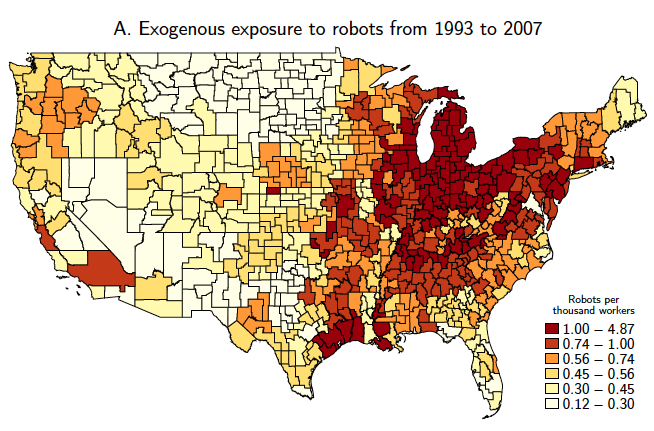
Evidence That Robots Are Winning the Race for American Jobs – in the NYT, pointing to research undertaken by two economists, Acemoglu and Restrepo, published by the (American) National Bureau of Economic Research: Robots and Jobs: Evidence from US Labor Markets (to which I have no access), with a commentary on the Centre for Economic Policy Research‘s Vox site. What is curious for me here is how one can evaluate the method of the researchers and what the assumptions they make say about how we (are invited to) understand automation. There’s some interesting geography in there too! E.g. see the choropleth map of “exogenous exposure to robots” below
How will the rise of automation and AI affect the workforce and economy moving forward? – Francis Fukuyama offers his answer to how automation and AI (interesting easy slip between those as almost a form of equivalence, which is open to significant debate/critique) may or may not “affect” the economy and, in particular, jobs – in the US.

It’s interesting how much of what we are offered in terms of a rationale for automation is a fairly simplistic robots replace workers sort of story. In this regard, it’s worth remembering what the MacDonalds CEO Ed Rensi flippantly observed as a canonical example (documented in this post on Fusion):

former McDonald’s CEO Ed Rensi made news by going on Fox Business and declaring that ongoing protests in the campaign for a $15 minimum wage were encouraging the automation of fast food jobs. The segment goes on for seven minutes, but here’s the meat of it:

I was at the National Restaurant Show yesterday and if you look at the robotic devices that are coming into the restaurant industry – it’s cheaper to buy a $35,000 robotic arm than it is to hire an employee who’s inefficient making $15 an hour bagging French fries – it’s nonsense and it’s very destructive and it’s inflationary and it’s going to cause a job loss across this country like you’re not going to believe

Nevertheless, other economists will tell you that processes of automation have, historically, created new kinds of jobs as they apparently ‘destroy’ others. For example, Deloitte, in their report “Technology and People: The great job creating machine“, suggest that while manual labour and routine jobs have been significantly automated since 1992, there has been an even larger growth in ‘care’ (and service) and ‘cognitive’ work in the UK labour market. So you see fewer people in manufacturing but more analysts, baristas and carers.

Of course, to see it as whole “jobs” that are being automated is somewhat misleading – another aspect of the automative imaginary that owes more to the depiction of automation in 1950/60s cartoons than in the actually existing forms of automation. As many commentators point out, it’s parts of jobs or tasks that become automated, which results in a need to reorganise that work. As the management consultants McKinsey point out in a report in 2016:

currently demonstrated technologies could automate 45 percent of the activities people are paid to perform and that about 60 percent of all occupations could see 30 percent or more of their constituent activities automated, again with technologies available today

What we tend to focus on is the automation full stop, not that it isn’t all of a job and may not result in an easy equivalence of “robot in = worker out”. We imagine the robots doing it all, when, in many cases, the use of robots (when they’re actually economically viable – they have a huge initial set-up cost) require a reorganisation of systems such that the work looks different.

Another illustration of this comes from the excellent Containers podcast by Alexis Madrigal. In the final episode, Madrigal talks to Karen Levy of Cornell  about the forms automation could take in relation to truck driving (upon which Uber clearly has its sights set). Of course, again, it’s not as simple as: automate the lorries, do-away with jobs. It’s more like the process of containerisation that Madrigal is exploring – automation is as much about reorganising systems of work / labour as it is about ‘replacing’ labour. So, in the example of picking in warehouses – you might get a Kiva or Fetch/Freight robot to do the donkey work of warehousing, with the worker performing the more sophisticated movements. This is not a future of people-less spaces but rather robots following people around or being tasked in order to support the worker, the argument being this leads to greater productivity. In fact, in the eighth episode of Containers, the CEO of Fetch Robotics justifies her company’s tech by saying that, in the US, there are over 600k jobs going unfilled in warehousing and manufacturing because people don’t want to do them, with a turnover rate of those who do sign-up for such work at around 25% (I don’t know the basis or veracity of those numbers – would like to though!). Again, if true, such figures are another aspect of the expectations of what work involves and how it may be performed.

So, it seems to me we need to talk about work not simply elide it by (somewhat hysterically) referring to ‘automation’ and ‘robots’. This is something I hope to research and write more about, if I ever get the time…

Choose how you feel, you have seven options

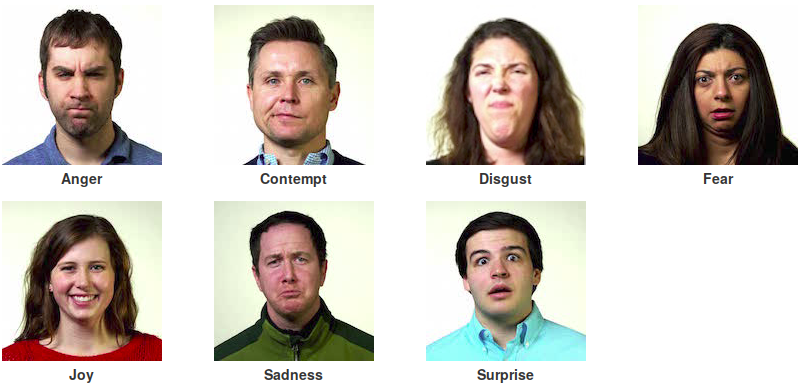
A great piece by Ruben Van de Ven stemming from his artwork of the same name, published on the Institute of Network Culture site. Van de Ven, in a similar vein to Will Davies, deconstructs the logic of ‘affective’ computing, sentiment analysis and their application to what has been termed the ‘attention economy’. The article does a really go job of demonstrating how the knowledge claims, and the epistemologies (perhaps ontologies too), that are at work behind these technologies are (of course) deeply political in their application. Very much worth reading! (snippet below).

 ‘Weeks ago I saw an older woman crying outside my office building as I was walking in. She was alone, and I worried she needed help. I was afraid to ask, but I set my fears aside and walked up to her. She appreciated my gesture, but said she would be fine and her husband would be along soon. With emotion enabled (Augmented Reality), I could have had far more details to help me through the situation. It would have helped me know if I should approach her. It would have also let me know how she truly felt about my talking to her.’

FOREST HANDFORD

This is how Forest Handford, a software developer, outlines his ideal future for a technology that has emerged over the past years. It is known as emotion analysis software, emotion detection, emotion recognition or emotion analytics. One day, Hartford hopes, the software will aid in understanding the other’s genuine, sincere, yet unspoken feelings (‘how she truly felt’). Technology will guide us through a landscape of emotions, like satellite navigation technologies guide us to destinations unknown to us: we blindly trust the route that is plotted out for us. But in a world of digitized emotions, what does it mean to feel 63% surprised and 54% joyful?

Please take the time to read the whole article.

Reblog> Accident tourist – driverless cars and ethics

Automated taxi figure in the 1990 film Total Recall

An interesting and well-written piece over on Cyborgology by Maya from Tactical Tech Collective (amongst many other things!)

I particularly like these bits copied below, but please read the whole post.

Accident Tourist: Driverless car crashes, ethics, machine learning

…I imagine what it may be like to arrive on the scene of  a driverless car crash, and the kinds of maps I’d draw to understand what happened. Scenario planning is one way in which ‘unthinkable futures’ may be planned for.

The ‘scenario’ is a phenomenon that became prominent during the Korean War, and through the following decades of the Cold War, to allow the US army to plan its strategy in the event of nuclear disaster. Peter Galison describes scenarios as a “literature of future war” “located somewhere between a story outline and ever more sophisticated role-playing war games”, “a staple of the new futurism”. Since then scenario-planning has been adopted by a range of organisations, and features in the modelling of risk and to identify errors. Galison cites the Boston Group as having written a scenario – their very first one-  in which feminist epistemologists, historians, and philosophers of science running amok might present a threat to the release of radioactive waste from the Cold War (“A Feminist World, 2091″).

The applications of the Trolley Problem to driverless car crashes are a sort of scenario planning exercise. Now familiar to most readers of mainstream technology reporting, the Trolley problem is presented as a series of hypothetical situations with different outcomes derived from a pitting of consequentialism against deontological ethics. Trolley Problems are constructed as either/or scenarios where a single choice must be made.

[…]

What the Trolley Problem scenario and the applications of machine learning in driving suggest is that we’re seeing a shift in how ethics is being constructed: from accounting for crashes after the fact, to pre-empting them (though, the automotive industry has been using computer simulated crash modeling for over twenty years); from ethics that is about values, or reasoning, to ethics as based on datasets of correct responses, and, crucially, of ethics as the outcome of software engineering. Specifically in the context of driverless cars, there is the shift from ethics as a framework of “values for living well and dying well”, as Gregoire Chamayou puts it, to a framework for “killing well”, or ‘necroethics’.

Perhaps the unthinkable scenario to confront is that  ethics is not a machine-learned response, nor an end-point, but as a series of socio-technical, technical, human, and post-human relationships, ontologies, and exchanges. These challenging and intriguing scenarios are yet to be mapped.

Coincidentally, in the latest Machine Ethics podcast (which I participated in a while ago), Joanna Bryson discusses these issues about the bases for deriving ethics in relation to AI, which is quite interesting.

Reblog> Gary Kasparov on fake news

Via John Naughton.

From an interesting interview:

Q: Does the term “fake news” have a Russian equivalent, and if so, what is it, who uses it and, in your experience, why?

Kasparov: My honest reply to this is that the word for “fake news” in Putin’s Russia is simply “news.” There isn’t a syllable uttered or printed in Russia without its author being very much aware of what the regime thinks of it and what would happen to him if he crosses a certain line–except perhaps the weather! Often those lines are explicit, sent out in memos about new topics and how to promote or spin them. But by now, after 17 years of Putin, everyone knows where the lines are. Under those conditions, what can news be except fake? Even if nearly everything that is published is, in and of itself, true, there is an ocean of falsity in what isn’t said, what isn’t asked, and how basic facts are presented. This is the story of the media in a modern dictatorship. It’s not like Pravda, with one official storyline that everyone knows is probably BS. There are hundreds of layers of carefully calibrated propaganda and censorship in Putin’s Russia, creating the illusion of freedom. One outlet says Putin is great 100 percent of the time about everything. Another only 80 percent, about, say, the economy or security. One writer can complain a little about education, while another is allowed to criticize the regime on one or two specific things, etc. It’s like the Matrix, a complex illusion. And since almost all Russians still depend on television news, it’s very effective.

Call for Papers: “Charting trans and posthumanist imaginaries in future-making”

Rachael in the film Blade Runner

via SERRC.

Call for Papers: “Charting trans and posthumanist imaginaries in future-making”
(see Panel 53: http://sipsheff17.group.shef.ac.uk/index.php?option=24)Science in Public Conference, University of Sheffield 10th-12th July, 2017
Emilie Whitaker, University of Salford, e.m.whitaker@salford.ac.ukThe call for papers closes April 18, 2017.

Posthumanism and transhumanism are two emerging cultural movements that use recent developments in science and technology to challenge, in rather different ways, conventional conceptions of the human condition. Originally seen as more aligned with science fiction than science fact, they now straddle the divide, helped along with increasing media attention and capital investment. Whilst posthumanism continues to be theoretically explored within the social sciences and humanities, transhumanism remains an outlier to the academy. This is despite developments in science and technology which decouple traditional understandings of human/non- human action, agency, labour and capital. In this respect, both trans and posthumanism come very well adapted to our ‘post-truth’ times. We welcome submissions on this general theme, including the following topics:

  • Post- vs trans- humanist projections of the future of humanity, both utopic and dystopic
  • The appeal to post- and trans- humanist ideas and images in the general culture
  • Scientific bases – or not – for post- and trans- humanist knowledge claims
  •  The influence – or not – of post- and trans- humanist views on public policy
  • The place of capitalism in post- and trans- humanist imaginaries
  • The place of post- and trans- humanism in the academy: Do they bridge the ‘Ëœtwo cultures’?
  • How trans and post humanism conceive of the place of democracy in guiding the future
  • Exploration of how science communication invokes, borrows or rejects trans and posthumanist tropes.

We welcome ‘alternative’ contributions – for example, short pieces of prose or extracts of speculative near-future fiction – as well as empirically-based findings papers. We are also particularly keen to support early career researchers.

Elemental machines – the becoming environmental of tech

Via dmf.

With: Andreas Broeckmann, Esther Leslie, Sascha Pohflepp
Moderated by Yvonne Volkart

“The concept of machines generally describes an assemblage of parts assigned to an overall function, designed by a human. Yet, the entwined histories of science, technology, and art are filled with ideas about nature functioning like machines, and of visions where machines become “natural” and organic. These two paths seem to merge as machines increasingly communicate autonomously and operate in fields beyond human perception and influence. Can we devise new perspectives for understanding the elemental machines that now seem to operate contingently within hybrid techno-ecologies like the forces of nature? What are the new aesthetic and political affordances or subjectivities involved in the process of technology becoming environmental?”

Brave new-old world – gig economy as scientific management

Deliveroo cyclists

They’re gonna be disrupted, yeah! Because your lives are being disrupted, yeah! This is the money you need to live!

An interesting article in the FT: “When your boss is an algorithm“, in which (if you ignore the sort of anthropomorphism of “the algorithm” and its apparently supreme agency) the author,  , draws out the similarity between the claims of efficiency etc. made for ‘gig economy’ -type work platforms, such as Uber and Deliveroo, are very similar to Taylorism:

Algorithmic management” might sound like the future but it has uncanny echoes from the past. A hundred years ago, a new theory called “scientific management” swept through the factories of America. It was the brainchild of Frederick W Taylor … Taylor wanted to replace this “rule of thumb” approach with “the establishment of many rules, laws and formulae which replace the judgment of the individual workman”. To that end, he sent managers with stopwatches and notebooks on to the shop floor. They observed, timed and recorded every stage of every job, and determined the most efficient way that each one should be done. “Perhaps the most prominent single element in modern scientific management is the task idea,” Taylor wrote in his 1911 book The Principles of Scientific Management. “This task specifies not only what is to be done but how it is to be done and the exact time allowed for doing it.”

Exemplified by the following excerpt articulating the experience of a Deliveroo driver, Kyaw, which is, in turn, of course similar to the kinds of working conditions of other delivery drivers and Amazon warehouse pickers (as has been covered widely in the press)…

Kyaw whips out his phone. The app expects him to respond to new orders within 30 seconds. The screen shows a map and address for the local Carluccio’s, an Italian restaurant chain. A swipe bar says “Accept delivery”. That is the only option. The algorithm will not tell him the delivery address until he has picked up the food from Carluccio’s. Deliveroo couriers are assigned fairly small geographic areas but Kyaw says sometimes the delivery address is way outside his allocated zone. You can only decline an order by phoning the driver support line. “They say, ‘No, you have to do it, you already collected the food.’ If you want to return the food to the restaurant they mark it as a driver refusal – that’s bad.”

Reblog> Workshop on Security and the Political Turn in the Philosophy of Technologies

An interesting event blogged by Peter-Paul Verbeek:

Workshop ‘Security and the Political Turn in the Philosophy of Technologies’, University of Twente | DesignLab, March 10 2017. How to understand the political significance of things? And how to deal with the politics of technology in a responsible way? Ever since Langdon Winner claimed in the early 1980s that “artifacts have politics”, these questions have been puzzling philosophers and ethicists of technology. Technologies are not just instruments for humans to do politics but actively shape politics themselves. In this workshop we will explore various dimensions of this political role of technologies, especially with regards to security, citizenship in a technological world, and the role of social media and ‘fake news’ in contemporary democracy.

Speakers include:

  • Babette Babich (Fordham)
  • Robin James (UNCC),
  • Laura Fichtner (TUD)
  • Wolter Pieters (TUD)
  • Melis Bas (UT)
  • Jonne Hoek (UT)
  • Philip Brey (UT)
  • Nolen Gertz (UT)
  • Michael Nagenborg (UT)
  • Peter-Paul Verbeek (UT)

The workshop is sponsored by the 4TU.Ethics working group on “Risk, Safety, and Security.”