Repost> Our new European Commission DG EMPL report: Algorithmic management trends and the world of work

We are happy to announce that our report, prepared for the Employment, Social Affairs and Inclusion (DG EMPL) of the European Commission, has …

Our new European Commission DG EMPL report: Algorithmic management trends and the world of work

Interesting discussion in this post about the uses of systems to automate particular kinds of management task. Originally written & a hared by Phoebe V Moore.

For a ‘digital studies’

 “Where do you want to go today?” –Microsoft advertisement campaign, 1994.

There has, for a long time, been a sort of silence on the ‘digital studies’ JiscMail list – so I thought it was probably worth trying to do something with it.

Several years ago, a few people met for a semi-regular reading group in Bristol (in the UK) to work through a variety of ideas relating to ‘the digital’, whatever that may be. I somewhat flippantly named the associated email list: ‘digital studies’. In part because I was, and continue to be, greatly influenced by the late philosopher Bernard Stiegler, who, amongst many other things, wrote a call for ‘Digital Studies’ in 2012 (here’s a blogpost by me around the same time).

What would a ‘digital studies’ list and maybe an online reading group(?) mean today, in 2025?

I would argue that in the intervening years, between 2012 and today, there has only grown a greater urgency for studying the things named ‘digital’ and the sorts of work ascribed to them, abstractly and materially, for good and bad. So, in this follow on, and more modest, call for a digital studies (pluralised, provisional and no capital letters) I want to offer an invitation to grasp that urgency to interrogate ‘the digital’.

“Now come, fire!” – The Ister, Hölderlin

Digital technologies, in Stiegler’s terms, are the latest form of writing and access to writings, they are the means by which an industrialisation of knowledge has been taking place. There is, for Stiegler, an accelerating industrial and largely automated form of writing shaped, edited, broadcast and read with the help of forms of automation that take place at speeds tending towards the speed of light. The digital technologies are ‘intellectual technology’, following the work of Jack Goody, in which an automation, industrialisation and performance of speed radically transforms the conditions of the ‘life of the mind’, our collective capacities for creativity and critique – including and across the arts, culture, economy, geopolitics, science.

Writing, in any form, is an ensemble of traces, and rules of combination of those traces. For Stiegler, following the likes of Andre Leroi-Gourhan and Bertrand Gille, all human societies can be described as regimes of traces: the inscription, exteriorisation, and interiorisation of traces are what constitutes the material culture of the human ‘spirit’ and the ‘life of the mind’ (la vie de l‘esprit). The processes of ongoing digitalisation raise, for Stiegler and I argue for us, questions concerning the future of human cerebral organisation, what kinds of lives of the mind (and their material and social supports) we want to flourish.

It is essential to all disciplines in all their dimensions to question the status given to technics in our ongoing becoming as humans, and in the becoming of knowledge by which we come to know ourselves and our world/s. The questions imposed by digitalisation – what kinds of life we (collectively) want to live, according to Stiegler, is posed well before that of digitalisation itself, as if the radical experience of the upheavals provoked by digitalisation renders these questions apparently unavoidable.

What is to be done? 

I propose a monthly online meet-up to read and discuss work we feel might be relevant to this broad questioning of ‘the digital’. I cannot run this alone, so It will need, from the outset, people to volunteer time and ideas, but this email list can act as the initial vehicle for organising. People may come and go, of course, and I wouldn’t wish this to be a burden, but rather an opportunity. For many, these may be worrying times, but there is solidarity in coming together to affirm creative and critical reflection.

In his 2012 call, Stiegler argues that:

[D]igital studies should not be limited to the study of digital technologies: their general object would be the study of technics and intellectual technologies in general from the angle of their effects on all knowledge in general. In this sense, rather than digital studies, it would be without a doubt better to talk of knowledge studies (“studies” in plural form denoting a specific relation regarding epistemology which, other than studying scientific knowledge (savoir) and understanding (connaissance), is conceived from the outset as a discourse unified by a pure logos of all technicity).

Hence knowledge studies would propose in principle – and as their common position – that the study of knowledge is not soluble to that of cognition, as all knowledge and understanding supposes, at the same time, being able to transmit and transform a technical artifactuality is essential to what Georges Canguilhem described as the form of technical life.

Now, some of these terms and their phrasing may seem grandiose. Even so, the ethos of a digital studies as an interdisciplinary endeavour with the goal of interrogating the contemporary conditions of our ongoing negotiations of creativity, critical reflection and culture, remain worthy goals to which we might aspire. Albeit, perhaps, in more modest terms. In 2012, for those involved in Stiegler’s circle (The Insitute de Recherche et d’Innovation  at the Pompidou Centre and the Ars Industrialis collective) this was located in a conference that led to a website [digital-studies.org]. I would argue it is possible for a modest goal of forming a community of practice to read and explore work, our own and others, by acquiring fairly easily and inexpensively various means and consuming little time, allowing the maintenance of an online forum, beginning with this email list. 

I can offer some suggestions for readings, I think a great place to start, though, is with you – what do you want to think about? What do you want to discuss with likeminded peers?

Please contribute ideas and suggestions! Open the conversation. Everyone is welcome.

Join the list here

Narratives of labour as infrastructure and the automative imagination

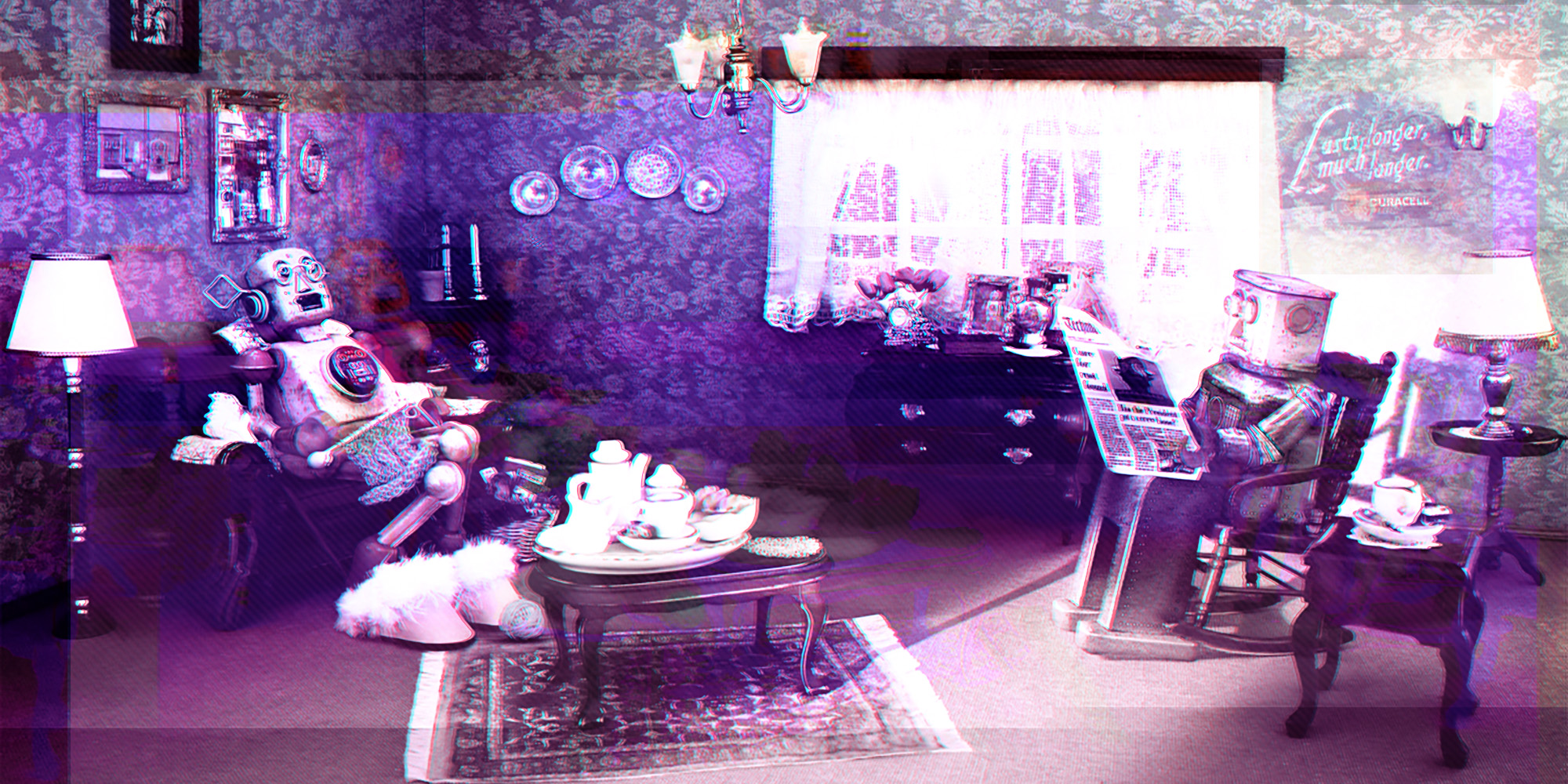
Glitched representation of 1980s Duracell robots in a domestic setting

I have a new journal article out, as part of a theme issue in Environment and Planning D: Society & Space. This forms the first peer-reviewed publication that stems from work I began around 2016 concerning automation (this is one of the earliest posts on this blog about it, with a talk I did at the SW Futures meet-up group). This took an impetus from the work of Bernard Stiegler around automation and my initial thinking with and through his ideas was influenced by many conversations around that time with my friend and former colleague Patrick Crogan, who has also written on automation (more than me!), e.g. here.

What the does ‘automative’ mean? You might be asking yourself. Well, I coined a neologism because I couldn’t find a word that fit what I wanted to say. In the paper I put it this way:

The ‘automative imagination’, in the context of this article, is a heuristic that enables two things: (i) a critique of the spatial politics scale pregnant within debates around the opportunities and threats brought by automation; (ii) an interrogation of the normative character of different habits of considering and discussing automation. I am not using the neologism ‘automative’ to assert any kind of authority but rather as a pragmatic tool. Other words do not quite fit—to speak of an ‘automated’ or ‘automatic’ imagination does not describe the characteristics of automation but suggests the imagining is itself automated, which is not the argument I am seeking to make. My aim is not to validate/invalidate particular narratives of automation. A ‘technologically determinist’ reading of the automative imagination might see what is imagined as goals towards which companies are specifically working, largely driven by economic imperative.

In the final sentence of the article I argue:

Using the automative imagination as a lens for inquiry asks for what kinds of ‘problem’ automation is situated as a ‘solution’, by whom and how they do so; and thereby how they are or may be contested.

For lots of personal reasons, this work has taken a long time to make it into print. Even so, I think the argument I make in the paper is at least interesting and has something to contribute in the current maelstrom of debate/s around automation. You can read the article for free, it is open access, courtesy of ESRC/UKRI funding. Here’s the abstract:

This article argues that the ways automation is imagined illustrate a wider problematisation of labour. The concept of an ‘automative imagination’ is proposed to articulate these different habits of considering and discussing automation. In these forms of imagination, I argue labour is discursively reconfigured as a logistical infrastructure. The concrete value of labour, the labouring body and the place of work as such are abstracted into an opaque logistical infrastructure in the narratives of an automative imagination. The impetus for this analysis comes from press releases and reports concerning automation and COVID-19 focused on the UK economy, creating a vanguard of abstracting ‘labour’ into infrastructure. The work of automation can usefully be understood as a relation, both in its implementation and in its imagining—a relation that geographers can, and should, interrogate. The automative imagination powerfully articulates the normative force of the performative abstraction and devaluation of work.

I hope you find it of interest.

CFP AAG 2020 – ‘New geographies of automation?’

Still from the video for All is Love by Bjork

I’d welcome submissions, questions or any form of interest for the proposed session I outline below.

My aim with this session is to continue a conversation that has arisen in geography and beyond about as wide a range of tropes about automation as possible. Papers needn’t be empirical per se or about actually existing automation, they could equally be about the rationales, promises or visions for automation. Likewise, automation has been about for a while, so historical geographies of automation, in agriculture for example, or policies for automation that have been tried and failed would be also welcome.

There are all sorts of ways that ‘automation’ has been packaged in other rubrics, such as ‘smart’ things, cities and so on, or perhaps become a ‘fig leaf’ or ‘red herring’ to cover for unscrupulous activities, such as iniquitous labour practices.

I guess what I’m driving at is – I welcome any and all ideas relevant to the broad theme!

CFP: New Geographies of Automation?

Denver, USA, 6-10 April 2020

Organiser: Sam Kinsley (Exeter).

Abstract deadline: 16th October 2019.

This session invites papers that respond to the variously promoted or forewarned explosion of automation and the apparent transformations of culture, economy, labour and workplace we are told will ensue. Papers are sought from any and all branches of geography to investigate what contemporary geographies of automation may or should look like, how we are/could/should be doing them and to perhaps question the grandiose rhetoric of alarmism/boosterism of current debates.

Automation has lately gained a renewed focus of hyperbolic commentary in print and online. We are warned by some of the ‘rise of the robots’ (Ford 2015) sweeping away whole sectors of employment or by others exhorted to strive towards ‘fully automated luxury communism’ (Srnicek & Williams 2015). Beyond the hyperbole it is possible to trace longer lineages of geographies of automation. Studies of the industrialisation of agriculture (Goodman & Watts 1997); Fordist/post-Fordist systems of production (Harvey 1989); shifts to globalisation (Dicken 1986) and (some) post-industrial societies (Clement & Myles 1994) stand testament to the range of work that has addressed the theme of automation in geography. Indeed, in the last decade geographers have begun to draw out specific geographical contributions to debates surrounding ‘digital’ automation. In similar if somewhat divergent ways, geographers have paid a closer attention to: the apparent automation of labour and workplaces (Bissell & Del Casino 2017); encounters with apparently autonomous ‘bots’ (Cockayne et al. 2017); the interrogation of automation in governance and surveillance across a range of scales (Amoore 2013, Kitchin & Dodge 2011); the integration of AI techniques into spatial analysis (Openshaw & Openshaw 1997); and the processing of ‘big’ data in order to discern things about, or control, people (Leszczynski 2015). 

The invitation of this session is to submit papers that consider contemporary discussions, movements and propositions of automation from a geographical perspective (in the broadest sense). 

Examples of topics might include (but are certainly not limited to):

  • AI, machine learning and cognitive work
  • Boosterism and tales of automation
  • Gender, race and A.I
  • Labour and work
  • Autonomy, agency and law-making
  • Robotics and the everyday
  • Automation and workplace governance
  • Techno-bodily relations
  • Mobilities and materialities
  • Governance and surveillance

I intend to organize at least one paper session, depending on quantity and quality of submissions.  If you would like to propose a paper presentation, please email an abstract of 250 words to me by 16th October.

If you would also like to participate in a special issue on this topic I welcome expressions of interest.

Changing Digital Geographies – new book from Jess McLean

Person using both a paper map and a mapping app on a phone

I was delighted to have Dr Jess McLean from Macquarie visit us in Exeter this week. Jess gave a great talk in our department around themes from a new book, about to be published by Palgrave. It promises to be a really interesting contribution to the renewed interest in ‘digital’ in geographyland and especially at the intersections with political ecology and work concerning the anthropocene.

Here’s some details:

Changing Digital Geographies

Technologies, Environments and People

Jessica McLean

This book examines the changing digital geographies of the Anthropocene. It analyses how technologies are providing new opportunities for communication and connection, while simultaneously deepening existing problems associated with isolation, global inequity and environmental harm. By offering a reading of digital technologies as ‘more-than-real’, the author argues that the productive and destructive possibilities of digital geographies are changing important aspects of human and non-human worlds. Like the more-than-human notion and how it emphasises interconnections of humans and non-humans in the world, the more-than-real inverts the diminishing that accompanies use of the terms ‘virtual’ and ‘immaterial’ as applied to digital spaces.
Digital geographies are fluid, amorphous spaces made of contradictory possibilities in this Anthropocene moment. By sharing experiences of people involved in trying to improve digital geographies, this book offers stories of hope and possibility alongside stories of grief and despair. The more-than-real concept can help us understand such work – by feminists, digital rights activists, disability rights activists, environmentalists and more. Drawing on case studies from around the world, this book will appeal to academics, university students, and activists who are keen to learn from other people’s efforts to change digital geographies, and who also seek to remake digital geographies.

Ballet Robotique – popular representations of automation

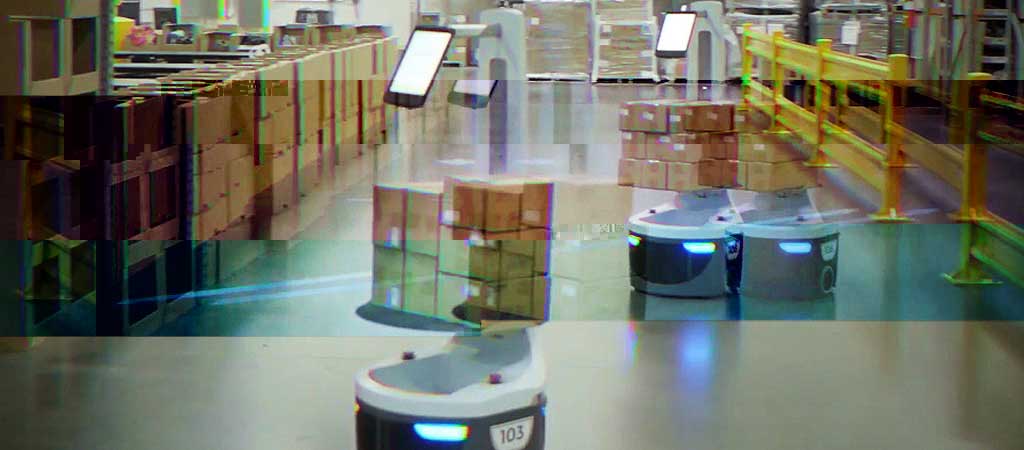
Warehouse robots moving packages

In between doing other things I am trying to maintain a little progress with work on The Automative Imagination. Recently I’ve been looking at (largely Anglophone and/or global North/West) representations of robots or automatons in cinema. There’s some funny examples (I posted a few music video representations some time ago) and it is interesting how humour, and I suppose forms of satire, and artistic representations are an enduring way of getting to grips with whatever we think ‘robots’ might be.

So, for your consideration – I have posted below two interesting pieces I have found recently (to me). I’ll try to write more on this in the near future.

The Automatic Motorist (1911)

Ballet Robotique (1982)

Bernard Stiegler on disruption & stupidity in education & politics – podcast

Bernard Stiegler being interviewed

Via Museu d’Art Conptemporani de Barcelona.

On the Ràdio Web Macba website there is a podcast interview with philosopher Bernard Stiegler as part of a series to ‘Reimagine Europe’. It covers many of the major themes that have preoccupied Stiegler for the last ten years (if not longer). You can download the pod as an mp3 for free. Please find the blurb below and a link.

In his books and lectures, Stiegler presents a broad philosophical approach in which technology becomes the starting point for thinking about living together and individual fulfilment. All technology has the power to increase entropy in the world, and also to reduce it: it is potentially a poison or cure, depending on our ability to distil beneficial, non-toxic effects through its use. Based on this premise, Stiegler proposes a new model of knowledge and a large-scale contributive economy to coordinate an alliance between social agents such as academia, politics, business, and banks. The goal, he says, is to create a collective intelligence capable of reversing the planet’s self-destructive course, and to develop a plan – within an urgent ten-year time-frame – with solutions to the challenges of the Anthropocene, robotics, and the increasing quantification of life.

In this podcast Bernard Stiegler talks about education and smartphones, translations and linguists, about economic war, climate change, and political stupidity. We also chat about pharmacology and organology, about the erosion of biodiversity, the vital importance of error, and the Neganthropocene as a desirable goal to work towards, ready to be constructed.

Timeline
00:00 Contributory economy: work vs proletarianization
05:21 Our main organs are outside of our body
07:45 Reading and writing compose the republic
12:49 Refounding Knowledge 
15:03 Digital pharmakon 
18:28 Contributory research. Neganthropy, biodiversity and diversification
24:02 The need of an economic peace
27:24 The limits of micropolitics
29:32 Macroeconomics and Neganthropic bifurcation
36:55 Libido is fidelity
42:33 A pharmacological critique of acceleration
46:35 Degrowth is the wrong question

“Merger” by Keiichi Matsuda – automation, work and ‘replacement’

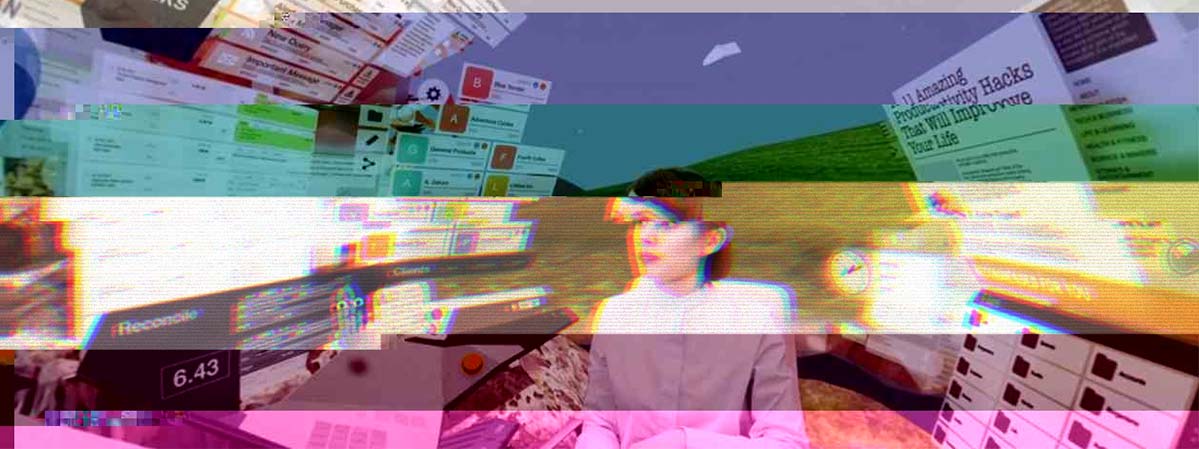
A still from the 360-degree video "Merger" by Keiichi Matsuda
“With automation disrupting centuries-old industries, the professional must reshape and expand their service to add value. Failure is a mindset. It is those who empower themselves with technology who will thrive.
“Merger is a new film about the future of work, from cult director/designer Keiichi Matsuda (HYPER-REALITY). Set against the backdrop of AI-run corporations, a tele-operator finds herself caught between virtual and physical reality, human and machine. As she fights for her economic survival, she finds herself immersed in the cult of productivity, in search of the ultimate interface. This short film documents her last 4 minutes on earth.”

I came across the most recent film by Keichii Matsuda which concerns a possible future of work, with the protagonist embedded in an (aesthetically Microsoft-style) augmented reality of screen-surfaces, and in which the narrative denouement is a sort of trans-human ‘uploading’ moment.

I like Matsuda’s work. i think he skilfully and playfully provokes particular sorts of conversations, mostly about what we used to call ‘immersion’ and the nature of mediation. This has, predictably happened in terms of human vs. AI vs. eschatology (etc etc.) sorts of narratives in various outlets (e.g. the Verge). The first time I encountered his work was at a Passenger Films event at which Rob Kitchin talked about theorisations of mediation in relation to both Matsuda’s work and the (original) Disney film ‘Tron‘.

What is perhaps (briefly) interesting here are two things:

  1. The narrative is a provocative short story that asks us to reflect upon how our world of work and technological development get us from now (the status quo) to an apparent future state of affairs, which carries with it certain kinds of ethical, normative and political contentions. So, this is a story that piggybacks the growing narrative of ‘post-work’ or widespread automation of work by apparently ‘inhuman’ technologies (i.e. A.I) that provokes debate about the roles of ‘technology’ and ‘work’ and what it means to be ‘human’. Interestingly, this (arguably) places “Merger” in the genre of ‘fantasy’ rather than ‘science fiction’ – it is, after all, an eschatological story (I don’t see this final point as a negative). I suppose it could also be seen as a fictional suicide note but I’d rather not dwell on that…
  2. The depiction of the interface and the interaction with the technology-world of the protagonist– and indeed the depiction of these within a 360-degree video –are as important as the story to what the video is signifying. By which I mean – like the videos I called ‘vision videos’ back in 2009/10 (and (in some cases) might be called ‘design fiction’ or ‘diagetic prototypes’) – this video is also trying to show you and perhaps sell you the idea of a technology (Matsuda recently worked for Leap Motion). As I and others have argued – the more familiar audiences are with prospective/speculative technologies the more likely we are (perhaps) to sympathise with their funding/ production/ marketing and ultimately to adopt them.

Call for papers: Geography of/with A.I

Still from the video for All is Love by Bjork

I very much welcome any submissions to this call for papers for the proposed session for the RGS-IBG annual conference (in London in late-August) outlined below. I also welcome anyone getting in touch to talk about possible papers or ideas for other sorts of interventions – please do get in touch.

Call for papers:

We are variously being invited to believe that (mostly Global North, Western) societies are in the cusp, or early stages, of another industrial revolution led by “Artificial Intelligence” – as many popular books (e.g. Brynjolfsson and McAfee 2014) and reports from governments and management consultancies alike will attest (e.g. PWC 2018, UK POST 2016). The goal of this session is to bring together a discussion explicitly focusing on the ways in which geographers already study (with) ‘Artificial Intelligence’ and to, perhaps, outline ways in which we might contribute to wider debates concerning ‘AI’. 

There is widespread, inter-disciplinary analysis of ‘AI’ from a variety of perspective, from embedded systematic bias (Eubanks 2017, Noble 2018) to the kinds of under-examined rationales and work through which such systems emerge (e.g. Adam 1998, Collins 1993) and further to the sorts of ethical-moral frameworks that we should apply to such technologies (Gunkel 2012, Vallor 2016). In similar, if somewhat divergent ways, geographers have variously been interested in the kinds of (apparently) autonomous algorithms or sociotechnical systems are integrated into decision-making processes (e.g. Amoore 2013, Kwan 2016); encounters with apparently autonomous ‘bots’ (e.g. Cockayne et al. 2017); the integration of AI techniques into spatial analysis (e.g. Openshaw & Openshaw 1997); and the processing of ‘big’ data in order to discern things about, or control, people (e.g. Leszczynski 2015). These conversations appear, in conference proceedings and academic outputs, to rarely converge, nevertheless there are many ways in which geographical research does and can continue to contribute to these contemporary concerns.

The invitation of this session is to contribute papers that make explicit the ways in which geographers are (already) contributing to research on and with ‘AI’, to identify research questions that are (perhaps) uniquely geographical in relation to AI, and to thereby advance wider inter-disciplinary debates concerning ‘AI’.

Examples of topics might include (but are certainly not limited to):

  • A.I and governance
  • A.I and intimacy
  • Artificially intelligent mobilities
  • Autonomy, agency and the ethics of A.I
  • Autonomous weapons systems
  • Boosterism and ‘A.I’
  • Feminist and intersectional interventions in/with A.I
  • Gender, race and A.I
  • Labour, work and A.I
  • Machine learning and cognitive work
  • Playful A.I
  • Science fiction, spatial imaginations and A.I
  • Surveillance and A.I

Please send submissions (titles, abstracts (250 words) and author details) to: Sam Kinsley by 31st January 2019.