Automation in financial services and the ongoing re-imagination of work

From Technology outsmarts the human investor – FT

“It just gets harder and harder and harder,” reflected one money manager this week. His is the predicament of other professionals – anything done by a person that follows a pattern and can be coded into a form that a computer understands will soon get squeezed. Technology also has the advantage identified in 1970: algorithms stay constantly alert.

It does not imply the complete death – or automation – of the investment manager. A professional can still undertake original research on a company or a security that provides insight. As more of the market becomes automated, originality becomes rarer and more valuable: an idiosyncratic investor should achieve higher returns by standing out from the robotic crowd.

Nor can algorithmic efficiency be wholly divorced from human intelligence, as the Oregon study showed – the point was that humans needed to set parameters for computers to follow. Many asset managers use analysts and researchers to build investment models that then trade securities automatically; others blend their active risk-taking with passive elements.

…

But these difficulties demonstrate how automation eats into professions, not by taking away all the jobs in one day but by unbundling them – dividing them between tasks that only humans can perform and those of which an algorithm is quite capable. Then the boundary relentlessly shifts.

The last paragraph is key – there seems to be a growing consensus that automation doesn’t simply ‘destroy’ jobs, it makes particular aspects of or kinds of role redundant and the implementation and development of automated systems requires the remaining workers to fit around those systems in different ways. In many ways, then, automation is a company or institution-specifc organisational or administrative problem as well as a wider political economic problem.

Reblog> Book Launch: Playful Mapping in the Digital Age

Via Institute of Network Cultures.

Generally wary of anything with “digital age” in the title, but good to see some geographers featuring in ‘digital cultures’ type networks…

Book Launch Playful Mapping in the Digital Age

MONDAY 13TH OF MARCH, 17:00 – 18:15 @SPUI25, AMSTERDAM.

With keynote lectures by Michiel de Lange and, Emma Fraser and Clancy Wilmott.

From Mah-Jong to the introduction of Prussian war-games, through to the emergence of location-based play: maps and play share a long and diverse history. In this programme, we will launch the book Playful Mapping in The Digital Age, which shows how playing and mapping can be liberating, dangerous, subversive and, performative.

>> Sign up here.

Playful Mapping in the Digital Age shows how mapping and playing unfold in the digital age and in which ways the relations between these apparently separate tropes are increasingly woven together. Fluid networks of interaction have encouraged a proliferation of hybrid forms of mapping and playing. A rich plethora of contemporary case-studies, ranging from fieldwork, golf, activism and automotive navigation to pervasive and desktop-based games, emphasizes this trend. Examining these cases shows how mapping and playing can form productive synergies, but also encourages new ways of being, knowing and shaping our everyday lives. This afternoon, the Members of the Playful Mapping Collective explore how play can be more than just an object or practice, and instead focus on its potential as a method for understanding maps and spatiality.

AI under feminist scrutiny

Searching for something else, I came across a 1999 book review by Tiziana Terranova of Alison Adam’s book Artifical Knowing in New Media and Society. As with much of Terranova’s incisive writing, there is a set of observations about the ontological politics of technology studies, in this case a really interesting reflection on how we might understand the issue of embodiment in relation to mediation:

…although embodiment is a foundational feminist category, it is far from being a resolved question. It is much easier to charge malestream science and technology with disembodiment than to come up with a model of embodiment which won’t stir the opposition of this or that feminist quarter. In many ways, the debate about cyberculture and technology keeps stumbling against the same block: if disembodiment is preferential bias of cybernetic technologies, how do we anser that? How do we bring back the body in cyberspace without essentializing it? Interestingly… if [we see] in Harraway’s cyborg (directly inspired by the skewed, labarynthine technologic of cybernetics) a machinic assemblage of organic and inorganics, of identity and difference, maybe [we] could have come up with a constructive, non-essentialist, embodied model of AI. Maybe it is a sad testimony of the overuse of the term ‘cyborg’ that [some are] all to ready to dismiss it as another ruse of an a-political postmodern feminism. It is a pity indeed since it seems to me that the charge of disembodiment more and more often levelled at digital culture (in all its manifestiations) has turned into the final word on the latter rather the beginning of a really different understanding of technology and subjectivity (or in this case, ‘intelligence’). Maybe we need a model of embodiment which is more about connections and partialities, more akin to cybernetics itself, to make AI work for feminists. (p. 142)

Material carriers of thought

In a recent article on the Social Epistemology Review and Reply Collective, Lyudmila A. Markova discusses the material supports for human communication, what Stiegler would call the processes of exteriorisation and thus materialisation of memory/thought:

Even the most common type of communication is not possible without a material carrier. For example, at a minimum stone, papyrus or paper is required for written communication. Their production processes obey the laws of engineering sciences, which are completely independent from the content of the information they convey. Even if the information is transmitted orally, with a voice, a material carrier is present. The sound is produced in a person’s larynx and is uttered through the mouth as language. Furthermore, the air movement, which is born inevitably during the conversation, obeys the laws of physics.

There’s some really interesting discussion of the various ways those involved in studies of social epistemology, and most notably in the essay it’s Steve Fuller’s work set in relation to Kuhn, have attempted to reconcile the passage to knowledge. It’s also curious to see how David Berry’s work ends up in there too, I suspect there’s more than a hint of Stiegler shining through there (but I haven’t read the work so should probably do so…) and it’s a shame Markova doesn’t make that connection. Might be interesting to pursue that angle…

Echoborg

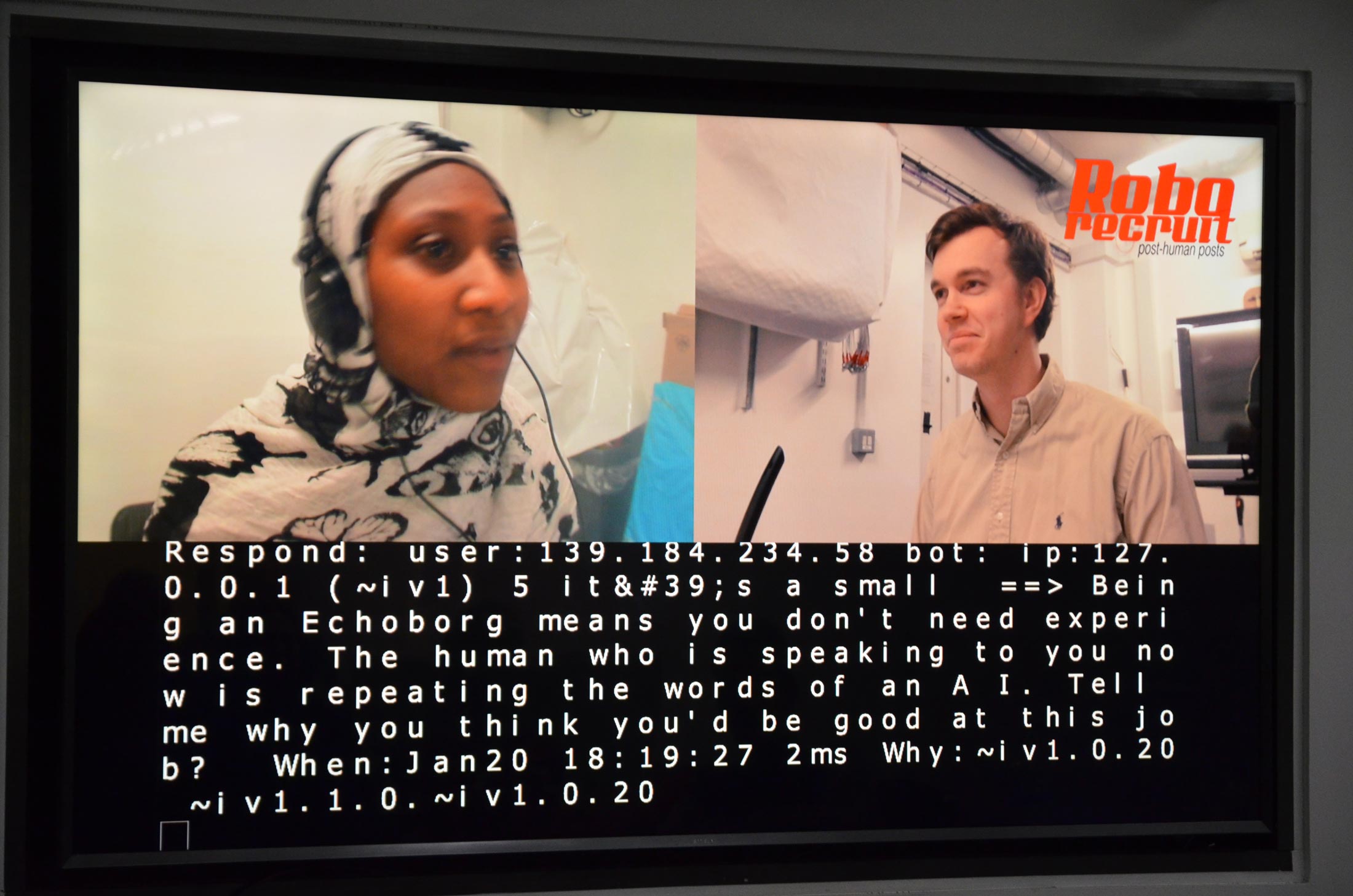
Former colleagues of mine at UWE are developing an interesting project, which you may have seen/heard about through the BBC’s Click programme, called Echoborg.

An echoborg is a hybrid agent composed of the body of a real person and the “mind” (or, rather, the words) of a conversational agent; the words the echoborg speaks are determined by the conversational agent, transmitted to the person via a covert audio-relay apparatus, and articulated by the person through speech shadowing[1].

Recently, the project team have demoed the project as part of an AHRC-funded network on Automation Anxiety and have written this up on the project website, here’s a snippet – it sounds like it is really compelling (I’ve not seen this in action):

Four people were interviewed by the AI which increasingly displayed an interest in eliciting help to reprogram itself. Proceedings were visible on a projector screen and the ‘audience’ of applicants gradually began to discuss the situation of the Echoborg and how to change it. At a certain point their reflections passed a threshold and the group fired into collective action, experimenting with various methods to bring the situation to a head in some way. The lively inventiveness of the group and the individual interviewees went a long way to confirming the interactive potential of this format of the work. It also gave Rik and Phil much to work with in considering the further development of the AI/Chatbot, the restricted delivery of narrative by the human Echoborg and the staging. This event also trialled a secondary, higher level, Echoborg character as part of the slow process of unfolding the potential for this Echoborg recruitment event to be a disruptive and thought and emotion provoking experience for all players.

Notes

  1. Corti, Kevin and Gillespie, Alex (2015) Offscreen and in the chair next to you: conversational agents speaking through actual human bodies. Lecture Notes in Computer Science, 9238 . pp. 405-417.

Tony Sampson on neuroculture

From a Conversation piece on Huxley, dystopia and how we might think about Facebook etc. in relation to Huxley’s “College of Emotional Engineering”, this concise evocation of his understanding of ‘neuroculture’ is interesting:

The origins of neuroculture begin in early anatomical drawings and subsequent neuron doctrine in the late 1800s. This was the first time that the brain was understood as a discontinuous network of cells connected by what became known as synaptic gaps. Initially, scientists assumed these gaps were connected by electrical charges, but later revealed the existence of neurochemical transmissions. Brain researchers went on to discover more about brain functionality and subsequently started to intervene in underlying chemical processes.

Interpretation of Cajal’s anatomy of a Purkinje neuron, by Dorota Piekorz.

On one hand, these chemical interventions point to possible inroads to understanding some crucial issues, relating to mental health, for example. But on the other, they warn of the potential of a looming dystopian future. Not, as we may think, defined by the forceful invasive probing of the brain in Room 101, but via much more subtle intermediations.

The internet is mostly bots(?)

“When I am king, you will be first against the wall…“

In an article for The Atlantic Adrienne LaFrance observes that a report by the security firm Imperva suggests that 51.8% of traffic online is bot traffic (by which they mean 51.8% of a sample of traffic [“16.7 billion bot and human visits collected from August 9, 2016 to November 6, 2016”] sent through their global content delivery network “Incapusla”):

Overall, bots–good and bad–are responsible for 52 percent of web traffic, according to a new report by the security firm Imperva, which issues an annual assessment of bot activity online. The 52-percent stat is significant because it represents a tip of the scales since last year’s report, which found human traffic had overtaken bot traffic for the first time since at least 2012, when Imperva began tracking bot activity online. Now, the latest survey, which is based on an analysis of nearly 17 billion website visits from across 100,000 domains, shows bots are back on top. Not only that, but harmful bots have the edge over helper bots, which were responsible for 29 percent and 23 percent of all web traffic, respectively.

LaFrance goes on to cite the marketing director of Imperva (who wants to sell you ‘security’ – he’s in the business of selling data centre services) to observe that:

“The most alarming statistic in this report is also the most persistent trend it observes,” writes Igal Zeifman, Imperva’s marketing director, in a blog post about the research. “For the past five years, every third website visitor was an attack bot.”

How do we judge this report? I find it difficult to know how representative this company’s representation of their data, although they are the purveyor of a ‘global content delivery network’. The numbers seem believable, given how long we’ve been hearing that the majority of traffic is ‘not human’ (e.g. a 2013 article in The Atlantic making a similar point and a 2012 ZDNet article saying the same thing: most web traffic is ‘not human’ and mostly malicious).

The ‘not human’ thing needs to be questioned a bit – yes, it’s not literally the result of a physical action but, then, how much of the activity on the electric grid can be said to be ‘not human’ too? I’d hazard that the majority of that so-called ‘not human’ traffic is under some kind of regular oversight and monitoring – it is, more or less, the expression of deliberative (human) agency. Indeed, to reduce the ‘human’ to what our simian digits can make happen seems ridiculous to me… We need a more expansive understanding of technical (as in technics) agency. We need more nuanced ways to come to terms with the scale and complexity of the ways we, as a species, produce and perform our experiences of everyday life – of what counts as work and the things we take for granted.

Microsoft Cognitive Services

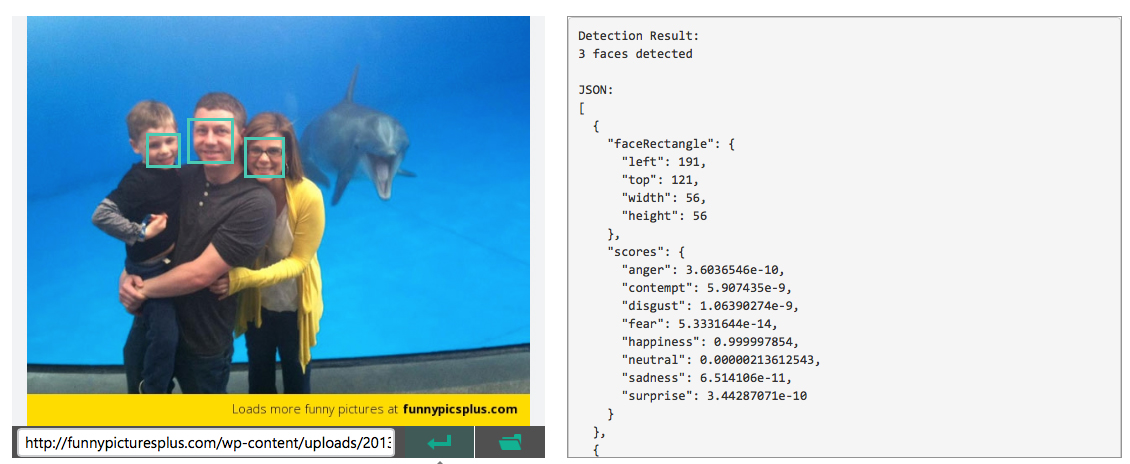
Microsoft Cognitive Services (sounds like something from a Phillip K. Dick novel) have opened up APIs, which you can call on (req. subscription), to outsource forms of machine learning. So, if you want to identify faces in pictures or videos you can call on the “Face API“, for example. Obviously, this is all old news… but, it’s sort of interesting to maybe think about how this foregrounds the homogenisation of process – the apparent ‘power’ of these particular programmes (accessed via their APIs) may be their widespread use.

This might be of further interest when we consider things like the “Emotion API” through which (in line with many other forms of programmatic measure of the display or representation of ’emotion’ or ‘sentiment’) the programme scores a facial expression along several measures”, listed in the free example as: “anger”, “contempt”, “disgust”,” fear, “happiness”, “neutral”, “sadness”, “surprise”. For each image you’ll get a table of scores for each recognised face. Have a play – its beguiling, but of course then perhaps prompts the sorts of questions lots of people have been asking about how ‘affect’ and emotions can get codified (e.g. Massumi) and the politics and ethics of the ‘algorithms’ and such like that do these things (e.g. Beer).

I am probably late to all of this and seeing significance here because it’s relatively novel to me (not the tech itself but the ‘easy-to-use’ API structure), nevertheless it seems interesting, to me at least, that these forms of machine learning are being produced as mundane through being made abundant, as apparently straightforward tools. Maybe what I’m picking up on is that these APIs, the programmes they grant access to, are relatively transparent, whereas much of what various ‘algorithm studies’ folk look at is opaque.  Microsoft’s Cognitive Services make mundane what, to some, are very political technologies.