Reblog> Days numbered for barcodes (according to Reuters)

A sort of interesting story from Reuters on an apparent growing demand for information by consumers that they suggest may lead to the demise of the low-fi barcode in favour of QR [really?! still trotting out that old nag?] and RFID… so, nothing people like Bruce Sterling haven’t been saying for quite a while but sort of interesting how it’s couched…

Days numbered for barcodes as shoppers demand more data

BERLIN | 

Barcodes are seen on a package in London August 27, 2015. REUTERS/Russell Boyce
Barcodes are seen on a package in London August 27, 2015. REUTERS/RUSSELL BOYCE

Growing demand for more information about the products we buy could mean the end of the simple barcode – the blocks of black and white stripes that adorn most objects for sale and are scanned five billion times a day.

First used on a pack of Wrigley’s Juicy Fruit chewing gum in 1974 in a store in Ohio, barcodes have revolutionized the retail world, allowing cashiers to ring up products much faster and more accurately, while also streamlining logistics.

But shoppers are now demanding far greater transparency about products, and store owners need more information to help with stock taking, product recalls and to fight fakes. The basic barcode is just not up to the job.

That could mean a costly upheaval for retailers and brands to change packaging and invest in new systems and scanners. But it should also bring benefits as more data helps them manage the flow of goods better.

“The barcode did a great job, but it is now time for succession,” said Capgemini consultant Kees Jacobs, who is working with the world’s top retailers and food manufacturers to try to agree new global standards for labels and product data.

“The current barcode is not sufficient to be the carrier of much more granular information that is needed,” Jacobs said.

The most ubiquitous barcodes allow an eight to 14 digit number to be read by a laser scanner. For example, barcode 4-003994-111000 identifies a box as being a 375 gram pack of Kellogg’s Corn Flakes.

However, that number does not directly capture any other information that might interest a shopper – such as ingredients, allergens or country of origin – nor does it provide a retailer with useful details such as the batch number or sell-by date.

That data is usually printed on the pack, but consumers increasingly want to read it online, or with a smartphone app such as one that measures calories. Retailers want data that can be scanned for tasks such as quickly locating faulty goods for recall or about-to-expire products for mark downs.

SUSTAINABLE AND SAFE?

GS1, the non-profit organization that assigns the unique numbers in barcodes, has developed a double-layered barcode it calls the “data bar” which can carry some extra details such as expiry date, quantity, batch or lot number.

That has allowed German retailer Metro (MEOG.DE) to launch PRO Trace, a smartphone app that shows, for example, that a filet of salmon on sale at a store in Berlin on Aug. 25 was caught at the Bremnes Seashore fish farm off the coast of Norway on Aug. 17 and processed in Germany on Aug. 21.

The app also displays a map highlighting the fishing area of the catch and a detailed description of the Atlantic salmon.

Metro says the app helps customers at its cash-and-carry stores such as professional chefs from hotels and restaurants, as they can now embellish their menus with information about the exact origin of pricey delicacies such as wagyu beef.

“We are the only ones in Germany that can do this for fresh fish. It’s about trust. Our customers challenge us to offer sustainable and safe products,” said Lena vom Stein, a corporate responsibility project manager at Metro.

Metro set up the tracking scheme to help it comply with European Union regulations aimed at stemming overfishing and started making the data available to customers in 2012. It now extends to meat, and fresh fruit and vegetables will follow.

Other retailers are also opening up, often supplementing the barcode with a pixilated square known as a quick response (QR) code. It can store dozens more data points and can be scanned by a smartphone camera to lead to a web page, but can still not be read by the majority of store scanners.

Dutch retailer Albert Heijn (AHLN.AS) recently introduced “Check Origin” QR labels on locally-grown radishes and blueberries. Scan the sticker on a mobile phone and it plays a film that rewinds to show the journey from the shelf back to the packing factory, then back to the farmer’s field.

Such tools are likely to fuel demands for more transparency. A GS1 survey found consumers are most interested in nutritional and ingredient information, details on allergens, organic certification, environmental impact and ethical standards.

HARMONIZING DATA

Making such a wealth of data accessible via codes that can be scanned is only part of the problem. A bigger challenge is gathering, storing and standardizing the information in the first place.

Fiona Wheatley, sustainable development manager at British retailer Marks and Spencer (MKS.L), says keeping tabs on all the company’s suppliers can be a daunting task.

“Your ability to give your customers more confidence that they can rely upon is proving to be increasingly challenging,” she said, adding that M&S relies on certification schemes such as Fairtrade to help audit smallholder farmers.

David Linich, supply chain expert at consultants Deloitte, advises retailers to find ways to work together to monitor the thousands of producers they buy from: “If you go it alone it can be really burdensome, really cost prohibitive.”

The Consumer Goods Forum (CGF), a global network of some 400 retailers and manufacturers from 70 countries, is coordinating efforts to harmonize product data and labeling.

Most firms accept that more transparency is needed after scares such as the 2013 scandal about horsemeat being sold as beef in Europe, but it is still proving hard to persuade them to share data that many see as commercially sensitive.

Capgemini’s Jacobs, who is working on the CGF project, hopes pilot schemes to standardize digital information, like one between rival retailers in Belgium including Delhaize (DELB.BR), Carrefour (CARR.PA) and Colruyt (COLR.BR), could be the precursors to new global data standards.

GS1 already holds data from 30,000 companies on some 18 million products that its industry members share with each other behind the scenes to smooth logistics.

It is trying to persuade its members to let consumers access more of this information, while keeping some of it confidential, such as detailed pricing and stock levels.

Malcolm Bowden, president of global solutions at GS1, predicts agreement could come quickest – within a year – on sharing nutrition data as there are already broadly accepted standards, and calorie and allergen apps are proliferating.

“The will is there. It has to happen. Like any major change, big companies have to have time to think through the implications,” he said.

GS1 is also working to create identifier numbers for individual farms and is trying to harmonize standards on sustainability data, such as a measure of water efficiency for detergents and washing powders currently being piloted.

But making such a wealth of data available will sound the death knell for the barcode. Only a QR code can carry that much information without taking up too much space on packaging.

Longer term, more products could carry wireless tags such as the RFID labels that are being widely rolled out across the fashion industry. These tiny tags, which can be embedded in an object and, unlike a barcode or QR code, do not need to be within the line of the sight of a reader, were long too expensive for everyday goods but their price is falling fast.

Bowden predicts different systems will probably have to coexist for the next decade or so as retailers and logistics providers gradually upgrade their scanning systems.

“I am convinced we will have a day where pretty much all information about all products will be available to all consumers,” he said.

(Editing by David Clarke)
French Conseil National du Numérique report published [video intro]

I’ve been following tweets from the Conseil National du Numérique for a little while, which have been interesting [with the hashtag #ambitionnumérique] – their “Ambition Numérique” (roughly: ‘Digital Goals’) report for the prime minister is now published and there’s a swish video intro for it (below).

It’s an interesting report because of the level of consultation the CNM attempted, with anyone ostensibly able to offer comment through an online consultation process and lots of other ‘stakeholders’ approached directly, with four big meetings held in Lille, Strasbourg, Bordeaux, and Nantes.


The video is worth a watch just to get a sense of how one of the G8 is approaching issues such as identity, neutrality, public services, privacy and work in relation to a growing digital economy. Although, none of what is said is particularly surprising. IT is sort of interesting that it is coming from a (sort of) ‘state actor’…


Le numérique nous concerne tous ! Les grands… by cnnumeriquefr

You can switch on the English subtitles by pressing the [cc] button and selecting “English”.

There’s also a press release in English here.

Reblog> A litmus test for the internet of things

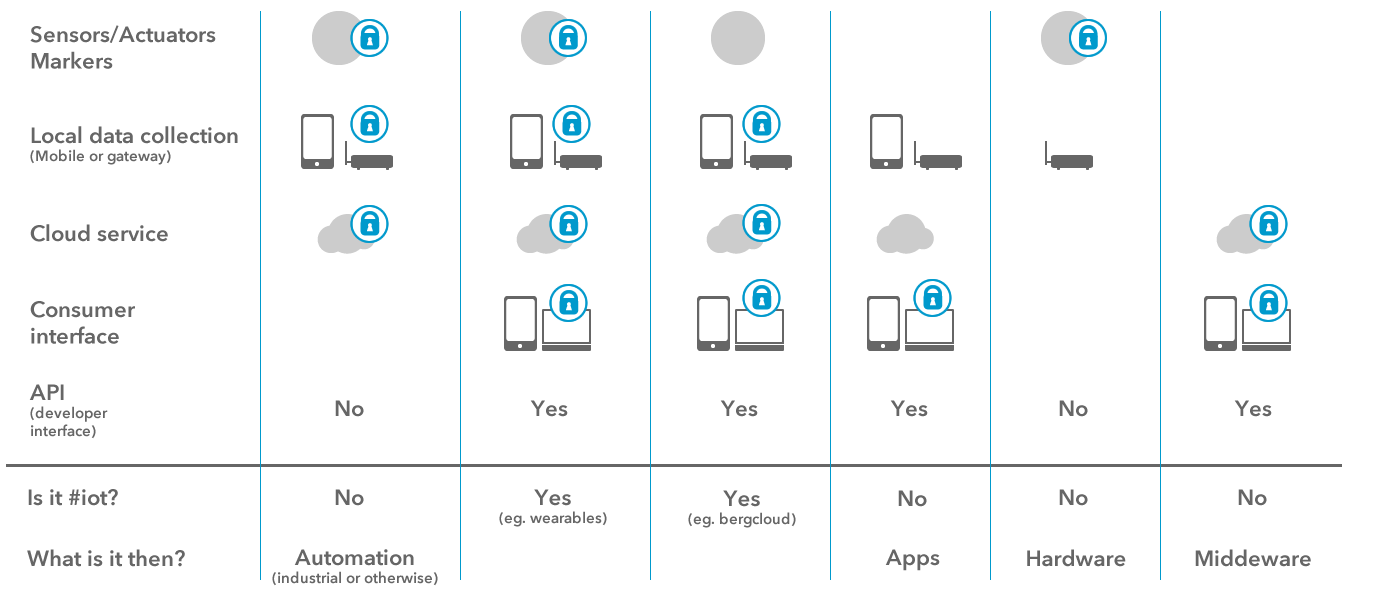
Alexandra Deschamps-Sensino blogged this really interesting ‘test’ to check if something is part of the IoT, or not – and what is it if not..?

I don’t have time to write about this now, but it resonates with the ThingTank project by Chris Speed et al. that I blogged about a little while ago…

A litmus test for the internet of things

It’s taken me about 2 months to work out how to show the differences between products that companies say are iot and those that possibly aren’t. I suspect I actually need to explain it but I’d rather have a good conversation on Twitter about it so I can tweak things accordingly.

For clarity, a lock means it’s proprietary.
No lock means it’s open source.
Absence of means its not provided by the company directly.

designswarm_iotlitmustest2

‘Wide’, not ‘big’, data

Saw this article a while ago on the NetworkWorld website, not sure if it’s a more broadly adopted concept – but the idea of ‘wide’ data appeals. Can’t remember if Rob Kitchin addresses it in his excellent book The Data Revolution… will have to check!

(I’m blogging this so I can finally close the tab in my browser!)

Why businesses should focus on wide data, not big data

In these heady days of big data, a lot of organizations treat data collection like a Pokémon game: Gotta catch it all. But Dane Atkinson, CEO of cross-platform marketing analytics specialist SumAll says most organizations need to think wide, not big, when it comes to data.

“The real impact of data always comes from the intersection of different data sets,” Atkinson says. “You don’t get into the earth shattering discoveries until you start to link disparate data sets.”

This idea of ‘wide’ data is what some marketing people have called ‘horizontals’ – the ability to stitch together different kinds of data to create a particular kind of value proposition (see Irene Ng’s book on this…)

Reblog> Reading list on the digital divide/digital inclusion

This looks like a really helpful resource over on the Social Media Collective blog –– although I’m sure Mark Graham may want to add to it… 🙂

Reading list on the digital divide/digital inclusion

We compiled a bibliography on the digital divide (including gender gaps) and ICTD. Please let us know if we missed anything interesting and we would be glad to add it!

1. Allen, Steven G. 2001. “Technology and the Wage Structure.” Journal of Labor Economics 19:440-483.

2. Anderson, B. 2005. “The value of mixed-method longitudinal panel studies in ICT research.” Information, Communication & Society 8:343-367.

3. Anderson, Ben. 2008. “The Social Impact of Broadband Household Internet Access.” Information, Communication & Society 11:5-24.

See the other 191 references on the Social Media Collective blog.

What might happen when ‘things’ design themselves?

I’ve been meaning to flag this for a while… Chris Speed at Edinburgh (who gave the ‘dancing with data‘ talk I posted a while ago) is leading a project called ThingTank:

The ThingTank project identifies that ‘things’ may soon know more about lives than we do and may also be able to make suggestions about what is missing. The purpose of this project is to explore the potential for identifying novel patterns of use within the data that is streamed through the interaction between people and things, and things and things. Our project builds on research and innovation that has been established by the three investigators across the fields of Internet of Things, Social Experience Design and Machine Learning. Through a better understanding of how what data can tell us about how we use objects, new models of use will emerge and reinvigorate the role of things and people within design and manufacturing.

The project offers some interesting provocations both as research outcomes and as innovation in methods. It’s worth looking at this write-up by Chris on his website Fields.

The web and its territories

(Well… DNS and territories)

Two things I’ve read recently converged in my mind and reminded me of work in geography undertaken a while ago about the ways apparently abstract or immaterial aspects of the internet are intimately tied up with traditional geo-political borders and territories.

First, as James Bridle finishes his essays about geographic Top Level Domains (gTLDs) for the Citizen-Ex project – its really interesting to reflect on the often fraught and muddy geo-politics of the domain name system (DNS), which Bridle expresses beautifully. The stories about the Libyan (.ly), Syrian (.sy) and British Indian Ocean Territory (.io) domains are especially arresting.

Second, over on Culture Digitally, Adam Fish wrote a post about the growth in interest in the high seas, the upper reaches of the atmosphere and space for creating extra-legal territories for ‘unencumbered’ innovation and for the delivery of services without the need for territorial wrangling:

Technical approaches towards national internet sovereigntyincluding IP address blocking, domain names, key words, and packet filtering. Non-technical forms of censorship include laws, regulations, threats, bribes, and arrests of publishers, ISPs, and authors. Reporters without Borders identifies 19 countries – including the US and the UK – along with Cuba, China, Iran, and North Korea, all of which use one or several of these tactics to create a distinct national internet.

Certainly, what governments want for their people and what the people want for themselves frequently diverge. But while we may agree that internet censorship by authoritarian dictatorships is an affront to free communication, can we really put our faith in Facebook’s drones? It is possible to overthrow a government and depose a dictator but it is nearly impossible to revolt against corporate drones and extraterritorial CEOs.

Both of these reminded me of a few things in geography: of work in  by Mark Wilson about 15 years ago and (of course) by Matthew Zook (also about 15 years ago [e.g.]) concerning the economic geographies of the infrastructures of the internet(s). It also strongly reminded me of Alexander Murphy‘s paper in the Annals of AAG a couple of years ago about ‘Territory’s continuing allure‘. It is interesting, amongst the hyperbole of immateriality and of ‘off-shore’ data centres through which our exhaust data are analysed and sold on, that (the idea of) territory maintains certain kinds of political-economic importance in particular circumstances.

As Murphy contends (in a different context but I suggest the argument holds in relation to the examples above):

if Agnew (1999, 504) is right that the spatialities of power will change “as material conditions and associated modes of understanding of them change” (italics added), then the continu- ing hold of modernist conceptions of territory on the political–geographic imagination (see Gregory 1994) must be seen as fundamental to any effort to understand the character and prospects of the current system (p. 1214)

…

Novel spatialities of power call out for a reinvention of the linguistic terms and conceptual frameworks we use to make sense of the world (see, e.g., Allen’s [2011] call for a consideration of what he terms topologies of power). At the same time, if we are to make sense of the circumstances and struggles shaping the political future, we must not underplay territory’s continuing ideological hold and practical significance … We also need to factor in the enduring significance of territorially based worldviews that continue to shape the perspective and ideas of billions of people–and by extension the institutions and regimes that circumscribe their lives.(p. 1224)


Reblog > CFP: “Critical Data Studies” – Big Data & Society Special Theme

Andrew Iliadis has blogged this interesting Call For Papers:

CFP: “Critical Data Studies” – Big Data & Society Special ThemeGuest Editors: Andrew Iliadis (Purdue University) and Federica Russo (Universiteit van Amsterdam)

Critical Data Studies (CDS) is a growing field of research that focuses on the unique theoretical, ethical, and epistemological challenges posed by “Big Data.” Rather than treat Big Data as a scientifically empirical, and therefore largely neutral phenomena, CDS advocates the view that data should be seen as always-already constituted within wider data assemblages. Assemblages is a concept that helps capture the multitude of ways that already-composed data structures inflect and interact with society, its organization and functioning, and the resulting impact on individuals’ daily lives. CDS questions the many assumptions about data that permeate contemporary literature on information and society by locating instances where data may be naively taken to denote objective and transparent informational entities.

CDS may be viewed as an emerging field connected to Information Ethics, Software Studies, and Critical Information Studies in that it seeks to question the ethical import of information and Big Data for society. Problems of causality, quality, security, and uncertainty concern CDS scholars. Recent articles outlining the theoretical program of CDS offer a new platform from which to question data in this manner. We seek essays for this special volume that broaden these latest commitments in CDS to include new empirical research projects on information and communication technologies (ICTs) that fall under the umbrella of Big Data, while also seeking to question their attendant epistemological shifts. Through the critical lens of ethics and morality, this special volume opens up CDS to localizations where Big Data can no longer be seen as neutral, and where an ethics of Big Data might emerge.

Issues of interest include (but are not limited to):
– Causality: how should we find causes in the era of ‘data-driven science?’ Do we need a new conception of causality to fit with new practices?
– Quality: how should we ensure that data are good enough quality for the purposes for which we use them? What should we make of the open access movement; what kind of new technologies might be needed?
– Security: how can we adequately secure data, while making it accessible to those who need it? How do we protect databases?
– Uncertainty: can Big Data help with uncertainty, or does it generate new uncertainties? What technologies are essential to reduce uncertainty elements in data-driven sciences?

Proposals of 1000 words are invited for consideration and inclusion in the Special Theme to be published in Big Data & Society (BD&S), an open access peer-reviewed scholarly journal that publishes interdisciplinary work principally in the social sciences, humanities and computing and their intersections with the arts and natural sciences about the implications of Big Data for societies.

Manuscripts should be 8,000 words for an Original Research Article, 3,000 words for a Commentary, and 1,000 words for an essay in the Early Career Research Forum section. All submissions of Original Research Articles to BD&S are double-blind, and triple peer-reviewed. Commentaries and ECR submissions are reviewed by the Guest Editors.

See the full thing on Andrew’s blog.

Geographers that blog (relatively frequently)

I’ve had the habit of reading blogs since blogs became ‘a thing’, back in the early noughties (for me anyway), and have moved through different RSS readers, desktop versions then web services – from NetNewsWire to dear old Bloglines introduced to me by Howard Rheingold, and more recently Netvibes… but I’ve allowed the list of sites I follow to atrophy and wither, with many no longer active and some no longer online.

I decided to do what all lazy Twitter users do and ask ‘which geographers should I read?‘ and received some helpful responses. I am therefore sharing the beginnings of a list that I hope others may help add to by leaving suggestions in the comments below…

My aim here is to compile a list of regular bloggers who blog about vaguely human geographical things, so here’s my provisional list – there must be more(!):

Australian Centre for Cultural Environmental Research

Hannah Awcock – Turbulent London / The historical geography of protest & riots

Clive Barnett – Pop Theory

Mike Batty – Smart Cities

Megan Blake – GeoFoodie

the Centre for Advanced Spatial Analysis (UCL) blog network (aggregate)

Jeremy Crampton – Open Geography

Tim Cresswell – place, landscape, mobility, poetry

Julie Cupples – geography/development/culture/media

Simon Cook – Jographies

Nicholas Crane – For Another Critique of the Pyramid

Andy Davies – Contentious Geographies

Gwilym Eades – Place Memes

Stuart Elden – Progressive Geographies

Eye on Geography – NUIM geography group blog

Thomas Frederiksen – Mining and CSR

Geocritique – group blog on ’emerging ecologies’

Geopolitics & security – Royal Holloway blog

Bradley Garrett

Hilary Geoghegan – Culture of Enthusiasm

Jen Jack Gieseking

Ben Gilby – Doronieth Kernow

Governing Emergencies – Leverhulme network blog (led by Ben Anderson)

Mark Graham – Zero Geography

Derek Gregory – Geographical Imaginations

Muki Haklay – Po Ve Sham

Adrian Ivakhiv – Immanence

Rob Kitchin’s Ireland After NAMA

Sara Koopman – Decolonizing Solidarity & Spanish for Social Change

Innes Keighren – On the archival trail of William Macintosh

Angela Last – Mutable Matter

Landscape Surgery – Royal Holloway postgrad group blog

Ludic Geopolitics – project blog

Colin McFarlane – City Fragment

Dominique Moran – Carceral Geography

Oli Mould – taCity

Helen Pallett – The Topograph

Rafael Pereira – Urban Demographics

Mark Purcell – Path to the Possible

The Programmable City – EU funded project at NUI Maynooth led by Rob Kitchin

Scott Rodgers – Publicly Sited

Gillian Rose – Visual/Method/Culture

Joe Smith – Citizen Joe Smith

Society for Radical Geography, Social Theory & Everyday Life (group)

Soft Paternalism – project blog: Rhys Jones, Mark Whitehead, Jessica Pykett & Marc Welsh

Chris W. Strother – The Anarchist Geographer

Gerard Toal – Critical Geopolitics

Leonard van Efferink – Exploring Geopolitics

Miranda Ward

Tara Woodyer – Material Sensibilities

Honorable mentions (not particularly regular)

Katherine Brickell

High Crossfield – Chomping at the bloodied bit

Ayona Datta – The City Inside Out

Design Geographies

Michael Gallagher

Matthew Gandy – Cosmopolis

Nick Heynen

Kurt Iveson – Cities & Citizenship

Helen Jarvis – Experiments in Community

Bob Jessop

Craig Jones – War, Law, Space

Rob Kitchin’s frequent blog about crime fiction

John Krygier – Making Maps

Karen Lai

Joanna Mann – KnitDiss / Exploring the geographies of craft & crafting

Ellie Miles – Museums, research, teaching

Pat Noxolo’s Dancing Maps project blog

Kris Olds / Global Higher Ed

Darren Patrick – Queer Urban Ecologies

Laura Prazeres – Learning beyond borders

Paul Simpson

Juanita Sundberg – Nature / Race / Militarization

Alex Vasudevan – Experimental Geographies

Tom Vickers – Refugees, Capitalism and the British State

Paulo Jorge Vieira

Amy Zang – Souvenir Geographies

PLEASE HELP ME ADD TO THIS LIST – comment below…

Changing the world together – Dirk Holemans’ postface to Bauwens’ Sauver le Monde

I recently posted a translation of Bernard Stiegler’s Preface to Michel Bauwens and Jean Lievens’ book Sauver le Monde or Saving the World: Towards a post-capitialist society with peer-to-peer. In the book Michel, with his collaborator Jean Lievens, argues that a new distributed and de-centralised economic model is necessary to shake up the world and  drive us towards a post-capitalist society.

I have read a bit of the book now, which I hope will make it into English translation, in which Bauwens and Lievens conduct a wide-ranging, almost breathless, conversation about the promise of peer-to-peer for constructing a post-capitalist society. Interestingly, there is also a postface by Dirk Holemans, who is a coordinator of the independent Belgian think tank or ‘ideas lab’ Oikos, which I feel offers a nice overview and fulsome recommendation of the book.

I offer here a translation, which I have made available to the authors and publishers – it may need finessing but I think its a pretty good attempt…

Postface
Changing the world together

Dirk Holemans – Coordinator of the independent think tank Oikos

Society faces an unprecedented challenge: the 20th century model of production and consumption has been utterly spent. It is no longer possible, on our vulnerable planet, to continue to commercialise and market everything, and, in the process, to exhaust our energy supplies and primary resources. Furthermore, the fact that the global economy is controlled by 150 multinational corporations, which have no care for social equality, runs counter to the ideal of a highly-skilled society where citizens wish to collectively take control of the future.

In this sense we urgently need formidable thinkers who are able to both keenly analyse the current state of affairs and to develop concepts and resources that facilitate the collective construction of a different world. In this book Michel Bauwens vigorously fulfils this task. In the context of the contemporary system of capitalism, which is set within a longer historical evolution, he describes the enormous possibilities of the new peer to peer system. His argument, which is, in turn, provocative and stimulating, is that the way people relate to one another in horizontal networks facilitates a form of self-organisation, without authority, in the creation of common value that is more productive than can be achieved by private companies or official organisations. A good example is Wikipedia, the product of the efforts of millions of citizens across the world that has rendered privately edited encyclopedias redundant.

Michel Bauwens sees a great potential for emancipation in civil society. Indeed, opportunities for collaboration in horizontal networks are more important than ever before thanks to new information and communication technologies.  Nevertheless, this cyber-philosopher is not naive: the future will emerge from social struggle and social power relations. Accordingly, Facebook allows people to communicate but also appropriates the use value they create as users, thereby capturing exchange value–in other words: profit. Bauwens poses questions that thus will remain relevant: “Why not create, as a society, a digital cooperative to develop an alternative to Facebook?”, or: “Why not consider social media a form of public service?” He does not share the postmodern vision of knowledge workers guaranteeing themselves a career by virtue of their talent and their laptops. Even if a flexible career is aligned with peer production, such a society can only be stable with a guaranteed basic income.

Bauwens challenges the reader by asserting that peer-to-peer is not simply a new mode of production but in fact heralds a revolution in productivity that will change society at every level. This new model of value through cooperative individualism is focused on openness, sharing and collaboration. This vision of a post-capitalist future enables the prospect of a movement away from a model where the market price dominates, as is the case today, towards a model where sharing in-common has more weight. While we are currently working in organisations that operate in a system based on competition, this is a vision of a system in which collaboration is the dominant logic and where, in this context, competition is based on merit.

Bauwens offers us a provocative conceptual framework that outlines the process of transformation towards a post-capitalist system of values and practices, and ultimately to a new socio-economic system. This designates a key role for “social associations for solidarity” which develop and manage the commons, common goods, and which work with existing cooperatives. Such value systems do not simply fall from the sky, rather they emerge from new, concrete, practices. In effect, the internet renders our world open and horizontal, and allows users to autonomously organise themselves. Non-hierarchical collaboration, which was only previously possible at a small scale, can now extend to a global scale through networks and this has many ramifications. Thus, building a commons amongst P2P networks creates a form of socialisation via positive experiences that influence how we think and feel. This can lead to self-perpetuating beneficial cycles: by sharing more and more things (such as carpools) and buying, and therefore owning, fewer products such activities will become increasingly normal, we will do it more regularly and we will enjoy it.

In short, for Bauwens, the concept of peer-to-peer encompasses much more than technologies and the opportunities they create. In his eyes, it is infused with political substance: we can use it as lever for human emancipation by developing and testing new practices, such as forms of public-commons partnerships to replace current public-private partnerships. This opens up unprecedented possibilities for citizens to variously and collectively participate in projects in which they can individually work towards a sustainable future. However, we must seize the opportunities that now present themselves. A clear understanding of what is at stake presents a straightforward choice: Either we resign ourselves to the appropriation of peer-to-peer networks by the dominant capitalist system (as the total control of everything we do through our digital footprints [“shadows” in the original French: ombre numérique]), or we seize control of the direction of these networks for ourselves.