Brilliant new paper: Mortal Questions, by @PepeRomanillos

There some good articles (with some interesting contributions to debates on urban geographies) in the latest issue of Progress in Human Geography, including a brilliant article by my colleague Pepe Romanillos, I heartily recommend reading this:

Mortal questions
Geographies on the other side of life

Drawing upon resources from philosophy, sociology, history, and anthropology, this paper explores the possibilities of attending to geographies on the other side of life. After an introductory review of work on deathscapes and extant geographical reflections on absence and loss, the paper turns to consider three horizons in which geographers might extend their interrogations of different mortal conditions: mourning, the spatial politics of the dead, and corporeality. The paper concludes by reflecting on the disciplinary possibilities of responding to these empirical concerns at a time when we are often asked to cultivate all manner of lively geographies.

Reblog> Here’s why visions of ubiquitous connectivity aren’t going to be realised any time soon

Interesting post from Mark Graham on his blog…

Here’s why visions of ubiquitous connectivity aren’t going to be realised any time soon

The last few months have seen a wealth of stories about visions to connect the world. Facebook, Google, large international organisations, states, and even Bono, dream of a world in the near future in which we are all hooked into the network.

In the midst of all of this, I found a comment made by Jimmy Wales particularly interesting.

This hope of the inevitability of ubiquitous connectivity is one that is widely reproduced by other policy makers, technologists, and thought leaders.

However, it is a hope that needs to be unpacked. There are two ways in which this hypothetical future in which everyone is connected could be brought into being.
The first one of these futures is a world where everyone can afford access. But as we demonstrated in our research about the global affordability of broadband, dropping prices is unlikely to be a sufficient strategy. There will remain billions of people making a subsistence living, for whom even extremely cheap access is unaffordable.  The average Mozambican worker, for instance, would need over one and a half year’s salary to pay for one year’s worth of broadband access.

In other words, Jimmy Wales’ prediction won’t happen simply by lowering prices.
Broadband_Affordability-1024x723
The second future is the one promoted by the likes of Mark Zuckerberg. One in which large corporations sponsor free (and importantly, limited) access for billions of people in return for attention monopolies. This brings a very different sort of Internet into being: one in which winners and losers, centres and peripheries, are already pre-selected by those who control your access.

What this all ultimately means is that it seems unlikely that any sort of open Web will be ubiquitously available in the near future. Simply lowering the cost of access will continue to leave out the very poorest; and handing over the project of connecting the disconnected to large technology firms will leave us with a very different (and far less desirable) sort of Internet.


To read a bit more about visions of connectivity, here are two of my recent papers:

Interesting posts by social scientists on the “refugee crisis” in Europe

Just a quick note to flag a couple of interesting posts on the current asylum/migrant/refugee crisis in Europe/the Middle East.

On the ESRC website, Professor Franck Düvell, ESRC Centre on Migration, Policy and Society, has written a piece entitled: From a refugee crisis to a crisis of Europe.

On Geography Directions, Julian Shaw, Kings College London, has written a piece entitled: Housing Refugees: Prejudice and the Potentials of Encounter.

Quite useful for student discussions…

Geographies of Popular Culture – a 1st year reading list

As we’re at the beginning of term here in Exeter and I’ve been fiddling with my teaching resources I thought I’d share some of them here, so please find below and in a linked PDF the suggested reading list I offer our first year students for a section of the module Geographies of Place, Identity and Culture concerning ‘Popular Culture’.

GEO1105 Geographies of Place, Identity and Culture

Geographies of Popular Culture: Reading List


In addition to Introducing Human Geographies, there are a few very good textbooks that may support further study, especially if you pursue cultural geographies in the second and third years:

Crang, Mike. 1998 Cultural Geography, London, Routledge.

Horton, John and Kraftl, Peter. 2014 Cultural Geographies. An Introduction, London, Routledge.

Storey, John. 2012 Cultural Theory and Popular Culture. An Introduction, 6th Edition, London, Pearson.

Lecture 1: Popular Culture

This lecture will introduce the theme of popular culture, revisiting key concepts and motifs that have emerged throughout the module and open out, as a context for further study, the pursuits and activities of popular culture.


Anderson et al. 2002 “A Rough Guide” in Anderson, K., Domosh, M., Pile, S., and Thrift, N. eds. Handbook of Cultural Geography, London, Sage, pp. 1-9

Storey, J 2012 ‘What is popular culture?’ in Cultural Theory and Popular Culture. An Introduction, London, Pearson, pp. 1-16

Wider reading

Bryman, A. 2004 The Disneyization of Society, London, Sage. –In library 306.3 BRY

du Gay, P., Hall, S., Janes, L., Mackay, H., & Negus, K. 1997 Doing Cultural Studies: The Story of the Sony Walkman, London, Sage.

Harvey, D. 1989 The condition of postmodernity, Oxford, Blackwell.

Klein, N. 1999 No logo, New York, Picador.

Mitchell, D. 1995 “There’s no such thing as culture: towards a reconceptualization of the idea of culture in geography”, Transactions of the Institute of British Geographers 20: pp. 102-116.

Skelton, T. and Valentine, G. 1998 Cool Places: Geographies of Youth Cultures, London, Routledge.

Turner, G. 2003 British Cultural Studies: An Introduction, 3rd Edition, London, Routledge.


Lecture 2: Geographies of Music

Music is the focus of the second lecture, situated both as forms of performance and a means of expression. We will look at the ways in which music is performed and how its audiences are convened. We will also explore how music is key medium for the expression of identity and the enactment of place.


Fraser, A. 2012 “The Spaces, Politics, and Cultural Economies of Electronic Dance Music”, Geography Compass 6(8): pp. 500-511.

Rogers, A. 2012 “Geographies of the Performing Arts: Landscapes, Places and Cities”, Geography Compass 6(2): pp. 60-75.


Wider reading

Anderson, B. 2004 “Time-stilled space-slowed: how boredom matters” Geoforum 35(6): pp. 739-754.

Cresswell, T. 2006 “‘You cannot shake that shimmie here’: producing mobility on the dancefloor”, Cultural Geographies 13: pp. 55-77.

Hudson, R. 2006 “Regions and place: music, identity and place”, Progress in Human Geography 30: pp. 626-634.


Kong, L. 1995 Music and cultural politics: ideology and resistance in Singapore. Transactions of the Institute of British Geographers 20: pp. 447–459.

Leyshon, A. 2009 “The software slump? Digital music, the democratisation of technology, and the decline of the recording studio sector within the musical economy”, Environment and Planning A 41(6): pp. 1301-1331.

Mels, T. 2004 “Lineages of a geography of rhythms”, in Mels, T. ed. Reanimating Places: A Geography of Rhythms, Aldershot, Ashgate, pp. 3-44.

Revill, G. 2000 “Music and the politics of sound: nationalism, citizenship and auditory space”, Environment and Planning D: Society and Space 18: pp. 597-613.

Saldanha, A. 2002 “Music, space, identity: geographies of youth culture in Bangalore”, Cultural Studies 16: pp. 337-350.

Simpson, P. 2008 “Chronic everyday life: rhythmanalysing street performance”, Social and Cultural Geography 9(7): pp. 807-829.

Simpson, P. 2012 “Apprehending everyday rhythms: rhythmanalysis, time-lapse photography, and the space-times of street performance”, Cultural Geographies 19(4): pp. 423-445.

Watson, A., Hoyler, M. and Mager, C. 2009 “Spaces and Networks of Musical Creativity in the City”, Geography Compass 3(2): pp. 856-878.

White, B. and Day, F. 1997 “Country music radio and American culture regions”, Journal of Cultural Geography 16: pp. 21-35.

Wood, N., Duffy, M. and Smith, S. J. 2007 “The art of doing (geographies of) music”, Environment and Planning D: Society and Space 25: pp. 867–889.

Wyndham, M. and Read, P. 2003 “Buena Vista Social Club: local meets global and lives happily ever after”, Cultural Geographies 10: pp. 498-503.


Lecture 3: Geographies of Life Online

In this lecture the we will explore the growing number of ways in which life is mediated with and through the internet. We will investigate the ways in which the internet reconfigures the performance of identity and our understandings of space and place.


Kinsley, S. 2013 “Beyond the screen: Methods for investigating geographies of life ‘online'”, Geography Compass 7(8): pp. 540-555.

Wider reading

Adams, P. C. 1997 “Cyberspace and virtual places”, Geographical Review 87(2): pp. 155-171.

– 2011, “A taxonomy for communication geography”, Progress in Human Geography 35(1): pp. 37-57.

Dodge, M. and Kitchin, R. 2001 Mapping Cyberspace, New York, Routledge.

Graham, S. 1998 “The end of geography or the explosion of place? Conceptualising space, place and information technology” Progress in Human Geography 22(2): pp. 165-185.

Hillis, K. 1998 “On the margins: the invisibility of communications in geography” Progress in Human Geography 22(4): pp. 543-566.

Kellerman, A. 2002 The internet on earth: a geography of information, Hoboken, NJ, Wiley.

Mossberger, K., Tolbert, C. J., and Stansbury, M. 2003 Virtual Inequality: beyond the digital divide, Washington DC, Georgetown University Press.

Thrift, N. 1996 “New Urban Eras and Old Technological Fears: Reconfiguring the Goodwill of Electronic Things”, Urban Studies 33(8): pp. 1463-1493.

Zook, M. 2005 The Geography of the Internet Industry: Venture capital dot-coms, and local knowledge, New York, Blackwell.

Lecture 4: Geographies of Books & Reading

While literature can be considered as ‘high’ culture, in this lecture we will consider the ways in which literature and fiction are a significant source of imaginative geographies and particular types of spatial experience.


Hones, S. 2008 “Text as It Happens: Literary Geography”, Geography Compass 2(5): pp. 1301-3117.

Kitchin, R. and Kneale, J. 2001 “Science Fiction or future fact? Exploring imaginative geographies of the new millennium”, Progress in Human Geography 25: pp. 17-33.


Wider reading

Cresswell, T. 1993 “Mobility as resistance: a geographical reading of Kerouac’s On the Road“, Transactions of the Institute of British Geographers 18: pp. 249-262.

DeLyser, D. 2005 Romana memories: tourism and the shaping of Southern California, Minneapolis, MN, University of Minnesota Press.

Kneale, J. 1999 “The virtual realities of technology and fiction: reading William Gibson;s cyberspace”, in Crang, M., Crang, P., and May, J. eds. Virtual Geographies, London, Routledge, pp. 205-221.

Lando, F. 1996 “Fact and fiction: geography and literature”, GeoJournal 38(1): pp. 3-18.

Livingstone, D. 2005 “Science, text and space: thoughts on the geography of reading”, Transactions of the Institute of British Geographers 30(4): pp. 91-401.

Romanillos, J-L. 2008 “‘Outside, it is snowing’: experience and finitude in the nonrepresentational landscapes of Alain Robbe-Grillet”, Environment and Planning D: Society and Space 26: 795-822.

Said, E. 1995 (originally, 1978) “Imaginative geography and its representations: Orientalizing the Oriental”, in Orientalism: Western Conceptions of the Orient. London: Penguin, pp. 49-73.

Sharp, J. 2000 “Towards a critical analysis of fictive geographies”, Area 32(3): pp. 327-334.

Shortridge, J. R. 1991 “The concept of the place-defining novel in American popular culture”, Professional Geographer 43(3): pp. 280-291.


Lecture 5: Geographies of Cinema and Television

As one of the key media of the 20th and 21st centuries, the moving image is crucial to understanding material cultures, changing ideas about landscape, and identity. In this lecture we will examine the ways in which cinema and television have both reflected and created kinds of spatial experience.

Rosati, C. 2007 “Media Geographies: Uncovering the Spatial Politics of Images”, Geography Compass 1(5): pp. 995-1014.

 Wider reading

Bolter, J. D. and Grusin, R. 1999 Remediation: understanding new media, Cambridge, MA, MIT Press.

Carter, S. 2007 “Mobilising generosity, framing geopolitics: Narrating crisis in the homeland through diasporic media”, Geoforum 38: pp. 1102-1112.

Carter, S. and McCormack, D. 2006 “Film, Geopolitics and the affective logics of intervention”, Political Geography 25: pp. 228-245.

Couldry, N. and McArthy, A. eds. 2004 MediaSpace: place, scale, and culture in the media age, New York, Routledge.

Lukinbeal, C. 2005 “Cinematic landscapes”, Journal of Cultural Geography 23(1): pp. 3-22.

Morley, D. 1996 “The geography of television: ethnography, communications and community”, in Hay, J., Grossberg, L., and Wartella, E. eds. The audience and its landscapes, Boulder, CO, Westview Press, pp. 317-342.

Rosati, C. 2007 “MTV: 360° of the industrial production of culture”, Transactions of the Institute of British Geographers 32(4): pp. 556-575.


Lecture 6: Spaces of Games and Play

Fun can be a serious business. In this lecture we will explore the various ways playing and playfulness are important to how we understand the world. We will examine how play allows us to be ‘other’, how structured games are important to how we negotiate individual and collective identity, and the ways playfulness is central to our performance of everyday life.

Woodyer, T. 2012 “Ludic geographies: not merely child’s play”, Geography Compass 6(6): pp. 313-326.

Wider reading

Ash, J. and Gallacher, L. 2011 “Cultural Geography and Videogames”, Geography Compass 5(6): pp. 351-368.

Borden, I. 2001 Skateboarding, space and the city: architecture and the body, Oxford, Berg.

Caillois, R. 1961 Man, play and games, New York, NY, Free Press of Glencoe.

Flusty, S. 2000 “Thrashing downtown: play as resistance to the spatial and representational regulation of Los Angeles”, Cities 17(2): pp. 149–158.

Holloway, S. L. and Valentine, G. 2000 Children’s geographies: playing, living, learning, London, Routledge.

Huizinga, J. 1949 Homo Ludens: a study of the play-element in culture, London, Routledge & Kegan Paul.

Stevens, Q. 2007 The ludic city: exploring the potential of public spaces, Abingdon & New York, Routledge.

Sutton-Smith, B. 1997 The ambiguity of play, Harvard, MA: Harvard University Press.

Valentine, G. and McKendrick, J. 1997 “Children’s outdoor play: exploring parental concerns about children’s safety and the changing nature of childhood”, Geoforum 28(2): pp. 219–235.

Winnicott, D. W. 1971 Playing and reality, Harmondsworth, Penguin.

Waitt, G. 2008 “Urban Festivals: Geographies of Hype, Helplessness and Hope”, Geography Compass 2(2): pp. 513-537.

Lecture 7: Geographies of Consumption

Consuming goods and services lies at the heart of everyday life, for subsistence, work and for leisure. The ways we consume are a significant focus for cultural geographies research. We will explore how consumption relates to identity and place.

Crewe, L. 2000 “Geographies of retailing and consumption”, Progress in Human Geography 24: pp. 275-290.

Clarke, N. 2008 “From ethical consumerism to political consumption”, Geography Compass 2(6): pp. 1870-1884.


Wider reading

Anderson, B. 2004 “Time-stilled space-slowed: how boredom matters” Geoforum 35(6): pp. 739-754.

Bell, D. and Valentine, G. 1996 Consuming Geographies: We are what we eat, Routledge London.

Clarke, D., Doel, M. and Housiaux, K (eds) 2003 The Consumption Reader, Routledge London.

Crewe, L. 2001 “The besieged body: geographies of retailing and consumption”, Progress in Human Geography 25: pp. 629–40.

Crewe, L. 2003 “Geographies of retailing and consumption: markets in motion”, Progress in Human Geography 27(3): pp. 352-362.

du Gay, P. 1997 ‘Introduction’, in: du Gay, P., Hall, S., Janes, L., Mackay, H., & Negus, K. Doing Cultural Studies: The Story of the Sony Walkman, London, Sage, pp. 1-7. –In library: 301.243 DUG

Lury, C. 1996 Consumer Culture, Polity Press, Cambridge.

Mansvelt, J. 2005 Geographies of Consumption, Sage, London.

Paterson, M. 2006 Consumption and Everyday Life, Routledge, London.

Ritzer, G. 2013 The MacDonaldization of Society, 7th edition, London, Sage. –In library: 306.0973 RIT

Urry, J. 1995 Consuming Places, Routledge, London.

Urry, J. 1990 The Tourist Gaze, Sage, London.


Some interesting papers: mothering with social media, archaeologies of e-waste, and performing tasks with wifi

Just wanted to flag some more interesting papers that have recently come out.

First, Robyn Longhurst‘s fantastic work on mothering with Skype and other social media has been really productive of some great papers and the latest in Social & Cultural Geographies is no exception. There’s some really lovely empirical work here and some interesting discussion of method too. I will be giving this paper to some of my students precisely because of this methods discussion. Good stuff!

Mothering, digital media and emotional geographies in Hamilton, Aotearoa New Zealand

This article traces a line between two literatures that can usefully be drawn into deeper conversation: geographies of digital media, and geographies of emotion. Its broad theoretical aim is to ascertain what insights might be gleaned by increasingly bringing together these two literatures. The more specific and primary aim, however, is an empirical one and that is to offer a materially grounded example of 35 mothers who live in Hamilton, Aotearoa New Zealand who use digital media to communicate with their children. Particular attention is paid to the capacities of different digital media, both individually and combined, to help facilitate, but certainly not guarantee, different emotions. The research is informed by a feminist geographical reading of theories of digital media and emotion. Findings illustrate that increasingly mothers are making use of digital media, both singularly and collectively, to increase the chances of a particular desired emotional outcome with their child or children. This article concludes that bodies, devices, screens, sounds and images comingle to mediate emotions over time and space.

Second, Sy Taffel has written another interesting article (following on from the paper he contributed to our theme issue of Culture Machine in 2012) concerning the desirable and undesirable materialities of electronic devices, not least when they are discarded and thrown away. This paper is part of an interesting forum convened by Angela Piccini. (You’ll find Sy’s piece between pp. 78-85):

Archaeologies of Electronic Waste

The toxicity and volume of electrical waste (commonly referred to as e-waste) forms one material legacy of contemporary digital culture which emphasizes the importance of paying attention to the deleterious material impacts of technological assemblages upon human and ecological systems, and asks serious questions about the sustainability and ethical orientation of current technocultural systems. Globally, around 50 million tonnes of e-waste are generated each year, and this waste is considered to be toxic due to the presence of a “witch’s brew” of substances which are highly hazardous to humans and other biotic systems. Whilst there exist inter-, supra-, and national laws and conventions mandating that most OECD nations (the US being a notable exemption) cannot legally export hazardous wastes to non-OECD nations, there exists a vibrant illegal market in exporting e-waste which is systematically mislabelled as working second-hand electronics goods for sale in emerging markets, with an estimated 50–100 shipping containers of illegally exported e-waste arriving daily in Hong Kong. This short essay seeks to sketch several ways that media archaeology and archaeologies of media provide productive apertures through which to consider issues surrounding e-waste, whilst contextualizing how media archaeology fits within the broader field of materialist media studies.

Thirdly, and by no means least, Sung-Yueh Perng has written a really thoughtful and interesting article on how the apparently ‘immaterial’ infrastructure of wi-fi is enrolled in ‘human-signal assemblages’ through which are performed the intricacies of everyday life. Again, some really lovely empirical work here and a nuanced synthesis of empirics and theory – with an interesting reading together of Adrian Mackenzie’s work on wireless communications, Ingold’s refrain of the ‘taskscape’ and the technocultural spatial imaginaries that have emerged in Taipei around these technologies.

Performing Tasks With Wi-Fi Signals in Taipei

This article examines the process of constructing, repairing, and improvising “human–signal assemblages” by drawing on in-depth interviews and virtual ethnography regarding the engineering of Wi-Fi connectivity in Taipei, Taiwan. It is demonstrated that spatial, temporal, infrastructural, and embodied orchestrations of Wi-Fi signals both reinforce and challenge prescribed ways of conducting daily tasks. Continuity and change, enacted by attempts to incorporate Wi-Fi signals into daily urban life, are explored by discussing a wide range of practices performed by government entities, local companies and initiatives, and users themselves. Particular attention is paid to the ways in which machines, the city landscape, discourses, maps, and signs grow and multiply, as well as intersect and intervene with each other at various levels, locales, and stages of establishing Wi-Fi connections. The article thus argues for the importance of “machine juggling” as a skillful performance that mends, maintains, and improvises Wi-Fi-enabled urban everyday rhythms.

Reblog> New Book Series – Cultural Geographies: Rewriting the Earth

I missed this somehow… Looks like an interesting new book series – which will, of course, now be part of the Informa (Routledge, Taylor & Francis stable). The academic editors (Kingsbury & Saldhana) have also posted this to Crit-Geog-Forum and invited people to contact them…

New Series – Cultural Geographies: Rewriting the Earth

Ashgate is delighted to announce the launch of a new series, Cultural Geographies: Rewriting the Earth, with series editors Paul Kingsbury (Simon Fraser University, Canada) and Arun Saldanha (University of Minnesota, USA).

Social and Cultural Geography series postcard

Cultural geography has witnessed profound changes in recent years on three interrelated levels: theoretical, methodological, and socio-political. In terms of theory, new conceptions of culture have emerged which examine social and geographical differentiation as involving objects, affect, nonhumans, mobility, emotion, queerness, assemblage, materiality, the unconscious, biopolitics, relationality, and intersectionality. At the level of methodology, experiments with fieldwork and writing practices demonstrate the extent to which cultural geography has learnt from and contributes to many areas of policy, science, therapy, ethics, aesthetics, and activism. Finally, in terms of the socio-political and engagements with the world outside of academia, cultural geographers are exploring the multiple crises of energy, climate change, nationalism, (sub)urban expansion, loss of biodiversity, inequality, and fragmentation of life under the spell of digital technologies and consumerism.

Contemporary cultural geography cannot be defined simply as a distinctive sub-field within geography (“earth writing”), but rather as an efflorescence of many strands of research exploring cultural phenomena with the shared commitment to spatiality. This new series offers a dedicated space for high-quality and innovative research monographs and edited collections in cultural geography which address the new hopes, dangers, and intensities that are rewriting the earth.

For further information about the series, including details of how to submit a book proposal, please email Senior Commissioning Editor Katy Crossan.

Reblog> Wanted: Members/RGS-IBG Fellows for Race, Culture & Equality Working Group

Geographers! Here’s a post by Angela Last on the RGS-IBG RCEWG – take a look please:

Wanted: Members/RGS-IBG Fellows for Race, Culture & Equality Working Group

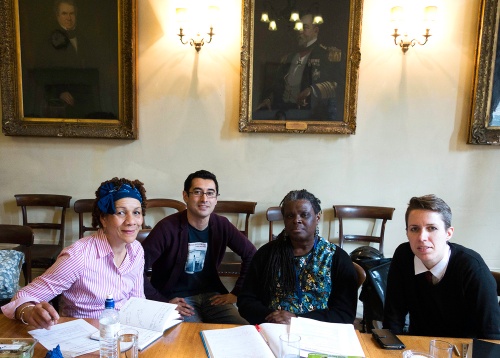
rgsibg_race01
Left to right: Margaret Byron (Acting Chair), Richard Baxter (Acting Secretary), Patricia Noxolo, Angela Last (Acting Treasurer)

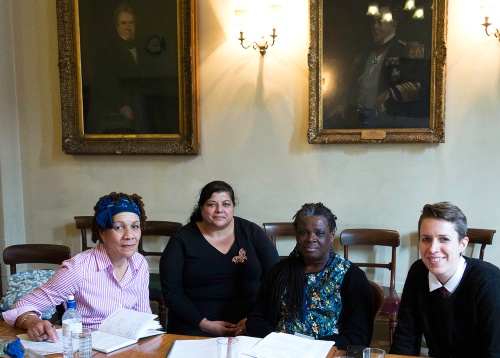
rgsibg_race02
Left to right: Margaret Byron, Divya Tolia-Kelly, Patricia Noxolo, Angela Last

We are currently recruiting staff and student members for a new RGS-IBG working groupon race, culture and equality. The group welcomes people who want to work around issues of race, diversity and equality in the academy, and in geography as a discipline, and for people who work on race as a subject.

Key objectives include networking and sharing resources on issues such as diversifying the curriculum, improving mentoring and supporting BME people in universities (students, early career and established academics), and developing closer links and working with secondary and wider education.

Current members include Richard Baxter, Wendy Larner, Tariq Jazeel, Patricia Noxolo, Caroline Bressey, Kathryn Yusoff, Parvati Raghuram, Divya Tolia-Kelly, Margaret Byron, Kye Askins, Angela Last.

In order to join the group, you do not have to be a fellow of the Royal Geographical Society/Institute of British Geographers, and you can also belong to other research or working groups. However, to become established as a working group, we will need 20 RGS-IBG Fellows to undersign our proposal. We understand that many people who are involved in research or activism on race matters are also often not fellows, partly because of the society’s colonial connections, partly because of the cost involved in joining the scheme. We currently have a lot of support from the RGS-IBG to address these issues. If you are interested in joining the group, or have queries regarding the group or fellowship, please contact Richard Baxter (r.baxter@qmul.ac.uk).

Videos to introduce lectures on geographies of popular culture

I give seven lectures on geographies of popular culture at the end of a 28-lecture torrent of social and cultural geography that is our first-year, first-term module “Geographies of Place, Identity & Culture‘.

We are asked to commence the actual lecture five minutes after the beginning of the session and end five minutes before, thus giving us 50 minutes of time to engage the students.

I have found that it can be rather awkward setting up and just waiting and watching the students pile in, while many of them sort of stare at you… so, I’m going to give them something else to look at!

I did this for one lecture last year and have now found a video for the first five minutes (-ish) of all seven. Here they are:

Introduction to Geographies of Popular Culture, begins with:

Lecture 2, geographies of music, begins with:

Lecture 3, geographies of life online, begins with:

Lecture 4, geographies of books & reading, begins with:

Lecture 5, geographies of cinema and TV, begins with:

Lecture 6, spaces of games and play, begins with:

Lecture 7, geographies of consumption, begins with:

‘Escaping the Anthropocene’, Stiegler on the Anthropocene

Following on from the various discussions and reflections on geography’s disciplinary mobilisation of the idea/concept of ‘the anthropocene’ I thought I’d just link to a bunch of things Bernard Stiegler has written about/in response to the concept.

I cannot pretend to be totally on top of this work. Likewise, I am not totally sure I can buy into the argument Stiegler presents in these works but it is relatively interesting nonetheless…

These are all translated and made available by the inimitable Daniel Ross:

“The Anthropocene and Neganthropology“, lecture by Bernard Stiegler at Canterbury, 2014.

“Escaping the Anthropocene“, lecture by Bernard Stiegler at the University of Durham, January 2015.

“Automatic Society 1: The Future of Work – Introduction“, the Introduction to Stiegler’s latest(?) book Automatic Society 1: The Future of Work (another series apparently!). This has been published in the new journal La Deleuziana.