CFP> Mapping (from) the minor of big data?

Here’s an interesting call for papers for the Association of American Geographers conference next year (2016), posted to Crit-Geog by Wen Lin…

Call for Papers:

Mapping (from) the minor of big data?
AAG Annual Meeting, San Francisco
29 March to 2 April 2015

http://www.aag.org/cs/annualmeeting

Organizers:
Wen Lin, Newcastle University
Matthew W. Wilson, University of Kentucky

“The minor is not a theory of the margins, but a different way of working with material. “¦ It is about the conscious use of displacement.” (Katz 1996, 489)

“Clearly, the technology has the potential to disenfranchise the weak and not so powerful through the selective participation of groups and individuals.” (Harris and Weiner 1998, 69)

Recent years have seen the explosive growth of geospatial data produced and shared by vast, diverse users, facilitated by an array of information and communication technologies and mobile devices. There is a burgeoning body of work attempting to theorize and investigate these processes and practices, with notions including neogeography (Turner 2006), volunteered geographic information (VGI) (Goodchild 2007), maps 2.0 (Crampton 2009), vernacular mapping (Gerlach 2014), alt.gis (Schuurman 2015), and a form of geographic big data (Mooney 2015). Significant efforts have been made to examine a range of issues derived from such phenomena regarding ways of mapping, data quality, and associated socio-political implications concerning power, equity and knowledge. Attention has been given to the empowering and emancipatory potential of new ways of mapping and storytelling, while questions have also been raised about possible implications of surveillance, population control, and unevenness of knowledge production.

Yet, there remains much to be known about those mapping efforts that are seemingly on and in the margins of ‘big data’, from those less active contributors, or by actors in relatively marginalized positions. Such efforts may constitute counter-hegemonic knowledge production (Harris and Weiner 1998, see also Elwood 2015) or may be alternatively understood as a kind of minor data (to draw upon ‘minor theory’ in Katz 1996).

This session intends to contribute to these vibrant discussions by engaging with documenting efforts of mappings and data construction that might be of a much smaller quantity in the wake of big data. We welcome papers addressing theoretical, methodological, and empirical investigations of these mapping efforts situated in a variety of contexts. Questions may include, but are not limited to:

  • How might we engage with mapping the minor in the context of big data?
  • In what ways are data generated, represented, or curated by those who might be from a more marginalized position in these mapping efforts?
  • In what ways are geospatial technologies used, reconfigured, or contested in these mapping efforts?
  • In what ways is knowledge (re)produced in these mappings?
  • What are the challenges of tracing and documenting mapping efforts from the margins?
  • What might be the broader implications of these accounts?

If you are interested in participating in this session, please send an abstract of no more than 250 words to Wen Lin (wen.lin[at]ncl.ac.uk) and Matthew W. Wilson (matthew.w.wilson[at]uky.edu) by Friday, 2 October. Please note that we are attempting to bring alternative perspectives and positions to this discussion, in alignment with this recent manifesto on the gender and racial composition of AAG panels (http://www.knowledgepolitics.org/2015/09/07/the-unbearable-white-maleness-of-aag/).

References:

Crampton, J. 2009. Cartography: performative, participatory, political. Progress in Human Geography, 33(6): 840-848.

Elwood, S. 2015. Still Deconstructing the Map: Microfinance Mapping and the Visual Politics of Intimate Abstraction. Cartographica, 50(1): 45-49

Gerlach, J. 2014. Lines, contours, legends: coordinates for vernacular mapping. Progress in Human Geography, 38(1): 22-39.

Goodchild, M. 2007. Citizens as sensors: the world of volunteered geography. GeoJournal, 69: 211-221.

Harris T., Weiner D. 1998. Empowerment, marginalization, and “community-integrated” GIS. Cartography and Geographic Information Systems, 25(2): 67-76.

Katz, C. 1996. Towards minor theory. Environment & Planning D: Society & Space, 14: 487-499.

Mooney, P. 2015. An Outlook for OpenStreetMap.  In J. Jokar Arsanjani, A. Zipf, P. Mooney, M. Helbich (eds.) OpenStreetMap in GIScience: Experiences, Research, and Applications. Cham, Springer, pp. 319-314.

Schuurman, N. 2015. What is alt.gis? Introduction to the Special Issue. The Canadian Geographer, 59(1): 1-2.

Turner. A. 2006. An Introduction to Neogeography. O’Reilly Media, Sebastapol, CA.

Round-up of the Programmable Cities Data & the City Workshop by @mhaklay

A great couple of posts offering an overview of the Data & the City workshop over at NUIM just before the RGS-IBG conference last week, very much worth reading:

Data and the City workshop (day 1)

Data and the City workshop (day 2)

Plus, there are some videos of the first session over on the Programmable Cities website. Here’s Rob Kitchin offering an interesting and informative overview of histories and key issues for studying data in/and cities:

Reblog> New papers for carceral geographers

An interesting round-up of work in/on carceral geographies over on the blog/website of the same name:

New papers for carceral geographers

I’ve been lucky enough to be invited to review some terrific scholarship recently. Thought-provoking, incisive, troubling and reflective work which I’m excited to see in print. It’s fascinating to see the ways in which geographers are drawing on criminological work, and vice versa – much in the spirit of the conversation we had last week at the European Society of Criminology conference in Porto, Portugal, in which Yvonne Jewkes chaired a roundtable session to which I contributed alongside Marie Hutton, Jen Turner, Anna Schliehe and Andrew Wooff. We’d hoped to be joined by Ben Crewe and Thomas Ugelvik but unfortunately complex conference scheduling got in the way. In any case, there was lively discussion of the different approaches (methodological, theoretical, political – both with a large and a small ‘p’) taken by carceral geographers, criminologists, prison sociologists and ethnographers, and new connections were made.

So in the spirit of that communication, (albeit without the Portuguese sunshine, back in overcast Birmingham), I wanted to share links to some recently published papers that I’ve really enjoyed reading.

Posing in Prison: Family Photographs, Emotional Labor, and Carceral Intimacy Nicole Fleetwood : Abstract : “Posing in Prison” examines vernacular photography and studio portraiture taken inside US prisons through an investigation of the production practices and the circulation of these images in and out of prisons. The photographs include images that document family visits to incarcerated relatives and portraits taken by incarcerated photographers in makeshift studios designed in prison. The article considers how such photographs function as practices of intimacy and belonging for those imprisoned and their loved ones.

This paper really struck a chord with me, as I’m involved in a research project about prison visitation right now (see job ad!) and grappling with what ‘intimacy’ means in this setting, and how it is expressed. Nicole Fleetwood’s paper also reminded me of Alyse Emdur’s Prison Landscapes collection of photographs of prison inmates representing themselves in front of visiting room backdrops. She writes: “Such backdrops, often painted by talented inmates, are used within the prisons as portrait studios. As inmates and their visitors pose for photos in front of these idealized landscapes they pretend, for a brief moment, that they are someplace else. The photographs are given to these visitors as gifts to take home and remember the faces of their loved ones while they are incarcerated. Prison Landscapes explores this little known and largely physically inaccessible genre of painting and portraiture seen only by inmates, visitors, and prison employees. Created specifically for escape and self-representation, the idealized paintings of tropical beaches, fantastical waterfalls, mountain vistas, and cityscapes invite sitters to perform fantasies of freedom.”

The Rise of a More Punitive State: On the Attenuation of Norwegian Penal Exceptionalism in an Era of Welfare State Transformation Victor L. Shammas : Abstract : While sociologists of punishment have been interested in the notion of Nordic penal exceptionalism, rapid changes are taking place in the penal policies of one of the members of the Nordic zone. Norway’s penal state is growing increasingly punitive, and penal exceptionalism appears to be on the wane, evidenced by a growing incarceration rate, increasingly punitive sentiments in the population, moral panics over street crime, raised sentencing levels, the forcible detention and extradition of asylum seekers, punitive drug policies, and the creation of segregated correctional facilities for stigmatized foreign offenders. Penal transformation should be understood as the outcome of symbolic contestation between politicians eager to present themselves as “tough on crime,” increasing differentiation of the social structure that has led to the declining fortunes of rehabilitationism, and a nascent neoliberalization of the welfare state. As a consequence, Europe’s penal landscape may be growing more homogeneous.

A cautionary tale for these troubled times.

Between a Rock and a Hard Place: Delaware Prison Reform and the Urban Landscape, 1961-1977 Yohuru Williams : Abstract : In the midst of several well publicized prison scandals, numerous lawsuits and a mass of studies revealing the squalid nature of U.S. prisons, in the early 1960s and 1970s Delaware was one of a handful of states experimenting with fresh alternatives to incarceration utilizing urban space. The leader of these reform efforts was Paul Keve, acting Delaware Commissioner of Corrections. Keve’s ambitious program was to be anchored in the state’s two largest cities, Wilmington and Dover, where he hoped to use the opportunities afforded by the urban landscape to facilitate and enhance his program of rehabilitation. Keve’s program, however, met with crushing opposition from Delaware’s two rural southern counties who controlled the state legislature. This essay examines the tumultuous history of the period by looking at the state as a microcosm of the nation and how heated discourse over prison reform intersected with the battle to control urban space and how issues of race and Delaware’s political geography ultimately defeated prison reform.

Having recently worked with Karen Morin to put together an edited collection on historical carceral geographies, I found this paper really fascinating, and it reminded me both of Jack Norton’s 2014 AAG paper and subsequent chapter in that collection, and also of Judah Schept’s piece which contrasted a local community’s critique of mass incarceration with its support for local carceral expansion.

A recent special issue of Kritika: Explorations in Russian and Eurasian History on “The Soviet Gulag: New Research and New Interpretations” is also worth a look. The Editors note that : “This special issue”¦ goes to press at a particular moment, at once promising and troubling. In the first instance, it comes at a time when scholarship on the Soviet camp system, which began to grow relatively slowly after the opening of the former Soviet archives, is now gaining a weight and synergy never before achieved”¦. The title of this special issue is intended to underscore how the new empirical work presented here, as well as the growing number of important recent works, goes hand in hand with a broader reconceptualization of the nature of the Gulag and its role in the Soviet system.”

Power in motion: Tracking time, space, and movement in the British Penal Estate – Luca Follis : Abstract: This paper tracks the impact of prison transfers (and mobility considerations more generally) on the spatio-temporal regimes pursued within the British Penal Estate. I argue that what appear from outside as static spaces of detention are in fact nodes within a network deeply crisscrossed by internal patterns of mobility and the problematics of time–space coordination. I explore the power relations that shape prisoner patterns of movement and highlight the distinctive states of deprivation they generate.

Having had a longstanding interest in the mobilities inherent in the apparent stasis of imprisonment, and working at present at one of the prisons mentioned, I found this an fascinating and enlightening read. Luca Follis describes “the institutional scaffolding that supports and drives the penal estate’s transportation system which is characterized by two countervailing approaches to prisoner transfers (a top-down, instrumental application of prisoner movement pursued alongside and against an embodied, progressive system of prisoner mobility)” (p3), which see the need to displace prisoners in order to accommodate new committals, or the arrival of other prisoners displaced by overcrowding elsewhere, disrupting the intended movements of prisoners through the carceral estate to undertake the programmes of training and rehabilitation to which they are entitled.

With these papers in hand, and Judah Schept’s new book out soon, I’m excited to welcome the new cohort of final year undergraduates taking carceral geography at Birmingham this academic year”¦

Reblog> CFP An Informational Right to the City? Rethinking the Production, Consumption, and Governance of Digital Geographic Information

Over on the OII blog for the ‘Connectivity, Inclusion and Inequality Group’, Jo Shaw has posted an interesting CFP for the AAG in San Francisco next year. Andy Merrifield will make an awesome discussant!

CfP at AAG 2016: An Informational Right to the City? Rethinking the Production, Consumption, and Governance of Digital Geographic Information

After presenting our paper on the same theme at ICCG 2015 in Palestine, myself and Mark Grahamare planning a session for the Association of American Geographers’ annual meeting in San Francisco during Spring 2016. The session aims to provide a space for discussion and research that seeks to ask what a ‘right to the city’ looks like in our increasingly digital world. Interested contributors should read the call for papers below and drop myself or Mark an email to express interest.


An Informational Right to the City? Rethinking the Production, Consumption, and Governance of Digital Geographic Information

Organisers: Joe Shaw and Mark Graham (University of Oxford)
Discussant: Andy Merrifield

Henri Lefebvre (2003:251) once talked of the right to information as a complement to the right to the city. Since then, information communication technologies have become integrally embedded into much of everyday life. The speed of these developments has also obfuscated many changes and processes that now envelop and define the urban experience. This includes changes in systems of abstract spatial representation through geographic information, and the economies surrounding this information as a commodity. The representations which are produced and mediated through this digital information are now contributing to an urban space that is densely digitally layered (Graham, M., M. Zook, and A. Boulton. 2013). These digital ‘abstract’ spaces are essential to the production and re-production of our socio-economic world (Lefebvre, 1991). From Wikipedia to Google Maps and TripAdvisor, the code and content that relates to a building is now potentially as important as its bricks and mortar. These processes raise new questions of spatial justice and the urbanization of information: Which spaces are seen, and which are hidden? How is information produced, for whom, and who consumes it? How does information change material places? Who are the powerful actors in these events, and who are powerless? And finally, is the broader concept of an ‘informational right to the city’ now required? If so, how should it be envisioned and put into practice? This session invites submissions concerned with the production, consumption, and governance of urban geographic information, and it encourages research and reflections that seek to rethink what informational rights we have in our hybrid material/digital cities.


Lefebvre, H. (1991). The production of space. (D. Nicholson-Smith & D. N.- Smith, Eds.). Oxford: Oxford : Blackwell.
Lefebvre, H. (2003). Henri Lefebvre: key writings. (S. Elden, E. Lebas, & E. Kofman, Eds.). New York: New York.
Graham, M., Zook, M., & Boulton, A. (2013). Augmented reality in urban places: contested content and the duplicity of code. Transactions of the Institute of British Geographers, 38(3), 464–479.

Please email abstracts of no more than 300 words to Mark Graham (mark.graham@oii.ox.ac.uk) or Joe Shaw (joe.shaw@oii.ox.ac.uk) by Friday 2nd October 2015. Successful submissions will be contacted by 9th October 2015 and will be expected to pay the registration fee and submit their abstracts online at the AAG website by October 29th 2015.

Reblog> CFP: Towards a geographical software studies

Nick Lally has posted this interesting call for papers for the AAG next year in San Francisco, an apposite location for such a discussion 🙂 I am sure that there are plenty of geographers who can and will offer some fascinating reflections on this. I hope you consider contributing…

Toward a geographical software studies

A series of sessions for the Annual Meeting of the Association of American Geographers in San Francisco, March 29-April 2, 2016

Ryan Burns (Temple University)
Nick Lally (University of Wisconsin–Madison)

A growing body of recent geographic scholarship has focused its attention on software and algorithms. Some of these studies analyze geographic technologies –GIS and the geoweb, for example– as such, while others investigate a myriad of digital technologies that have become ubiquitous within the spaces of everyday life. These software/code objects interact with and modulate the world in complex ways, enact processes that connect humans and nonhumans, and become entangled with social, cultural, political, and economic systems. Moreover, software created to visualize data is used to produce knowledge about urban environments and everyday life, but obscure the processes and contexts which underlie its development. Engaging these topics, geographers have developed concepts like the “automatic production of space” (Thrift and French 2002), “software-sorted geographies” (Graham 2005), and “code/space” (Kitchin and Dodge 2011) to describe how software and space are co-constituted in the contemporary world. Productive research is building on these topics to explore new ways geographies are produced (Rose, Degen, and Melhuish 2014), governed (Amoore 2011), materialized, represented (Woodward et al. 2015), and lived through software (Kinsley 2014).

This session seeks to bring together a range of spatial thinkers who are producing new studies, theories, and methods for understanding and producing software. We welcome submissions that address all facets of software: the context of its production, its internal operational logics, the material work it does in the world, and its spatial distribution of social and political effects. Suggested themes could include:

“¢ Radical, feminist, or postcolonial political theories of software, software production, and/or hacking. What are the liberatory potentials/limits of coding or software and its critiques?
“¢ The political economy of software, code, attentional economies, and the audience as commodity.
“¢ Methodological contributions for the study of software (deconstruction, ethnography, reading code, reverse-engineering, archival research, hacking, writing software, visual studies, understanding processes, online research, etc)
“¢ Software and visual and affective epistemology.
“¢ The materiality of software and the work it does in the world (the production of space, embodiment, urbanization, social sorting, securitization, infrastructure, etc).

Amoore, L. 2011. Data Derivatives: On the Emergence of a Security Risk Calculus for Our Times. Theory, Culture & Society 28 (6):24–43.

Graham, S. D. 2005. Software-sorted geographies. Progress in Human Geography 29 (5):562–580.

Kitchin, R., and M. Dodge. 2011. Code/space: software and everyday life. Cambridge, Mass: MIT Press.

Kinsley, S. 2014. The Matter of “Virtual” Geographies. Progress in Human Geography 38(3): 364-384.

Rose, G., M. Degen, and C. Melhuish. 2014. Networks, interfaces, and computer-generated images: learning from digital visualisations of urban redevelopment projects. Environment and Planning D: Society and Space 32 (3):386–403.

Thrift, N., and S. French. 2002. The automatic production of space. Transactions of the Institute of British Geographers 27 (3):309–335.

Woodward, K., J. P. Jones, L. Vigdor, S. A. Marston, H. Hawkins, and D. P. Dixon. 2015. One Sinister Hurricane: Simondon and Collaborative Visualization. Annals of the Association of American Geographers :1–16.

Please submit a 250 word abstract to Nick (nlally [AT] wisc [DOT] edu) and Ryan (ryan.burns [AT] temple [DOT] edu) by October 9th, 2015.

Bibliography on non-representational theory by @psimpy

Paul Simpson has created an annotated bibliography for those interested in non-representational theory, which is up on Oxford Bibliographies and is definitely worth checking out:

Non-representational Theory

Paul Simpson

Non-representational theory refers to a diverse body of work that emerged during the mid- to late 1990s in the United Kingdom as an alternative approach to the conception, practice, and production of geographic knowledge. Initially proposed by Nigel Thrift in a series of calls during that time, non-representational theory has sought to reorientate geographic analyses beyond a perceived overemphasis on representations (in a variety of forms), and a form of representationalism (whereby meaning is something formed in the mind and that acts as a precondition for action), toward an emphasis on practice, embodiment, materiality, and process. This call has been taken up by a range of geographers and has evolved in multiple, at times potentially conflicting, directions. This highlights a key feature of non-representational theory. It is not, in fact, a singular theory. Rather, non-representational theory marks a disposition based upon a range of styles of thinking that value practice and the processual. It is more easily understood in the plural–in terms of “non-representational theories.” Furthermore, the usefulness of the word non-representational has been questioned, both in critiques of this work and in responses to them. While this “non” suggests dispatching with concerns for representations in general, something many geographers have been troubled by, it is intended more to reflect a different approach to their consideration: a movement away from a focus on the interpretation of their meaning toward a consideration of what they “do” in the unfolding of the social world. The reception of non-representational theory in geography has been mixed. It is evident that a range of work has been inspired on the subject, particularly in terms of certain off-shoots, such as work on affect and materiality. It is clear also that non-representational theory has challenged geographers and encouraged reflection on the epistemological boundaries of the discipline. That said, it is clear also that it has led to the reassertion of certain core concerns for geography and critiques of non-representational theory’s potential devaluation of them. In light of such concerns and debates, non-representational theory has also come to be known by the alternative moniker of “more-than representational theory.” This title has sought to take a “softer” approach to the confrontational edge of the “non” and to suggest that the ideas proposed by non-representational theories can act as an animating supplement to existing approaches to geographic knowledge production.

Read the whole thing here.

Reblog> New paper: Anticipatory Logics of the Global Smart City Imaginary by @jimmerricks

Over on the programmable city website there’s news of a new paper by Jim Merricks White on the anticipatory logics of smart cities… I have previous here so it’ll be an interesting read!

New paper: Anticipatory Logics of the Global Smart City Imaginary

Jim White’s paper, ‘Anticipatory Logics of the Global Smart City Imaginary’, is available for download on the Social Science Research Network as Programmable City Working Paper 8.

Abstract

The smart city encompasses a broad range of technological innovations which might be applied to any city for a broad range of reasons. In this article, I make a distinction between local efforts to effect the urban landscape, and a global smart city imaginary which those efforts draw upon and help sustain. While attention has been given to the malleability of the smart city concept at this global scale, there remains little effort to interrogate the way that the future is used to sanction specific solutions. Through a critical engagement with smart city marketing materials, industry documents and consultancy reports, I explore how the future is recruited, rearranged and represented as a rationalisation for technological intervention in the present. This is done across three recurring crises: massive demographic shifts and subsequent resource pressure; global climate change; and the conflicting demands of fiscal austerity and the desire of many cities to attract foreign direct investment and highly-skilled workers. In revealing how crises are pre-empted, precautioned and prepared for, I argue that the smart city imaginary normalises a style and scale of response deemed appropriate under liberal capitalism.

Keywords: smart cities, the urban age, anticipation, risk

[pdf download]

How do geographers address technology? Some thoughts…

A while ago I was asked to provide an overview of how geographers look at technology, it came along at the same time that I was beginning to sketch out ideas for a new final year option module (imaginatively titled “Geographies of Technology”) that I’ll be delivering in the Spring term for our stage three students, so I bashed something out. This is a revised version of what I came up with and I’ve stuck a sort of ‘indicative reading’ list on the end that is by no means complete.

I just wanted to share this cos it interests me and it may be of some small help to someone else… I’m interested in what other people think and welcome feedback. Like I say, this is a bunch of notes not a detailed overview, so please do feel free to offer comments.

*

Geography, specifically, has addressed technology in a few different ways, but it may be useful to broadly think about geographies of technology as falling into these approaches:

1) Political economies of technology / economic geographies of innovation & technology:

You can go back to Marx of course here but in geography it can be suggested to range from Doreen Massey’s work in the on science parks and ‘high tech’, through the work of people like Michael Storper and Annalee Saxenian on regional/global economies of innovation, Matthew Zook’s work on the internet itself as an economic object (i.e. things like the DNS) and Mark Graham’s more recent work on IT and development. My colleagues David Harvey and Nicola Thomas have both worked on the geographies of regional creative industries and ‘creative clusters’, such as craft guilds. Ian Cook et al. has/have studied the commodity and logistics networks around the things we buy.  Likewise, there’s work by Andrew Leyshon on technology in the music industry, Nigel Thrift’s ‘knowing capitalism’ driven by ICTs, and Andrew Barry’s excellent book on the Baku–Tbilisi–Ceyhan oil pipeline (this relates to theme 4 on infrastructures too). From a more cultural geography angle, Ben Anderson and I have both written about nanotechnology and ubiquitous computing, respectively, in relation to the kinds of futures their development processes try to invoke and spatial imaginaries they produce.

2) The technologies of government/ government as technology

One might broadly argue that much of the work, inspired by Foucault, in geography around biopolitics and governmentality concerns the technologies of government and, indeed, the ways that government is a technology. Notable here is work on calculation by Stuart Elden, Andrew Barry’s book Political Machines, work on financialisation and insurance and risk by Michael Pryke and Shaun French, work on emergencies by Ben Anderson, and work on the use of biometrics and surveillance technologies in the policing of borders, of events and of everyday life by Louise Amoore, Francisco Klauser, Ruben Rose-Redwood and many others. There’s a lot of work on governmentality in particular that might be considered ‘technological’ in some way.

3) Technology as a mediation/producer of spatial experience:

Mostly cultural geography but also political, ranging from Stephen Graham’s excellent work on software and urban infrastructures, Rob Kitchin and Martin Dodge’s prolific writing partnership on Code/space, as well as Kitchin’s more recent work through the ‘programmable city‘ project, Paul Adams’ and Ken Hillis’ respective work on the visuality of digital media, Mike Batty’s proposition of ‘virtual geography’, through the work of Robyn Longhurst on mothering with Skype, and on to the critical GIS work by the likes of Matthew Wilson on location based services and Muki Haklay’s work on geographical technologies of citizen science. There’s work on the technologies of play by James Ash and Tara Woodyer. There’s work on architecture and buildings by number of people, including, of course, Loretta Lees as well as Jane Jacobs Donald McNeill and others. Gillian Rose has offered a fantastic overview of how to address the technologies of image capture and presentation as well as the technologies of visualisation and she has recently been thinking about the challenge of ‘digital objects’ to (‘new’) cultural geography.

4) Technology (as) infrastructures

Again, we can look at a range of urban and political geographies of infrastructures and, indeed, plenty of work that doesn’t call itself geography that nevertheless offers geographical readings of technology infrastructures/ infrastructures of technology. So, one can, of course look to a huge range of work in Transport Geographies here. Stephen Graham’s work on urban and communications, again, is important here. Followthethings.com can also be seen as a project inherently about infrastructures. The recently published Infrastructural Lives, edited by Graham and Colin McFarlane is an excellent resource. It’s worth noting the influential piece by Susan Lee Star and Karen Ruhleder has been widely cited in geography. There’s an awful lot!

5) Technology as prosthesis / technology as a form of relation:

Theoretical work in cultural geography predominates here. So, James Ash’s, heavily philosophical, work; John Murdoch’s work using ANT and some of the STS inflected work in geography like Nick Bingham, Gail Davies, and Steve Hinchliffe; and others. There’s quite a bit of work around post-humanism in geography that is relevant here too. One can look to a theme issue on post-humanism and work on post-phenomenology to explore more of this.

6) The technologies of geography

There has been quite a bit of work on the technologies of geography – how geographical knowledge(s) get produced, how we derive data, and what kinds of things it becomes possible to say about what geography is, have all been addressed, mostly through the lens of geographical information systems. Here the AAG centenary volume on Geography and Technology offers an overview of such work. Likewise, there’s plenty of critical discussion of GIS by the likes of Crampton, Elwood and Leszczynski amongst others out there too. There is some work that also addresses similar questions from different angles, such as how transcription plays a part in geographical ‘data’, as well as the use of video ethnography methods.

Very rough list of some reading

Adams, Paul C., 1997, “Cyberspace and virtual places” Geographical Review 87 (2), pp. 155-171.
Adams, Paul C., 2005 The Boundless Self: Communication in Physical and Virtual Spaces. Syracuse University Press, Syracuse, NY.
Adams, Paul C., 2011, “A taxonomy for communication geography” Progress in Human Geography 35 (1), pp. 37-57.
Anderson, Ben, 2007, “Hope for nanotechnology: anticipatory knowledge and the governance of affect” Area 39 (2), pp. 156-165.
Ash, James, 2009, “Emerging spatialities of the screen: video games and the reconfiguration of spatial awareness” Environment and Planning A 41 (9), pp. 2105-2124.
Ash, James, 2010, “Teleplastic technologies: charting practices of orientation and navigation in videogaming” Transactions of the Institute of British Geographers 35 (3), pp. 414-430.
Ash, James, 2012, “Attention, videogames and the retentional economies of affective amplification” Theory, Culture & Society 29 (6), pp. 3-26.
Ash, James, 2013, “Technologies of captivation: videogames and the attunement of affect” Body and Society 19 pp. 27-51.
Ash, James, 2013, “Rethinking Affective Atmospheres: technology, perturbation and space times of the non-human” Geoforum 49 pp. 20-28.
Ash, James, Gallacher, Lesley Annw, 2011, “Cultural Geography and Videogames” Geography Compass 5 (6), pp. 351-368.
Barry, Andrew, 2001 Political Machines: Governing a technological society. Athlone, London.
Barry, Andrew, 2006, “Technological Zones” European Journal of Social Theory 9 (2), pp. 239-253.
Batty, Michael, 1997, “Virtual geography” Futures 29 (4/5), pp. 337-352.
Bingham, Nick, 1996, “Object-ions: From technological determinism towards geographies of relations” Environment and Planning D: Society and Space 14 (6), pp. 635-657.
Bingham, Nick, 1999, “The governance of cyberspace: politics, technology and global restructuring by Brian D Loeder (ed)” Transactions of the Institute of British Geographers 24 (2), pp. 249-251.
Bingham, Nick, 2001, “Digital places: living with geographic information technologies” Ecumene 8 (2), pp. 227-229.
Bingham, Nick, 2008, “Slowing things down: Lessons from the GM controversy” Geoforum 39 (1), pp. 111-122.
Bingham, Nick, Valentine, Gill, Holloway, Sarah, 1999, “Where do you want to tomorrow? Connecting children and the Internet” Environment and Planning D: Society & Space 17 (6), pp. 655-672.
Bingham, Nick, Valentine, Gill, Holloway, Sarah, 2001, “Life around the screen: reframing young people’s use of the internet”. In: Watson, N., Cunningham-Burley, S. (Eds.) Reframing Bodies. Palgrave Macmillan, London, pp. 228-243.
Brunn, Stanley D., Cutter, Susan L., Harrington Jr., Susan L. (Eds.), 2004 Geography and Technology. Kluwer Academic Publishers, Dordrecht.
Crang, Michael, Crosbie, Tracie, Graham, Stephen, 2007, “Technology, time-space, and the remediation of neighbourhood life” Environment and Planning A 39 pp. 2405-2422.
Crang, Michael, Graham, Stephen, 2007, “Sentient Cities: Ambient intelligence and the politics of urban space” Information, Communication and Society 10 (6), pp. 789-817.
Davies, Gail, 2003, “A geography of monsters?” Geoforum 34 (4), pp. 409-412.
DeLyser, Dydia, Sheehan, Rebecca, Curtis, Andrew, 2004, “eBay and research in historical geography” Journal of Historical Geography 30 (4), pp. 764-782.
Dodge, Martin, 2001, “Cybergeography” environment and Planning B: Planning and Design 28 (1), pp. 1-2.
Dodge, Martin, Kitchin, Rob, 2005, “Code and the transduction of space” Annals of the Association of American Geographers 95 pp. 162-180.
Dodge, Martin, Kitchin, Rob, 2013, “Crowdsourced cartography” Environment and Planning A 45 (1), pp. 19-36.
Dodge, Martin, Kitchin, Rob, Zook, Matthew, 2009, “How does software make space? Exploring some geographical dimensions of pervasive computing and software studies” Environment and Planning A 41 (6), pp. 1283-1293.
Elwood, Sarah, Leszczynski, Agnieszka, 2013, “New spatial media, new knowledge politics” Transactions of the Institute of British Geographers 38 pp. 544-559.
Gabrys, Jennifer, 2011 Digital Rubbish: A natural history of electronics. University of Michigan Press, Ann Arbor, MI.
Graham, Mark, 2008, “Warped Geographies of Development: The Internet and Theories of Economic Development” Geography Compass 2 (3), pp. 771-789.
Graham, Stephen, 1998, “The end of geography or the explosion of place? Conceptualising space, place and information technology” Progress in Human Geography 22 (2), pp. 165-185.
Graham, Stephen, 2005, “Software-sorted geographies” Progress in Human Geography 29 (5), pp. 562-580.
Graham, Stephen, Marvin, Simon, 2001 Splintering Urbanism: Networked Infrastructures, Technological Mobilities
and the Urban Condition. Routledge, London.
Graham, Stephen, Thrift, Nigel, 2007, “Out of order – Understanding repair and maintenance” Theory Culture & Society 24 (3), pp. 1-25.
Hinchliffe, Steve, 1996, “Technology, power and space – the means and ends of geographies of technology” Environment and Planning D: Society and Space 14 (6), pp. 659-682.
Hinchliffe, Steve, Bingham, Nick, 2008, “Securing life: the emerging practices of biosecurity” Environment and Planning A 40 (7), pp. 1537-1551.
Kinsley, Samuel, 2010, “Representing ‘things to come’: feeling the visions of future technologies” Environment and Planning A 42 (11), pp. 2771-2790.
Kinsley, Samuel, 2014, “The matter of ‘virtual’ geographies” Progress in Human Geography 38 (3), pp. 364-384.
Kitchin, Rob, 2011, “The programmable city” environment and Planning B: Planning and Design 38 (6), pp. 945-951.
Kitchin, Rob, 2014, “The real-time city? Big data and smart urbanism” GeoJournal 79 pp. 1-14.
Kitchin, Rob, Dodge, Martin, 2011 Code/Space: Software and Everyday Life. MIT Press, Cambridge, MA.
Kneale, James, 1999, “The virtual realities of technology and fiction: Reading William Gibson’s cyberspace”. In: Crang, M., Crang, P., May, J. (Eds.) Virtual Geographies: Bodies, spaces, relations. Routledge, London, pp. 205-221.
Laurier, Eric, 1999, “Geographies of talk: ‘Max left a message for you'” Area 31 (1), pp. 36-45.
Longhurst, Robyn, 2009, “YouTube: a new space of birth” Feminist Review 93 pp. 46-63.
Longhurst, Robyn, 2013, “Using Skype to mother: bodies, emotions, visuality, and screens” Environment and Planning D: Society & Space 31 (4), pp. 664-679.
Madge, Clare, O’Connor, Henrietta, 2002, “On-line with e-mums: exploring the Internet as a medium for research” Area 34 (1), pp. 92-102.
Madge, Clare, O’Connor, Henrietta, 2004, “Online Methods in Geography Educational Research” Journal of Geography in Higher Education 28 (1), pp. 143-152.
Massey, Doreen, 1992 High-Tech Fantasies: Science Parks in Society, Science and Space. Routledge, London.
Mitchell, William J., 2003 Me++ The cyborg self and the networked city. MIT Press, Cambridge, MA.
Murakami Wood, David, 2008, “Towards Spatial Protocol: The topologies of the pervasive surveillance society”. In: Aurigi, A., De Cindio, F. (Eds.) Augmented Urban Spaces: Articulating the physical and electronic city. Ashgate, Aldershot, UK and Burlington, VT, pp. 93-106.
Murdoch, Jonathan, 1997, “Towards a geography of heterogenous associations” Progress in Human Geography 21 (3), pp. 321-337.
Murdoch, Jonathan, 1998, “The Spaces of Actor-Network Theory” Geoforum 29 (4), pp. 357-374.
Pickerill, Jennifer, 2007, “‘Autonomy online’: Indymedia and practices of alter-globalization” Environment and Planning A 39 pp. 2668-2684.
Rose, Gillian, 2015, “Rethinking the geographies of cultural ‘objects’ through digital technologies: Interface, network and friction” Progress in Human Geography In Press.
Rose-Redwood, Reuben, 2006, “Governmentality, geography, and the geo-coded world” Progress in Human Geography 30 (4), pp. 469-486.
Rose-Redwood, Reuben, 2012, “With numbers in place: security, territory and the production of calculable space” Annals of the Association of American Geographers 102 (2), pp. 295-319.
Saxenian, AnnaLee, 1994 Regional advantage: culture and competition in Silicon Valley and Route 128. Harvard University Press, Cambridge, MA.
Saxenian, AnnaLee, 2002, “Brain Circulation: How high-skill immigration makes everyone better off” The Brookings Review 20 (1), pp. 28-31.
Shields, Rob, 2003 The Virtual. Routledge, London.
Star, Susan Leigh, Ruhleder, Karen, 1996, “Steps towards an ecology of infrastructure: Design and access for large information spaces” Information Systems Research 7 (1), pp. 111-134.
Storper, Michael, Walker, Richard, 1989 The capitalist imperative: Territory, technology, and industrial growth. Wiley, London.
Thrift, Nigel, 2003, “Closer to the machine? Intelligent environments, new forms of possession and the rise of the supertoy” Cultural Geographies 10 (4), pp. 389-407.
Thrift, Nigel, 2004, “Remembering the technological unconscious by foregrounding knowledges of position” Environment and Planning D: Society and Space 22 (1), pp. 175-190.
Thrift, Nigel, 2004, “Electric animals – New models of everyday life?” Cultural Studies 18 (2-3), pp. 461-482.
Thrift, Nigel, 2005, “From born to made: technology, biology and space” Transactions of the Institute of British Geographers 30 (4), pp. 463-476.
Thrift, Nigel, 2006, “Re-inventing invention: new tendencies in capitalist commodification” Economy and Society 35 (2), pp. 279-306.
Valentine, Gill, Holloway, Sarah, 2002, “Cyberkids? Exploring children’s identities and social networks in on-line and off-line worlds” Annals of the Association of American Geographers 92 (2), pp. 302-319.
Wilson, Matthew, 2011, “Data matter(s): legitimacy, coding, and qualifications-of-life” Environment and Planning D: Society & Space 29 (5), pp. 857-872.
Wilson, Matthew, 2012, “Location-based services, conspicuous mobility and the location-aware future” Geoforum 43 (6), pp. 1266-1275.
Zook, Matthew, 2008 The geography of the internet industry: Venture capital, dot-coms, and local knowledge. John Wiley & Sons, New York.
Zook, Matthew, Dodge, Martin, Aoyama, Yuko, Townsend, Anthony, 2004, “New Digital Geographies: Information, Communication, and Place”. In: Brunn, S. D., Cutter, S. L., Harrington Jr., S. L. (Eds.) Geography and Technology. Kluwer, Dordrecht, NL, pp. 155-178.

Some thoughts about how ‘algorithms’ are talked about & what it might mean to study them

A while ago, in a grump, I tweeted something along the lines of “I’m fairly convinced that most social scientists who write about algorithms do not understand what that term means”… Provocative I know, but I was, like I said, in a grump. Rob Kitchin tweeted me back saying that he looked forward to the blogpost – well here it is – finally.

I’m afraid its not going to be a well-structured and in-depth analysis of what one may or may not mean by the word algorithm because, well, other people have already done that. What I want to offer here is an expression of the anxiety that lay behind my grumpy tweet and means of mitigating that. So, this is a post that uses other people’s work to address:

  • what is an algorithm?
  • how/should we analyse/study them?

To be totally open from the start, my principle sources here are:

So, what do we mean when we use the word ‘algorithm’?

To begin with a straight-forward answer from Paul Ford:

“Algorithm” is a word writers invoke to sound smart about technology. Journalists tend to talk about “Facebook’s algorithm” or a “Google algorithm,” which is usually inaccurate. They mean “software.”

Algorithms don’t require computers any more than geometry does. An algorithm solves a problem, and a great algorithm gets a name. Dijkstra’s algorithm, after the famed computer scientist Edsger Dijkstra, finds the shortest path in a graph. By the way, “graph” here doesn’t mean  but rather 

Or, as Rob Kitchin notes in his working paper it is (following Kowalski) “logic+control“, such that (citing Miyazaki) the term denotes a form of:

specific step-by-step method of performing written elementary arithmetic… [and] came to describe any method of systematic or automatic calculation.

This answers a simple definitional question: “what is an algorithm?” but doesn’t quite answer the question I’ve posed: “what do we mean when we use the word algorithm?”, which Ford gestures towards when suggesting journos (and one might include a lot of academics here) use the word ‘algorithm’ when they mean ‘software’. As Gillespie notes

there is a sense that the technical communities, the social scientists, and the broader public are using the word in different ways

There isn’t a single/singular meaning of the word then (of course!) and after decades of post-structuralism that really shouldn’t be a surprise… nevertheless there is a kind of discursive politics being performed when we (geographers, social scientists etc etc) invoke the term and idea of an ‘algorithm’, and we perhaps need to reflect upon that a little more than we do. I may be wrong, perhaps we just need to let the signifier/signified relation flex and evolve – my main motivation for addressing this question is that I think we do already have useful words that address what is being suggested in the use of the word ‘algorithm’ – amongst these words are: code, function (as in software function), policy, programme, protocol (e.g. Ã  la Alexander Galloway), rule and software.

What is salient about the technical definition of an algorithm to how we might use the word more broadly is the sense of a (logical) model of inferred relations between things formally defined in code that is developed through iteration towards a particular end. As Gillespie notes:

Engineers choose between them based on values such as how quickly they return the result, the load they impose on the system’s available memory, perhaps their computational elegance. The embedded values that make a sociological difference are probably more about the problem being solved, the way it has been modeled, the goal chosen, and the way that goal has been operationalised.

What quickly takes us away from simply thinking about a function defined in code is that the programmes or scripts upon which the algorithms are founded need to be validated in some way – to test their effectiveness, and this involves using test data (another word that has become fashionable). The selection of the data also necessarily has embedded assumptions, values and workarounds which, as Gillespie goes on to suggest: “may also be of much more importance to our sociological concerns than the algorithm learning from it.” The code that represents the algorithm is instantiated either within a software programme – a collection of instructions, operations, functions etc. etc. – that is bundled together as what we used to call an ‘application’ or it might exist in a ‘script’ of code that gets pulled into use as and when – for example: in the context of a website. As Gillespie argues:

these exhaustively trained and finely tuned algorithms are instantiated inside of what we might call an application, which actually performs the functions we’re concerned with. For algorithm designers, the algorithm is the conceptual sequence of steps, which should be expressible in any computer language, or in human or logical language. They are instantiated in code, running on servers somewhere, attended to by other helper applications (Geiger 2014), triggered when a query comes in or an image is scanned. I find it easiest the think about the difference between the “book” in your hand and the “story” within it. These applications embody values as well, outside of their reliance on a particular algorithm.

This is often missed when algorithms are invoked, all-too-quickly, in the discussion of contemporary phenomena that involve the use of computing in some way. Like Kitchin says in his working paper:

As a consequence, how algorithms are most often understood is very narrowly framed and lacking in critical reflection.

Indeed, I’d go further, there’s a weird sense in which some discussions of ‘algorithms’ connote the dystopian sci-fi of The Matrix, or The Terminator. Ian Bogost has gone so far as to suggest that this is a form of ‘worship’ of the idea of an ‘algorithm’, suggesting

algorithms hold a special station in the new technological temple because computers have become our favorite idols.


And as Gillespie noted in an earlier piece:

there is an important tension emerging between what we expect these algorithms to be, and what they in fact are

Yet, as with production of religious texts, there are people making decisions every step of the way in the production of software. On top of that, there were decisions made by people in all of the steps of the development and production of the other technologies and infrastructures upon which that software rely.

What we mean when we use the word ‘algorithm’ is, as Gillespie argues (much better than I), a synecdoche: “when we settle uncritically on this shiny, alluring term, we risk reifying the processes that constitute it. All the classic problems we face when trying to unpack a technology, the term packs for us”.

Calling the complex sociotechnical assemblage an “algorithm” avoids the need for the kind of expertise that could parse and understand the different elements; a reporter may not need to know the relationship between model, training data, thresholds, and application in order to call into question the impact of that “algorithm” in a specific instance. It also acknowledges that, when designed well, an algorithm is meant to function seamlessly as a tool; perhaps it can, in practice, be understood as a singular entity. Even algorithm designers, in their own discourse, shift between the more precise meaning, and using the term more broadly in this way.

How should we study algorithms?

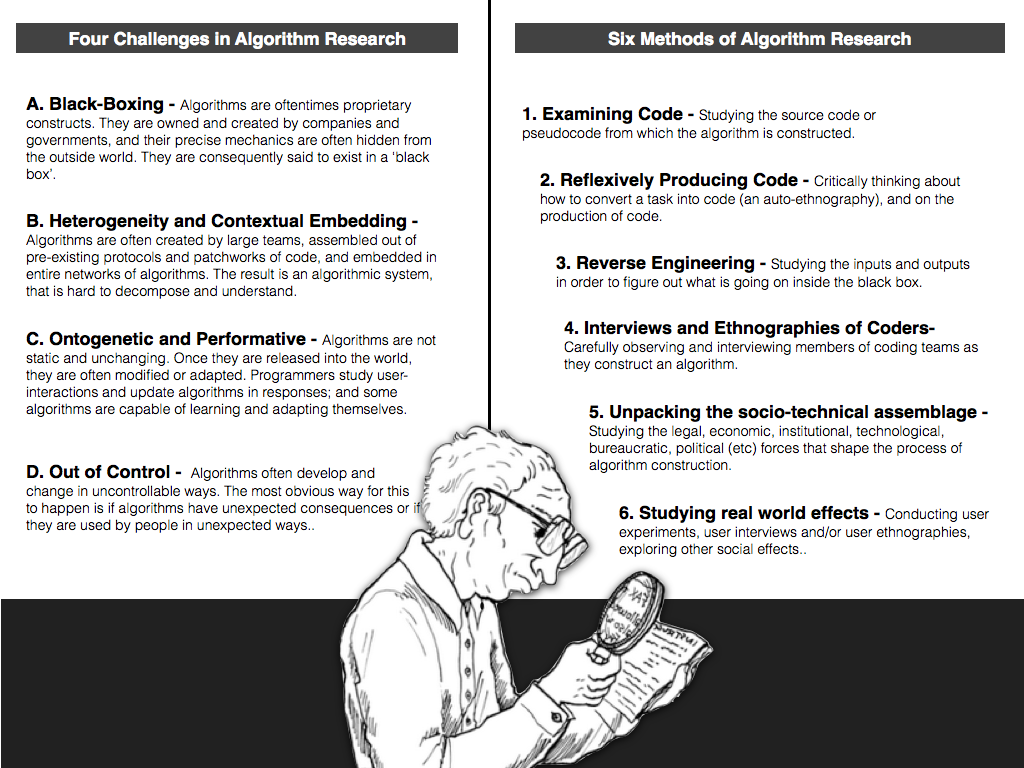
Here, I’m not totally sure I can add much to what Kitchin has written in his working paper. This has been adroitly summarised by John Danaher on his blog, and he produced this brilliant graphic:

The challenges and methods for studying algorithms


We need to be alive to the challenge that most software we may be interested in is proprietary, although not always and we can look to repositories like GitHub for plenty of open source code, and so it may actually prove impossible to gain access to the code itself –– and here we’d really want the code of the whole programme, and perhaps the training data too. Likewise, software like any complex endeavour may well be the result of collective authorship and maintained by lots of different people. So there are complex sets of relations between people, laws, protocols, standards and many other considerations to negotiate – they are contextually embedded. Furthermore, the programmes we’re calling algorithms here actually have a hand in producing the world within which they exist –– they may bring new kinds of entities and relationships into existence, they may formulate new and different forms of spatial relation and understanding. In this sense they are ontogenetic and performative. Added to this, once ‘in the wild’ this performativity can render the kinds of outcomes of a programme unexpected and peculiar, especially once it is fed all sorts of data, adapted and adopted in unexpected ways.

How can we go about studying these kinds of socio-technical systems then? Well, rather than treat as discrete the six techniques offered by Kitchin (summarised above) – I’d argue we need to combine most of these. Even so, it may prove extremely difficult to actually gain access to code. Further, even if one might reflexively produce code and/or attempt to reverse engineer software –– some systems are the product of companies with such extensive resources that it may well prove near-impossible to do so. Where social scientists might find more traction and actually be able to make a more valuable contribution is, as Kitchin suggests, looking t the full sociotechnical assemblage. We can look at the wider institutional, legal and political apparatuses (the dispositifs) and we can certainly look at the various kinds of relation the assemblages make and how they are enrolled in performing the world they inhabit.

Make no mistake – this kinds of research is necessarily hard. I’m not sure I can imagine papers in geography journals that tie the a/b testing logs of experiments in how a given system works and commit logs to version control systems (even if you could access them!) to particular forms of experience and/or their political consequences… but it might be worth a go. Perhaps this difficulty is why we see (and I am as guilty as any of this) papers written in abstract terms, focusing on the (social) theoretical ways we can talk about these sociotechnical systems in broad terms.

Like Bogost, I can see a kind of pseudo-theological romancing of the ‘algorithm’ and the agency of software in much of what is written about it, and its sort of easy to see why – it is so abundant and yet relatively hidden. We see effects but do not see the systems that produce them:

Algorithms aren’t gods. We need not believe that they rule the world in order to admit that they influence it, sometimes profoundly. Let’s bring algorithms down to earth again.

The algorithm as synecdoche is a kind of ‘talisman’, as Gillespie argues, that reveals something of what Stiegler calls our ‘originary technicity’ – the sense in which we (humans) have always already been bound up in technology and its the forgetting and then remembering of this that forges our ongoing reconstitution (transindividuation) of ourselves.

So, I’d like to end with Kitchin’s argument:

it is clear that much more critical thinking and empirical research needs to be conducted with respect to algorithms [and the software and sociotechnical systems in which they are necessarily embedded] and their work.

Addendum:

It is worth noting that both Gillespie and Kitchin draw on another paper that is very much worth reading by Nick Seaver, who reminded me of this on Twitter, take a look:

“Knowing Algorithms“, presented at Media in Transition 8, Cambridge, MA, April 2013 [revised 2014].

For these companies you, walking down the street, are a data point

I’ve been collecting the promotional videos of various companies that surveil ‘public’ spaces to garner information that, using the logics applied to web analytics, they see as valuable commercial intelligence.

The rationale that is common throughout is that the aggregate crowd on the street, in a shopping centre, or in any form of apparently ‘public’ space are fair game for surveillance measurement and in turn address (albeit by their commercial partners – retailers etc. etc.). In fact, this is merely a technical or perhaps social problem – not a political one. It’s a technical problem for them because as the chap from Placemeter says “it’s all data” and its ‘waiting’ to be harvested. It’s a social problem for them only insofar as it’s about improving ‘services’ for us as consumers (not as citizens, as families or any other part of our skein of identity). It is NOT a political problem for them – it’s not an issue of who has the right to the city, who has a right to privacy or what might constitute reasonable expectations of any of those things. It certainly is never couched in terms of there needing to be governance of these activities – at least in these kinds of videos.

So, the videos are interesting artefacts of the formulation of what pervasive media/ubiquitous computing and smart cities look like and how they are performed…

A reasonable article about Placemeter is in/on the Guardian Cities section.