Over on Savage MindsRex Golub has written a compelling provocation about the places of ‘public anthropology’ (which I think could probably be broadened to ‘public scholarship). He points out that it’s all very well writing letters to venerable broad sheet newspapers but that doesn’t necessarily achieve much. Instead, Professors (or academics more broadly) might better spend their time editing wikipedia pages because that is the prime site of the public sourcing, and contestation, of knowledge. I think its quite a compelling argument… not least when thinking about the current trend and push for demonstrating “impact”. Isn’t it quite “impactful” to be the person who attempts to ensure that the most widely used source of knowledge on a given topic is rigorously written/edited? There’s no academic brownie points in that though… no promotions or awards/rewards are going to be given on that basis!
What do you think?
…my issue is that anthropologists are doing public anthropology in the wrong places and in the wrong way because they don’t understand how social media works today and are seduced by an out-moded model of cultural capital that makes them feels heroic, but it isn’t actually efficacious.
The new public anthropology, on the other hand, is not glamorous, will not make you famous, can be emotionally uncomfortable, involves working in new and unfamiliar genres, and can change the world. A good example of this sort of public anthropology is editing Wikipedia
Wikipedia is ground zero for knowledge in the world today. Everyone uses it to look stuff up quickly. Everyone. Some people may take it more seriously than others, but because its content can be reused on other sites, what wikipedia says spreads everywhere. For better or for worse – I’d say for better – it’s the public record of the state of human knowledge at the moment. Unlike letters to the New York Times, Wikipedia gets read. Constantly. When you contribute to Wikipedia, you are concretely and immediately altering what the world knows about your topic of expertise.
Containers is an 8-part audio documentary about how global trade has transformed the economy and ourselves. Host and correspondent Alexis Madrigal leads you through the world of ships and sailors, technology and tugboats, warehouses and cranes. At a time when Donald Trump is threatening to toss out the global economic order, Containers provides an illuminating, deep, and weird look at how capitalism actually works now.
Workshop ‘Security and the Political Turn in the Philosophy of Technologies’, University of Twente | DesignLab, March 10 2017. How to understand the political significance of things? And how to deal with the politics of technology in a responsible way? Ever since Langdon Winner claimed in the early 1980s that “artifacts have politics”, these questions have been puzzling philosophers and ethicists of technology. Technologies are not just instruments for humans to do politics but actively shape politics themselves. In this workshop we will explore various dimensions of this political role of technologies, especially with regards to security, citizenship in a technological world, and the role of social media and ‘fake news’ in contemporary democracy.
Speakers include:
Babette Babich (Fordham)
Robin James (UNCC),
Laura Fichtner (TUD)
Wolter Pieters (TUD)
Melis Bas (UT)
Jonne Hoek (UT)
Philip Brey (UT)
Nolen Gertz (UT)
Michael Nagenborg (UT)
Peter-Paul Verbeek (UT)
The workshop is sponsored by the 4TU.Ethics working group on “Risk, Safety, and Security.”
“It just gets harder and harder and harder,” reflected one money manager this week. His is the predicament of other professionals – anything done by a person that follows a pattern and can be coded into a form that a computer understands will soon get squeezed. Technology also has the advantage identified in 1970: algorithms stay constantly alert.
It does not imply the complete death – or automation – of the investment manager. A professional can still undertake original research on a company or a security that provides insight. As more of the market becomes automated, originality becomes rarer and more valuable: an idiosyncratic investor should achieve higher returns by standing out from the robotic crowd.
Nor can algorithmic efficiency be wholly divorced from human intelligence, as the Oregon study showed – the point was that humans needed to set parameters for computers to follow. Many asset managers use analysts and researchers to build investment models that then trade securities automatically; others blend their active risk-taking with passive elements.
…
But these difficulties demonstrate how automation eats into professions, not by taking away all the jobs in one day but by unbundling them – dividing them between tasks that only humans can perform and those of which an algorithm is quite capable. Then the boundary relentlessly shifts.
The last paragraph is key – there seems to be a growing consensus that automation doesn’t simply ‘destroy’ jobs, it makes particular aspects of or kinds of role redundant and the implementation and development of automated systems requires the remaining workers to fit around those systems in different ways. In many ways, then, automation is a company or institution-specifc organisational or administrative problem as well as a wider political economic problem.
From a Conversation piece on Huxley, dystopia and how we might think about Facebook etc. in relation to Huxley’s “College of Emotional Engineering”, this concise evocation of his understanding of ‘neuroculture’ is interesting:
The origins of neuroculture begin in early anatomical drawings and subsequent neuron doctrine in the late 1800s. This was the first time that the brain was understood as a discontinuous network of cells connected by what became known as synaptic gaps. Initially, scientists assumed these gaps were connected by electrical charges, but later revealed the existence of neurochemical transmissions. Brain researchers went on to discover more about brain functionality and subsequently started to intervene in underlying chemical processes.
Interpretation of Cajal’s anatomy of a Purkinje neuron, by Dorota Piekorz.
On one hand, these chemical interventions point to possible inroads to understanding some crucial issues, relating to mental health, for example. But on the other, they warn of the potential of a looming dystopian future. Not, as we may think, defined by the forceful invasive probing of the brain in Room 101, but via much more subtle intermediations.
Interesting from Gary Hall… lots to think through politically here, as with blockchain-like, more-or-less libertarian, strategies for a new “new economy” (as per the Post-Fordists)… and possibly relevant to the recent interest in “digital” labour in geography…
part of a series of posts in which I provide ten proposals as to how to affirmatively disrupt ubercapitalism and the corporate sharing economy. Together these posts constitute the draft of a text provisionally titled Data Commonism, designed to follow on from my recently published short book, The Uberfication of the University. If the latter provides a dystopian sense of what is lying in store for many us over the course of the next few years, Data Commonism is more optimistic in that it shows what we can do about it.
…
[We can disrupt the sharing economy by] byworking toward the kind of “universal micropayment system” Jaron Lanier envisages in Who Owns The Future: “If observation of you yields data that makes it easier for”¦ a political campaign to target voters with its message, then you ought to be owed money for the use of that valuable data.” In this system we would be paid for the data we generate if it turns out to be valuable. Our relationship with the platforms of the for-profit sharing economy would thus take the form of a “two-way” financial transaction in which we all “benefit, concretely, with real money,” rather than just a few San Francisco-based entrepreneurs and investors.
…
A universal micropayment system may result in some degree of financial redistribution. But while it provides a means of reuniting data with those users who produce it […] there is not really all that much we can do with our own small amounts of data. How much leverage would we have when it comes to negotiating a price for it, bearing in mind most of us will have to rely on these companies to determine for us the extent to which our data […] has actually contributed to a political campaign aimed at targeting voters, to stay with Lanier’s example?
…
for Clare Birchall, it is not at all “clear that data belongs to us in the first place in order for it then to be given or taken“–or monetized, in this case. Instead, “we are within a dynamic sharing assemblage: always already sharing data with human or non-human agents.” Birchall introduces the term “shareveillance” to describe the “condition of consuming shared data and producing data to be shared in ways that shape” what she refers to as an “an ascendant shareveillant subjectivity.” This is a “subject who is at once surveillant (veiller ‘to watch’ is from the Latin vigilare, from vigil, ‘watchful’) and surveilled. To phrase it with a slightly different emphasis: the subject of shareveillance is one who simultaneously works with data and on whom the data works.”
We would like to invite artists and researchers to submit proposals to join this event hosted by John Cabot University and Universita degli Studi RomaTre in Rome, and organized in collaboration with the Institute of Network Cultures, Amsterdam.
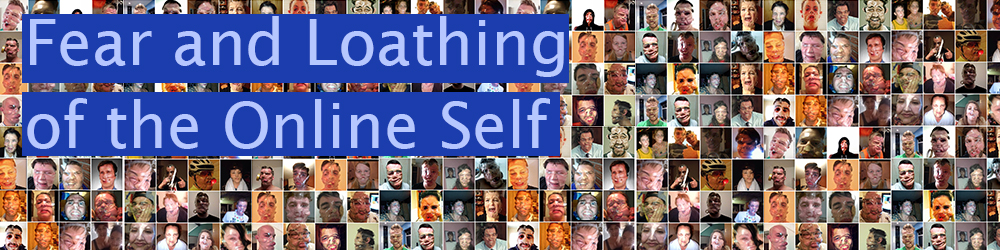
The conference aims at exploring the state of the online self by raising questions about its status as a focal point of contemporary power/networks. Is the online self merely a product of software predictability and viral marketing? Is there any space left for self-determination? Or should we search elsewhere for new forms resistance by changing our political categories and perspectives? Which contradictions are at play? How and where can we locate the spaces of performativity of the online self?
Critical political-economic readings of platform capitalism do not explain nor grasp new forms of (visual) online subjectivity. There is a growing gap between the obsessive quest for measurability, big data and algorithmic regimes (such as AI/bots),and critical investigations of an emerging variety of compulsive forms taken by the online self. We need to fill this gap and bring them back together. If a humanities approach of Internet studies nurtured by artistic and activist practices aims to survive the ‘big data’ onslaught from the social sciences, then it is vital to ask what the citizen-as-user wants. To portray the population as (innocent or guilty) victims of the data monopolies is, politically speaking, a dead-end street.
The cynical condition rules: we know we’re under surveillance, yet we continue to click, like, love and share ourselves online as usual. We are told by concerned experts and libertarians that our privacy “matters” and we want to believe it; yet it silently confers a guilty stigma upon another vital need, to engage socially and culturally with others. While some preach the offline escape as a way out, most of us are so deeply invested in the everyday social media life that it is inconceivable for most of us to leave Facebook and the like. And this not only out of desire but necessity: networking and self-sharing has become imperative for succesfully managing the double binds of the immaterial labour economy. Instead, we’d rather deal with peculiar pathologies, such as addiction, depression and solitude generated by hyper-connection and lack of connections.
Abstracts and proposals are welcome to contribute to the following sections:
1. ONLINE SUBJECTIVITY THEORY
How much free room do we have to design new identities? What aesthetic and philosophic paths and patterns does meme distribution hint at? What is the role of theory and criticism, if any, in the ever changing yet endless production of the latest user affordances, from dating sites, Tinder swipes and Snapchat lenses, to Pokemon-Go? Can we still attempt to design new modes of subjectivity, or has our role withdrawn to a mere Cassandra-like gloom and doom prediction of digital catastrophes, while start-ups (read: future monopolies) have all taken over the cool business of designing and shaping the online self?
2. BEHIND AND BEYOND SELFIES
It is easy to diagnose the selfie as a symptom of a growing narcissism of our daily digital obsessions. But how do we get beyond the predictable split between the politically correct assessment of empowerment (of young girls) against the nihilist reading of self-promotion and despair? Does criticism of today’s photography of the everyday life always have to end up giving medical prescriptions and recipes of wellbeing? What could a materialist reading of large databases and facial recognition techniques (including protection) that goes beyond media archaeology (the historical approach) and the ever-changing pop gestures involve and say? Can we still talk about the liberation of the self in the age of digital self-generation of the images?
3. ARTISTIC PRACTICES OF THE ONLINE SELF
Artists play an important role in the anticipation, and critique, of new modes of the self. What role does the artistic imagination play beyond the creative industries paradigm? How can artistic and creative avant garde practices help disrupt the trite quantitative approach and the dogma of the algorithm in defining modes and moods of the onlife self? What separates a (properly) artistic imagination and the aesthetic imagination of the online curators of selfie-constructed personas and are contemporary critical paradigms merely reproducing an understanding of online practices that are aligned with the requirements of corporation?
4. POLITICS AND AESTHETICS OF MASK DESIGN
Masks and selfies should not be seen as opposites as they both represent different modes (and moods) of being of the self. Masks create spaces of performance; they are playful and seductive (or scary) forms of self-representation that ultimately do not protect us against the computational repression of the security apparatus. What are the lessons learned from the Anonymous movement? We should come to a new social contract between the individuals, groups and the cybernetic machine. In the meanwhile, how can we make sure to protect us, and what premises are hidden in the numerous crypto-design projects that circulate?
Confirmed speakers: Wendy Chun, Ana Peraica, Jodi Dean, Marco Deseriis, Gabriella Coleman, Daniel de Zeeuw, Rebecca Stein, Vito Campanelli, Franco Berardi.
Editorial Team: Donatella Della Ratta (John Cabot University), Geert Lovink (Institute of Network Cultures/HvA), Teresa Numerico (Universita degli Studi RomaTre), Peter Sarram (John Cabot University).
Please send your proposal (max 500 words in word/pdf format), a short bio and any other material that could support your idea visually (artwork, film links, etc) to selfieconference@johncabot.edu. Deadline: March 1, 2017.
The Data Justice Lab will be officially launched on Friday, 17 March 2017. Join us for the launch event at Cardiff University’s School of Journalism, Media and Cultural Studies (JOMEC) at 4pm. Three international speakers will discuss the challenges of data justice.
Data Justice Lab – Launch Event – Friday 17 March 4pm – Cardiff University
Our financial transactions, communications, movements, relationships, and interactions with government and corporations all increasingly generate data that are used to profile and sort groups and individuals. These processes can affect both individuals as well as entire communities that may be denied services and access to opportunities, or wrongfully targeted and exploited. In short, they impact on our ability to participate in society. The emergence of this data paradigm therefore introduces a particular set of power dynamics requiring investigation and critique.
The Data Justice Lab is a new space for research and collaboration at Cardiff University that has been established to examine the relationship between datafication and social justice. With this launch event, we ask: What does social justice mean in age of datafication? How are data-driven processes impacting on certain communities? In what way does big data change our understanding of governance and politics? And what can we do about it?
We invite you to come and participate in this important discussion. We will be joined by the following keynote speakers:
Virginia Eubanks (New America), Malavika Jayaram (Digital Asia Hub), and Steven Renderos (Center for Media Justice).
Virginia Eubanks is the author of Digital Dead End: Fighting for Social Justice in the Information Age (MIT Press, 2011) and co-editor, with Alethia Jones, of Ain’t Gonna Let Nobody Turn Me Around: Forty Years of Movement Building with Barbara Smith (SUNY Press, 2014). She is also the cofounder of Our Knowledge, Our Power (OKOP), a grassroots economic justice and welfare rights organization. Professor Eubanks is currently working on her third book, Digital Poorhouse, for St. Martin’s Press. In it, she examines how new data-driven systems regulate and discipline the poor in the United States. She is a Fellow at New America, a Washington, D.C. think tank and the recipient of a three-year research grant from the Digital Trust Foundation (with Seeta Peña Gangadharan and Joseph Turow) to explore the meaning of digital privacy and data justice in marginalized communities.
Malavika Jayaram is the Executive Director of the Digital Asia Hub in Hong Kong. Previously she was a Fellow at the Berkman Klein Center for Internet & Society at Harvard University, where she focused on privacy, identity, biometrics and data ethics. She worked at law firms in India and the UK, and she was voted one of India’s leading lawyers. She is Adjunct Faculty at Northwestern University and a Fellow with the Centre for Internet & Society, India, and she is on the Advisory Board of the Electronic Privacy Information Center (EPIC).
Steven Renderos is Organizing Director at the Center for Media Justice. With over 10 years of organizing experience Steven has been involved in campaigns to lower the cost of prison phone calls, preserving the Open Internet, and expanding community owned radio stations. Steven previously served as Project Coordinator of the Minnesotano Media Empowerment Project, an initiative focused on improving the quality and quantity of media coverage and representation of Latinos in Minnesota. He currently serves on the boards of Organizing Apprenticeship Project and La Asamblea de Derechos Civiles. Steven (aka DJ Ren) also hosts a show called Radio Pocho at a community radio station and spins at venues in NYC.
Registration is now open for this event in the UK, co-organised by Gareth Millington (University of York) who is also an assistant editor of JUCS:
Archiving the City/ The City as Archive
Thursday 16 March 2017, University of York, UK 10.00am-6.00pm
Confirmed keynote speakers: Sharon Macdonald (Humboldt), Paul Jones (Liverpool), Rebecca Madgin (Glasgow) and Graeme Gilloch (Lancaster).
This event, hosted by the Centre for Modern Studies and supported by the Department of History and Department of Sociology at University of York, considers the cultural forms through which the modern city is archived. It critically examines the different ways–via institutions, public art, collective practice, and more–in which urban history and memory are organised and presented in contemporary culture. It also engages with how the spaces and architecture of the city may themselves present as an archive, offering up reminders of social and cultural processes, imaginaries, struggles and events.
The symposium engages with Henri Lefebvre’s (2014) argument that the reign of the city is ending; that the city now only exists as an image and an idea. In addition, the importance of heritage in gentrification processes and the museification of the historic urban core reveals, at least in part, the sense of loss through which that the modern metropolis is remembered. This connects more broadly with Derrida’s (1996) notion of ‘archive fever’, which, he understands, is part of a compulsive, repetitive culture; a ‘homesickness’ born of a ‘nostalgic desire to return to the origin’ (ibid: 167). Through keynote speakers and panels the symposium will explore perspectives that make links between contemporary archiving processes, city museums, visual culture, heritage urbanism, ‘authenticity’ and the cultural regeneration of historic urban spaces.