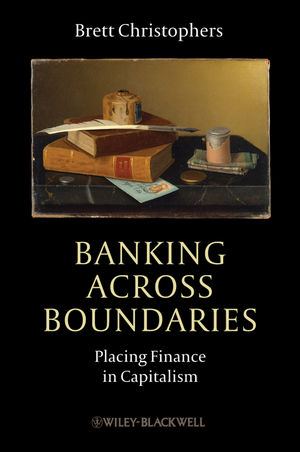
Brett Christophers – Banking Across Boundaries

Over on his blog Progressive Geographies, Stuart Elden highlights that Brett Christophers’ book Banking Across Boundaries has been published:
Banking across boundaries, book by Brett Christophers

Brett Christophers’s new book Banking Across Boundaries: Placing Finance in Capitalism has just been published. It’s part of the Antipode Book Series, and comes with glowing endorsements from David Harvey, Mary Poovey and Leonard Seabrooke.

There are excerpts available to read on the Wiley-Blackwell page for the book.

The Wager of Sublimation (translation), Petit on Stiegler

[Co-posted at technophilia]

In the book of interviews “The hypermaterial economy and psychopower” [Économie de l’hypermatériel et pyschopouvoir], Bernard Stiegler (with Philip Petit and Vincent Bontems) works through and explicates a range of the political-economic and socio-technical issues he feels are most pressing in the contemporary milieu. In the interviews Stiegler ties together his more ontological arguments concerning the co-constitution of the human/technology with his wide-ranging critique of political economy. At the heart of these arguments are the related issues of sublimation in a libidinal economy (the translation of libidinal energy into social objects) and the hypermaterial nature of our material supports (technology, taken in the broadest sense). Stiegler argues for a revitalisation of the economy by better translating our desires into more fulfilling outcomes, rather than submitting to mindless consumption. This is more an evolutionary rather than a revolutionary imperative, as can also be seen by the manifesto of the campaigning organisation Stiegler co-founded, Ars Industrialis.

At the beginning of the book, one of the interviewers in the book, the philosopher Philip Petit, has written an introduction to Stiegler’s project and to the areas of discussion covered in the three interviews. Petit’s short introductory essay, ‘the Wager of sublimation’ (Le Pari de la sublimation), is a useful, if playful, introduction to the life and work of Stiegler. I offer here a translation of Petit’s introductory essay: The Wager of Sublimation [PDF], I hope it is of interest and perhaps of use. I would like to particularly thank Patrick Crogan for his significant and invaluable help in honing the translation of this piece. Continue reading “The Wager of Sublimation (translation), Petit on Stiegler”

Bernard Stiegler: “We are entering an era of contributory work”

The website Rue89 have published an interesting and accessible interview with Bernard Stiegler on the theme of an economy of contribution. In the interview Stiegler offers some general observations and examples of how contributory work might function. I have made a quick translation of the interview, below, I hope it is of interest. As ever, please do offer comments, corrections etc.

Continue reading “Bernard Stiegler: “We are entering an era of contributory work””

Careful making – Stiegler’s Economy of Contribution

Following on from the fairly rapid translation I made of the Fondation Macif interview with Stiegler, a few emerging thoughts have been rattling around that I thought I’d post here. I want to think about the centrality of an ethos of care to Stiegler’s proposition of the economy of contribution and the kind of ethics this suggests for Stiegler’s philosophy. Continue reading “Careful making – Stiegler’s Economy of Contribution”

Stiegler – overconsumption and the economy of contribution

The French activist organisation Fondation Macif have recently published a short interview with Bernard Stiegler, in French, that I have translated below. In the interview Stiegler briefly restates his theory of proletarianisation in relation to (over)consumption and, in response, the creation of an economy of contribution.

My main interest in (quickly) translating this short piece is Stiegler’s ongoing development of the economy of contribution and the examples he uses to explain it. Stiegler regularly uses the example of open source code and software as a basis for the economy of contribution. Here, for example, the economy of contribution is further elucidated through 3D printing technology. We might think of these technologies as examples of the ‘hyper material‘ character of matter Stiegler suggests should form the basis of rethinking production.

I have followed the convention of including my additions/clarifications or original French in square brackets. I would also like to note that I am not entirely confident about the use of the verb ‘idealise’ here and would welcome comments [please refer to the original interview in French].

Interview: People consume more because they idealise less and less

Initiator and chairman of the philosophical group Ars Industrialis*, the philosopher Bernard Stiegler answers our questions concerning the logic of overconsumption and the emergence of a model that he describes here as the economy of contribution.

Q. Individuals consume more and more, not to meet their own needs, it seems, but for their desires. What has happened?

B.S. We must go back 100 years. The industrial capitalist system, to live, wrestles against the satisfaction of [achievable] needs and therefore must produce innovation [1]. This is the emergence of Fordism and what economist Joseph Schumpeter called ‘creative destruction’, that is to say, constant innovation. A recent example: in 1994, France Telecom completed an investigation to see if people need a mobile phone. The answer was overwhelmingly no. Today, 79% of the population are equipped with them. Why? Because we constructed a need. Edward Bernays, nephew of Sigmund Freud and one of the first thinkers of marketing, theorised this process in 1920. He knew that to push people to consume, you must capture their desires. And for this we need to create processes for identification. This coincides with the advent of cinema and television. On the screen, Humphrey Bogart who smokes lots of cigarettes and encourages tobacco consumption later gave his name to a verb ‘to Bogart’ – to chain smoke. Consumer capitalism is organised to artificially produce desires for things that people do not need – or that are even harmful to them.

Q. What are the implications of our tendency for overconsumption?

B.S. People consume more and more because they idealise [2] less and less. Desire is a social production, which transforms our drives [pulsions] for life, death, aggression, in a relation of idealisation, of sublimation. Where a drive consumes its object, a desire invests in taking care. Transforming drives through social investment is a long process of education that begins at birth. Today, industry consumes our attention and destroys that same capacity to desire by short-circuiting education. We are no longer able to invest in ourselves over time. We live impulsively in the immediacy of the present.

Q. You even say that consumption is an addiction.

B.S. I work with many psychiatrists, addictologists [addictologues], and we agree on this point: the consumption process has engendered an addictive society. A few years ago, a survey showed that 56% of French people did not like the TV they watched. This is exactly like what writer William S. Burroughs said: “I hate heroin, it destroys me but I cannot do without it.” People are totally dependent. A part of themselves totally rejects what other parts cannot do without. The problem is that people need to exist and they can no longer find a way to exist in this society. The relationship with consumer goods has become a vicious circle based on an intrinsically deceptive relation of ephemeral rewards which creates an existential vacuum.

Q. What is the risk of placing consumption at the heart of the project of society?

B.S. The system became insolvent and fell back upon addictions that destroy all of the forces of knowledge because consumerism is based on the functional opposition between production and consumption. We know nothing of what we consume, which we buy on credit and which once we have paid is fit for the bin. All of this in a context where social structures have virtually disintegrated, where the school has great difficulty in channeling the attention of young people, and where those who feel isolated and desocialised become the majority. When we created Ars Industrialis, we argued, eight years ago, that the crisis was inevitable: you cannot build a society on addiction.

Q. Which economic model can therefore replace the one we know?

B.S. This is the economy of contribution. Such an economy depends upon the investment and empowerment of the citizens. It breaks with Fordism, because it is based on “deprolaterisation” [déprolatérisation]. For Marx, the workers are proletarianised when their expertise [savoir-faire] is replaced by machines which they then [must] serve. In the 20th century, it is the consumers who are proletarianised: they lose their life skills [savoir-vivre]. Proletarianization is not financial impoverishment, but the loss of knowledge of how to live [savoir-vivre]. Consumers no longer produce modes of living for themselves, which are proscribed from them by brands. Amartya Sen, the Nobel Laureate, speaks of “incapacitation”. He has described this process in a comparative analysis between the life expectancy of people in Harlem and that which is paradoxically higher amongst the population of Bangladesh as the latter, which have not been subjected to consumerism, have preserved their social relationships and their capabilities [capacités], that is to say their knowledge [savoirs]. The economy of contribution is what consists in the reconstitution of such capabilities.

Q. Who are the pioneers of this economy of contribution?

B.S. The economy of contribution emerged thirty years ago. It has mostly developed thanks to the web and, industrially, with free software. In the domain of energy [production and consumption], the Smart Grid gives rise to a model of decentralised and re-localised energy production and contributes to the recovery of knowledge, accountability and public “recapacitation” – to return to Amartya Sen. It is the same with the Fab Lab (Fabrication Laboratory, Ed.) developed by MIT (the Massachusetts Institute of Technology). These local laboratories make invention accessible to all by providing digital fabrication tools, the best known being the 3D printer. More generally digital technologies encourage the development of new knowledge communities. These are new industrial models and [also] indications that we live in a transitional phase, where the challenge is, in France, for the present government, to design a critical path for our society – a path where we invent real growth based on the development of knowledge [savoirs], and which exceeds the consumerist model that has become fundamentally toxic and alienating.

* An international association for an industrial politics for technologies of mind/spirit [or, following Christian Fauré: an activist association that promotes an intervention in the development of contemporary digital technoculture].

Notes

1. The phrasing of “lutter contre la saturation des besoins et donc produire de l’innovation” here may point to the economic theory of the ‘law of diminishing marginal utility‘, in the sense that the more that a consumer object is (re)produced the less value is invested in any one of the individual objects – thus creating the demand for innovation. Following this logic then, the diminishing value upsets the settled balance of needs being statisfied by a given product or service thereby opening a space for the ‘new creation of wealth’. See Joseph Schumpeter’s theorisation of ‘Creative Destruction‘, to which Stiegler also alludes in the following sentence.

2. The use of ‘idealise’ here probably follows Stiegler’s reading of Freud, where idealisation can be understood as ‘healthy’ forms of narcissism – attributing exagerated positive qualities to the self or an other. This also relates to Steigler’s reading of Lyotard, insofar as the diminution of ‘idealisation’ highlighted here is perhaps analogous to a diminution of desire and a tendency to carelessness that undermines the libidinal economy. See: Stiegler’s For a New Critique of Political Economy and The Decadence of Industrial Democracies.

The Economy of Contribution

This post offers a translation of the entry for ‘the economy of contribution‘ given in the Glossary on the Ars Industrialis website. I am not a skilled translator but I trust that this work offers something useful to those with an interest in such things. The economy of contribution forms a central trope of Bernard Stiegler’s critique of political economy and represents one of the tenets of his activist work with the association Ars Industrialis.

An ‘economy of contribution’, according to the definition given below, is not a radical break with the system of capitalism-in the vein of the historical attempts to create communism-rather it is a system that works within and alongside the contemporary market economy. This resonates with some of the theorisations of peer-to-peer as a political economic system (see, for example, my interview with Michel Bauwens). The aim of an economy of contribution is thus to use and adapt new technical affordances to facilitate different, perhaps broader, means of creating and sharing value.

There is not a great deal of literature available in English by Stiegler, or Ars Industrialis, that develops the concept of the economy of contribution (but see: For a New Critique of Political Economy in particular) and from the literature available it seems, to me, that it is a concept in progress-it is in the process of development within the writings and activist activities of both Stiegler and Ars Industrialis. Thus, it is an interesting provocation to both those with an interest in the study and critique of political economy and, of course, those interested in Stiegler’s work.

What follows is the translated ‘Glossary’ entry. It contains clarifications of translations, or the original French, in square brackets. It also includes five endnotes, four of which come from the original entry, although [2] has been adapted to point to the English translation of The Decadence of Industrial Democracies. The first note [1] contains some of my notes concerning what might be meant by ‘disintrestedness’.

NB. (04/12/12) Translator of a significant amount of Stiegler’s work Daniel Ross has very kindly given me some feedback on the translation and I have corrected it accordingly. In particular, I incorrectly translated the second paragraph of the section headed The economy of contribution (function and calculation), where it is important to note, following Dan, that “Stiegler is correcting capitalism’s error of mistakenly founding itself on an alleged general equilibrium of private decisions”. Also, Dan suggests that désintéressement may refer more to ‘selflessness’ than ‘disinterestedness’ – I’ve left my note in, however, because I find it an interesting juxtaposition.

The Economy of Contribution

The economy of contribution is principally characterised by three traits:

  1. Economic actors are no longer separated as producers on one side and consumers on the other
  2. The value produced by contributors is not totally monetisable, it is a ‘positive externality’
  3. It is as much an economy of existence (as the production of ‘savoir vivre‘) as it is an economy of subsistence

The economy of contribution takes place, in the manner of a general economy, alongside the market, public and gift economies: Through regulation by prices, public decision making and by the principle of reciprocity, the economy of contribution replaces regulation by the interactions of participation (both quantitative and qualitative) within an activity. However, the economy of contribution does not exclude alternative means of production and exchange, but rather combines with them, accommodating the rules of monetary exchange, and is concerned with investment decisions, especially those which lead to the production of public goods. Gifting is one such possible modality of participation.

The contributor is neither the consumer, the taxpayer or the (co-)sponsor. Whereas the market economy is interested in the producer in terms of profit maximisation, and the consumer in terms of desirability [ophélimité] or as a function of utility; the public economy occupies itself with the functions of redistribution and bailing out market failures; and the gift economy is embedded in a circular relationship between gift-giving and gift-receiving (making-to-receive [donner-recevoir-rendre]); the economy of contribution raises the alternative figure of the contributor, who is characterised by participation in chosen activities, the creation of social value and an interest in selflessness [désintéressement 1].

The mobilisation of resources [in an economy of contribution] takes into account four main features:

  1. The production model, which must deal with finite natural resources and the cumulative nature of resources related to cognitive activity. This dimension leads to a redefinition of the system of production and the installation of this system in a psycho-techno-social milieu.
  2. The relationship between the function of contribution and the consolidation of solidarity, beyond the safety net of the welfare state. It is important here to link protection and creativity within a dynamic form of solidarity, requiring the ipso facto revision of the system of redistribution.
  3. The requirement to establish a new system of scale. This raises the question of measurement, and presupposes the development of a new basis of calculation and new accounting standards.
  4. The territorialisation function of contribution which implies a redefinition of the effects of agglomeration [centralisation?] and a reassessment of public policy.

The economy of contribution is situated in an general ecosystem of production and circulation of wealth that can be described through a ‘general organology'[2]. It is the source of collective creative practice and new measures of scale, at a time when digital technologies have intensified the exchange of information.

The economy of contribution (function and measurement)

The function of contribution is to the economy of contribution what the functions of production, embodied as supply and demand, as instruments, are for neoclassical [economic] theory: it shows how resources are allocated between different possible uses, between different activities, and between different participants. However the nature of contribution [as an economic function] guides us away from the economic fetishes [l’éconisme] of the self-fulfilling preference curves for consumers and supply curves for producers of mainstream economic theory.

For the same reasons, it [contribution] should not be confused with the process of adjustment of quantities and prices in different markets, and is therefore not reducible to the conditions of formation of a purported ‘general equilibrium’ [modeling prices for a whole economy] – before becoming a calculable model – of private decisions.

Conjugation within its market and nonmarket activities also makes [contribution] irreducible to a single conversion into a monetary equivalent that gives shape to the market as the cost of work with regard to production and desire with regard to consumption. On the contrary, the function of contribution introduces us to the construction of a general economy, where the mobilisation of resources and productive services is carried out according to objectives agreed in a deliberative manner, thus in terms of societal development. Contribution refers to both a microeconomic dimension, as a modality of the actions of participants in organizations, and a macroeconomic dimension, as a principle of political economy-oriented collective creation and societal value, and hence as a condition of terminating the economic cycle.

Microeconomic guidance of the function of contribution can facilitate an enriched form of economic analysis, highlighting the links with innovation, creating new activities and externalities.

The economy of contribution and the internet

The hyperconsumerist essence of the concept of the creative economy, supported by the work of John Howkins (which is closest to what has been called “cognitive capitalism”[3]), must be surpassed by societies and territories of contribution based on collaborative cultural technologies. If the Internet makes possible an apparently contributory economy – typified by free and open source software – it is because it is a technical environment in which the recipients are put in the position of senders: it is dialogical[4]. The Web (2.0 or 3.0) therefore contributes to an economy of contribution as it is:

    1. an infrastructure: systems for sharing and publishing knowledge online (such as: CMS, wikis);
    2. mechanisms for desire: in the classical industrial system, consumption drives desire – which, however, deteriorates and decays tendentiously and inevitably into drives[5] – while in the case of Web 2.0, desire operates around personal creativity and work shared in online spaces (YouTube, Flickr, MySpace, Wikis in general);
    3. digital technology which empowers and enables the development of the economic model (in the same way that the tourism boom was made possible by advances in transportation technology, web technologies allow the appropriation of read / write content).

But the rapid success of the internet will only be a truly economic success (in both senses of the term) if it makes itself the subject of a public industrial policy, moving beyond the spectacular dynamics of new industrial enterprises emerging in this contributory milieu, currently dominated by search engines and social networks.

Notes

1. Disinterestedness, here, may refer to the aesthetics proposed by Kant, wherein disinterest is a level of perception that facilitates ‘true’ judgement: ‘A state of mind in which no biases are present, no memories or beliefs make any affect on the aesthetic pleasure you get from viewing a piece of art or an object'(Aesthetics in ‘Kant’s Aesthetics and Teleology‘, Stanford Encyclopedia of Philosophy). Perhaps, then, an ‘interest in disinterest’ might be aesthetic values derived principally in affective registers. This would fit with the three traits of the economy of contribution defined at the beginning (trans.)

2. See Stiegler’s description of a ‘general organology’ in The Decadence of Industrial Democracies (trans.).

3. Cf. Christian Azaïs, Antonella Corsani, Patrick Dieuaide, eds., Vers un capitalisme cognitif. Entre mutations du travail et territoires, with a preface by Bernard Paulré and a postface by Christan Palloix, L’Harmattan, 2001. In this collection, see in particular Pascal Jollivet, “Les NTIC et l’affirmation du travail coopératif réticulaire”, pp. 45-63. Cf. also Le capitalisme cognitif. La nouvelle grande transformation, Yann Moullier Boutang, Amsterdam, 2007.

4. For this concept cf. the Glossary entry on Associated/Disassociated Milieu (in French -trans.).

5. For more, cf. the Glossary entry on desire (and drives) (in French -trans.).