Reblog> A litmus test for the internet of things

Alexandra Deschamps-Sensino blogged this really interesting ‘test’ to check if something is part of the IoT, or not – and what is it if not..?

I don’t have time to write about this now, but it resonates with the ThingTank project by Chris Speed et al. that I blogged about a little while ago…

A litmus test for the internet of things

It’s taken me about 2 months to work out how to show the differences between products that companies say are iot and those that possibly aren’t. I suspect I actually need to explain it but I’d rather have a good conversation on Twitter about it so I can tweak things accordingly.

For clarity, a lock means it’s proprietary.
No lock means it’s open source.
Absence of means its not provided by the company directly.

designswarm_iotlitmustest2

Reblog> CounterText: call for papers

Interesting CFP via Edinburgh Press blog...

CounterText
Call for Papers
Special Issue: Explorations in Electronic Literature
Edited by Mario Aquilina and Ivan Callus

An entire epoch of so-called literature, if not all of it cannot survive a certain technological regime of telecommunications.
– Jacques Derrida, The Post Card

Is literature surviving? Is it not still electrifying? Might electronic literature be one form of its survival? Does electronic literature mark another stage in the evolution of literature or does it open a new, unprecedented paradigm for the concept of the ‘literary’? This special issue investigates electronic literature’s challenges to established conceptions of literature and literariness. The following will be irrepressible questions. How should authorship, creation and originality be rethought? Can we still speak of ‘literature’ when the letter becomes only one element in works which are characterised by kinetic, visual, ludic, and sensory dynamics? Can we think of the electronic (post-)literary also as an electronic post-letter? And how might this be countertextual?

The apocalyptic threat to literature implied in Derrida’s comment on ‘a certain technological regime of telecommunications’ has not come to pass, nor might we be expecting it to. There can be no doubt, however, that computing technologies and code (the digital affordances enabling electronic literature) can prompt fevered speculation on literature’s evolving futures and platforms. As a result literary criticism, too, changes. Long traditions of aesthetic, thematic and formal discussions of literature are brought into question by electronic literature, as is the meaning of reading more generally (never mind close reading).

However, discussions of electronic literature countenancing technological determinism risk ignoring genealogies of electronic literature founded in long traditions of combinatorics and generative (not quite algorithmic) rules. Is electronic literature, then, a manifestation of a potential always already within the literary rather than simply a technology-determined transformation in the literary? And if it is so, how do we conceive the temporal relation and notional continuities between electronic literature and print literature, for example? Do we speak of supplementation, supplantation, renovation, complementarity, convergence? All these terms seem unsatisfying – but why?

The editors of this special issue of CounterText welcome articles with a focus related to these and related points that explore the connections between electronic literature and the concepts of ‘literature’ and ‘literariness’. The following list indicates some other possible points of discussion:

  • E-lit and new understandings of literary ‘value’.
  • The humanist affinities of e-lit.
  • E-lit and communal understanding of the literary.
  • E-Lit and the expectation of originality.
  • E-lit as a literature of the fragment.
  • E-lit and the problem of the total work.
  • Precursors of the electronic post-literary.
  • The space of e-lit: where does e-lit happen?
  • E-lit and literary criticism and theory.
  • E-lit as literary criticism and theory.
  • The role of the letter in e-lit.
  • Code and literariness.
  • Literariness and digital affordances.
  • E-lit as a space where literature meets other art forms.

Potential contributors to the special issue may email the Guest editor, Mario Aquilina (mario.aquilina@um.edu.mt), or Ivan Callus (ivan.callus@um.edu.mt) for further information. They may also wish to refer to the journal’s site for information about CounterText‘s style sheet (http://www.euppublishing.com/journal/count).

Submissions are to be sent as an email attachment to countertext@um.edu.mt by 14thDecember 2015. Notice of acceptance/refusal will be given by February 2016. Final manuscripts incorporating editorial suggestions and changes will then have to be submitted by 28th March 2016.

Some thoughts about how ‘algorithms’ are talked about & what it might mean to study them

A while ago, in a grump, I tweeted something along the lines of “I’m fairly convinced that most social scientists who write about algorithms do not understand what that term means”… Provocative I know, but I was, like I said, in a grump. Rob Kitchin tweeted me back saying that he looked forward to the blogpost – well here it is – finally.

I’m afraid its not going to be a well-structured and in-depth analysis of what one may or may not mean by the word algorithm because, well, other people have already done that. What I want to offer here is an expression of the anxiety that lay behind my grumpy tweet and means of mitigating that. So, this is a post that uses other people’s work to address:

  • what is an algorithm?
  • how/should we analyse/study them?

To be totally open from the start, my principle sources here are:

So, what do we mean when we use the word ‘algorithm’?

To begin with a straight-forward answer from Paul Ford:

“Algorithm” is a word writers invoke to sound smart about technology. Journalists tend to talk about “Facebook’s algorithm” or a “Google algorithm,” which is usually inaccurate. They mean “software.”

Algorithms don’t require computers any more than geometry does. An algorithm solves a problem, and a great algorithm gets a name. Dijkstra’s algorithm, after the famed computer scientist Edsger Dijkstra, finds the shortest path in a graph. By the way, “graph” here doesn’t mean  but rather 

Or, as Rob Kitchin notes in his working paper it is (following Kowalski) “logic+control“, such that (citing Miyazaki) the term denotes a form of:

specific step-by-step method of performing written elementary arithmetic… [and] came to describe any method of systematic or automatic calculation.

This answers a simple definitional question: “what is an algorithm?” but doesn’t quite answer the question I’ve posed: “what do we mean when we use the word algorithm?”, which Ford gestures towards when suggesting journos (and one might include a lot of academics here) use the word ‘algorithm’ when they mean ‘software’. As Gillespie notes

there is a sense that the technical communities, the social scientists, and the broader public are using the word in different ways

There isn’t a single/singular meaning of the word then (of course!) and after decades of post-structuralism that really shouldn’t be a surprise… nevertheless there is a kind of discursive politics being performed when we (geographers, social scientists etc etc) invoke the term and idea of an ‘algorithm’, and we perhaps need to reflect upon that a little more than we do. I may be wrong, perhaps we just need to let the signifier/signified relation flex and evolve – my main motivation for addressing this question is that I think we do already have useful words that address what is being suggested in the use of the word ‘algorithm’ – amongst these words are: code, function (as in software function), policy, programme, protocol (e.g. Ã  la Alexander Galloway), rule and software.

What is salient about the technical definition of an algorithm to how we might use the word more broadly is the sense of a (logical) model of inferred relations between things formally defined in code that is developed through iteration towards a particular end. As Gillespie notes:

Engineers choose between them based on values such as how quickly they return the result, the load they impose on the system’s available memory, perhaps their computational elegance. The embedded values that make a sociological difference are probably more about the problem being solved, the way it has been modeled, the goal chosen, and the way that goal has been operationalised.

What quickly takes us away from simply thinking about a function defined in code is that the programmes or scripts upon which the algorithms are founded need to be validated in some way – to test their effectiveness, and this involves using test data (another word that has become fashionable). The selection of the data also necessarily has embedded assumptions, values and workarounds which, as Gillespie goes on to suggest: “may also be of much more importance to our sociological concerns than the algorithm learning from it.” The code that represents the algorithm is instantiated either within a software programme – a collection of instructions, operations, functions etc. etc. – that is bundled together as what we used to call an ‘application’ or it might exist in a ‘script’ of code that gets pulled into use as and when – for example: in the context of a website. As Gillespie argues:

these exhaustively trained and finely tuned algorithms are instantiated inside of what we might call an application, which actually performs the functions we’re concerned with. For algorithm designers, the algorithm is the conceptual sequence of steps, which should be expressible in any computer language, or in human or logical language. They are instantiated in code, running on servers somewhere, attended to by other helper applications (Geiger 2014), triggered when a query comes in or an image is scanned. I find it easiest the think about the difference between the “book” in your hand and the “story” within it. These applications embody values as well, outside of their reliance on a particular algorithm.

This is often missed when algorithms are invoked, all-too-quickly, in the discussion of contemporary phenomena that involve the use of computing in some way. Like Kitchin says in his working paper:

As a consequence, how algorithms are most often understood is very narrowly framed and lacking in critical reflection.

Indeed, I’d go further, there’s a weird sense in which some discussions of ‘algorithms’ connote the dystopian sci-fi of The Matrix, or The Terminator. Ian Bogost has gone so far as to suggest that this is a form of ‘worship’ of the idea of an ‘algorithm’, suggesting

algorithms hold a special station in the new technological temple because computers have become our favorite idols.


And as Gillespie noted in an earlier piece:

there is an important tension emerging between what we expect these algorithms to be, and what they in fact are

Yet, as with production of religious texts, there are people making decisions every step of the way in the production of software. On top of that, there were decisions made by people in all of the steps of the development and production of the other technologies and infrastructures upon which that software rely.

What we mean when we use the word ‘algorithm’ is, as Gillespie argues (much better than I), a synecdoche: “when we settle uncritically on this shiny, alluring term, we risk reifying the processes that constitute it. All the classic problems we face when trying to unpack a technology, the term packs for us”.

Calling the complex sociotechnical assemblage an “algorithm” avoids the need for the kind of expertise that could parse and understand the different elements; a reporter may not need to know the relationship between model, training data, thresholds, and application in order to call into question the impact of that “algorithm” in a specific instance. It also acknowledges that, when designed well, an algorithm is meant to function seamlessly as a tool; perhaps it can, in practice, be understood as a singular entity. Even algorithm designers, in their own discourse, shift between the more precise meaning, and using the term more broadly in this way.

How should we study algorithms?

Here, I’m not totally sure I can add much to what Kitchin has written in his working paper. This has been adroitly summarised by John Danaher on his blog, and he produced this brilliant graphic:
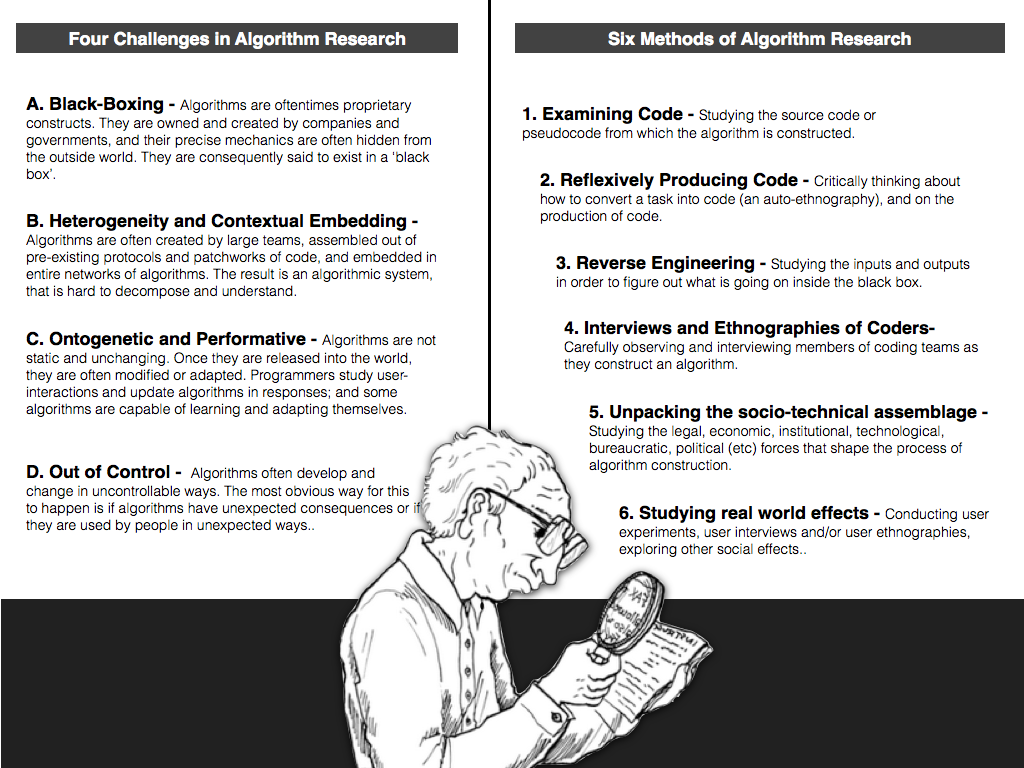
The challenges and methods for studying algorithms


We need to be alive to the challenge that most software we may be interested in is proprietary, although not always and we can look to repositories like GitHub for plenty of open source code, and so it may actually prove impossible to gain access to the code itself –– and here we’d really want the code of the whole programme, and perhaps the training data too. Likewise, software like any complex endeavour may well be the result of collective authorship and maintained by lots of different people. So there are complex sets of relations between people, laws, protocols, standards and many other considerations to negotiate – they are contextually embedded. Furthermore, the programmes we’re calling algorithms here actually have a hand in producing the world within which they exist –– they may bring new kinds of entities and relationships into existence, they may formulate new and different forms of spatial relation and understanding. In this sense they are ontogenetic and performative. Added to this, once ‘in the wild’ this performativity can render the kinds of outcomes of a programme unexpected and peculiar, especially once it is fed all sorts of data, adapted and adopted in unexpected ways.

How can we go about studying these kinds of socio-technical systems then? Well, rather than treat as discrete the six techniques offered by Kitchin (summarised above) – I’d argue we need to combine most of these. Even so, it may prove extremely difficult to actually gain access to code. Further, even if one might reflexively produce code and/or attempt to reverse engineer software –– some systems are the product of companies with such extensive resources that it may well prove near-impossible to do so. Where social scientists might find more traction and actually be able to make a more valuable contribution is, as Kitchin suggests, looking t the full sociotechnical assemblage. We can look at the wider institutional, legal and political apparatuses (the dispositifs) and we can certainly look at the various kinds of relation the assemblages make and how they are enrolled in performing the world they inhabit.

Make no mistake – this kinds of research is necessarily hard. I’m not sure I can imagine papers in geography journals that tie the a/b testing logs of experiments in how a given system works and commit logs to version control systems (even if you could access them!) to particular forms of experience and/or their political consequences… but it might be worth a go. Perhaps this difficulty is why we see (and I am as guilty as any of this) papers written in abstract terms, focusing on the (social) theoretical ways we can talk about these sociotechnical systems in broad terms.

Like Bogost, I can see a kind of pseudo-theological romancing of the ‘algorithm’ and the agency of software in much of what is written about it, and its sort of easy to see why – it is so abundant and yet relatively hidden. We see effects but do not see the systems that produce them:

Algorithms aren’t gods. We need not believe that they rule the world in order to admit that they influence it, sometimes profoundly. Let’s bring algorithms down to earth again.

The algorithm as synecdoche is a kind of ‘talisman’, as Gillespie argues, that reveals something of what Stiegler calls our ‘originary technicity’ – the sense in which we (humans) have always already been bound up in technology and its the forgetting and then remembering of this that forges our ongoing reconstitution (transindividuation) of ourselves.

So, I’d like to end with Kitchin’s argument:

it is clear that much more critical thinking and empirical research needs to be conducted with respect to algorithms [and the software and sociotechnical systems in which they are necessarily embedded] and their work.

Addendum:

It is worth noting that both Gillespie and Kitchin draw on another paper that is very much worth reading by Nick Seaver, who reminded me of this on Twitter, take a look:

“Knowing Algorithms“, presented at Media in Transition 8, Cambridge, MA, April 2013 [revised 2014].

For these companies you, walking down the street, are a data point

I’ve been collecting the promotional videos of various companies that surveil ‘public’ spaces to garner information that, using the logics applied to web analytics, they see as valuable commercial intelligence.

The rationale that is common throughout is that the aggregate crowd on the street, in a shopping centre, or in any form of apparently ‘public’ space are fair game for surveillance measurement and in turn address (albeit by their commercial partners – retailers etc. etc.). In fact, this is merely a technical or perhaps social problem – not a political one. It’s a technical problem for them because as the chap from Placemeter says “it’s all data” and its ‘waiting’ to be harvested. It’s a social problem for them only insofar as it’s about improving ‘services’ for us as consumers (not as citizens, as families or any other part of our skein of identity). It is NOT a political problem for them – it’s not an issue of who has the right to the city, who has a right to privacy or what might constitute reasonable expectations of any of those things. It certainly is never couched in terms of there needing to be governance of these activities – at least in these kinds of videos.

So, the videos are interesting artefacts of the formulation of what pervasive media/ubiquitous computing and smart cities look like and how they are performed…

A reasonable article about Placemeter is in/on the Guardian Cities section.

Thinking Histories of Race and Computation, or “Why are the Digital Humanities so White?”

Dorothea Klein tweeted a link to this excellent piece by Tara McPherson in an online book Debates in the Digital Humanities:

I wanted to quote this paragraph because it offers a fantastic critical and productive response to the problem of a-historical and a-political studies of code and computation that McPherson diagnoses:

Scholars in the digital humanities and in the emerging field of code studies are taking up the challenge of understanding how computational systems (especially but not only software) developed and operate. However, we must demand that these fields not replay the formalist and structuralist tendencies of new media theory circa 1998. This formalist turn displayed a stubborn technological determinism and often privileged the machine over the social. To end run such determinism, the digital humanities and code studies must also take up the questions of culture and meaning that animate so many scholars of race in fields like the new American studies. Likewise, scholars of race must analyze, use, and produce digital forms and not smugly assume that to engage the digital directly is to be complicit with the forces of capitalism.The lack of intellectual generosity across our fields and departments only reinforces the divide-and-conquer mentality that the most dangerous aspects of modularity underwrite.We must develop common languages that link the study of code and culture. We must historicize and politicize code studies. And, because digital media were born as much of the civil rights era as of the cold war era (and of course these eras are one and the same), our investigations must incorporate race from the outset, understanding and theorizing its function as a ghost in the digital machine. This does not mean that we should simply add race to our analysis in a modular way, neatly tacking it on or building digital archives of racial material, but that we must understand and theorize the deep imbrications of race and digital technology even when our objects of analysis (say UNIX or search engines) seem not to be about race at all. This will not be easy. In the writing of this essay, the logic of modularity continually threatened to take hold, leading me into detailed explorations of pipe structures in UNIX or departmental structures in the university, taking me far from the contours of race at midcentury. It is hard work to hold race and computation together in a systemic manner, but it is work that we must continue to undertake.

I’ve only quickly read the piece but I will definitely return to re-read it more thoroughly – brilliant.

Reblog> Data and the City Workshop (31/08-01/09)

The Programmable City project team are running a(nother!) interesting workshop/event at the end of the month, just before the RGS annual conference. See the details below:

Data and the City Workshop

The Programmable City Project is hosting a two day workshop on the relations between data and the city.  The Data and the City Workshop will take place on August 31st and September 1st 2015 and will bring together 20 invited experts in the field and the ProgCity team.  A description of the workshop and the agenda are below with links to some of the papers to be presented that are already available online…

Read more in the original post – including the schedule.

New journal: “Digital Literacy Studies”

David Cooper tweeted a link to an interesting new open access journal called “Digital Literacy Studies“, published through Penn State University Libraries. Here’s the info from their page:

Digital Literary Studies

Digital Literary Studies is an international peer-reviewed interdisciplinary publication with a focus on those aspects of Digital Humanities primarily concerned with literary studies.

Digital Literary Studies publishes scholarly articles on research concerned with computational approaches to literary analysis/criticism, or critical/literary approaches to electronic literature, digital media, and textual resources.

In addition to longer, more traditionally-formed articles, this journal publishes positional papers and articles with a shorter experimental focus, as well as reviews of books and electronic literature. Contributors may also submit curated electronic texts for peer-review, as well as thoroughly-documented hermeneutical methods and tools. Any digital project with a literary focus, whether that be a digital edition, tool, or otherwise, may be considered for peer-review.

I’ve highlighted a bit above to point out that they welcome experimental shorter contributions too.

‘Wide’, not ‘big’, data

Saw this article a while ago on the NetworkWorld website, not sure if it’s a more broadly adopted concept – but the idea of ‘wide’ data appeals. Can’t remember if Rob Kitchin addresses it in his excellent book The Data Revolution… will have to check!

(I’m blogging this so I can finally close the tab in my browser!)

Why businesses should focus on wide data, not big data

In these heady days of big data, a lot of organizations treat data collection like a Pokémon game: Gotta catch it all. But Dane Atkinson, CEO of cross-platform marketing analytics specialist SumAll says most organizations need to think wide, not big, when it comes to data.

“The real impact of data always comes from the intersection of different data sets,” Atkinson says. “You don’t get into the earth shattering discoveries until you start to link disparate data sets.”

This idea of ‘wide’ data is what some marketing people have called ‘horizontals’ – the ability to stitch together different kinds of data to create a particular kind of value proposition (see Irene Ng’s book on this…)

Reblog> Reading list on the digital divide/digital inclusion

This looks like a really helpful resource over on the Social Media Collective blog –– although I’m sure Mark Graham may want to add to it… 🙂

Reading list on the digital divide/digital inclusion

We compiled a bibliography on the digital divide (including gender gaps) and ICTD. Please let us know if we missed anything interesting and we would be glad to add it!

1. Allen, Steven G. 2001. “Technology and the Wage Structure.” Journal of Labor Economics 19:440-483.

2. Anderson, B. 2005. “The value of mixed-method longitudinal panel studies in ICT research.” Information, Communication & Society 8:343-367.

3. Anderson, Ben. 2008. “The Social Impact of Broadband Household Internet Access.” Information, Communication & Society 11:5-24.

See the other 191 references on the Social Media Collective blog.

Reblog> Data and the City

Mike Batty blogs about the ‘Data and the City’ event that is being convened by Rob Kitchin and the Programmable City team.

Data and the City

data-city
The Programmable City Project is holding a meeting on Data and the City in Maynooth from August 31- September 1st. You can get Rob Kitchin’s and Mike Batty’s papers from this blog but the programme is diverse and the Project web site contains details of the various contributions. I argue in my paper that we need to redefine big data in terms of the tools we use to interpret it and that size is not the main criterion as quite modest data sets in cities, particularly those dealing with transport and flows, are too large for most of current tools which involve statistical manipulation and visualisation. Here are two of the papers to be presented:

Michael Batty: Data About Cities: Redefining Big, Recasting Small

Rob Kitchin: Data-Driven, Networked Urbanism

The image above was produced by Stephan Hugel and Flora Roumpani from their animation of tweets in London Using City Engine. Click here for the movie.