Echoborg

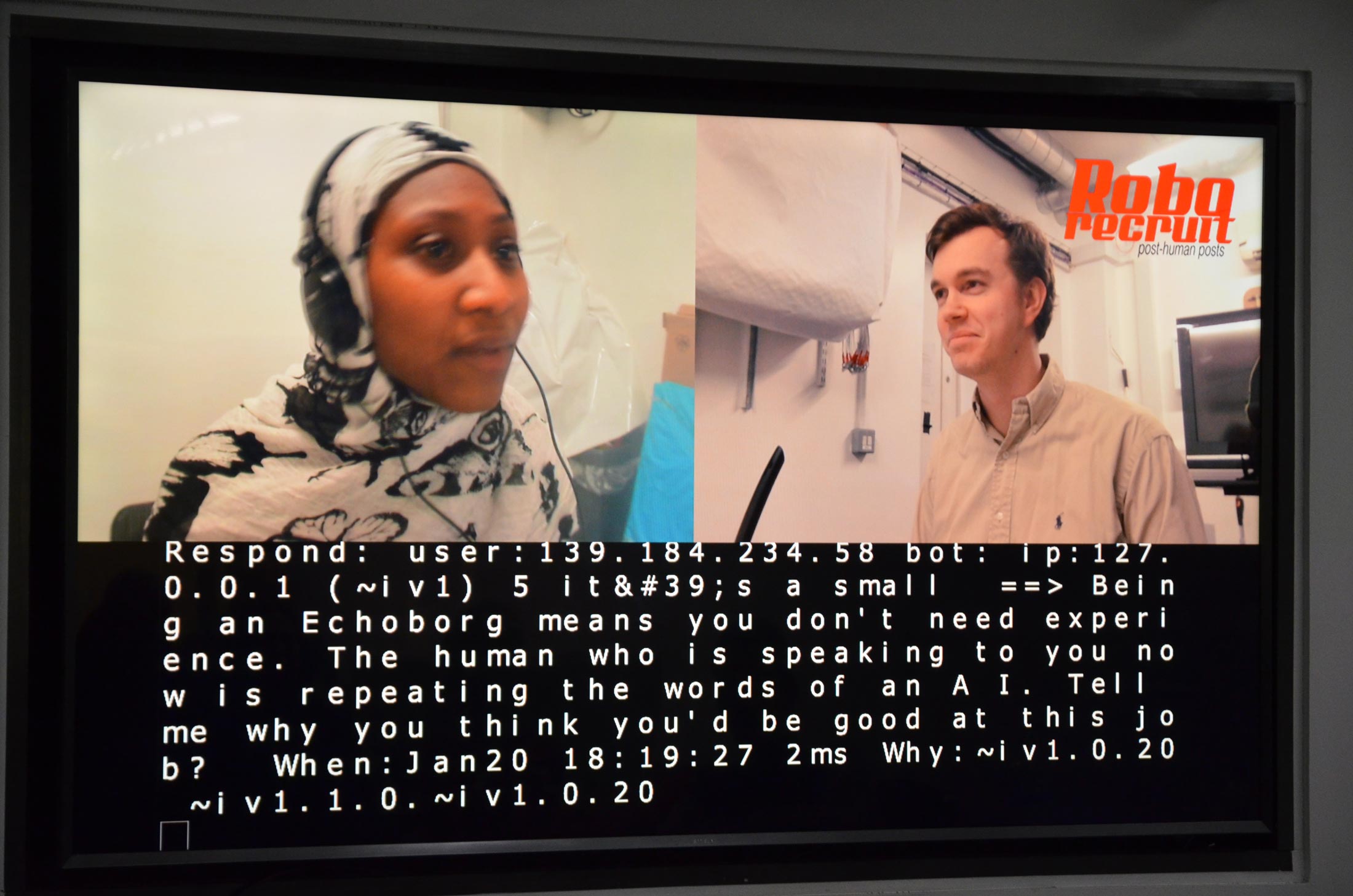
Former colleagues of mine at UWE are developing an interesting project, which you may have seen/heard about through the BBC’s Click programme, called Echoborg.

An echoborg is a hybrid agent composed of the body of a real person and the “mind” (or, rather, the words) of a conversational agent; the words the echoborg speaks are determined by the conversational agent, transmitted to the person via a covert audio-relay apparatus, and articulated by the person through speech shadowing[1].

Recently, the project team have demoed the project as part of an AHRC-funded network on Automation Anxiety and have written this up on the project website, here’s a snippet – it sounds like it is really compelling (I’ve not seen this in action):

Four people were interviewed by the AI which increasingly displayed an interest in eliciting help to reprogram itself. Proceedings were visible on a projector screen and the ‘audience’ of applicants gradually began to discuss the situation of the Echoborg and how to change it. At a certain point their reflections passed a threshold and the group fired into collective action, experimenting with various methods to bring the situation to a head in some way. The lively inventiveness of the group and the individual interviewees went a long way to confirming the interactive potential of this format of the work. It also gave Rik and Phil much to work with in considering the further development of the AI/Chatbot, the restricted delivery of narrative by the human Echoborg and the staging. This event also trialled a secondary, higher level, Echoborg character as part of the slow process of unfolding the potential for this Echoborg recruitment event to be a disruptive and thought and emotion provoking experience for all players.

Notes

  1. Corti, Kevin and Gillespie, Alex (2015) Offscreen and in the chair next to you: conversational agents speaking through actual human bodies. Lecture Notes in Computer Science, 9238 . pp. 405-417.

Tony Sampson on neuroculture

From a Conversation piece on Huxley, dystopia and how we might think about Facebook etc. in relation to Huxley’s “College of Emotional Engineering”, this concise evocation of his understanding of ‘neuroculture’ is interesting:

The origins of neuroculture begin in early anatomical drawings and subsequent neuron doctrine in the late 1800s. This was the first time that the brain was understood as a discontinuous network of cells connected by what became known as synaptic gaps. Initially, scientists assumed these gaps were connected by electrical charges, but later revealed the existence of neurochemical transmissions. Brain researchers went on to discover more about brain functionality and subsequently started to intervene in underlying chemical processes.

Interpretation of Cajal’s anatomy of a Purkinje neuron, by Dorota Piekorz.

On one hand, these chemical interventions point to possible inroads to understanding some crucial issues, relating to mental health, for example. But on the other, they warn of the potential of a looming dystopian future. Not, as we may think, defined by the forceful invasive probing of the brain in Room 101, but via much more subtle intermediations.

CFP> Fear and Loathing of the Online Self, Rome, May 22-23, 2017

Via Institute of Network Cultures… looks interesting… be good to see a wider variety of folks ‘participating’…

Fear and Loathing of the Online Self–A Savage Journey into the Heart of Digital Cultures

Call for Participation
Conference, Rome, May 22-23, 2017
http://networkcultures.org/online-self/

We would like to invite artists and researchers to submit proposals to join this event hosted by  John Cabot University and Universita degli Studi RomaTre in Rome, and organized in collaboration with the Institute of Network Cultures, Amsterdam.

The conference aims at exploring the state of the online self by raising questions about its status as a focal point of contemporary power/networks. Is the online self merely a product of software predictability and viral marketing? Is there any space left for self-determination? Or should we search elsewhere for new forms resistance by changing our political categories and perspectives? Which contradictions are at play? How and where can we locate the spaces of performativity of the online self?

Critical political-economic readings of platform capitalism do not explain nor grasp new forms of (visual) online subjectivity. There is a growing gap between the obsessive quest for measurability, big data and algorithmic regimes (such as AI/bots),and critical investigations of an emerging variety of compulsive forms taken by the online self. We need to fill this gap and bring them back together. If a humanities approach of Internet studies nurtured by artistic and activist practices aims to survive the ‘big data’ onslaught from the social sciences, then it is vital to ask what the citizen-as-user wants. To portray the population as (innocent or guilty) victims of the data monopolies is, politically speaking, a dead-end street.

The cynical condition rules: we know we’re under surveillance, yet we continue to click, like, love and share ourselves online as usual. We are told by concerned experts and libertarians that our privacy “matters” and we want to believe it; yet it silently confers a guilty stigma upon another vital need, to engage socially and culturally with others. While some preach the offline escape as a way out, most of us are so deeply invested in the everyday social media life that it is inconceivable for most of us to  leave Facebook and the like. And this not only out of desire but necessity: networking and self-sharing has become imperative for succesfully managing the double binds of the immaterial labour economy. Instead, we’d rather deal with peculiar pathologies, such as addiction, depression and solitude generated by hyper-connection and lack of connections.

Abstracts and proposals are welcome to contribute to the following sections:

1. ONLINE SUBJECTIVITY THEORY

How much free room do we have to design new identities? What aesthetic and philosophic paths and patterns does meme distribution hint at? What is the role of theory and criticism, if any, in the ever changing yet endless production of the latest user affordances, from dating sites, Tinder swipes and Snapchat lenses, to Pokemon-Go? Can we still attempt to design new modes of subjectivity, or has our role withdrawn to a mere Cassandra-like gloom and doom prediction of digital catastrophes, while start-ups (read: future monopolies) have all taken over the cool business of designing and shaping the online self?

2. BEHIND AND BEYOND SELFIES

It is easy to diagnose the selfie as a symptom of a growing narcissism of our daily digital obsessions. But how do we get beyond the predictable split between the politically correct assessment of empowerment (of young girls) against the nihilist reading of self-promotion and despair? Does criticism of today’s photography of the everyday life always have to end up giving medical prescriptions and recipes of wellbeing? What could a materialist reading of large databases and facial recognition techniques (including protection) that goes beyond media archaeology (the historical approach) and the ever-changing pop gestures involve and say? Can we still talk about the liberation of the self in the age of digital self-generation of the images?

3. ARTISTIC PRACTICES OF THE ONLINE SELF

Artists play an important role in the anticipation, and critique, of new modes of the self. What role does the artistic imagination play beyond the creative industries paradigm? How can artistic and creative avant garde practices help disrupt the trite quantitative approach and the dogma of the algorithm in defining modes and moods of the onlife self? What separates a (properly) artistic imagination and the aesthetic imagination of the online curators of selfie-constructed personas and are contemporary critical paradigms merely reproducing an understanding of online practices that are aligned with the requirements of corporation?

4. POLITICS AND AESTHETICS OF MASK DESIGN

Masks and selfies should not be seen as opposites as they both represent different modes (and moods) of being of the self. Masks create spaces of performance; they are playful and seductive (or scary) forms of self-representation that ultimately do not protect us against the computational repression of the security apparatus. What are the lessons learned from the Anonymous movement? We should come to a new social contract between the individuals, groups and the cybernetic machine. In the meanwhile, how can we make sure to protect us, and what premises are hidden in the numerous crypto-design projects that circulate?

Confirmed speakers: Wendy Chun, Ana Peraica, Jodi Dean, Marco Deseriis, Gabriella Coleman, Daniel de Zeeuw, Rebecca Stein, Vito Campanelli, Franco Berardi.

Editorial Team: Donatella Della Ratta (John Cabot University), Geert Lovink (Institute of Network Cultures/HvA), Teresa Numerico (Universita degli Studi RomaTre), Peter Sarram (John Cabot University).

Please send your proposal (max 500 words in word/pdf format), a short bio and any other material that could support your idea visually  (artwork, film links, etc) to selfieconference@johncabot.edu.  Deadline: March 1, 2017.

Reblog> Social Justice in an Age of Datafication: Launch of the Data Justice Lab

Via The Data Justice Lab.

Social Justice in an Age of Datafication: Launch of the Data Justice Lab

The Data Justice Lab will be officially launched on Friday, 17 March 2017. Join us for the launch event at Cardiff University’s School of Journalism, Media and Cultural Studies (JOMEC) at 4pm. Three international speakers will discuss the challenges of data justice.

The event is free but requires pre-booking at https://www.eventbrite.com/e/social-justice-in-an-age-of-datafication-launching-the-data-justice-lab-tickets-31849002223

Data Justice Lab – Launch Event – Friday 17 March 4pm – Cardiff University

Our financial transactions, communications, movements, relationships, and interactions with government and corporations all increasingly generate data that are used to profile and sort groups and individuals. These processes can affect both individuals as well as entire communities that may be denied services and access to opportunities, or wrongfully targeted and exploited. In short, they impact on our ability to participate in society. The emergence of this data paradigm therefore introduces a particular set of power dynamics requiring investigation and critique.

The Data Justice Lab is a new space for research and collaboration at Cardiff University that has been established to examine the relationship between datafication and social justice. With this launch event, we ask: What does social justice mean in age of datafication? How are data-driven processes impacting on certain communities? In what way does big data change our understanding of governance and politics? And what can we do about it?

We invite you to come and participate in this important discussion. We will be joined by the following keynote speakers:

Virginia Eubanks (New America), Malavika Jayaram (Digital Asia Hub), and Steven Renderos (Center for Media Justice).

Virginia Eubanks is the author of Digital Dead End: Fighting for Social Justice in the Information Age (MIT Press, 2011) and co-editor, with Alethia Jones, of Ain’t Gonna Let Nobody Turn Me Around: Forty Years of Movement Building with Barbara Smith (SUNY Press, 2014). She is also the cofounder of Our Knowledge, Our Power (OKOP), a grassroots economic justice and welfare rights organization. Professor Eubanks is currently working on her third book, Digital Poorhouse, for St. Martin’s Press. In it, she examines how new data-driven systems regulate and discipline the poor in the United States. She is a Fellow at New America, a Washington, D.C. think tank and the recipient of a three-year research grant from the Digital Trust Foundation (with Seeta Peña Gangadharan and Joseph Turow) to explore the meaning of digital privacy and data justice in marginalized communities.

Malavika Jayaram is the Executive Director of the Digital Asia Hub in Hong Kong. Previously she was a Fellow at the Berkman Klein Center for Internet & Society at Harvard University, where she focused on privacy, identity, biometrics and data ethics. She worked at law firms in India and the UK, and she was voted one of India’s leading lawyers. She is Adjunct Faculty at Northwestern University and a Fellow with the Centre for Internet & Society, India, and she is on the Advisory Board of the Electronic Privacy Information Center (EPIC).

Steven Renderos is Organizing Director at the Center for Media Justice. With over 10 years of organizing experience Steven has been involved in campaigns to lower the cost of prison phone calls, preserving the Open Internet, and expanding community owned radio stations. Steven previously served as Project Coordinator of the Minnesotano Media Empowerment Project, an initiative focused on improving the quality and quantity of media coverage and representation of Latinos in Minnesota. He currently serves on the boards of Organizing Apprenticeship Project and La Asamblea de Derechos Civiles. Steven (aka DJ Ren) also hosts a show called Radio Pocho at a community radio station and spins at venues in NYC.

The event will be followed by a reception.

Reblog> Free Download: Digital Rights to the City

Via Mark Purcell.

2017-02-06-103004_550x790_scrot

Free Download: Digital Rights to the City

Published Today: Our Digital Rights to the City

Free to download (pdf, epub, mobi): http://meatspacepress.org/


‘Our Digital Rights to the City’ is a small collection of articles about digital technology, data and the city. It covers a range of topics relating to the political and economic power of technologies that are now almost inescapable within the urban environment. This includes discussions surrounding security, mapping, real estate, smartphone applications and the broader idea of a ‘right to the city’ in a post-digital world.

The collection is edited by Joe Shaw and Mark Graham and its contributing authors are Jathan Sadowski, Valentina Carraro, Bart Wissink, Desiree Fields, Kurt Iveson, Taylor Shelton, Sophia Drakopoulou and Mark Purcell.

Please follow us @meatspacepress

Join our mailing list at http://meatspacepress.org/

‘Our Digital Rights to the City’ also available free at:

* Free to download (epub, most e-readers): epub

* Free to download (pdf): pdf

* Free to download (mobi, for Kindle): mobi

* Free to read (pdf): Here

The internet is mostly bots(?)

“When I am king, you will be first against the wall…“

In an article for The Atlantic Adrienne LaFrance observes that a report by the security firm Imperva suggests that 51.8% of traffic online is bot traffic (by which they mean 51.8% of a sample of traffic [“16.7 billion bot and human visits collected from August 9, 2016 to November 6, 2016”] sent through their global content delivery network “Incapusla”):

Overall, bots–good and bad–are responsible for 52 percent of web traffic, according to a new report by the security firm Imperva, which issues an annual assessment of bot activity online. The 52-percent stat is significant because it represents a tip of the scales since last year’s report, which found human traffic had overtaken bot traffic for the first time since at least 2012, when Imperva began tracking bot activity online. Now, the latest survey, which is based on an analysis of nearly 17 billion website visits from across 100,000 domains, shows bots are back on top. Not only that, but harmful bots have the edge over helper bots, which were responsible for 29 percent and 23 percent of all web traffic, respectively.

LaFrance goes on to cite the marketing director of Imperva (who wants to sell you ‘security’ – he’s in the business of selling data centre services) to observe that:

“The most alarming statistic in this report is also the most persistent trend it observes,” writes Igal Zeifman, Imperva’s marketing director, in a blog post about the research. “For the past five years, every third website visitor was an attack bot.”

How do we judge this report? I find it difficult to know how representative this company’s representation of their data, although they are the purveyor of a ‘global content delivery network’. The numbers seem believable, given how long we’ve been hearing that the majority of traffic is ‘not human’ (e.g. a 2013 article in The Atlantic making a similar point and a 2012 ZDNet article saying the same thing: most web traffic is ‘not human’ and mostly malicious).

The ‘not human’ thing needs to be questioned a bit – yes, it’s not literally the result of a physical action but, then, how much of the activity on the electric grid can be said to be ‘not human’ too? I’d hazard that the majority of that so-called ‘not human’ traffic is under some kind of regular oversight and monitoring – it is, more or less, the expression of deliberative (human) agency. Indeed, to reduce the ‘human’ to what our simian digits can make happen seems ridiculous to me… We need a more expansive understanding of technical (as in technics) agency. We need more nuanced ways to come to terms with the scale and complexity of the ways we, as a species, produce and perform our experiences of everyday life – of what counts as work and the things we take for granted.

Microsoft Cognitive Services

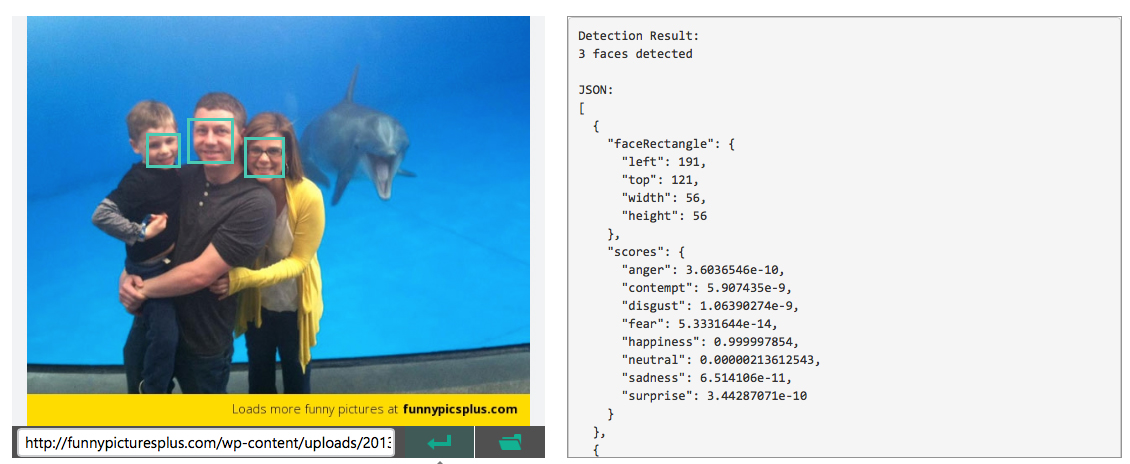
Microsoft Cognitive Services (sounds like something from a Phillip K. Dick novel) have opened up APIs, which you can call on (req. subscription), to outsource forms of machine learning. So, if you want to identify faces in pictures or videos you can call on the “Face API“, for example. Obviously, this is all old news… but, it’s sort of interesting to maybe think about how this foregrounds the homogenisation of process – the apparent ‘power’ of these particular programmes (accessed via their APIs) may be their widespread use.

This might be of further interest when we consider things like the “Emotion API” through which (in line with many other forms of programmatic measure of the display or representation of ’emotion’ or ‘sentiment’) the programme scores a facial expression along several measures”, listed in the free example as: “anger”, “contempt”, “disgust”,” fear, “happiness”, “neutral”, “sadness”, “surprise”. For each image you’ll get a table of scores for each recognised face. Have a play – its beguiling, but of course then perhaps prompts the sorts of questions lots of people have been asking about how ‘affect’ and emotions can get codified (e.g. Massumi) and the politics and ethics of the ‘algorithms’ and such like that do these things (e.g. Beer).

I am probably late to all of this and seeing significance here because it’s relatively novel to me (not the tech itself but the ‘easy-to-use’ API structure), nevertheless it seems interesting, to me at least, that these forms of machine learning are being produced as mundane through being made abundant, as apparently straightforward tools. Maybe what I’m picking up on is that these APIs, the programmes they grant access to, are relatively transparent, whereas much of what various ‘algorithm studies’ folk look at is opaque.  Microsoft’s Cognitive Services make mundane what, to some, are very political technologies.


Spacing social media – seminar at Swansea (18th Jan)

I am participating in the geography seminar series at Swansea next week. I’ll be talking about some of the ideas that came out of the work we did with social media for the Contagion project.

Mostly the talk is about how ideas about space and spatial experience are important to understanding social media. This, very broadly, appears in two ways: (1) like any technology, how we use social media performs, reflects and reveals forms of spatial understanding and experience; and (2) both the methods and the subsequent analysis we do of social media, as geographers (but also that done in other disciplinary contexts), carry assumptions about space that perhaps need to be made more explicit (especially when methodological techniques carry contradictory assumptions about space to the ideas we then employ in our analysis). This comes from a far-too-long reflection on a manuscript written for publication that had some issues and in reflecting on those issues I realised that there were some interesting geographical issues to make more explicit.

Anyway, the seminar is at 2pm on the 18th of January in Glyndwr E (see 11.1 on this campus map). Hope to see a few people there…

Here’s the abstract:

Spacing Social Media

This talk will interrogate the promise as well as the critical implications of the emerging geographies of social media. In particular, the spacing of social media will be addressed in terms of the ways we might understand and theorise space and spatiality. There will be three parts to the discussion: First, the promise of social media research is addressed through an initial exploration of how those media are ineluctably entangled in changes within social, economic and political fields. Second, the translations of data in social media research are addressed through the applications and techniques involved. Third, this provides a basis for subsequent discussion of the theoretical implications of digital data methods and their spacings. I will argue that the techniques and discourses of social media methods both imply and challenge forms of spatial understanding that present challenges for geographical research.

When design fiction becomes the advert(?) Amazon Go and the refiguring of trust

I think I’ve been late to this. I saw the story about Barclaycard wanting to do “cardless” credit cards but, of course, Amazon want to vertically integrate. See the first video below. Interesting that this is incredibly similar to previous ‘envisionings’ of “the future” of retail/shopping. The first thing I thought was: ‘hang on, this is  Microsoft circa 2004’, see the second video below… and I’m sure there’s been others, not least from the likes of HP Labs… I wonder where patents lie on this stuff, cos that will be a big bargaining chip.

This is interesting though insofar as, when I was writing about the Microsoft Office Labs videos in 2008/9, the ‘future’ they figured was always positioned at some distance, it was certainly not explicitly stated that this is something you should definitely expect to happen, more a kind of ‘mood music’ to capture some sensibilities of a possible future, by representing it and hooking ideas into our general  imagination of technology and society. It certainly plays on the trope of the normalisation of heavy surveillance… what else can such a system be?

The Amazon Go video is an interesting confluence of lots of contemporary trends in attempts to refigure how we imagine digital technology. Implicit in the video is a normalisation of yet-more automation (of payment, of trust). Explicit here, as already mentioned, is that these kinds of places are not ‘private’ in any way – the system “knows” you, will know your habits, manages your money and that’s ok, in fact – it’s apparently preferable (trust, again).

Amazon seem to be fairly aggressively pushing this, taking the smooth apparently effortless aesthetics of many tech design fiction videos and using this as a means to capture the idea that such technology = Amazon. Apparently there is a “beta” shop in Seattle (where else?). No doubt someone will already be writing a journal article about this as code/space and, of course it is (and just as Kitchin & Dodge suggest about airports – I wouldn’t want to be in this shop when the servers go down), but I think the thing I find more interesting is that it seems to me that this is perhaps an overtly political manoeuvre to capture the public story about what ‘currency’ is and how payment works when we take for granted higher levels of automation, through what kinds of institution and who we can trust. This is quite a different story to the blockchain, Amazon seem to be saying “let us handle the trust issue” – a pitch usually made by a bank, or PayPal…  That might be interesting to think about (I’m sure people, like Rachel O’Dwyer, already are), not least in relation to other ways ‘trust’ is being addressed (and attempts are being made to refigure it) by other companies, institutions and groups.

All this means I’ll definitely be re-writing my lecture about money for the next iteration of my “Geographies of Technology” module next term…