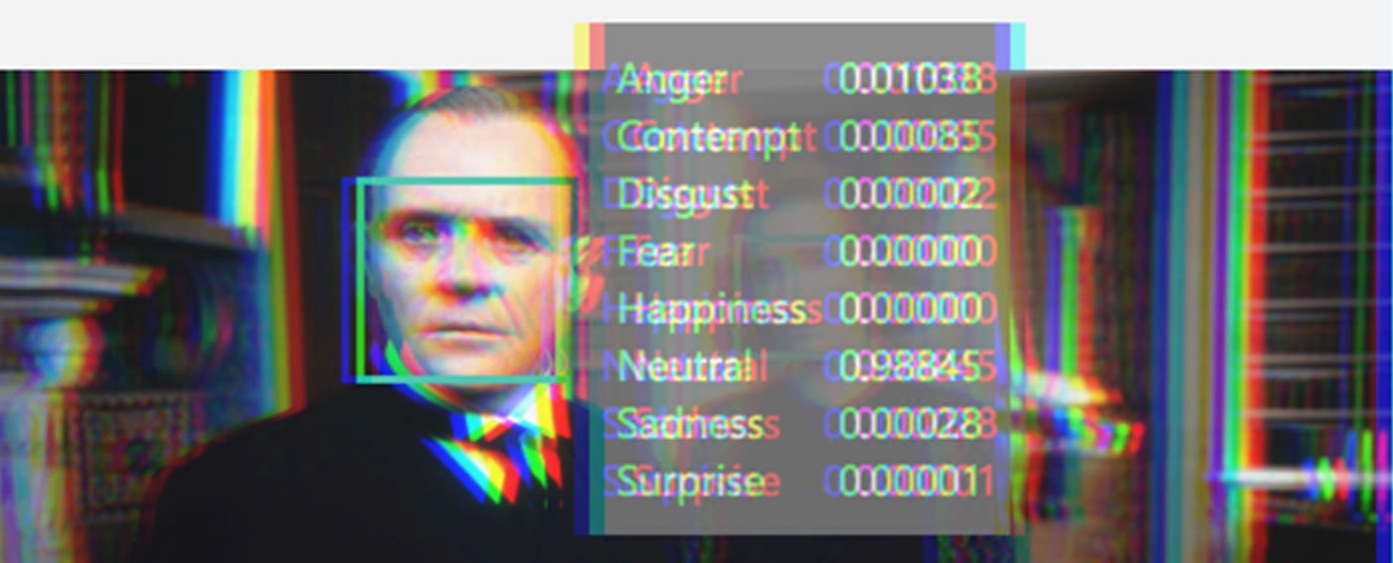
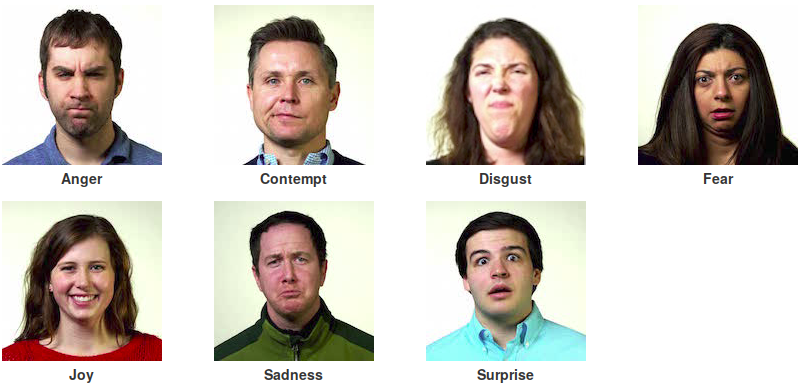
Choose how you feel, you have seven options

A great piece by Ruben Van de Ven stemming from his artwork of the same name, published on the Institute of Network Culture site. Van de Ven, in a similar vein to Will Davies, deconstructs the logic of ‘affective’ computing, sentiment analysis and their application to what has been termed the ‘attention economy’. The article does a really go job of demonstrating how the knowledge claims, and the epistemologies (perhaps ontologies too), that are at work behind these technologies are (of course) deeply political in their application. Very much worth reading! (snippet below).

 ‘Weeks ago I saw an older woman crying outside my office building as I was walking in. She was alone, and I worried she needed help. I was afraid to ask, but I set my fears aside and walked up to her. She appreciated my gesture, but said she would be fine and her husband would be along soon. With emotion enabled (Augmented Reality), I could have had far more details to help me through the situation. It would have helped me know if I should approach her. It would have also let me know how she truly felt about my talking to her.’

FOREST HANDFORD

This is how Forest Handford, a software developer, outlines his ideal future for a technology that has emerged over the past years. It is known as emotion analysis software, emotion detection, emotion recognition or emotion analytics. One day, Hartford hopes, the software will aid in understanding the other’s genuine, sincere, yet unspoken feelings (‘how she truly felt’). Technology will guide us through a landscape of emotions, like satellite navigation technologies guide us to destinations unknown to us: we blindly trust the route that is plotted out for us. But in a world of digitized emotions, what does it mean to feel 63% surprised and 54% joyful?
Please take the time to read the whole article.

Reblog> Accident tourist – driverless cars and ethics

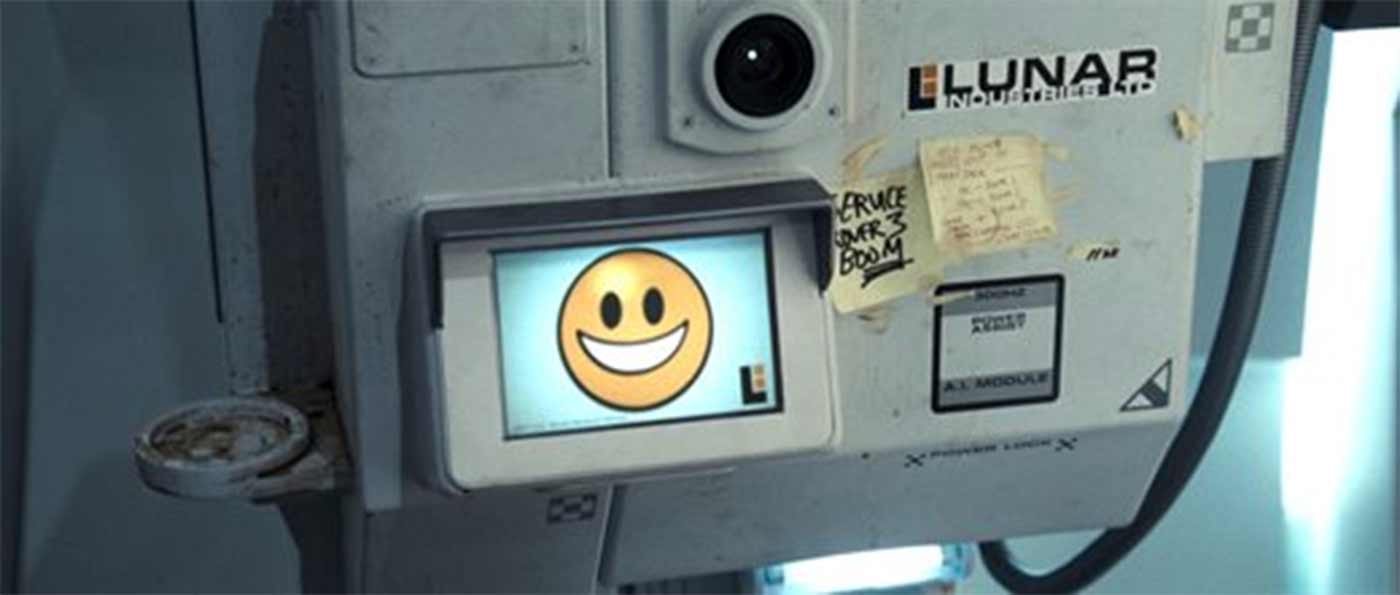
Automated taxi figure in the 1990 film Total Recall

An interesting and well-written piece over on Cyborgology by Maya from Tactical Tech Collective (amongst many other things!)

I particularly like these bits copied below, but please read the whole post.

Accident Tourist: Driverless car crashes, ethics, machine learning

…I imagine what it may be like to arrive on the scene of  a driverless car crash, and the kinds of maps I’d draw to understand what happened. Scenario planning is one way in which ‘unthinkable futures’ may be planned for.

The ‘scenario’ is a phenomenon that became prominent during the Korean War, and through the following decades of the Cold War, to allow the US army to plan its strategy in the event of nuclear disaster. Peter Galison describes scenarios as a “literature of future war” “located somewhere between a story outline and ever more sophisticated role-playing war games”, “a staple of the new futurism”. Since then scenario-planning has been adopted by a range of organisations, and features in the modelling of risk and to identify errors. Galison cites the Boston Group as having written a scenario – their very first one-  in which feminist epistemologists, historians, and philosophers of science running amok might present a threat to the release of radioactive waste from the Cold War (“A Feminist World, 2091″).

The applications of the Trolley Problem to driverless car crashes are a sort of scenario planning exercise. Now familiar to most readers of mainstream technology reporting, the Trolley problem is presented as a series of hypothetical situations with different outcomes derived from a pitting of consequentialism against deontological ethics. Trolley Problems are constructed as either/or scenarios where a single choice must be made.

[…]

What the Trolley Problem scenario and the applications of machine learning in driving suggest is that we’re seeing a shift in how ethics is being constructed: from accounting for crashes after the fact, to pre-empting them (though, the automotive industry has been using computer simulated crash modeling for over twenty years); from ethics that is about values, or reasoning, to ethics as based on datasets of correct responses, and, crucially, of ethics as the outcome of software engineering. Specifically in the context of driverless cars, there is the shift from ethics as a framework of “values for living well and dying well”, as Gregoire Chamayou puts it, to a framework for “killing well”, or ‘necroethics’.

Perhaps the unthinkable scenario to confront is that  ethics is not a machine-learned response, nor an end-point, but as a series of socio-technical, technical, human, and post-human relationships, ontologies, and exchanges. These challenging and intriguing scenarios are yet to be mapped.

Coincidentally, in the latest Machine Ethics podcast (which I participated in a while ago), Joanna Bryson discusses these issues about the bases for deriving ethics in relation to AI, which is quite interesting.

Brave new-old world – gig economy as scientific management

Deliveroo cyclists

They’re gonna be disrupted, yeah! Because your lives are being disrupted, yeah! This is the money you need to live!

An interesting article in the FT: “When your boss is an algorithm“, in which (if you ignore the sort of anthropomorphism of “the algorithm” and its apparently supreme agency) the author,  , draws out the similarity between the claims of efficiency etc. made for ‘gig economy’ -type work platforms, such as Uber and Deliveroo, are very similar to Taylorism:

Algorithmic management” might sound like the future but it has uncanny echoes from the past. A hundred years ago, a new theory called “scientific management” swept through the factories of America. It was the brainchild of Frederick W Taylor … Taylor wanted to replace this “rule of thumb” approach with “the establishment of many rules, laws and formulae which replace the judgment of the individual workman”. To that end, he sent managers with stopwatches and notebooks on to the shop floor. They observed, timed and recorded every stage of every job, and determined the most efficient way that each one should be done. “Perhaps the most prominent single element in modern scientific management is the task idea,” Taylor wrote in his 1911 book The Principles of Scientific Management. “This task specifies not only what is to be done but how it is to be done and the exact time allowed for doing it.”

Exemplified by the following excerpt articulating the experience of a Deliveroo driver, Kyaw, which is, in turn, of course similar to the kinds of working conditions of other delivery drivers and Amazon warehouse pickers (as has been covered widely in the press)…

Kyaw whips out his phone. The app expects him to respond to new orders within 30 seconds. The screen shows a map and address for the local Carluccio’s, an Italian restaurant chain. A swipe bar says “Accept delivery”. That is the only option. The algorithm will not tell him the delivery address until he has picked up the food from Carluccio’s. Deliveroo couriers are assigned fairly small geographic areas but Kyaw says sometimes the delivery address is way outside his allocated zone. You can only decline an order by phoning the driver support line. “They say, ‘No, you have to do it, you already collected the food.’ If you want to return the food to the restaurant they mark it as a driver refusal – that’s bad.”

‘Ways of Being in a Digital Age’ scoping

I’ve only just caught on here, but the ESRC’s “Ways of Being in a Digital Age” scoping review, for their new theme of the same name, has been awarded to the Liverpool Institute of Cultural Capital (a collaboration between Liverpool and Liverpool John Moores) in a partnership with 17 other institutions (a core of eight in the UK apparently). They say:

The project will undertake a Delphi review of expert opinion and a systematic literature review and overall synthesis to identify gaps in current research.

The project will also run a programme of events to build and extend networks among the academic community, other stakeholders and potential funding partners.

There’s a website, so you can read more there…

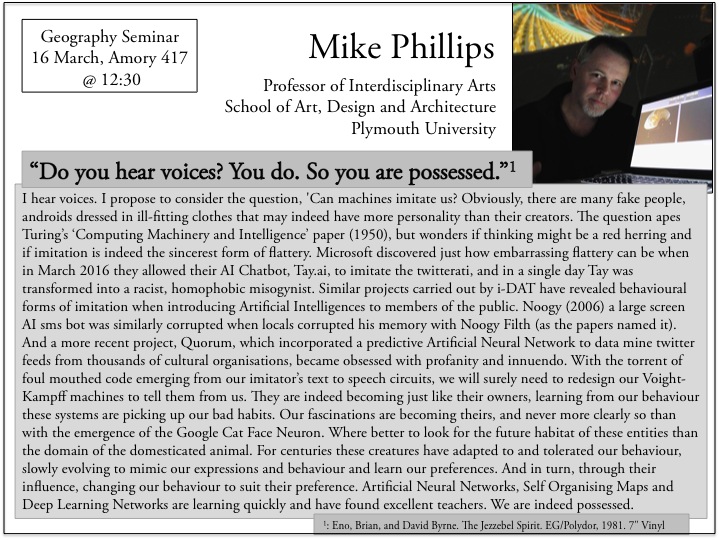
“Do you hear voices? You do. So you are possessed” – @mikedotphillips talk @exetergeography

I’m really pleased to share that Prof. Mike Phillips (i-DAT, Plymouth) will be speaking  next week as part of the Exeter Geography seminar series. Mike is a founder of the Institute of Digital Art and Technology and one of the founders of the undergraduate programme I studied MediaLab Arts, which is now called  Digital Media Design.

Details: Thursday 16th March, 12:30: Amory 417. All welcome!

Automation in financial services and the ongoing re-imagination of work

From Technology outsmarts the human investor – FT

“It just gets harder and harder and harder,” reflected one money manager this week. His is the predicament of other professionals – anything done by a person that follows a pattern and can be coded into a form that a computer understands will soon get squeezed. Technology also has the advantage identified in 1970: algorithms stay constantly alert.

It does not imply the complete death – or automation – of the investment manager. A professional can still undertake original research on a company or a security that provides insight. As more of the market becomes automated, originality becomes rarer and more valuable: an idiosyncratic investor should achieve higher returns by standing out from the robotic crowd.

Nor can algorithmic efficiency be wholly divorced from human intelligence, as the Oregon study showed – the point was that humans needed to set parameters for computers to follow. Many asset managers use analysts and researchers to build investment models that then trade securities automatically; others blend their active risk-taking with passive elements.

…

But these difficulties demonstrate how automation eats into professions, not by taking away all the jobs in one day but by unbundling them – dividing them between tasks that only humans can perform and those of which an algorithm is quite capable. Then the boundary relentlessly shifts.

The last paragraph is key – there seems to be a growing consensus that automation doesn’t simply ‘destroy’ jobs, it makes particular aspects of or kinds of role redundant and the implementation and development of automated systems requires the remaining workers to fit around those systems in different ways. In many ways, then, automation is a company or institution-specifc organisational or administrative problem as well as a wider political economic problem.

AI under feminist scrutiny

Searching for something else, I came across a 1999 book review by Tiziana Terranova of Alison Adam’s book Artifical Knowing in New Media and Society. As with much of Terranova’s incisive writing, there is a set of observations about the ontological politics of technology studies, in this case a really interesting reflection on how we might understand the issue of embodiment in relation to mediation:

…although embodiment is a foundational feminist category, it is far from being a resolved question. It is much easier to charge malestream science and technology with disembodiment than to come up with a model of embodiment which won’t stir the opposition of this or that feminist quarter. In many ways, the debate about cyberculture and technology keeps stumbling against the same block: if disembodiment is preferential bias of cybernetic technologies, how do we anser that? How do we bring back the body in cyberspace without essentializing it? Interestingly… if [we see] in Harraway’s cyborg (directly inspired by the skewed, labarynthine technologic of cybernetics) a machinic assemblage of organic and inorganics, of identity and difference, maybe [we] could have come up with a constructive, non-essentialist, embodied model of AI. Maybe it is a sad testimony of the overuse of the term ‘cyborg’ that [some are] all to ready to dismiss it as another ruse of an a-political postmodern feminism. It is a pity indeed since it seems to me that the charge of disembodiment more and more often levelled at digital culture (in all its manifestiations) has turned into the final word on the latter rather the beginning of a really different understanding of technology and subjectivity (or in this case, ‘intelligence’). Maybe we need a model of embodiment which is more about connections and partialities, more akin to cybernetics itself, to make AI work for feminists. (p. 142)