Do ‘robots’ replace (‘human’) jobs?

prof-automation

‘Robots’ (or automated systems for manufacturing and distribution) seem to be on-trend amongst social scientists[1] (following on the heels of economists [especially those trying to peddle reports predicting futures] and tech evangelists), so here’s a deceptively simple question:

Do ‘robots’ (i.e. automation) replace/destroy jobs?

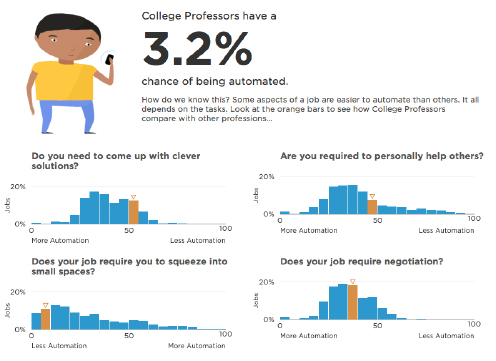
Lots of coverage across various media will give you an answer that is pretty much a categorical ‘yes’. In specific industries this is true, up to a point. It is true that jobs in specific manufacturing firms that bring in ‘robots’ do become redundant.

As this AP story on Yahoo (based on bits from Rand and some academic economists) suggests: “General Motors, for instance, now employs barely a third of the 600,000 workers it had in the 1970s. Yet it churns out more cars and trucks than ever.” However, as another bit of economic research from Deloitte attests that between 1992 & 2014 total employment rose by 23%. Indeed, academic economists Georg Graetz and Guy Michaels argue in a paper that “robots had no significant effect on total hours worked, [however] there is some evidence that they reduced the hours of both low-skilled and middle-skilled workers”.

So, what of this apparent paradox? Well, apparently, the jobs being replaced by automated processes are in specific sectors and at the same time those processes have removed jobs we have had a larger growth in other sectors, such as care (at least according to Deloitte). Bodily energy, in the wielding of a hammer etc. has been replaced by an automated machine process but various ‘caring’, ‘cognitive’ and ‘creative’ forms of work have massively grown in number [2].

I’m not an economist and neither can I necessarily verify the numbers and so on, but I am interested in the ways we use this information and these ideas of creation and destruction of jobs/work to tell stories about our social/economic future [3]. We are asked to buy into various forms of technological determinism. A particularly pungent example of this is the ways in which ‘algorithms‘, and the kinds of agency of computer system that word connotes, are said to have particular (mostly problematic or sinister) effects. Following Sally Wyatt’s excellent work on technology development we can point out some of the ways this determinism is functioning:

  1. We can be selectively descriptive in our technological determinism – explain and define specific processes as having an origin and impulse from particular technologies. Here, the story about GM above, is a kind of what Wyatt terms descriptive technological determinism.
  2. We can simply assume the technology leads in a particular direction as a kind of common sense. Many of us cannot imagine life without some of our technological supports: e.g. electric power, artificial light and so on. We already have things like this, so they will surely lead to other (faster, ‘smarter’, more sophisticated etc etc) things. Some robots have existed in manufacturing for some time, so that surely means we will have more, and perhaps in other parts of our life (automated home here we come!). This is a form of what Wyatt terms normative technological determinism.
  3. The most readily understood version of determinism in relation to technology is when we say: “x” will happen because of technology developments (in particular ways). This is rather common in relation to ‘robots’ – for instance Deloitte in another report on “the state of the State” suggest around 865k jobs will be lost to automation by 2030. This is what Wyatt calls justifactory technological determinism.
  4. We have methods for making claims about the world and these make particular kinds of normative and epistemological assumptions about technology development, innovation and use. In this way there are forms of what Wyatt calls methodological determinism (and maybe that’s part of what I’m doing here too).

Of course, this isn’t only about the rationale of future orientation – it is also about the kinds of imagination that rationale both draws upon and produces. If we tell stories about the apparent destruction of working time then we can also tell stories about how that may lead to an increase in leisure time – as JM Keynes famously argued in his Economic Possibilities for Our Grandchildren. 

One of the more interesting arguments in the imagining of an automated future is what a given society should do with the apparent wealth of time freed up by the robots. The ‘universal basic income‘ is one such story – that everyone should be granted a share of the wealth of the productivity gains through the granting of a universal stipend that covers the basic cost of living. Here we enter the realm of (depending on your standpoint) attempting to think beyond capitalism – in the vein of ‘accelerationism‘ and so on (and, of course, there are critiques of this).

Like many forms of discussion about the development of technology, the gap in thinking about automation, I think, is  the easy slip into affirming the stories we are told about technological development without questioning the assumptions and rationale of those stories and without attempting to tell our own. For example, while I am a great admirer of Bernard Stiegler’s work I think he falls into this trap when building parts of his narrative about an economy of contribution. It seems to me that there is perhaps some thinking to be done on what I’ve begun to call (for my own thinking purposes) the ‘automative imaginary’, the work it does and the ways it might be put into question.

We, geographers and social scientists, can and should collaborate in the study and development of automation, algorithms, robots, and so forth. However, we should retain our critical stance on all generalised attempts to declare that these technologies and systems have done this or that to young people, leisure time, jobs, and so on. This doesn’t preclude seeing how automating systems can be used to increase what gets measured as productivity, for example as the GM case discussed above does, or to determine behavior, for example as Natasha Schüll does in reference to Las Vegas slot machines. However, such instances usually depend upon a very specific context that we need to unpick. We should speak up for a critical and playful perspective to counter the rise of the apparent certainty that a particular version of modeling will ‘predict’ technological futures. We can and should be provocative [4].

Notes

  1. See for example the articles and upcoming conference sessions on robots in human geography: Social Geography II: Robots, robotic futures, digital\\human\\labour.
  2. It is interesting to note that for a while now, there has been a compelling counter narrative to the ‘robots are taking/will take our jobs’ story, which is a rather more familiar one: globalisation and post-Fordism. This story argue that rather than ‘re-shoring’ manufacturing to automated hi-tech plants, manufacturers are still paying for cheap labour ‘off shore’ and instituting ever leaner practices through ‘supplemental’ (to traditional human labour) robots. Likewise, Amazon, the apparent champion of robotising their processes, have a growing workforce, and have had for several years.
  3. It is depressingly predictable that these claims seem to rely upon the systematic dismissal or forgetting of work more-often-than-not identified as in some way female (such as care work), which has actually significantly grown, when focussing upon traditionally normative male work, like manual labour. Likewise, there is no accounting for the quality of work being generated by automation, which may be badly paid,  more precarious and less regular.
  4. For example: Counting Sheep, The Museum of Contemporary Commodities, Uninvited Guests

A quantitative ideology? James Bridle on an algorithmic imaginary

The excellent artist James Bridle has written something for the New Humanist, which is published on their website, entitled “What’s wrong with big data?” Perhaps he’s been reading Rob Kitchin’s The Data Revolution? 🙂 Anyway, it sort of chimes with my previous post on data debates and with the sense in which the problems Bridle so incisively lays out for the readers of his article are not necessarily practical problems but rather are epistemological problems – they pertain to the ways in which we are asked to make sense of the world…

This belief in the power of data, of technology untrammelled by petty human worldviews, is the practical cousin of more metaphysical assertions. A belief in the unquestionability of data leads directly to a belief in the truth of data-derived assertions. And if data contains truth, then it will, without moral intervention, produce better outcomes. Speaking at Google’s private London Zeitgeist conference in 2013, Eric Schmidt, Google Chairman, asserted that “if they had had cellphones in Rwanda in 1994, the genocide would not have happened.” Schmidt’s claim was that technological visibility – the rendering of events and actions legible to everyone – would change the character of those actions. Not only is this statement historically inaccurate (there was plenty of evidence available of what was occurring during the genocide from UN officials, US satellite photographs and other sources), it’s also demonstrably untrue. Analysis of unrest in Kenya in 2007, when over 1,000 people were killed in ethnic conflicts, showed that mobile phones not only spread but accelerated the violence. But you don’t need to look to such extreme examples to see how a belief in technological determinism underlies much of our thinking and reasoning about the world.

…

Quantified thinking is the dominant ideology of contemporary life: not just in scientific and computational domains but in government policy, social relations and individual identity. It exists equally in qualified research and subconscious instinct, in the calculations of economic austerity and the determinacy of social media. It is the critical balance on which we have placed our ability to act in the world, while critically mistaking the basis for such actions. “More information” does not produce “more truth”, it endangers it.

You can read the whole article on the New Humanist website.

Video> Imagining automation – public talk

I gave a talk for the SW Futurists meet up group this week and they’ve recorded the talks. There are two speakers: Lucas Godfrey (Edinburgh) talked about the challenges of creating models of phenomena in the world so that you can automate things. I talked about the politics of the kinds of stories we tell about automation and how they orient our understandings of how automation might function. Both are included in the video but I’ve skipped to the start of my talk below.

Feel free to leave comments, ask questions etc. using the “Comments” function below… this presentation is sort of based on two bits of work about automation that have been developing as academic presentations. The first is about how we tell stories about work in relation to automation, and way we use ‘algorithm’ as a proxy for that idea. The second is about how we imagine what apparently automated/automatic technologies are doing and what they can do. I think both of these things constitute what I’ve come to call an “automative imaginary”… I started out calling this “algorithmic–“, but I don’t think that ‘s what I have ever really meant. I also don’t think, another fashionable term, “robots” is a particularly helpful way to frame the ideas I’m interested in. Anyway, I’m hoping to develop this into a journal article.

N. Katherine Hayles on UAVs/drones as ‘cognitive assemblages’

In a recent article in Critical Inquiry, N. Katherine Hayles formulates an understanding of particular kinds of technological support as ‘cognitive assemblages’ (sort of following Deleuze & Guattari*). She takes as her particular case study the advent of swarming, quasi-autonomous UAVs/drones and their use in warfare. The final paragraph of the piece is interesting but, for me, raises as many questions as it seeks to answer:

Language, human sociality, somatic responses, and technological adaptations, along with emotion, are crucial to the formation of modern humans. Whether warfare should be added to the list may be controversial, but the twentieth and twenty-first centuries suggest that it will persist, albeit in modified forms. As the informational networks and feedback loops connecting us and our devices proliferate and deepen, we can no longer afford the illusion that consciousness alone steers our ships. How should we reimagine contemporary cognitive ecologies so that they become life enhancing rather than aimed toward dysfunctionality and death for humans and nonhumans alike? Recognizing the role played by non conscious cognitions in human/technical hybrids and conceptualizing them as cognitive assemblages is of course not a complete answer, but it is a necessary component. We need to recognize that when we design, implement, and extend technical cognitive systems, we are partially designing ourselves. We must take care accordingly. More accurate and encompassing views of how our cognitions enmesh with technical systems and those of other life forms will enable better designs, humbler perceptions of human roles in planetary cognitive ecologies, and more life-affirming practices as we move toward a future in which technical agency and autonomy become increasingly intrinsic to human complex systems.

(Hayles, 2016: 55)

A couple of immediate questions pop out for me:

  1. Could you get designers of UAVs to factor in affective responses without reducing them to something like galvanic skin response or another quantifiable measure (which Hayles critiques in relation to MIT Prof. Sandy Pentland’s proselytisation of a ‘sociometer‘)?
  2. What is meant by “accuracy” in that final sentence?! How might we qualify the idea of “better” designs? This seems to assert a kind of ethics (and maybe aesthetics) antithetical to the institutions and companies that make military equipment – by not addressing this, there seems to me to be a risk of simply making naive assertions.

I appreciate Hayles’ attempt to harness a broadly Deleuzian understanding of cognition (which might be understood as “affect theory”) in attending to pressing contemporary issues such as the rise of “killer robots” (or quasi-autonomous technological platforms that can inflict death), however – it seems to me that the paper uses the case studies (taken from other researchers’ work, such as Chamayou) to validate the theory, rather than using the theory to critically interrogate the empirical state of affairs. This, it seems to me, is a shame (not least because there’s a fruitful application of aspects of How we became posthuman here), and, as observed above, leaves more questions than answers. Maybe that’s productive, it can open debates – but others are doing slightly more to qualify how we might problematise ethics in this arena. I’d recommend taking a look at Lucy Suchman’s work, especially “robot futures” and the Campaign to Stop Killer Robots…

Addendum: I’m not suggesting that Chamayou and other ‘droners’ are “right” and Hayles is somehow wrong… I’d definitely agree with Prof Louise Amoore who suggested on Twitter that those folk could do with reading Hayles’ (and Suchman’s) work

* I’m uncertain about the proposition of ‘cognitive assemblages’ – if we were to follow D&G’s theory of agencements would not all ‘assemblages’ be cognitive? The implication is, it seems, that the ‘cognitive’ in Hayles’ formulation is human cognition – which implies a human exceptionalism that might be seen as antithetical to D&G’s philosophy.

A dream of an algorithm – Agnieszka Zimolag

Photo by: Agnieszka Zimolag

A compelling piece on the Institute of Network Cultures‘ “long forms” website by Agnieszka Zimolag entitled “A dream of an algorithm” explores “our” relation to “technology, or (to my mind) technics as the co-constitutional (and originary [not essential]) relation between what we call, in common sense terms, “the human” and”technology”.

Technology is my reflection. Just as if I never see myself unless I look in the mirror, the same goes for technology. Once I plug, once i turn on the devices, I look at my comforting reflection, I can finally become one with my own image. The perception of the self becomes a continuum, a reassurance of my own existence. Zimolag

It’s a beautiful essay and well worth reading/ looking at in full – the images are lovely and there’s some thoughtful prose reflecting upon this relation. I guess where I’d differ from Zimolag is her implied assertion that the technology, what it does/can do somehow comes after ‘the human’; that technology does something to “us” (humans) that alters us. I can see why, in the face of rapid technological change, we might figure things in this way. Nevertheless, I’m inclined to insist that there never was a “human” somehow separate from “technology”. We have an ‘aporetic origin’ in Derrida & Stiegler’s terms, we continually perform the coming to being of “the human”.

As I’ve observed elsewhere, the theory of technogenesis offered by a range of anthropologists and philosophers is the idea that humans and technology co-evolved together, that you do not get one without the other. Humans are irreducibly distinct because of the reflexive transmission of complex cultures made possible by technics and the ‘exteriorization’ of thought. Both Stiegler and Derrida argue that the mental interior is only recognized as such with the advent of the technical exterior: our conscious self-knowledge is only possible with the ability to exteriorize thought as a trace, commonly as language and gesture. Stiegler explains this aporia of origin as a paradox: ‘The paradox is to have to speak of an exteriorization without a preceding interior: the interior is constituted in exteriorisation’ (Stiegler, Technics and Time 1, p. 141).

Technics can be thought of as a technogenetic ‘double-bind’ between being both constitutive and a supplement of ‘the human’. The interior and exterior, and with them the contemporary understanding of the experience of being human and what we understand to be technology, are mutually co-constituted and continue to be so.

In opposing ‘technology’ and ‘the human’, the apparently immaterial ‘algorithm’ and apparently concrete human, we either oppose technically mediated experience to other forms of experience or we oppose our technical life to other, apparently ‘natural’, forms of exis- tence. Either way, we risk reasserting old, problematic binaries: human/technology and nature/society.

To bring this back to ‘algorithms’ and their devices, following Zimolag – they are not our ‘others’. these technologies discussed and depicted in Zimolag’s beautiful essay are materially of and with us, they are perhaps not so much the ‘reflection’ she asserts (above) but rather a mirror that we ourselves have crafted through which to look upon ourselves, but, precisely in doing so, the “we” is irrevocably altered to include the mirror. The knowledge born from coming to know our own images, in Zimolag’s metaphor, is irreducibly tied to technics.

A lack of politics in the geographies of code/software?

An interesting provocation for those who feel wedded to the ‘digital turn‘ from Mark Purcell on his blog… in particular:

the work, in general, seems to be quite aloof, or detached, or trying to stay above the fray, to remain non-committal, as though that were the more professional, academic stance to take.  All this detachment seems to have produced an upshot that is something like: “with all the new technologies coming into our lives in the past 10 years or so, it is important to think through their implications instead of just adopting them uncritically.”

Perhaps those that do “geography o[f] software/ information/ geodata” would like to respond..(?) For me, I think, there is simply a difference in focus between Purcell’s locating of politics and, for example – his colleague at Washington, Sarah Elwood’s in relation to “geodata” (e.g.), i.e. perhaps the difference between a politics of production as such and a politics of implementation.

Nevertheless, Purcell’s point about commons and peer production in open source software is valid – perhaps those involved in recent conference sessions on geographies of software have addressed these issues in some way? (I don’t know, I wasn’t there…)

Read Mark Purcell’s full blogpost on his blog.

“At play on the field of ghosts” – James Bridle on code/spaces of competitive sport

Reflecting upon the increasing instrumentation of the sporting field off play, for spectating, e.g. the ‘Hanwha chickens‘, and for the judgement of rules, e.g. ‘HawkEye’, James Bridle has written a nice piece on Medium about how the idea/ideal of ‘sport’ may be getting translated into something else…

This distinction between the actuality of the event and the fidelity of its recreation is narrow and could easily be dismissed as just another conjuration of spectacular TV coverage, were its remit limited to mere representation. But in the hyper-competitive domain of sports, lubricated with broadcasting and gambling dollars, recreation turns into prediction, and representation into judgement. The distinction between what is seen and what occurs becomes crucial.

More and more, the practice of human adjudication in sports is being crowded out by the supposed superiority of machine perception; a perception which is based on the recreation and prediction of real events, rather than their explicit witnessing. Since 2001, the Hawk-Eye computer system has become increasingly ubiquitous in major sporting competitions, combining machine vision with motion analysis to not only declare where precisely a ball touched or crossed a line, but where the ball would have gone if it were not rudely interrupted.

Behaviourism, productivity & the ‘quantified self’

metronome.gif

Steven Poole, in the New Statesman, on “How the craze for Apple Watches, Fitbits and other wearable tech devices revives the old and discredited science of behaviourism“:

Arguably, this authoritarian strand of behaviourist thinking is what morphed into the subtly reinforcing “choice architecture” of nudge politics, which seeks gently to compel citizens to do the right thing (eat healthy foods, sign up for pension plans) by altering the ways in which such alternatives are presented.

By contrast, the Apple Watch, the Pavlok and their ilk revive a behaviourism evacuated of all social concern and designed solely to optimise the individual customer. By ­using such devices, we voluntarily offer ourselves up to a denial of our voluntary selves, becoming atomised lab rats, to be manipulated electronically through the corporate cloud. It is perhaps no surprise that when the founder of American behaviourism, John B Watson, left academia in 1920, he went into a field that would come to profit very handsomely indeed from his skills of manipulation – advertising. Today’s neo-behaviourist technologies promise to usher in a world that is one giant Skinner Box in its own right: a world where thinking just gets in the way, and we all mechanically press levers for food pellets.

Echoes a common trope of theorising “subjectiv(is)ation” as a process (often labelled “neoliberal”, for good value) that gets done to a being/person… which gets entangled in an all-encompassing ‘labour theory of value’ but that’s a longer discussion…

CFP> “Countercultures of Data” – Special Issue of Philosophy & Technology

Another interesting CFP and goodness knows this needs doing(!) I look forward to seeing what comes of this, should be great!

CFP: “COUNTERCULTURES OF DATA” – SPECIAL ISSUE OF PHILOSOPHY & TECHNOLOGY

Call for Papers for Philosophy and Technology’s special issue on Countercultures of Data

Guest Editor – Anna Lauren Hoffmann, School of Information – University of California, Berkeley

Journal cover featuring white text on blue backgroundAbout the Issue
25 years ago, Sandra Harding–in her influential book Whose Science? Whose Knowledge? Thinking from Women’s Lives–detailed and extended critical debates surrounding knowledge production and practices in science and technology. Collectively, these “countercultures of science” confronted the “problematics, agendas, ethics, and consequences” of scientific and technological production head on. Today, these same perspectives offer insight into the realm of data science, as philosophers, scholars, and practitioners alike grapple with ethical questions in a world where discourse, design, and governance increasingly revolve around “big” data and quantifiable knowledge.

This special issue will bring together rigorous conceptual and theoretical perspectives on what might best be called–following Harding–emerging “countercultures of data.” In particular, this issue will further critical and philosophical thinking about the theories, methods, institutions, and technological arrangements that underwrite or support data science in various industries and forms. Combined, contributions to the special issue will put forward a more realistic assessment of possible futures for a data driven world.

We invite submissions related (but not limited) to:

– Race and Data Science
– Theories of Property, Labor, and Data
– Political Economies of Data
– Data and Imperialism
– Feminist Perspectives on Data Science
– Data, Bodies, and Disability
– Data, Infrastructure, and the Environment
– Data, Philosophy, and the Law
– Communities and Data
– Data and Queer Subjects
– Data and/as Human Subjects in Research
– Data Science and Epistemic Justice

Timetable for Submissions
October 24, 2016: Deadline for paper submissions
December 21, 2016: Deadline reviews papers
February 6, 2017: Deadline revised papers
2017: Publication of the special issue

Submission Details
To submit a paper for this special issue, authors should go to the journal’s Editorial Manager http://www.editorialmanager.com/phte/
The author (or a corresponding author for each submission in case of co- authored papers) must register into EM.

The author must then select the special article type: “COUNTERCULTURES OF DATA” from the selection provided in the submission process. This is needed in order to assign the submissions to the Guest Editor.

Submissions will then be assessed according to the following procedure:
New Submission => Journal Editorial Office => Guest Editor(s) => Reviewers => Reviewers’ Recommendations => Guest Editor(s)’ Recommendation => Editor-in-Chief’s Final Decision => Author Notification of the Decision. (The process will be reiterated in case of requests for revisions.)

About the Journal
The journal addresses the expanding scope and unprecedented impact of technologies, in order to improve the critical understanding of the conceptual nature and practical consequences, and hence provide the conceptual foundations for their fruitful and sustainable developments. The journal welcomes high-quality submissions, regardless of the tradition, school of thought or disciplinary background from which they derive. The journal’s Editor-in-Chief is Luciano Floridi (Oxford).

Contact
For any further information please contact: Anna Lauren Hoffmann – annalauren [at] berkeley [dot] edu