Past event > Technology’s Limits: Automation, Invention, Labour, and the Exhausted Environment

Glitched image of a mural of Prometheus giving humans' fire in Freiberg

This looks like it was a fascinating event…

Workshop hosted by the Digital Life Research Program 

An abstract artwork of a light background with brown and red rectangles of various sizes.

Artwork by Stephen Scrivener Opens in a new window

Event Details

Date: Friday March 10, 2017
Time: 10am – 4.30pm
Venue: EB.G.21, Parramatta South campus

Among its many political preoccupations, 2016 was marked by an obsessive concern with the new powers of the machine to erase human labour and employment. Science fiction dystopias – among them, the French Trepalium and the Brazilian 3% – saddled older anxieties about a world without work to a more novel recognition of resource depletion and scarcity. Academic publishing houses, conference organisers, funding agencies and the press have responded with a deluge of content covering algorithms, automation and the Anthropocene. Meanwhile, a less conspicuous narrative about the decline of innovation has resurfaced with claims that the rate of fundamental new technology inventions is slowing and jeopardising long term global productivity returns. What happens when technology hits its limits? Velocity and volume excite machinic economies, but do little to confront some of the core problems and challenges facing planetary labour and life today.

This workshop brings together leading Australian scholars of technology and society with contemporary German and French reflections on the prevailing discourses of technology’s limits. Since the 1990s, Bernard Stiegler has been a leading philosopher and critic of technology, and in his recent book Automatic Society he directly tackles problems of automation and algorithms for the distribution of financial and social resources to populations increasingly bereft of economic capital and political agency. Building upon Frankfurt School critical theory and Kittlerian media theory, contemporary German critique intersects with similar questions by combining investigations of epistemology, history and the technical. The Australian take on these European developments is simultaneously appreciative and critical, though often oriented toward more regional conditions that arise in part due to different economic, cultural and political relations with Asia.

The morning session of the workshop will introduce current theoretical European work on technology. Daniel Ross will develop a critical introduction to Bernard Stiegler, whose recent work in Automatic Society and In the Disruption continues to mount a wide-ranging and provocative critique of technology. Armin Beverungen will then offer an overview of his research on algorithmic management and high-frequency trading, with Ned Rossiter introducing logistical media as technologies of automation and labour control. In the afternoon, Gay Hawkins will outline her theoretical interest in nonhuman and technical objects and their irreducible role in making humans and ecologies. A key empirical example will be the history of plastic and the emergence of its technical agency and capacity to reconfigure life. Nicholas Carah will follow with a discussion of his latest work on algorithms, brand management and media engineering. The workshop will close with an audience-driven panel session and discussion. These interventions will be held in conjunction with a close reading of the key texts below.

Register

Attendance numbers will be limited so please register in advance. No registration fee required.

RSVP by 7 March on Eventbrite Opens in a new window

Speakers

  • Armin Beverungen
    Junior Director at the Digital Cultures Research Lab (DCRL) at Leuphana Universität Lüneburg & Visiting Fellow, Institute for Culture and Society, Western Sydney University
  • Nicholas Carah
    Author of Brand Machines, Sensory Media and Calculative Culture (2016)
  • Gay Hawkins
    Author of Plastic Water: The Social and Material Life of Bottled Water (2015)
  • Liam Magee
    Author of Interwoven Cities (2016)
  • Nicole Pepperell
    Author of Dissembling Capital (forthcoming, 2017)
  • Daniel Ross
    Translator of Bernard Stiegler’s Automatic Society (2016) and numerous other works
  • Ned Rossiter
    Author of Software, Infrastructure, Labor: A Media Theory of Logistical Nightmares (2016).

Co-chairs: Liam Magee and Ned Rossiter, co-convenors of the Institute for Culture and Society’s Digital Life research program.

Recommended Readings

Frank Pasquale (2017), Duped by the Automated Public Sphere Opens in a new window
Lee Rainer and Janna Anderson [Pew Research Center] (2017), Code-Dependent: Pros and Cons of the Algorithm Age Opens in a new window
Bernard Stiegler (2012), Die Aufklärung in the Age of Philosophical Engineering (opens in a new window)
Bernard Stiegler (2015), Escaping the Anthropocene Opens in a new window
Bernard Stiegler (2015), On Automatic Society Opens in a new window
Sonia Sodha [The Guardian] (2017), Is Finland’s basic universal income a solution to automation, fewer jobs and lower wages? Opens in a new window

Related Readings

Bruce Braun (2014), A New Urban Dispositif? Governing Life in an Age of Climate Change Opens in a new window
Nick Dyer-Witheford (2013), Contemporary Schools of Thought and the Problem of Labour Algorithms (opens in a new window)
Victor Galaz (2015), A Manifesto for Algorithms in the Environment Opens in a new window
Victor Galaz et al. (2017), The Biosphere Code Opens in a new window
Orit Halpern (2015), Cloudy Architectures Opens in a new window
Erich Hörl (2014), Prostheses of Desire: On Bernard Stiegler’s New Critique of Projection Opens in a new window
Yuk Hui (2015), Algorithmic Catastrophe: The Revenge of Contingency (opens in a new window)
International Labour Organisation (2016), ASEAN in Transformation Opens in a new window
Lilly Irani (2015), The Cultural Work of Microwork Opens in a new window
MIT Technology Review (2012), The Future of Work Opens in a new window
Cathy O’Neill (2016), How Algorithms Rule Our Working Lives Opens in a new window
Elaine Ou (2017), Working for an Algorithm Might Be an Improvement (opens in a new window)
The Guardian (2016), Robot Factories Could Threaten Jobs of Millions of Garment Workers Opens in a new window
Tommaso Venturini, Pablo Jensen, Bruno Latour (2015), Fill in the Gap. A New Alliance for Social and Natural Sciences Opens in a new window

Agenda

  • 10:00 –10:10: Liam Magee, Ned Rossiter: Welcome and Introduction
  • 10:10–11:10: Daniel Ross
  • 11:10–11:30: Q&A
  • 11:30–11:45: Coffee
  • 11:45–1:00: Armin Beverungen, Ned Rossiter
  • 1:00–2:00: Lunch
  • 2:00–3:15: Gay Hawkins, Nicholas Carah
  • 3:15–4:15: Panel discussion responding to automation: Dan / Gay / Nicholas / Armin / Nicole – Liam & Ned to chair
  • 4:15–4:30: Closing thoughts, future actions

65% of future non-existent jobs (which doesn’t exist) 70% of jobs automated (just not yet)

Twiki the robot from Buck Rogers

The future of work is the work of imagination. We are, repeatedly, and have been for a while, bombarded with (pseudo-)facts about what the future of work will bring. These are, of course, part of well-known, long-standing, narratives about ‘innovation’, ‘growth’, technological advance and, of course, ‘automation’.

Martin shared a good post by , on his site Long View on Education, about some persistent kinds of story around the nature of work our schools are preparing children for, or not. Here’s  an abridged, and selective, version of the story…

“The top 10 in demand jobs in 2010 did not exist in 2004. We are currently preparing students for jobs that don’t exist yet, using technologies that haven’t been invented, in order to solve problems we don’t even know are problems yet.”

Shift Happens videos (2007).

People repeat the claim again and again, but in slightly different forms. Sometimes they remove the dates and change the numbers; 65% is now in fashion. Respected academics who study education, such as Linda Darling-Hammond (1:30), have picked up and continue to repeat a mutated form of the factoid, as has the World Economic Forum and the OECD.

[…]

“By one popular estimate 65% of children entering primary schools  today will ultimately work in new job types and  functions that currently don’t yet exist. Technological  trends such as the Fourth Industrial Revolution will  create many new cross-functional roles for which  employees will need both technical and social and analytical skills. Most existing education systems at all levels provide highly siloed training and continue a  number of 20th century practices that are hindering  progress on today’s talent and labour market issues.  “¦  Businesses should work closely with governments,  education providers and others to imagine what a true 21st century curriculum might look like.”

The WeF Future of Jobs report

[…]

Cathy Davidson (May 2017) explains up how she came to the factoid:

“I first read this figure in futurist Jim Carroll’s book, Ready, Set, Done (2007). I tracked his citation down to an Australian website where the “65%” figure was quoted with some visuals and categories of new jobs that hadn’t existed before. “Genetic counseling” was the one I cited in the book.

After Now You See It appeared, that 65% figure kept being quoted so I attempted to contact the authors of the study to be able to learn more about their findings but with no luck.  By then, the site was down and even the Innovation Council of Australia had been closed by a new government.”

The BBC radio programme More or Less picks up the story from here, demonstrating how it most likely has no factual basis derived from any identifiable source (there never was an Innovation Council of Australia, for example).

Davidson sort of defends this through dissimulation, in an interview for More or Less, by saying she believes that 100% of jobs have been affected by ‘the digital era we now live in’.

As Audrey Watters has highlighted, statistics like this and the appeal for a ‘disruption’ of education by the tech sector to teach ‘the skills of the future’ etc. can be reasonably interpreted as a marketing smoke screen – ‘the best way to predict the future is to issue a press release’.

An allied claim, that fall within the same oeuvre as the “65%” of not-existing jobs (or should that be non-existent?), is the various statistics for the automation of job roles, with varying timescales. A canonical example, from another “thought leader” (excuse me while I just puke in this bin), is from WIRED maven Kevin Kelly:

There are an awful lot of variations on this theme, focusing on particular countries, especially the USA, or particular sectors, or calculating likelihoods for particular kinds of jobs and so on and so on. This is, of course, big business in and of itself – firms like Deloitte, McKinsey and others sell this bullshit to anyone willing to pay.

What should we make of all this..?

There are a few interpretations we can make of this genre of ‘foresight’. Alongside several other academics I have written about particular ways of communicating possible futures, making them malleable-yet-certain in some way, as a ‘politics of anticipation‘. This politics has various implications, some banal some perhaps more troubling.

First, you might say it’s a perfectly understandable tendency, of pretty much all of us, to try and lend some certainty to the future. So, in our adolescent know-it-all way, we are all wont to lend our speculations some authority, and statistics, however spurious, is a key tool for such a task.

Second, and perhaps allied to the first, is the sense in which methods for speculation become formalised and normative – they’re integrated into various parts of institutional life. So, it becomes normal to talk about speculative (spurious?!) statistics about a future of work, education etc. in the same tone, with the same seriousness, and the same confidence as statistics about a firm’s current inventory, or last year’s GDP trends. Of course, all statistics, all facts, have conditions and degrees of error and so if the calculation of trends for past events is open to change, the rationale might be, perhaps future trends are just as reliable (there’s all sorts of critique available here but I’m not going to delve into that). In this way, consultancies can package up ‘foresight’ as a product/service that can be sold to others. “Futures” are, of course, readily commodified.

Third, an ideological critique might be that it is precisely these forms of storytelling about the redundancy or insufficiency of the labour force that allows those with the large concentrations of capital to accrue more by demeaning the nature of work itself and privatising profits upwards. If we are repeatedly told that the work that generates the good and services that move through our economy is worth less – because it can be automated, because it is ‘out-dated’, because there are other kinds of superior ‘skilled’ work – then it perhaps becomes easier to suppress wage growth, to chip away at labour rights and render work more precarious. Gloomy I know. However, some data (oh no! statistics!) Doxtdator has in his blogpost (and the kinds of data David Harvey uses in his books, such as The Engima of Captial) could be seen as backing up such arguments. For example (source):


These sorts of graphs, tell a different story about yesterday’s future – which didn’t lead to families reaping the rewards of automation and increased productivity by profiting from a share in increased leisure time (following JM Keynes), but rather delivered the profits of these trends to the “1%” (or even the “0.1%”) by massively increasing top executive salaries while keeping wider wage growth comparatively low, if not stagnant. I’m not an economist, so I don’t want to push my luck arguing this point but there are folk out there who argue such points pretty convincingly, such as David Harvey (though see also economic critiques of the ‘zombie’ automation type of argument).

Ultimately, I am, personally, less interested in the numbers themselves – who knows if 65% of today’s school children will be doing new jobs that represent only 70% of the total work we currently undertake?!  I’m more interested in the kinds of (speculative) truth-making or arguing practices they illustrate. The forms of speculative discourse/practice/norms about technology and work we’re all involved in reproducing. It seems to me that if we can’t fathom those things, we’re less able to care for those of us materially affected by what such speculation does, because, of course, sometimes speculation is self-fulfilling.

To try to advance some discussions about the kinds of technological and economic future that get proposed, gain momentum and become something like “truths”, I’ve been puzzling over the various ways we might see the creation of these economic statistics, the narrating of technological ‘innovation’ in particular ways, and the kinds of stories ‘critical’ academics then tell in analysing these things as making up collectively some form of collective imagination. I started out with ‘algorithms’ but I think that’s merely one aspect of a wider set of discourses about automation that I increasingly feel need to be addressed. My placeholder term for the moment is an “automative imaginary” ~ a collective set of discourses and practices by which particular versions of automation, in the present and the future, are brought into being.

Responsibility gaps and autonomy – AI, autonomous weapons and cars

Kitt the 'intelligent' car from the TV show Knight Rider

Over on the excellent Algocracy blog/podcast John Danaher interviews Hin-Yan Liu, a law scholar in Copenhagen who’s done some work on responsibility and autonomy in relation to autonomous weapons systems and driverless cars. The discussion is really interesting, thinking through various ways on understanding responsibility in relation to autonomy, expanding out ideas about what an ‘autonomous weapons system’ might be (such as – is a private military contractor an AWS?) and thinking through the ethical, moral and political issues of different ways responsibility gets understood. I encourage you to have a listen.

This stems from work by Liu that is published in two papers:

Here’s Liu’s faculty webpage.

More tales of the automative imaginary

A warehouse worker and robot

Here’s some links that further sketch out some of what I’ve been thinking about as an ‘automative imaginary’. I’ve offered links with a bit of brief commentary at the bottom…

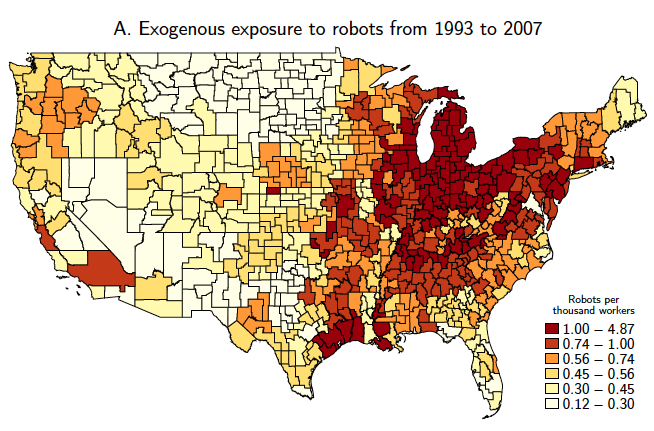
Evidence That Robots Are Winning the Race for American Jobs – in the NYT, pointing to research undertaken by two economists, Acemoglu and Restrepo, published by the (American) National Bureau of Economic Research: Robots and Jobs: Evidence from US Labor Markets (to which I have no access), with a commentary on the Centre for Economic Policy Research‘s Vox site. What is curious for me here is how one can evaluate the method of the researchers and what the assumptions they make say about how we (are invited to) understand automation. There’s some interesting geography in there too! E.g. see the choropleth map of “exogenous exposure to robots” below

How will the rise of automation and AI affect the workforce and economy moving forward? – Francis Fukuyama offers his answer to how automation and AI (interesting easy slip between those as almost a form of equivalence, which is open to significant debate/critique) may or may not “affect” the economy and, in particular, jobs – in the US.

It’s interesting how much of what we are offered in terms of a rationale for automation is a fairly simplistic robots replace workers sort of story. In this regard, it’s worth remembering what the MacDonalds CEO Ed Rensi flippantly observed as a canonical example (documented in this post on Fusion):

former McDonald’s CEO Ed Rensi made news by going on Fox Business and declaring that ongoing protests in the campaign for a $15 minimum wage were encouraging the automation of fast food jobs. The segment goes on for seven minutes, but here’s the meat of it:

I was at the National Restaurant Show yesterday and if you look at the robotic devices that are coming into the restaurant industry – it’s cheaper to buy a $35,000 robotic arm than it is to hire an employee who’s inefficient making $15 an hour bagging French fries – it’s nonsense and it’s very destructive and it’s inflationary and it’s going to cause a job loss across this country like you’re not going to believe

Nevertheless, other economists will tell you that processes of automation have, historically, created new kinds of jobs as they apparently ‘destroy’ others. For example, Deloitte, in their report “Technology and People: The great job creating machine“, suggest that while manual labour and routine jobs have been significantly automated since 1992, there has been an even larger growth in ‘care’ (and service) and ‘cognitive’ work in the UK labour market. So you see fewer people in manufacturing but more analysts, baristas and carers.

Of course, to see it as whole “jobs” that are being automated is somewhat misleading – another aspect of the automative imaginary that owes more to the depiction of automation in 1950/60s cartoons than in the actually existing forms of automation. As many commentators point out, it’s parts of jobs or tasks that become automated, which results in a need to reorganise that work. As the management consultants McKinsey point out in a report in 2016:

currently demonstrated technologies could automate 45 percent of the activities people are paid to perform and that about 60 percent of all occupations could see 30 percent or more of their constituent activities automated, again with technologies available today

What we tend to focus on is the automation full stop, not that it isn’t all of a job and may not result in an easy equivalence of “robot in = worker out”. We imagine the robots doing it all, when, in many cases, the use of robots (when they’re actually economically viable – they have a huge initial set-up cost) require a reorganisation of systems such that the work looks different.

Another illustration of this comes from the excellent Containers podcast by Alexis Madrigal. In the final episode, Madrigal talks to Karen Levy of Cornell  about the forms automation could take in relation to truck driving (upon which Uber clearly has its sights set). Of course, again, it’s not as simple as: automate the lorries, do-away with jobs. It’s more like the process of containerisation that Madrigal is exploring – automation is as much about reorganising systems of work / labour as it is about ‘replacing’ labour. So, in the example of picking in warehouses – you might get a Kiva or Fetch/Freight robot to do the donkey work of warehousing, with the worker performing the more sophisticated movements. This is not a future of people-less spaces but rather robots following people around or being tasked in order to support the worker, the argument being this leads to greater productivity. In fact, in the eighth episode of Containers, the CEO of Fetch Robotics justifies her company’s tech by saying that, in the US, there are over 600k jobs going unfilled in warehousing and manufacturing because people don’t want to do them, with a turnover rate of those who do sign-up for such work at around 25% (I don’t know the basis or veracity of those numbers – would like to though!). Again, if true, such figures are another aspect of the expectations of what work involves and how it may be performed.

So, it seems to me we need to talk about work not simply elide it by (somewhat hysterically) referring to ‘automation’ and ‘robots’. This is something I hope to research and write more about, if I ever get the time…

A few cultural geographies of tech

As it’s/they’re now a sort of trend, here’s a few recently published papers that offer some  cultural geographies of tech…

Being in a mediated world: self-tracking and the mind–body–environment

Sarah Pink, Vaike Fors

Self-tracking is an increasingly ubiquitous everyday activity and therefore is becoming implicated in the ways that everyday environments are experienced and configured. In this article, we examine theoretically and ethnographically how the digital materiality of these technologies mediates and participates in the constitution of people’s tacit ways of being in the world. We argue that accounting for the presence of such technologies as part of everyday environments in this way offers new insights for non-representational accounts of everyday life as developed in geography and anthropology and advances existing understandings of these technologies as it has emerged in sociology and media studies.

The GoPro gaze

Phillip Vannini, Lindsay M Stewart

During 2014–2015, we produced a short video documentary, titled The Art of Wild, which focused on the audiovisual practices of outdoor adventurers. This short written report reflects on an idea inspired by the video: the GoPro gaze. Enacted by increasingly sophisticated, portable and affordable recording audiovisual technologies such as the GoPro Hero camera, the ‘GoPro gaze’ entails not just the pursuit of pleasures derived from adventure and nature-based travel, but also the production and distribution of professional-quality independent videos for Internet audiences. Based on a series of ‘go-along’ interviews with adventure travelers/athletes/artists, this article and the accompanying video prompt us to reflect on how the affective pleasures and technological affordances of the ‘GoPro gaze’ trouble the established idea of the ‘tourist gaze’.

The lit world: living with everyday urban automation

Sarah Pink & Shanti Sumartojo

In this article, we develop and advance the concept of the lit world by bringing together literatures about everyday lighting, automation in everyday life and human perception, along with our ethnographic research into people’s experience of automated lighting in Melbourne, Australia. In doing so we formulate and argue for an approach to automation that situates it as part of everyday mundane worlds and acknowledges its entanglement with the emergent and experiential qualities of everyday environments as they unfold. We demonstrate this through the example of automated lighting, understood as a situated technology that has contingent effects and participates in the making of particular ways of seeing and feeling the world. We thereby argue for an account of automation that reaches beyond its potential for the management of human (and other) behaviour, to ask how the qualities and affordances of automated technologies might seep out of their intended domains, and create new perceptual and experiential opportunities. In a context where automation is increasingly prevalent in everyday life, such attention to the experience and use of automated technologies which already exist on a large scale is needed. Urban lighting is an example par excellence of automation in the world because it has a long history beyond the recent association of automated technologies with code and digital infrastructures. As scholars debate how automated technologies will become part of our future digital lives, understanding how people live in a lit world offers a starting point for considering how we might live with other anticipated algorithmic forms of automation.

Songs “written by AI” from SonyCSL

Songs written by Sony CSL’s “AI”…

From the Sony CSL “flow machines” website:

Flow Machines is a research project funded by the European Research Council (ERC) and coordinated by François Pachet (Sony CSL Paris – UMPC).

The goal of Flow Machines is to research and develop Artificial Intelligence systems able to generate music autonomously or in collaboration with human artists.
We do so by turning music style into a computational object. Musical style can come from individual composers, for example Bach or The Beatles, or a set of different artists, or, of course, the style of the musician who is using the system.

Their “Deep Bach” thing was doing the rounds at the end of last year, so I presume there will be more to come.

Reblog> Accident tourist – driverless cars and ethics

Automated taxi figure in the 1990 film Total Recall

An interesting and well-written piece over on Cyborgology by Maya from Tactical Tech Collective (amongst many other things!)

I particularly like these bits copied below, but please read the whole post.

Accident Tourist: Driverless car crashes, ethics, machine learning

…I imagine what it may be like to arrive on the scene of  a driverless car crash, and the kinds of maps I’d draw to understand what happened. Scenario planning is one way in which ‘unthinkable futures’ may be planned for.

The ‘scenario’ is a phenomenon that became prominent during the Korean War, and through the following decades of the Cold War, to allow the US army to plan its strategy in the event of nuclear disaster. Peter Galison describes scenarios as a “literature of future war” “located somewhere between a story outline and ever more sophisticated role-playing war games”, “a staple of the new futurism”. Since then scenario-planning has been adopted by a range of organisations, and features in the modelling of risk and to identify errors. Galison cites the Boston Group as having written a scenario – their very first one-  in which feminist epistemologists, historians, and philosophers of science running amok might present a threat to the release of radioactive waste from the Cold War (“A Feminist World, 2091″).

The applications of the Trolley Problem to driverless car crashes are a sort of scenario planning exercise. Now familiar to most readers of mainstream technology reporting, the Trolley problem is presented as a series of hypothetical situations with different outcomes derived from a pitting of consequentialism against deontological ethics. Trolley Problems are constructed as either/or scenarios where a single choice must be made.

[…]

What the Trolley Problem scenario and the applications of machine learning in driving suggest is that we’re seeing a shift in how ethics is being constructed: from accounting for crashes after the fact, to pre-empting them (though, the automotive industry has been using computer simulated crash modeling for over twenty years); from ethics that is about values, or reasoning, to ethics as based on datasets of correct responses, and, crucially, of ethics as the outcome of software engineering. Specifically in the context of driverless cars, there is the shift from ethics as a framework of “values for living well and dying well”, as Gregoire Chamayou puts it, to a framework for “killing well”, or ‘necroethics’.

Perhaps the unthinkable scenario to confront is that  ethics is not a machine-learned response, nor an end-point, but as a series of socio-technical, technical, human, and post-human relationships, ontologies, and exchanges. These challenging and intriguing scenarios are yet to be mapped.

Coincidentally, in the latest Machine Ethics podcast (which I participated in a while ago), Joanna Bryson discusses these issues about the bases for deriving ethics in relation to AI, which is quite interesting.

Reblog> We need to tell better stories about our surveilled future[s]

Via Cyborgology.

“We need to tell more diverse and realistic stories about AI,” Sara Watson writes, “if we want to understand how these technologies fit into our society today, and in the future.”

Watson’s point that popular narratives inform our understandings of and responses to AI feels timely and timeless. As the same handful of AI narratives circulate, repeating themselves like a befuddled Siri, their utopian and dystopian plots prejudice seemingly every discussion about AI. And like the Terminator itself, these paranoid, fatalistic stories now feel inevitable and unstoppable. As Watson warns, “If we continue to rely on these sci-fi extremes, we miss the realities of the current state of AI, and distract our attention from real and present concerns.”

Watson’s criticism is focused on AI narratives, but the argument lends itself to society’s narratives about other contemporary worries, from global warming to selfies and surveillance. On surveillance, Zeynep Tufekçi made a similar point in 2014 about our continued reliance on outdated Orwellian analogies (hi 1984) and panoptic metaphors.

Resistance and surveillance: The design of today’s digital tools makes the two inseparable. And how to think about this is a real challenge. It’s said that generals always fight the last war. If so, we’re like those generals. Our understanding of the dangers of surveillance is filtered by our thinking about previous threats to our freedoms. But today’s war is different. We’re in a new kind of environment, one that requires a new kind of understanding. [“¦]

To make sense of the surveillance states that we live in, we need to do better than allegories [1984] and thought experiments [the Panopticon], especially those that derive from a very different system of control. We need to consider how the power of surveillance is being imagined and used, right now, by governments and corporations.

We need to update our nightmares.

Read the whole post.

Reblog> the Ideology behind the gig economy

Deliveroo cyclists

Via John Naughton.

The ideology behind the gig economy

Jia Tolentino has a very good piece in the New Yorker about the ideology that underpins the gig economy. The piece opens with the story of Mary, a Lyft driver in Chicago who kept accepting rides even though she was nine months pregnant – and even kept going when her contractions began!

In the end, it ended well. Mary had a customer who only needed a short ride, so she was able to drive herself to hospital after dropping him off. Once there, she gave birth to a baby girl – who appears on the company blog wearing a “Little Miss Lyft” onesie.

The point of the company blog post is to laud the spirit of workers like Mary. But, writes Tolentino,

It does require a fairly dystopian strain of doublethink for a company to celebrate how hard and how constantly its employees must work to make a living, given that these companies are themselves setting the terms. And yet this type of faux-inspirational tale has been appearing more lately, both in corporate advertising and in the news. Fiverr, an online freelance marketplace that promotes itself as being for “the lean entrepreneur”–as its name suggests, services advertised on Fiverr can be purchased for as low as five dollars–recently attracted ire for an ad campaign called “In Doers We Trust.” One ad, prominently displayed on some New York City subway cars, features a woman staring at the camera with a look of blank determination. “You eat a coffee for lunch,” the ad proclaims. “You follow through on your follow through. Sleep deprivation is your drug of choice. You might be a doer.”

Quite so. Lyft drivers in Chicago earn about $11 per trip.

Perhaps, as Lyft suggests, Mary kept accepting riders while experiencing contractions because “she was still a week away from her due date,” or “she didn’t believe she was going into labor yet.” Or maybe Mary kept accepting riders because the gig economy has further normalized the circumstances in which earning an extra eleven dollars can feel more important than seeking out the urgent medical care that these quasi-employers do not sponsor. In the other version of Mary’s story, she’s an unprotected worker in precarious circumstances.

Spot on.