Call for Papers: “Charting trans and posthumanist imaginaries in future-making”

Rachael in the film Blade Runner

via SERRC.

Call for Papers: “Charting trans and posthumanist imaginaries in future-making”
(see Panel 53: http://sipsheff17.group.shef.ac.uk/index.php?option=24)Science in Public Conference, University of Sheffield 10th-12th July, 2017
Emilie Whitaker, University of Salford, e.m.whitaker@salford.ac.ukThe call for papers closes April 18, 2017.

Posthumanism and transhumanism are two emerging cultural movements that use recent developments in science and technology to challenge, in rather different ways, conventional conceptions of the human condition. Originally seen as more aligned with science fiction than science fact, they now straddle the divide, helped along with increasing media attention and capital investment. Whilst posthumanism continues to be theoretically explored within the social sciences and humanities, transhumanism remains an outlier to the academy. This is despite developments in science and technology which decouple traditional understandings of human/non- human action, agency, labour and capital. In this respect, both trans and posthumanism come very well adapted to our ‘post-truth’ times. We welcome submissions on this general theme, including the following topics:

  • Post- vs trans- humanist projections of the future of humanity, both utopic and dystopic
  • The appeal to post- and trans- humanist ideas and images in the general culture
  • Scientific bases – or not – for post- and trans- humanist knowledge claims
  •  The influence – or not – of post- and trans- humanist views on public policy
  • The place of capitalism in post- and trans- humanist imaginaries
  • The place of post- and trans- humanism in the academy: Do they bridge the ‘Ëœtwo cultures’?
  • How trans and post humanism conceive of the place of democracy in guiding the future
  • Exploration of how science communication invokes, borrows or rejects trans and posthumanist tropes.

We welcome ‘alternative’ contributions – for example, short pieces of prose or extracts of speculative near-future fiction – as well as empirically-based findings papers. We are also particularly keen to support early career researchers.

Brave new-old world – gig economy as scientific management

Deliveroo cyclists

They’re gonna be disrupted, yeah! Because your lives are being disrupted, yeah! This is the money you need to live!

An interesting article in the FT: “When your boss is an algorithm“, in which (if you ignore the sort of anthropomorphism of “the algorithm” and its apparently supreme agency) the author,  , draws out the similarity between the claims of efficiency etc. made for ‘gig economy’ -type work platforms, such as Uber and Deliveroo, are very similar to Taylorism:

Algorithmic management” might sound like the future but it has uncanny echoes from the past. A hundred years ago, a new theory called “scientific management” swept through the factories of America. It was the brainchild of Frederick W Taylor … Taylor wanted to replace this “rule of thumb” approach with “the establishment of many rules, laws and formulae which replace the judgment of the individual workman”. To that end, he sent managers with stopwatches and notebooks on to the shop floor. They observed, timed and recorded every stage of every job, and determined the most efficient way that each one should be done. “Perhaps the most prominent single element in modern scientific management is the task idea,” Taylor wrote in his 1911 book The Principles of Scientific Management. “This task specifies not only what is to be done but how it is to be done and the exact time allowed for doing it.”

Exemplified by the following excerpt articulating the experience of a Deliveroo driver, Kyaw, which is, in turn, of course similar to the kinds of working conditions of other delivery drivers and Amazon warehouse pickers (as has been covered widely in the press)…

Kyaw whips out his phone. The app expects him to respond to new orders within 30 seconds. The screen shows a map and address for the local Carluccio’s, an Italian restaurant chain. A swipe bar says “Accept delivery”. That is the only option. The algorithm will not tell him the delivery address until he has picked up the food from Carluccio’s. Deliveroo couriers are assigned fairly small geographic areas but Kyaw says sometimes the delivery address is way outside his allocated zone. You can only decline an order by phoning the driver support line. “They say, ‘No, you have to do it, you already collected the food.’ If you want to return the food to the restaurant they mark it as a driver refusal – that’s bad.”

Automation in financial services and the ongoing re-imagination of work

From Technology outsmarts the human investor – FT

“It just gets harder and harder and harder,” reflected one money manager this week. His is the predicament of other professionals – anything done by a person that follows a pattern and can be coded into a form that a computer understands will soon get squeezed. Technology also has the advantage identified in 1970: algorithms stay constantly alert.

It does not imply the complete death – or automation – of the investment manager. A professional can still undertake original research on a company or a security that provides insight. As more of the market becomes automated, originality becomes rarer and more valuable: an idiosyncratic investor should achieve higher returns by standing out from the robotic crowd.

Nor can algorithmic efficiency be wholly divorced from human intelligence, as the Oregon study showed – the point was that humans needed to set parameters for computers to follow. Many asset managers use analysts and researchers to build investment models that then trade securities automatically; others blend their active risk-taking with passive elements.

…

But these difficulties demonstrate how automation eats into professions, not by taking away all the jobs in one day but by unbundling them – dividing them between tasks that only humans can perform and those of which an algorithm is quite capable. Then the boundary relentlessly shifts.

The last paragraph is key – there seems to be a growing consensus that automation doesn’t simply ‘destroy’ jobs, it makes particular aspects of or kinds of role redundant and the implementation and development of automated systems requires the remaining workers to fit around those systems in different ways. In many ways, then, automation is a company or institution-specifc organisational or administrative problem as well as a wider political economic problem.

Echoborg

Former colleagues of mine at UWE are developing an interesting project, which you may have seen/heard about through the BBC’s Click programme, called Echoborg.

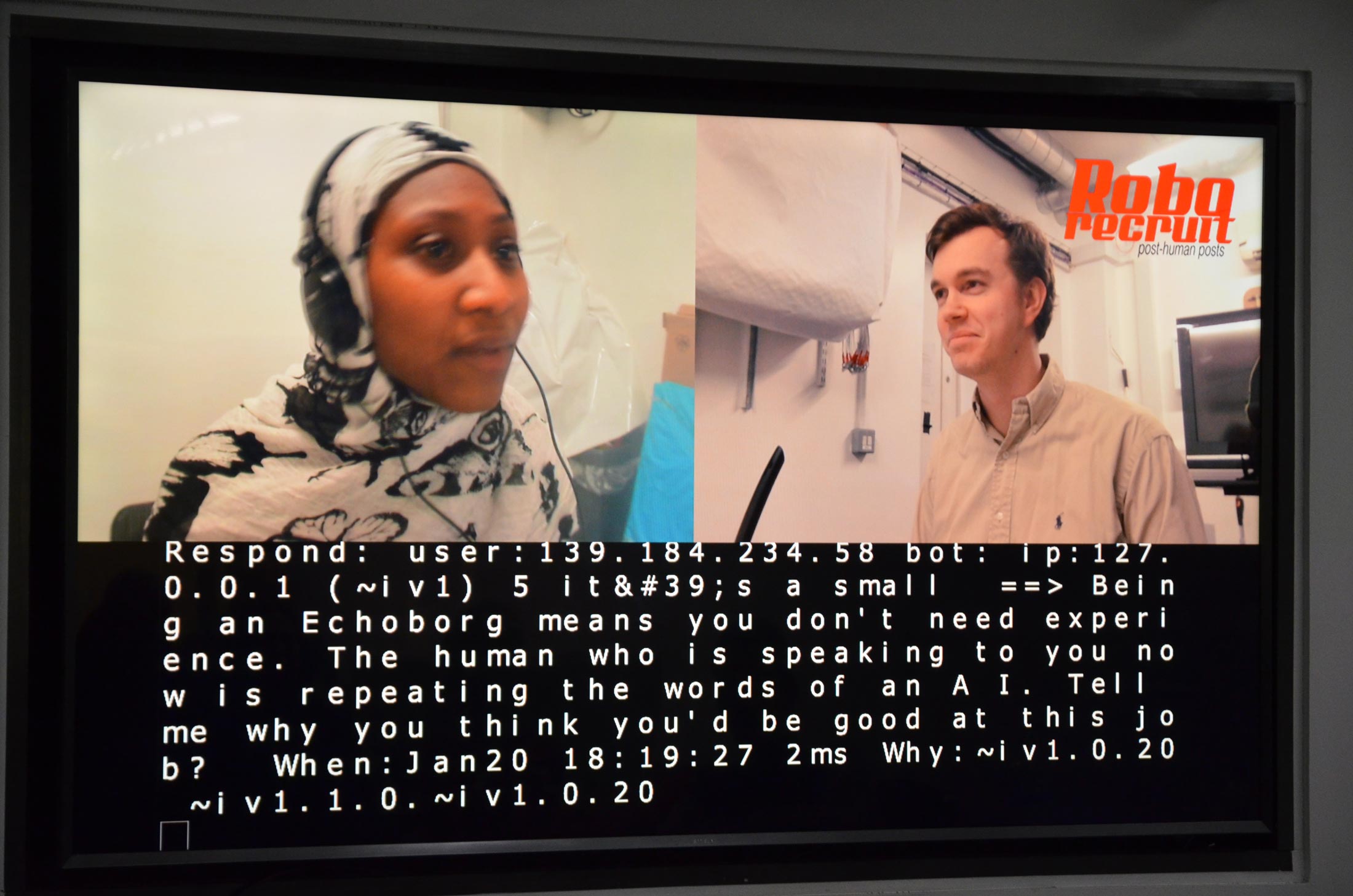
An echoborg is a hybrid agent composed of the body of a real person and the “mind” (or, rather, the words) of a conversational agent; the words the echoborg speaks are determined by the conversational agent, transmitted to the person via a covert audio-relay apparatus, and articulated by the person through speech shadowing[1].

Recently, the project team have demoed the project as part of an AHRC-funded network on Automation Anxiety and have written this up on the project website, here’s a snippet – it sounds like it is really compelling (I’ve not seen this in action):

Four people were interviewed by the AI which increasingly displayed an interest in eliciting help to reprogram itself. Proceedings were visible on a projector screen and the ‘audience’ of applicants gradually began to discuss the situation of the Echoborg and how to change it. At a certain point their reflections passed a threshold and the group fired into collective action, experimenting with various methods to bring the situation to a head in some way. The lively inventiveness of the group and the individual interviewees went a long way to confirming the interactive potential of this format of the work. It also gave Rik and Phil much to work with in considering the further development of the AI/Chatbot, the restricted delivery of narrative by the human Echoborg and the staging. This event also trialled a secondary, higher level, Echoborg character as part of the slow process of unfolding the potential for this Echoborg recruitment event to be a disruptive and thought and emotion provoking experience for all players.

Notes

  1. Corti, Kevin and Gillespie, Alex (2015) Offscreen and in the chair next to you: conversational agents speaking through actual human bodies. Lecture Notes in Computer Science, 9238 . pp. 405-417.

When design fiction becomes the advert(?) Amazon Go and the refiguring of trust

I think I’ve been late to this. I saw the story about Barclaycard wanting to do “cardless” credit cards but, of course, Amazon want to vertically integrate. See the first video below. Interesting that this is incredibly similar to previous ‘envisionings’ of “the future” of retail/shopping. The first thing I thought was: ‘hang on, this is  Microsoft circa 2004’, see the second video below… and I’m sure there’s been others, not least from the likes of HP Labs… I wonder where patents lie on this stuff, cos that will be a big bargaining chip.

This is interesting though insofar as, when I was writing about the Microsoft Office Labs videos in 2008/9, the ‘future’ they figured was always positioned at some distance, it was certainly not explicitly stated that this is something you should definitely expect to happen, more a kind of ‘mood music’ to capture some sensibilities of a possible future, by representing it and hooking ideas into our general  imagination of technology and society. It certainly plays on the trope of the normalisation of heavy surveillance… what else can such a system be?

The Amazon Go video is an interesting confluence of lots of contemporary trends in attempts to refigure how we imagine digital technology. Implicit in the video is a normalisation of yet-more automation (of payment, of trust). Explicit here, as already mentioned, is that these kinds of places are not ‘private’ in any way – the system “knows” you, will know your habits, manages your money and that’s ok, in fact – it’s apparently preferable (trust, again).

Amazon seem to be fairly aggressively pushing this, taking the smooth apparently effortless aesthetics of many tech design fiction videos and using this as a means to capture the idea that such technology = Amazon. Apparently there is a “beta” shop in Seattle (where else?). No doubt someone will already be writing a journal article about this as code/space and, of course it is (and just as Kitchin & Dodge suggest about airports – I wouldn’t want to be in this shop when the servers go down), but I think the thing I find more interesting is that it seems to me that this is perhaps an overtly political manoeuvre to capture the public story about what ‘currency’ is and how payment works when we take for granted higher levels of automation, through what kinds of institution and who we can trust. This is quite a different story to the blockchain, Amazon seem to be saying “let us handle the trust issue” – a pitch usually made by a bank, or PayPal…  That might be interesting to think about (I’m sure people, like Rachel O’Dwyer, already are), not least in relation to other ways ‘trust’ is being addressed (and attempts are being made to refigure it) by other companies, institutions and groups.

All this means I’ll definitely be re-writing my lecture about money for the next iteration of my “Geographies of Technology” module next term…

Do ‘robots’ replace (‘human’) jobs?

prof-automation

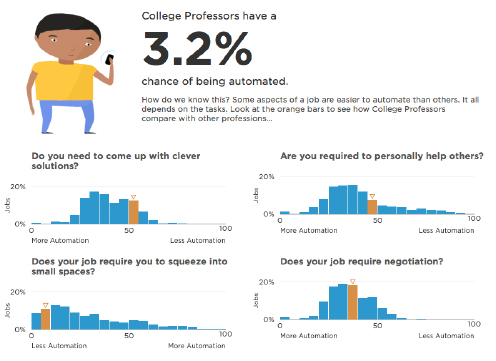
‘Robots’ (or automated systems for manufacturing and distribution) seem to be on-trend amongst social scientists[1] (following on the heels of economists [especially those trying to peddle reports predicting futures] and tech evangelists), so here’s a deceptively simple question:

Do ‘robots’ (i.e. automation) replace/destroy jobs?

Lots of coverage across various media will give you an answer that is pretty much a categorical ‘yes’. In specific industries this is true, up to a point. It is true that jobs in specific manufacturing firms that bring in ‘robots’ do become redundant.

As this AP story on Yahoo (based on bits from Rand and some academic economists) suggests: “General Motors, for instance, now employs barely a third of the 600,000 workers it had in the 1970s. Yet it churns out more cars and trucks than ever.” However, as another bit of economic research from Deloitte attests that between 1992 & 2014 total employment rose by 23%. Indeed, academic economists Georg Graetz and Guy Michaels argue in a paper that “robots had no significant effect on total hours worked, [however] there is some evidence that they reduced the hours of both low-skilled and middle-skilled workers”.

So, what of this apparent paradox? Well, apparently, the jobs being replaced by automated processes are in specific sectors and at the same time those processes have removed jobs we have had a larger growth in other sectors, such as care (at least according to Deloitte). Bodily energy, in the wielding of a hammer etc. has been replaced by an automated machine process but various ‘caring’, ‘cognitive’ and ‘creative’ forms of work have massively grown in number [2].

I’m not an economist and neither can I necessarily verify the numbers and so on, but I am interested in the ways we use this information and these ideas of creation and destruction of jobs/work to tell stories about our social/economic future [3]. We are asked to buy into various forms of technological determinism. A particularly pungent example of this is the ways in which ‘algorithms‘, and the kinds of agency of computer system that word connotes, are said to have particular (mostly problematic or sinister) effects. Following Sally Wyatt’s excellent work on technology development we can point out some of the ways this determinism is functioning:

  1. We can be selectively descriptive in our technological determinism – explain and define specific processes as having an origin and impulse from particular technologies. Here, the story about GM above, is a kind of what Wyatt terms descriptive technological determinism.
  2. We can simply assume the technology leads in a particular direction as a kind of common sense. Many of us cannot imagine life without some of our technological supports: e.g. electric power, artificial light and so on. We already have things like this, so they will surely lead to other (faster, ‘smarter’, more sophisticated etc etc) things. Some robots have existed in manufacturing for some time, so that surely means we will have more, and perhaps in other parts of our life (automated home here we come!). This is a form of what Wyatt terms normative technological determinism.
  3. The most readily understood version of determinism in relation to technology is when we say: “x” will happen because of technology developments (in particular ways). This is rather common in relation to ‘robots’ – for instance Deloitte in another report on “the state of the State” suggest around 865k jobs will be lost to automation by 2030. This is what Wyatt calls justifactory technological determinism.
  4. We have methods for making claims about the world and these make particular kinds of normative and epistemological assumptions about technology development, innovation and use. In this way there are forms of what Wyatt calls methodological determinism (and maybe that’s part of what I’m doing here too).

Of course, this isn’t only about the rationale of future orientation – it is also about the kinds of imagination that rationale both draws upon and produces. If we tell stories about the apparent destruction of working time then we can also tell stories about how that may lead to an increase in leisure time – as JM Keynes famously argued in his Economic Possibilities for Our Grandchildren. 

One of the more interesting arguments in the imagining of an automated future is what a given society should do with the apparent wealth of time freed up by the robots. The ‘universal basic income‘ is one such story – that everyone should be granted a share of the wealth of the productivity gains through the granting of a universal stipend that covers the basic cost of living. Here we enter the realm of (depending on your standpoint) attempting to think beyond capitalism – in the vein of ‘accelerationism‘ and so on (and, of course, there are critiques of this).

Like many forms of discussion about the development of technology, the gap in thinking about automation, I think, is  the easy slip into affirming the stories we are told about technological development without questioning the assumptions and rationale of those stories and without attempting to tell our own. For example, while I am a great admirer of Bernard Stiegler’s work I think he falls into this trap when building parts of his narrative about an economy of contribution. It seems to me that there is perhaps some thinking to be done on what I’ve begun to call (for my own thinking purposes) the ‘automative imaginary’, the work it does and the ways it might be put into question.

We, geographers and social scientists, can and should collaborate in the study and development of automation, algorithms, robots, and so forth. However, we should retain our critical stance on all generalised attempts to declare that these technologies and systems have done this or that to young people, leisure time, jobs, and so on. This doesn’t preclude seeing how automating systems can be used to increase what gets measured as productivity, for example as the GM case discussed above does, or to determine behavior, for example as Natasha Schüll does in reference to Las Vegas slot machines. However, such instances usually depend upon a very specific context that we need to unpick. We should speak up for a critical and playful perspective to counter the rise of the apparent certainty that a particular version of modeling will ‘predict’ technological futures. We can and should be provocative [4].

Notes

  1. See for example the articles and upcoming conference sessions on robots in human geography: Social Geography II: Robots, robotic futures, digital\\human\\labour.
  2. It is interesting to note that for a while now, there has been a compelling counter narrative to the ‘robots are taking/will take our jobs’ story, which is a rather more familiar one: globalisation and post-Fordism. This story argue that rather than ‘re-shoring’ manufacturing to automated hi-tech plants, manufacturers are still paying for cheap labour ‘off shore’ and instituting ever leaner practices through ‘supplemental’ (to traditional human labour) robots. Likewise, Amazon, the apparent champion of robotising their processes, have a growing workforce, and have had for several years.
  3. It is depressingly predictable that these claims seem to rely upon the systematic dismissal or forgetting of work more-often-than-not identified as in some way female (such as care work), which has actually significantly grown, when focussing upon traditionally normative male work, like manual labour. Likewise, there is no accounting for the quality of work being generated by automation, which may be badly paid,  more precarious and less regular.
  4. For example: Counting Sheep, The Museum of Contemporary Commodities, Uninvited Guests

Video> Imagining automation – public talk

I gave a talk for the SW Futurists meet up group this week and they’ve recorded the talks. There are two speakers: Lucas Godfrey (Edinburgh) talked about the challenges of creating models of phenomena in the world so that you can automate things. I talked about the politics of the kinds of stories we tell about automation and how they orient our understandings of how automation might function. Both are included in the video but I’ve skipped to the start of my talk below.

Feel free to leave comments, ask questions etc. using the “Comments” function below… this presentation is sort of based on two bits of work about automation that have been developing as academic presentations. The first is about how we tell stories about work in relation to automation, and way we use ‘algorithm’ as a proxy for that idea. The second is about how we imagine what apparently automated/automatic technologies are doing and what they can do. I think both of these things constitute what I’ve come to call an “automative imaginary”… I started out calling this “algorithmic–“, but I don’t think that ‘s what I have ever really meant. I also don’t think, another fashionable term, “robots” is a particularly helpful way to frame the ideas I’m interested in. Anyway, I’m hoping to develop this into a journal article.