CFP The Body Productive

Gilbreth motion studies light painting

Saw this via Twitter. Looks good.

Call for Papers

How are bodies produced under capitalism?

How, in turn, does capitalism make bodies productive?

How is the body (and knowledge of the body) shaped by demands of production, consumption and exchange, and how can these logics be resisted, challenged and overcome?

These are the questions at the heart of François Guéry and Didier Deleule’s Productive Body. First published in French in 1972, The Productive Body asks how the human body and its labour have been expropriated and re-engineered through successive stages of capitalism. The Productive Body challenges us to rethink the relationships between the biological and the social; the body and the mind; power and knowledge; discipline and control. Finally, it invites us to think about the body as a site of resistance and revolutionary potential.

corpsbody

At this one-day, interdisciplinary conference, we invite scholars and activists to assess the contribution of The Productive Body, and to address its relevance as a theoretical tool for understanding and challenging contemporary ideologies of bodily health, efficiency and productivity.

We invite submissions from scholars, activists and artists for 20-minute papers, or 10-minute provocations on the relationships – past and present – between capitalism, work and the body. Collaborative papers are welcome, and proposals for longer workshops and panel discussions will also be considered. Please contact the organisers if you are unsure. Proposals that explore or are inspired by any of the following areas are welcome:

  • Critical responses to Guéry and Deleule – the biological, the social, and the productive
  • Materialist vs. discursive approaches to the history of the body
  • Conceptualising discipline in Marx and Foucault
  • The body as an object of discipline vs. the body as a site of dissent
  • The psychology and corporeality of activism, organising and resistance
  • Hierarchies of gender and race in the division of labour
  • (Re)productive bodies; intimate and emotional labour, sex work, body work
  • How are ideas of health and disability shaped by the demands of wage labour?
  • How do queer bodies disrupt or challenge logics of productivity? How are queer bodies in turn, commodified or appropriated by capital?
  • How do the demands of productivity complicate/interact with the body as a site of intimacy?
  • Biopolitics and neoliberalism
  • Body-machines – technology and automation; robotics, cybernetics and transhumanism; digital surveillance, ‘lifelogging’ and the ‘quantified self’
  • Counterproductive bodies: pre-capitalist, non-capitalist, and post-capitalist bodies

Please send abstracts of no more than 300 words to thebodyproductive@gmail.com by 24th August 2018. Submissions are especially encouraged from graduate students, early-career researchers, and groups typically underrepresented in the academy.

Some more A.I. links

Twiki the robot from Buck Rogers

This post contains some tabs I have had open in my browser for a while that I’m pasting here both to save them in a place I may remember to look and to share them with others that might find them of interest. I’m afraid I don’t have time, at present, to offer any cogent commentary or analysis – just simply to share…

Untold AI - Christopher NoesselUntold A.I. – “What stories are we not telling ourselves about A.I?”, Christopher Noessel: An interesting attempt to look at popular, sci-fi stories of A.I. and compare them to contemporary A.I. research manifestos and look at where we might not be telling ourselves stories about the things people are actually trying to do.


The ethics of crashes with self?driving cars: A roadmap – Sven Nyholm: A two-part series of papers [one and two ($$) / one and two (open)] published in Philosophy Compass concerning how to think through the ethical issues associated with self-driving cars. Nyholm recently talked about this with John Danaher on his podcast.

Cognitive Bias CodexWEF on the Toronto Declaration and the “cognitive bias codex”: A post on the World Economic Forum’s website about “The Toronto Declaration on Machine Learning” on guiding principles for protecting human rights in relation to automated systems. As part of the post they link to a nice diagram about cognitive bias – the ‘cognitive bias codex‘.

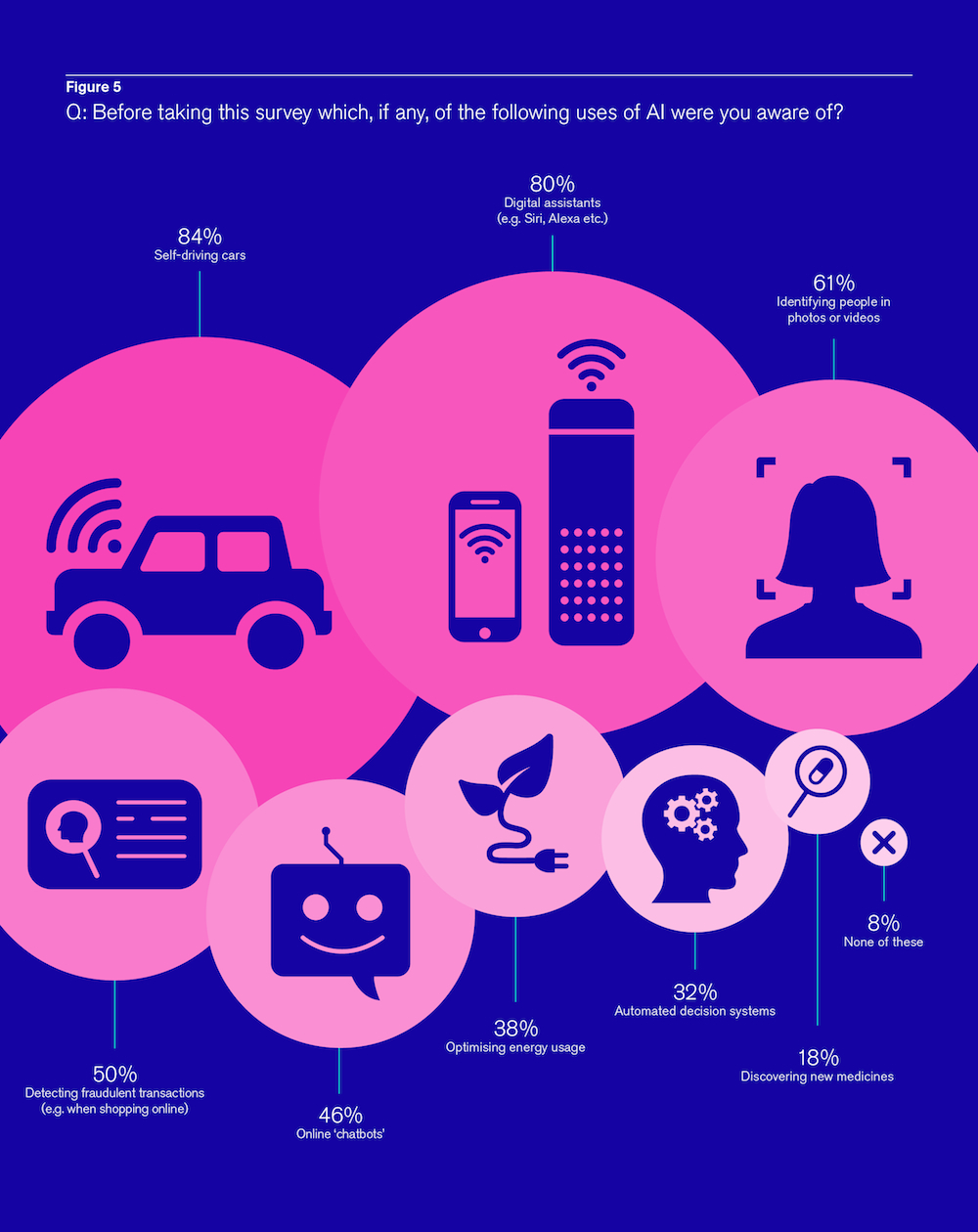
RSA public engagement with AI reportRSA report on public engagement with AI: “Our new report, launched today, argues that the public needs to be engaged early and more deeply in the use of AI if it is to be ethical. One reason why is because there is a real risk that if people feel like decisions about how technology is used are increasingly beyond their control, they may resist innovation, even if this means they could lose out on benefits.”

artificial unintelligence - broussardArtificial Unintelligence, Meredith Broussard: “In Artificial Unintelligence, Meredith Broussard argues that our collective enthusiasm for applying computer technology to every aspect of life has resulted in a tremendous amount of poorly designed systems. We are so eager to do everything digitally—hiring, driving, paying bills, even choosing romantic partners—that we have stopped demanding that our technology actually work.”

Data-driven discrimination: a new challenge for civil society: A blogpost on the LSE ‘Impact of Soc. Sci.’ blog: “Having recently published a report on automated discrimination in data-driven systems, J?drzej Niklas and Seeta Peña Gangadharan explain how algorithms discriminate, why this raises concerns for civil society organisations across Europe, and what resources and support are needed by digital rights advocates and anti-discrimination groups in order to combat this problem.”

‘AI and the future of work’ – talk by Phoebe Moore: Interesting talk transcript with links to videos. Snippet: “Human resource and management practices involving AI have introduced the use of big data to make judgements to eliminate the supposed “people problem”. However, the ethical and moral questions this raises must be addressed, where the possibilities for discrimination and labour market exclusion are real. People’s autonomy must not be forgotten.”

Government responds to report by Lords Select Committee on Artificial Intelligence: “The Select Committee on Artificial Intelligence receives the Government response to the report: AI in the UK: Ready, willing and able?, published on 16 April 2018.”

How a Pioneer of Machine Learning Became One of Its Sharpest Critics, Kevin Hartnett – The Atlantic: “Judea Pearl helped artificial intelligence gain a strong grasp on probability, but laments that it still can’t compute cause and effect.”

Practising speculation and tech futures

Glitched AT&T 1990s advert

I’ve had a sort of moment of realisation this morning that a bunch of tabs I’ve had open, saved, reopened (etc etc) for the past few months are all more-or-less about doing speculative work around A.I., automation and suchlike.

This is interesting for me cos I wrote a PhD (and I am by no means the only one) about rationales for and forms of speculative practice in computing R&D (my fieldwork for this was, soberingly, now approximately ten years ago). It’s also interesting cos I have, in the last eight or so years, pitched for funding to do this sort of work and miserably failed three times.

I think what interests me most is the ways in which story telling is more-or-less the method. I’m not sure how good we are at this, as academics. There’s some good work that analyses speculative things, such as architects visualisations, but I’m not sure I’ve seen much work doing speculation that is not design-oriented. I am not seeking to criticise speculative design practices, I really admire that work, I just wonder if there is a way of de-centring the ‘design’ bit to engage in broader forms of ‘speculation’. I’m also not sure how one can tread the line between evoking particular kinds of scenario/ story (or dare I say imaginative geography) and affirming them. Likewise, I don’t think it is sufficient to simply refer to Black Mirror – it’s fun but it’s not the only way of doing speculation about technology (as afrofuturism demonstrates). I don’t think we want to merely replicate the sorts of ‘visioning’ practices of the likes of Microsoft, Samsung or Beko, not because they’re not interesting but because I’d like to think academics doing this kind of thing want to critically reflect on, not simply propose (or impose!), possibilities.  Playful examples that I think are successful include Superflux’s excellent “Uninvited Guests” – though again, this is perhaps more design-oriented: it’s more about the function in relation to the individual rather than the kinds of world that are necessary for those functions to work.

I do not claim any special insight here – I’m curious about speculative methods – they seem to have some analytical/ explanatory/ critical power but also that also seems to be rather hard to negotiate. In practice, I think you may have to be in the right context, and I’m not convinced academic geography is (without quite a bit of work, given particular kinds of disciplinary assumptions and proclivities – happy to be proven wrong!), and you may have to work with non-academic partners in a way I am not skilled in doing. Good examples, I think, are work like Anne’s Counting Sheep project, which is a canonical example of interesting and provocative speculative design. As I’ve said – I’m not so sure about where non-design-oriented work sits and how this is, or can be, done well. I’m interested in some of the attempts anyway, and here’s some examples, listed below.

UPDATE: Sam Hind shared this piece from Warwick concerning issue mapping techniques that allowed for speculative reflection on driverless cars:

Surfacing Social Aspects of Driverless Cars with Creative Methods, Noortje Marres, Rebecca Cain, Ana Gross, Lucy Kimbell and Arun Ulahannan – “The Warwick workshop explored the potential of creative social research methods – such as design research and debate mapping – to surface still hidden social dynamics around the operation of intelligent technologies in everyday environments, and to complement more established approaches to societal testing of these technologies.”

This made me also think of the speculative policy making practices that arose from “Open Policy” work at the British Cabinet Office’s PolicyLab, which I think involved folks from Strange Telemetry and Superflux.


Crafting stories of technology and progress: five  considerations, Cian O’Donavan & Johan Schot – From Technology Stories the website of the Society for the History of Technology comes this brief post that refers to the longer report from the International Panel on Social Progress concerning the fairly classic Science and Technology Studies issue of how to tell stories about “progress” without necessarily resorting to (unreflexive) forms of determinism. There are four ‘stories’ by several researchers linked from this article that address a number of issues:

Economic Science Fictions, edited by William Davies – I’m not really sure why the “science” is in the title but there we go… From the blurb: “Rooted in the sense that our current economic reality is no longer credible or viable, this collection treats our economy as a series of fictions and science fiction as a means of anticipating different economic futures.”

Designing the future, Justin Reynolds – reviews the above book on the New Socialist site, with some interesting commentary.

Future Perfect conference/event, coordinated by Data & Society – characterised as “speculative fiction in the public interest” this event was first run in 2017 as an invitation-only thing but had an open call in 2018. From the 2018 event blurb: “Future Perfect is an annual workshop and conference dedicated to different approaches to understanding, living in, and challenging dominant narratives of speculative fiction in a time where powerful actors in technology and politics treat the future like a foregone conclusion.”

Robot Futures, Illah Reza Nourbakhsh – “Future robots will have superhuman abilities in both the physical and digital realms. They will be embedded in our physical spaces, with the ability to go where we cannot, and will have minds of their own, thanks to artificial intelligence. In Robot Futures, the roboticist Illah Reza Nourbakhsh considers how we will share our world with these creatures, and how our society could change as it incorporates a race of stronger, smarter beings.”

Reblog> Internet Addiction watch “Are We All Addicts Now? Video

Twitter

Via Tony Sampson. Looks interesting >

This topic has been getting a lot of TV/Press coverage here in the UK.Here’s a video of a symposium discussing artistic resistance, critical theory strategies to ‘internet addiction’ and the book Are We All Addicts Now? Convened at Central St Martins, London on 7th Nov 2017. Introduced by Ruth Catlow with talks by Katriona Beales, Feral Practice, Emily Rosamond and myself…

@KatrionaBeales @FeralPractice @TonyDSpamson @EmilyRosamond & @furtherfield

Two excellent reflections on ethics in relation to Google’s AI principles

Holly from the UK TV programme Red Dwarf

Two excellent pieces by Anab Jain and Lucy Suchman that I recommend you read if you’re interested in studying technology (not just AI) that reflect upon Google’s announcement of its ‘AI principles’ and its apparent commitment not to work on the US Government’s “project Maven”.

Here’s a couple of quotes that stood out, but you should definitely read both pieces:

Corporate Accountability – Lucy Suchman

The principle “Be accountable to people,” states “We will design AI systems that provide appropriate opportunities for feedback, relevant explanations, and appeal. Our AI technologies will be subject to appropriate human direction and control.” This is a key objective but how, realistically, will this promise be implemented? As worded, it implicitly acknowledges a series of complex and unsolved problems: the increasing opacity of algorithmic operations, the absence of due process for those who are adversely affected, and the increasing threat that automation will translate into autonomy, in the sense of technologies that operate in ways that matter without provision for human judgment or accountability. […]

Tackling the Ethical Challenges of Slippery Technology – Anab Jain

The overriding question for all of these principles, in the end, concerns the processes through which their meaning and adherence to them will be adjudicated. It’s here that Google’s own status as a private corporation, but one now a giant operating in the context of wider economic and political orders, needs to be brought forward from the subtext and subject to more explicit debate.

Given the networked nature of the technologies that companies like Google create, and the marketplace of growth and progress that they operate within, how can they control who will benefit and who will lose? What might be the implications of powerful companies taking an overt moral or political position? How might they comprehend the complex possibilities for applications of their products? […]

How many unintended consequences can we think of? And what happens when we do release something potentially problematic out into the world? How much funding can be put into fixing it? And what if it can’t be fixed? Do we still ship it? What happens to our business if we don’t? All of this would mean slowing down the trajectory of growth, it would mean deferring decision-making, and that does not rank high in performance metrics. It might even require moving away from the selection of The Particular Future in which the organisation is currently finding success.

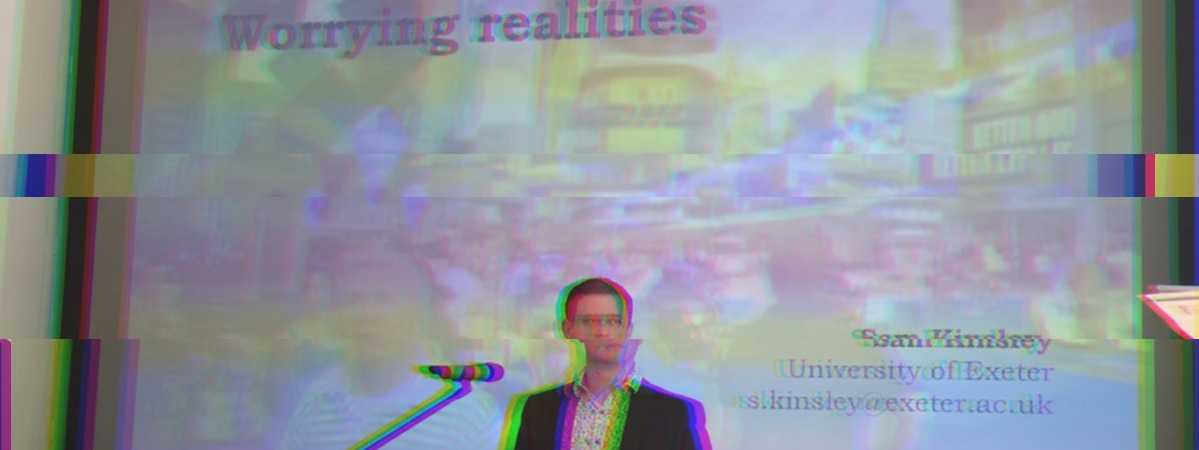
Worrying realities – doing spatial theory for digital geographies

worrying realities - kinsley 2018

I wrote something new… haven’t done that in a while for lots of reasons.

I was compelled to do it because I accepted the kind invitation of colleagues at the wonderful Leibniz Institute for Research on Society and Space for their Spring Academy 2018, themed: “virtuality and socio-materiality”.

I gave a talk called “Worrying realities – doing spatial theory for digital geographies”. In the talk I concerned myself, and maybe those listening, with the ways in which forms of spatial theory get ‘done’ in relation to ‘digital’ or ‘virtual’ phenomena, sometimes generalised as proper nouns… ‘the digital’ and so on. I was not interested, and I still am not, with ‘policing’ the correct theory here, instead I pointed out some habits of theorising space in relation to mediation that I think are interesting and that perhaps those of us interested in doing, talking about and writing about ‘digital geographies’ maybe need to reflect upon sometimes. In particular, I think what Theodore Adorno diagnoses as an ‘ontological need’ pertains, and we perhaps need to be a little more reflexive about how that plays out.

So, I’m sharing a PDF of the slides with the notes I’ve written up. [Now the revised PDF.]

In any case, I don’t know what to do with this… I’d like to write it up, not sure where it would go..? Any comments or arguments, or suggestions for venues to which it might be submitted, are gratefully received 🙂

Please take this material in the spirit in which it is shared – as an attempt to open a conversation. Please also give credit where it’s due – this is not (yet) published but these are my current ideas and I’m sharing them in good faith.

Data materiality – a new project by Scott Rodgers

A huge array of overhead wires on a street

This new project at Birkbeck by Scott Rodgers & Joel McKim looks really interesting:

Data Materiality: collaborative BIRMAC/Vasari project

[…]

Data Materiality

The expanded presence and impact of data, and arrival of so-called Big Data, has become an accepted, background feature of contemporary life. But while data clearly matters, the question arising now is: just how does data come to ‘matter’? What are the sometimes unseen material infrastructures that bring data into being, into circulation and into action? What are the social and political structures, policies and institutions through which data comes to have effects? And what might it mean to think about data – as suggested by Sarah Pink and others – as ‘broken’: as always already implicated in ordinary processes of maintenance and repair?

Data Materiality – a three-year collaborative project co-sponsored by the Birkbeck Centre for Interdisciplinary Research in Media and Culture, and the Vasari Centre for Art and Technology – seeks to address these questions. By data ‘materiality’ we mean not only the ways in which data crystallises into physical forms and depends on material technical and social infrastructures, but also the related ways in which data comes to matter, in and through practical action, collective imaginaries, or biological conditions. So we are interested in questioning the proliferating network of data centres, fibre-optic cables and server farms that underpin our data usage, but we also wish to explore perhaps less tangible or apparent infrastructures of data – materialities that might include, for instance, digital objects and artefacts, from network protocols to markup languages, as well as the labour and organizational structures putting data to work.

Our key aim in exploring data materiality is to get beyond the idea of data as a raw or unprocessed and, as Lisa Gitelman has suggested, understand the ordinary material conditions under which data is induced and deduced. We wish to ask, in other words, how does data leave its traces on the world? And how does the world leave its traces on data?

Read more on Scott’s website.

Reblog> Derrida’s Margins: Inside the personal library of Jacques Derrida

Jacques Derrida

Really interesting… via Stuart Elden.

Derrida’s Margins: Inside the personal library of Jacques Derrida

downloadDerrida’s Margins: Inside the personal library of Jacques Derrida

For Jacques Derrida (1930-2004), reading was an active process: he read texts by thinkers like Rousseau, Heidegger, Lévi-Strauss, Hegel, and Husserl with a writing utensil in hand.  As Derrida affirmed in a late interview, the books in his personal library bear the “traces of the violence of pencil strokes, exclamation points, arrows, and underlining.”

Derrida’s Margins invites scholars to investigate these markings while unpacking the library contained within each of Derrida’s published works, beginning with the landmark 1967 text De la grammatologie (Of Grammatology).  Additional Derrida works will be added as the project continues.

The website catalogues each reference (quotation, citation, footnote, etc.) in De la grammatologie and allows users to explore Derrida’s personal copies of the texts he cites. Due to copyright restrictions, only annotated pages corresponding to references in De la grammatologie are shown here; users may also view external images of each book as well as images of the numerous insertions (post-it notes, bookmarks, calendar pages, index cards, correspondence, notes, etc.) Derrida tipped in to his books.

The website includes the following sections, accessible via the links in the four corners of this page: Derrida’s Library, where users may browse or search Derrida’s copies of the books referenced in De la grammatologie; Reference List, where users may browse or search the nearly one thousand references to other texts found in the pages of De la grammatologie; Interventions, where users may browse or search Derrida’s annotations, marginalia, and markings that correspond to the references in De la grammatologie; and Visualization, which provides users with alternative ways of exploring the references in De la grammatologie.  Users may search a particular section or the entire site at any time by using the search field at the top of every page.  

The Library of Jacques Derrida is housed at Princeton University Library’s Rare Books and Special Collections.