CFP> “VIRAL/GLOBAL Popular Culture and Social Media: An International Perspective” 13th Sept 17 CAMRI

Via Tony Sampson.

“VIRAL/GLOBAL Popular Culture and Social Media: An International Perspective” The University of Westminster Communication and Media Research Institute (CAMRI), Sept 13th 2017

Date:
13 September 2017
Time: 9:00am to 7:00pm
Location: 309 Regent Street Regent Campus, 309 Regent Street, London W1B 2HW – View map

Gone-Viral-event-main-photo

Conference organised by the Communication and Media Research Institute (CAMRI)

Keynote Panel

  • Nancy Baym 
  • Emily Keightley
  • Dave Morley (TBC)
  • Tony D Sampson
  • Paddy Scannell

This interdisciplinary conference aims to examine how and why everyday popular culture is produced and consumed on digital platforms. There is increasing interest in studying and discussing the linkages between popular cultural and social media, yet there exist important gaps when comparing such cultural phenomena and modes of consumption in a global, non-west-centric context. The conference addresses a significant gap in theoretical and empirical work on social media by focusing on the politics of digital cultures from below and in the context of everyday life. To use Raymond Williams’s phrase, we seek to rethink digital viral cultures as ‘a whole way of life’; how ‘ordinary’, everyday digital acts can amount to forms of ‘politicity’ that can redefine experience and what is possible.

The conference will examine how social media users engage with cultural products in digital platforms. We will also be assessing how the relationship between social media and popular cultural phenomena generate different meanings and experiences.

The conference engages with the following key questions:

  • How do online users in different global contexts engage with viral/popular cultures?
  • How can the comparative analysis of different global contexts help us contribute to theorising emergent viral cultures in the age of social media?
  • How do viral digital cultures redefine our experience of self and the world?

We welcome papers from scholars that will engage critically with particular aspects of online popular cultures. Themes may include, but are not limited to, the following:

  • Analysing viral media texts: method and theory
  • Theorising virality: new/old concepts
  • Rethinking popular culture in the age of social media
  • Social media, politicity and the viral
  • The political economy of viral cultures
  • Memes, appropriation, collage, virality and trash aesthetics
  • Making/doing/being/consuming viral texts
  • Hybrid strategies of anti-politics in digital media
  • Viral news/Fake news
  • Non-mainstream music, protest, and political discussion
  • Capitalism and viral marketing

PROGRAMME AND REGISTRATION

This one-day conference, taking place on Wednesday, 13th of September 2017, will consist of a keynote panel and panel sessions. The fee for registration for all participants, including presenters, will be £40, with a concessionary rate of £15 for students, to cover all conference documentation, refreshments and administration costs.

DEADLINE FOR ABSTRACTS

The deadline for abstracts is Monday 10 July 2017. Successful applicants will be notified by Monday 17 July of 2017. Abstracts should be 250 words. They must include the presenter’s name, affiliation, email and postal address, together with the title of the paper and a 150-word biographical note on the presenter. Please send all these items together in a single Word file, not as pdf, and entitle the file and message with ‘CAMRI 2017’ followed by your surname. The file should be sent by email to Events Coordinator Karen Foster at har-events@westminster.ac.uk
Original: https://www.westminster.ac.uk/call-for-papers-viral-global-popular-cultures-and-social-media-an-international-perspective

Songs “written by AI” from SonyCSL

Songs written by Sony CSL’s “AI”…

From the Sony CSL “flow machines” website:

Flow Machines is a research project funded by the European Research Council (ERC) and coordinated by François Pachet (Sony CSL Paris – UMPC).

The goal of Flow Machines is to research and develop Artificial Intelligence systems able to generate music autonomously or in collaboration with human artists.
We do so by turning music style into a computational object. Musical style can come from individual composers, for example Bach or The Beatles, or a set of different artists, or, of course, the style of the musician who is using the system.

Their “Deep Bach” thing was doing the rounds at the end of last year, so I presume there will be more to come.

Coffee etiquette around the world (well some of it)

Interesting post, from a while ago, about the various ways we differently prepare and consume coffee and I guess then how we develop a taste (both gustatory and aesthetic) for coffee…

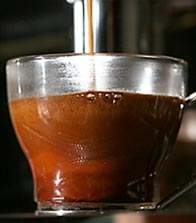
crema

When it comes to dining etiquette, it is different all around the world. From the United States, to Spain, Africa to Japan, the world eats differently. And the world drinks differently too. The myriad ways in which the world drinks coffee is vastly different too. For instance, in India, slurping coffee is normal whereas it’s considered rude in US. In Turkey, your fortune is read from the coffee ground left at the bottom of your cup whereas in Ethiopia, coffee drinking is an hour affair- not a to-go option. Here is a handy guide to help you maneuver through the world’s coffee drinking experience.

COFFEE DRINKING IN ITALY

In Italy, it is common for a glass of water to be served alongside coffee, so that you can cleanse your palate and prepare it for the coffee. Coffee is always ordered after meals, never before or during. Also, espressos are not ordered to go. Espressos are drunk quickly in a shot at the coffee bar. It is also common to have a cappuccino in the morning, and nothing else. It is also common in Italy for liquor to be included in coffee.

COFFEE DRINKING IN TURKEY 

After meals, black Turkish coffee is served strong with sweet Turkish candy. As Turkish coffee is strong, it is never ordered double. If you want more to drink later, then your next order should be tea. Also, sugar is often added while the coffee is made, and not after. Once your coffee is drunk, it is often normal to have your fortune read from the coffee grounds at the bottom of your cup.

COFFEE DRINKING IN FRANCE 

Dunking a croissant in coffee is acceptable in France. Café au lait is normally drunk early in the morning and using a wide mug so it is easier to dunk your croissant in. Coffee mugs can be held with both hands to savor your coffee. In France, never order flavored coffee; never order filtered coffee, and never order coffee with whipped cream. Coffee in France is always served after dessert.

COFFEE DRINKING IN BOSNIA

Coffee preparation in Bosnia is similar to that in Turkey. Coffee is served in a Dzezva, together with sugar cubes, rahat lokum and a glass of water. The proper way to drink your coffee is to take the sugar cube, and let it dissolve under your tongue while you sip the coffee.

COFFEE DRINKING IN VIETNAM

Coffee in Vietnam is served using an individual drip filter. Hot water is poured onto the coffee grounds in the drip filter and the dissolved coffee slowly fills the cup underneath with fresh coffee. Condensed milk and sugar is added into the cup at the bottom.

COFFEE DRINKING IN SPAIN

A very popular drink both in Spain as well as Portugal is called Cortado, which is based off of the espresso. To reduce the acidity of the coffee, a bit of warm milk is added to the coffee. Cortado is drunk for breakfast as well as during La Merienda which is coffee and snack time, usually happens after a siesta.

COFFEE DRINKING IN ETHIOPIA 

Coffee is considered a national drink in Ethiopia and is a long ritual that stretches for two hours. Sugar is added into small cups, and then water is added followed by coffee. It is normal and customary to inhale the aroma of the coffee before sipping it.  Coffee is served in three rounds which are awol, tona and Baraka. When drinking coffee in Ethiopia, it is always sipped slowly and never drunk quickly.

COFFEE DRINKING IN DENMARK

Due to the extremely cold climate during Scandinavian winters, Denmark ranks highest in the world for coffee drinkers. Cafes are usually packed at every street corner especially in Copenhagen. Filter coffee is especially popular in Denmark and is normally eaten with sweet Danish pastries.

Tony Sampson on neuroculture

From a Conversation piece on Huxley, dystopia and how we might think about Facebook etc. in relation to Huxley’s “College of Emotional Engineering”, this concise evocation of his understanding of ‘neuroculture’ is interesting:

The origins of neuroculture begin in early anatomical drawings and subsequent neuron doctrine in the late 1800s. This was the first time that the brain was understood as a discontinuous network of cells connected by what became known as synaptic gaps. Initially, scientists assumed these gaps were connected by electrical charges, but later revealed the existence of neurochemical transmissions. Brain researchers went on to discover more about brain functionality and subsequently started to intervene in underlying chemical processes.

Interpretation of Cajal’s anatomy of a Purkinje neuron, by Dorota Piekorz.

On one hand, these chemical interventions point to possible inroads to understanding some crucial issues, relating to mental health, for example. But on the other, they warn of the potential of a looming dystopian future. Not, as we may think, defined by the forceful invasive probing of the brain in Room 101, but via much more subtle intermediations.

“Post-Internet Art”

Many of the artists represented here are working with digital forms – what’s sometimes called New Media or Post-Internet Art (Internet Art proper is already shelved and classified: it refers to the first, comparatively naive artistic responses to the internet in the 1990s and early 2000s). Post-Internet artists are the first generation to have grown up with mass digital technology, and often with parallel selves on social media (they wouldn’t call it ‘virtual’). They don’t just respond to the internet but often try to use it as a medium.

Alice Sprawls on the LRB blog – read it here.

Affect & Social Media 3.0 CFP

Via Tony Sampson…

Affect and Social Media#3 2nd CFP

main2Call for presentations and artworks

Affect and Social Media#3

experience

engagement 

entanglement                                

Including the Sensorium Art Show (the sequel)

Event Date: Thurs 25th May, 2017

Venue: University of East London, Docklands Campus

Confirmed keynote: Prof Jessica Ringrose (UCL) 

https://iris.ucl.ac.uk/iris/browse/profile?upi=JLRIN58

Call for 15min presentations and artworks

The organizers of A&SM#3 welcome proposals for 15min presentations and artworks that interpret and explore the affective, feely and emotional encounters with social media grasped through the following themes:

  1. Experience
  2. Engagement
  3. Entanglement 

Presentations and artworks can widely interpret each theme, but preference will be given to proposals that respond in two ways.

Firstly, the organizers are particularly interested in creative responses (academic and artistic) to recent social media events – the US election, for example. So proposals might address how the Trump win allows us to develop a fresh understanding of shared experiences, emotional engagements or new entanglements with social media.

Secondly, we ask presenters and artists to consider how their approach to affect and social media can be put to work in an education context. For example, how can the potential of affect theory reach out across teaching practices and develop novel understandings of the political nature and transformative possibilities of teaching.

The academic part of this call is open to experienced scholars, new researchers and postgrad students from across the disciplinary boundaries of affect studies and related areas of study interested in theorizing and working with emotion and feelings in a social media context. We welcome a good mixture of innovative conceptual and methodological approaches.

The Sensorium Art Exhibit will interweave the conference proceedings and bring it to a close with a special show, alongside free drinks and nibbles.

15min presentations and artwork proposals to: t.d.sampson@uel.ac.uk

Please include 200 word max description and short bio including academic affiliation and relevant links to previous work and/or website profile.

DEADLINE: Tues 28th Feb 2017.

Full registration details will be made available from 27th Jan via UEL event page.

https://www.uel.ac.uk/Events/2017/05/Affect-and-Social-Media-3

HyperNormalisation – New Adam Curtis film

Several folk on Twitter last night pointed to the post below on the BBC website. Seems like Adam Curtis is doing a Zizek, at least in the vein of the Perverts Guide to Ideology…

HyperNormalisationAcclaimed filmmaker, Adam Curtis brings his new epic film, HyperNormalisation to BBC iPlayer this October. The film will premiere at 9pm on Sunday 16 October. 

HyperNormalisation tells the extraordinary story of how we got to this strange time of great uncertainty and confusion – where those who are supposed to be in power are paralysed – and have no idea what to do. And, where events keep happening that seem inexplicable and out of control – from Donald Trump to Brexit, the War in Syria, the endless migrant crisis, and random bomb attacks. It explains not only why these chaotic events are happening – but also why we, and our politicians, cannot understand them.

The film shows that what has happened is that all of us in the West – not just the politicians and the journalists and the experts, but we ourselves – have retreated into a simplified, and often completely fake version of the world. But because it is all around us, we accept it as normal.

HyperNormalisation has been made specifically for BBC iPlayer. It tells an epic narrative spanning 40 years, with an extraordinary cast of characters. They include the Assad dynasty, Donald Trump, Henry Kissinger, Patti Smith, the early performance artists in New York, President Putin, intelligent machines, Japanese gangsters, suicide bombers – and the extraordinary untold story of the rise, fall, rise again, and finally the assassination of Colonel Gaddafi.

All these stories are woven together to show how today’s fake and hollow world was created. Part of it was done by those in power – politicians, financiers and technological utopians. Rather than face up to the real complexities of the world, they retreated. And instead constructed a simpler version of the world in order to hang onto power.

But it wasn’t just those in power. The film shows how this strange world was built by all of us. We all went along with it because the simplicity was reassuring. And that included the left and the radicals who thought they were attacking the system. The film reveals how they too retreated into this make-believe world – which is why their opposition today has no effect, and nothing ever changes.

Made me think of:

Reblog> Bite Size Theory [on the presence/absence of mobile phones]

via Pop Theory:

“The presence/absence of mobile phones in one’s fictional worlds is going to be, I suspect, no trivial matter. Because so much of the mechanics of novel writing, past and present, is taken up with making information available to characters or keeping it from them, with getting people together in the same room or holding them apart. If, all of a sudden, everyone has access to more or less everyone else – electronic access, that is – what becomes of all that plotting?”John Coetzee, in Paul Auster and J.M. Coetzee, 2013, Here and Now: Letters 2008-2011.