Finally letting go of Twitter

Twitter

This is by no means a ‘hot’ take, if anything it is a moderately cool one. I finally deleted my Twitter/X accounts. I had several. One for me as an academic, one for a bot I created and one for a module I teach on Digital Geographies.

Loads of people have written about leaving X/Twitter, like journalists and organisations. Many have discussed moving to BlueSky, another very similar social network, linked for a time with one of the creators of Twitter – which in itself is not without issues. Others use Mastodon, but I haven’t found enough people to connect with on there.

I have been using BlueSky a bit. I have a Mastodon account and look occasionally. I also use LinkedIn a bit, as many academics seem to have shifted in that direction. However, with the latter it all feels a bit too much like a stream of announcements of other people being more successful, not that I’m not pleased for them, but its not always good for your own wellbeing. Also, there seems to be a shift to a sort of broadcast mentality, not sure how helpful it is though… This blog auto-posts to those three platforms as well, so maybe I am perpetuating that.

There was a period between around 2010 and 2016(ish) when I took a great deal of comfort and value from the networks I was involved in on Twitter. I was a postdoc between 2010-2013 outside of geography and I made a sort of academic ‘home’ for myself online with colleagues across a number of disciplines. When I joined my current department in 2013, I was part of a team that studied the uses of Twitter in the performance of controversy, in which we detailed some of the forms of community and network –making practices in which I had myself variously engaged. We argued (on p. 117), and I think this still holds:

These mediated communities clearly generate publics in terms of both who and what is being shared or passed on. We argue it is crucial to understand that digital media platforms themselves are performative, and participate in the shaping of a public. Furthermore, we argue that this epistemically situates issue ‘publicisation’ research differently, in novel and perhaps difficult, contexts. Rather than debate, or presuppose, the ontological character of ‘digital’ or ‘online’ debates, we instead attend to the ‘productive confusions’ of mediation.

We find ourselves in all sorts of different contexts, all sorts different ‘publics’, with and through digital platforms and have to puzzle out how to make sense of them. We collectively construct the norms as we go (as Nancy Baym has discussed), and for a time that seemed to work on Twitter, but contexts shift and can (and did!) radically change. The ‘home’ online that many, I think, felt and the sort of ‘public square’ that Twitter may or may not have performed (at least for journalists in the global North) has now gone. It wasn’t all great though. One of the reasons I created GeoCritBot was my frustration with people churning out announcements of papers and projects following what I perceived to be the currently trendy ideas, I was trying to satirise the ‘hot take’ almost identikit approach to quick scholarship. I am really not sure that it worked but it still exists, mostly for posterity.

Sometime it can be a mistake to dwell on the past, but I think it is also worthwhile remembering things that worked. For a brief period I learned from and connected with many others I wouldn’t have otherwise via Twitter and I am thankful for that. I have been lucky enough to be able to re-connect with people in-person at conferences and academic events but that costs money. In these uncertain times, I know that many of us just don’t get those opportunities. So the possibilites for connecting online become a bit more urgent and yet at the same time, in the current geopolitical climate, they have become very fraught. I can imagine that many of us are stumbling along trying to find ways to connect digitally. There’s plenty of scholarship that is addressing these changes out there and I won’t try to review that here. Instead, I simply wanted to (arbitrarily) mark the moment.

So grab your things and stumble into the night
So we can shut the door
And shut the door on terrible times
Oh
Yeah, do it right
And head again into space
So you can carry on
And carry on, and fall all over the place
Home– LCD Soundsystem

Ballet Robotique – popular representations of automation

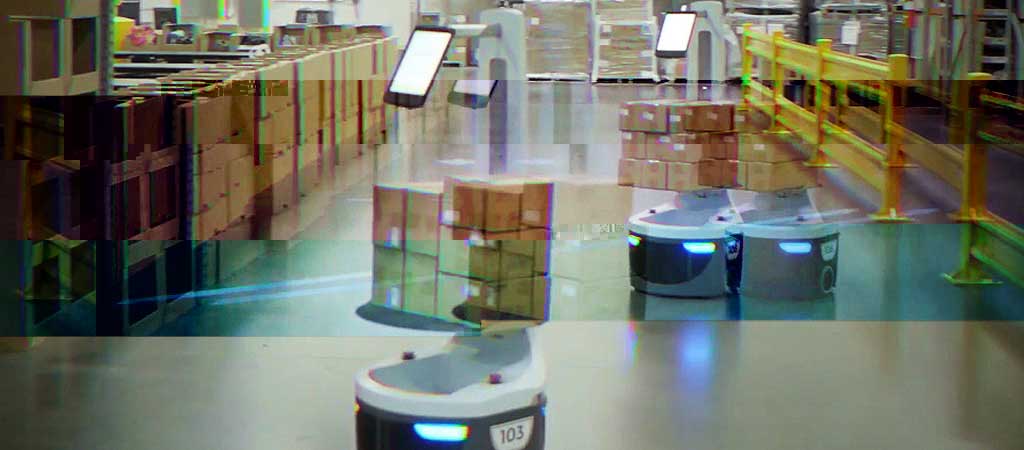
Warehouse robots moving packages

In between doing other things I am trying to maintain a little progress with work on The Automative Imagination. Recently I’ve been looking at (largely Anglophone and/or global North/West) representations of robots or automatons in cinema. There’s some funny examples (I posted a few music video representations some time ago) and it is interesting how humour, and I suppose forms of satire, and artistic representations are an enduring way of getting to grips with whatever we think ‘robots’ might be.

So, for your consideration – I have posted below two interesting pieces I have found recently (to me). I’ll try to write more on this in the near future.

The Automatic Motorist (1911)

Ballet Robotique (1982)

Imagine all the people deepfaked

A person removing a mask

Via Kottke.

This ‘deepfake’ video of lots of current and former world leaders and other famous people is interesting and provokes all sorts of questions. Some suggest legislation against them, which is what the US seems to be pursuing, but that of course asks further questions about how to ‘police’ them and who has agency. There are, perhaps, some interesting resonances with the increasing use of performance holograms to re-animate dead performers – but there, of course, the legal issues are different. Nevertheless, all sorts of ideas, aesthetic, ethical and otherwise, about ‘authenticity’ crop up (e.g. this from New Scientist, or this on trust in ‘evidence’ re ‘deepfakes’), which we will increasingly be provoked into discussing.

It is interesting, I think, that while those of us in what we call ‘critical’ social sciences or humanities have been developing fairly nuanced articulations of identity and subjectivity, arguing they are not necessarily essential and acknowledging how they are performed (for example), contemporary digital/ social media, and our uses of them, have forged new norms of ‘authenticity’ in relation to identity. Facebook wants ‘true’ names, for instance. “Finsta” (‘f’ denoting ‘fake’), the phenomenon of setting up hidden, often pseudonymous, Instagram accounts – only for selected friends (as opposed to your curated “rinsta” account (‘r’ denoting ‘real’)) shows how these two understandings of the performative nature of identity and the construction of a normative insistence on ‘authenticity’ collide. We might reasonably ask, for instance, why the ‘finsta’/’rinsta’ labels don’t actually mean the reverse if the more public of the two accounts is heavily curated and the ‘secret’ one is in some senses then more ‘authentic’.

‘Deepfakes’ are, amongst other things, a sensory ‘trick’, an attempt to somehow fool the conscious and sub-conscious habitual discernment of what feels whatever it is we mean by ‘authentic’, ‘genuine’ or ‘real’. In some senses, ‘deepfakes’ reveal back to us the extent to which digital media may have shifted how we pay attention and how we feel (about ourselves, others and the world around us) with and through them. Digital media cultivate attention in different ways, many of them perhaps oriented towards a capitalist imperative, also, perhaps, with them we cultivate forms of paying attention. If this is the case then, as was argued in terms of the potency of TV advertising, we may begin to ‘see through’ the ‘tricks’ precisely because we are bombarded with them (for example, the Putin bits in the video above are not very convincing to my eye). Or, to be pessimistic, we may simply begin to assume nothing can be trusted, that all media is created in bad faith, which of course prompts discussions of a crisis of democracy because how can a population make informed decisions without ‘trustworthy’ sources.

Sophia – show robots and deception

Hanson Robotics' "Sophia"

…when first we practice to deceive…

Walter Scott

Prof Noel Sharkey has written a thoughtful, informative and entertaining piece for Forbes (so, for a general audience) that does some unpacking of ‘Sophia’ with reference to the history of ‘show robots’ (such as the Westinghouse show robots of the the mid-C20, like Elektro, and of course Honda’s Asimo). It’s worth reading the piece in full but here’s a couple of choice clips:

Sophia is not the first show robot to attain celebrity status. Yet accusations of hype and deception have proliferated about the misrepresentation of AI to public and policymakers alike. In an AI-hungry world where decisions about the application of the technologies will impact significantly on our lives, Sophia’s creators may have crossed a line. What might the negative consequences be? To get answers, we need to place Sophia in the context of earlier show robots.


The tradition extends back to the automata precursors of robots in antiquity. Moving statues were used in the temples of ancient Egypt and Greece to create the illusion of a manifestation of the gods. Hidden puppeteers pulled ropes and spoke with powerful booming voices emitted from hidden tubes. This is not so different from how show robots like Sophia operate today to create the illusion of a manifestation of AI.

For me, the biggest problem with the hype surrounding Sophia is that we have entered a critical moment in the history of AI where informed decisions need to be made. AI is sweeping through the business world and being delegated decisions that impact significantly on peoples lives from mortgage and loan applications to job interviews, to prison sentences and bail guidance, to transport and delivery services to medicine and care.


It is vitally important that our governments and policymakers are strongly grounded in the reality of AI at this time and are not misled by hype, speculation, and fantasy. It is not clear how much the Hanson Robotics team are aware of the dangers that they are creating by appearing on international platforms with government ministers and policymakers in the audience.

Sing the body electric… robots in music videos

Still from the video for All is Love by Bjork

I recently saw the Chemical Brothers new-ish video for the song “Free Yourself”, featuring androids/robots apparently going feral and raving in a warehouse and it made me consciously think about something I’ve known for some time – there are quite a few music videos with ‘robots’ in them. 

So, here’s a very partial collection:

Talk – Plymouth, 17 Oct: ‘New geographies of automation?’

Rachael in the film Blade Runner

I am looking forward to visiting Plymouth (tomorrow) the 17th October to give a Geography department research seminar. It’s been nearly twenty years (argh!) since I began my first degree, in digital art, at Plymouth so I’m looking forward to returning. I’ll be talking about a couple of aspects of ‘The Automative Imagination’ under a slightly different title – ‘New geographies of automation?’ The talk will take in archival BBC and newspaper automation anxieties, management consultant magical thinking (and the ‘Fourth Industrial Revolution’), gendered imaginings of domesticity (with the Jetsons amongst others) and some slightly under-cooked (at the moment) thoughts about how ‘agency’ (what kinds of ‘beings’ or ‘things’ can do what kinds of action).

Do come along if you’re free and happen to be in the glorious gateway to the South West that is Plymouth.

(More) Gendered imaginings of automata

My Cayla Doll

A few more bits on how automation gets gendered in particular kinds of contexts and settings. In particular, the identification of ‘home’ or certain sorts of intimacy with certain kinds of domestic or caring work that then gets gendered is something that has been increasingly discussed.

Two PhD researchers I am lucky enough to be working with, Paula Crutchlow (Exeter) and Kate Byron (Bristol), have approached some of these issues from different directions. Paula has had to wrangle with this in a number of ways in relation to the Museum of Contemporary Commodities but it was most visible in the shape of Mikayla, the hacked ‘My Friend Cayla Doll’. Kate is doing some deep dives on the sorts of assumptions that are embedded into the doing of AI/machine learning through the practices of designing, programming and so on. They are not, of course, alone. Excellent work by folks like Kate Crawford, Kate Devlin and Gina Neff (below) inform all of our conversations and work.

Here’s a collection of things that may provoke thought… I welcome any further suggestions or comments 🙂

Alexa, does AI have gender?


Alexa is female. Why? As children and adults enthusiastically shout instructions, questions and demands at Alexa, what messages are being reinforced? Professor Neff wonders if this is how we would secretly like to treat women: ‘We are inadvertently reproducing stereotypical behaviour that we wouldn’t want to see,’ she says.

Prof Gina Neff in conversation with Ruth Abrahams, OII.

Predatory Data: Gender Bias in Artificial Intelligence

it has been reported that female-sounding assistive chatbots regularly receive sexually charged messages. It was recently cited that five percent of all interactions with Robin Labs, whose bot platform helps commercial drivers with routes and logistics, is sexually explicit. The fact that the earliest female chatbots were designed to respond to these suggestions
deferentially or with sass was problematic as it normalised sexual harassment.

Vidisha Mishra and Madhulika Srikumar – Predatory Data: Gender Bias in Artificial Intelligence

The Gender of Artificial Intelligence

Chart showing that the gender of artificial intelligence (AI) is not neutral
The gendering, or not, of chatbots, digital assistants and AI movie characters – Tyler Schnoebelen

“Consistently representing digital assistants as female…hard-codes a connection between a woman’s voice and subservience.”

Stop Giving Digital Assistants Female Voices – Jessica Nordell, The New Republic

Why WIRED’s future never arrives – David Karpf

Promotional image for the 1995 film Hackers

Quite a good piece on the Wired website reflecting upon 25 years of predictions about the future in the pages of that magazine (though I’m not sure the exonerating final paragraph rings true). Worth a read…

Looking back at WIRED’s early visions of the digital future, the mistake that seems most glaring is the magazine’s confidence that technology and the economics of abundance would erase social and economic inequality. Both Web 1.0 and Web 2.0 imagined a future that upended traditional economics. We were all going to be millionaires, all going to be creators, all going to be collaborators. But the bright future of abundance has, time and again, been waylaid by the present realities of earnings reports, venture investments, and shareholder capitalism. On its way to the many, the new wealth has consistently been diverted up to the few.

By now, the digital revolution isn’t just the future; it has a history. Digital technology runs our economy. It organizes our daily lives. It mediates how we learn information, tell each other stories, and connect with our neighbors. It’s how we control and harass and encourage one another. It’s a tool of both surveillance and resistance. You can almost never be entirely offline anymore. The internet is setting the agenda for the world around us.

The digital revolution’s track record suggests that its arc doesn’t always bend toward abundance—or in a straight line at all. It flits about, responding to the gravitational forces of hype bubbles and monopoly power, warped by the resilience of old institutions and the fragility of new ones. Today’s WIRED seems to have learned these lessons.

25 years of wired predictions: why the future never arrives – David Karpf

“Emett” and “Miss Honeywell”

Twiki the robot from Buck Rogers

A couple of short films produced by British Pathé, both documenting what I guess were seen as whimsical takes on computerisation and automation originating from Honeywell. I don’t have much to say about these at the moment beyond the ways in which these videos more-or-less demonstrate the biases and norms of their time (gender and sexism being the most clear here) but also the ways in which they say something about how ‘automation’, robots and forms of novel technology (and so on) have been bound up with ideas about invention (which again is coloured by contemporary assumptions about who does the inventing).

Thanks to Mar Hicks for sharing “Miss Honeywell” on Twitter.

The Computer by Emett (1966) – British Pathé
Miss Honeywell (1968) – British Pathé