Worth watching.
Shannon Mattern – Fifty (Thousand) Eyes On a Scene: Digital | Visual | Cultural [video]


Spatial Machinations
Worth watching.

I came across Janelle Monáe‘s work a while ago, through Twitter, I was really taken by the video for “Many Moons“, which is beautiful. Metropolis, the album from which it is taken, is a really interesting blend of pop, sci-fi and perhaps afrofuturism, or at least forms of sci-fi that don’t conform to, or queer, standard Western/Global North sci-fi themes/norms. Some have argued Monáe’s videos blends American and African Sci-Fi themes (a teaser trailer for Dirty Computer was shown before cinematic performances of Black Panther) in a sort of queer aesthetic (that’s my reading of what longer pieces say anyway) and I think I can see it in several videos, though my knowledge of other work that might complement or contrast this is very limited.
In the “emotion picture” (what a beautifully evocative term) for the album Dirty Computer we’re presented with a rich and confident, feature length, work of art. I’m not currently able to dedicate the time to offer a lengthier visual analysis, I’m simply going to post the video, below. All I can say, really, is: wow.

There’s a really nice piece by Tarleton Gillespie in Issue 04 of Logic themed on “scale” that concerns the scale of social media platforms and how we might understand the qualitative as well as quantitative shifts that happen when things change in scale.
But the question of scale is more than just the sheer number of users. Social media platforms are not just big; at this scale, they become fundamentally different than they once were. They are qualitatively more complex. While these platforms may speak of their online “community,” singular, at a billion active users there can be no such thing. Platforms must manage multiple and shifting communities, across multiple nations and cultures and religions, each participating for different reasons, often with incommensurable values and aims. And communities do not independently coexist on a platform. Rather, they overlap and intermingle—by proximity, and by design.
…
The huge scale of the platforms has robbed anyone who is at all acquainted with the torrent of reports coming in of the illusion that there was any such thing as a unique case… On any sufficiently large social network everything you could possibly imagine happens every week, right? So there are no hypothetical situations, and there are no cases that are different or really edgy. There’s no such thing as a true edge case. There’s just more and less frequent cases, all of which happen all the time.
…
No matter how they handle content moderation, what their politics and premises are, or what tactics they choose, platforms must work at an impersonal scale: the scale of data. Platforms must treat users as data points, subpopulations, and statistics, and their interventions must be semi-automated so as to keep up with the relentless pace of both violations and complaints. This is not customer service or community management but logistics—where concerns must be addressed not individually, but procedurally.
However, the user experiences moderation very differently. Even if a user knows, intellectually, that moderation is an industrial-sized effort, it feels like it happens on an intimate scale. “This is happening to me; I am under attack; I feel unsafe. Why won’t someone do something about this?” Or, “That’s my post you deleted; my account you suspended. What did I do that was so wrong?”
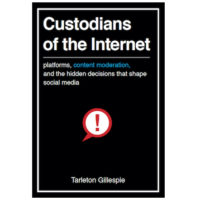 Over on the Culture Digitally site Tarleton Gillespie discusses his new book Custodians of the Internet, reflecting on some of the meanings of “custodian” and how they variously relate to the topic of the book – content moderators for social media services. Gillespie is an astute observer and analyst of contemporary ‘digital culture’ (I struggle to think of another noun right now) and the issue of moderation is certainly timely.
I thought I would explain the book’s title, particularly my choice of the word “custodians.” This title came unnervingly late in the writing process, and after many, many conversations with my extremely patient friend and colleague Dylan Mulvin. “Custodians of the Internet” captured, better than many, many alternatives, the aspirations of social media platforms, the position they find themselves in, and my notion for how they should move forward.

I blogged about the BBC’s unpopped podcast a while ago, and in reply Scott kindly made a further recommendation (below). I’ve also recently begun to listen to a few more podcasts and so I thought I’d do another quick post that recommends some podcasts that some of the readers of this blog may find interesting…

Scott Rodgers recommended the podcast 99% Invisiblewhich is ostensibly about design but covers all sorts of things and I’ve enjoyed listening to this over the last couple of months. They have a website with lots of additional info and articles based on the topics of each show. The show is part of the Radiotopia stable, which has quite a few well-regarded podcasts.
 One of the recommendations that I’ve been incredibly thankful for, actually from the BBC’s Podcast Radio Hour, is the sublime Everyone Else – a podcast ‘telling the stories of strangers’. One of the many things I love about the podcast is the sound design – there are all sorts of wonderful atmospheric effects and incidental music. The stories themselves are fascinating, often moving and always evocative of a very human experience of life.
 Another recommendation from Podcast Radio Hour is The Tip Off – a podcast concerning investigative journalism. Maeve McClenaghan from The Bureau of Investigative Journalism takes you through the processes of investigative journalism. Again, some really evocative audio production and some gripping stories.
Whilst I’m thinking about it, and maybe I’ll blog about this another day – one thing I am beginning to find a little frustrating about the majority of recommendations from the BBC’s Podcast Radio Hour and other folks who are, for want of a better word, podcasting ‘insiders’ is what I’ve come to think of as a weird kind of fetishisation of a privileged position as a listener being party to some kind of apparently authentic or intimate story or truth. These sorts of podcasts are becoming the norm – a presenter, often a comedian for some reason, talks to someone else and apparently intimate or frank conversations ensue. Either that or we are invited into an otherwise hard-to-access or ‘edgy’ context, such as a prison, and allowed to gawp. Most of the time, in my limited and partial experience, recommendations of podcasts (and sometimes the podcasts themselves) presuppose a white middle-class audience, who most likely are metropolitan and/or university-educated – one might look at the winners of the recent British Podcast Awards and ask questions along these lines. The fact that many are hosted by women often performing either/both of what comes across as earnest concern or compassion or a confessional revelation of intimacy also seems worthy of critical reflection. I’m just sort of uncomfortable about the aesthetic that seems to have become a norm in British, perhaps BBC-favoured, podcasting. Maybe I’m wrong. I hope so.
If you’ve read this far and have any thoughts I’d be really happy to hear from you – especially with other podcast recommendations!

A podcast episode of Some Noise on speciality coffee :
Since the turn of the millennium, the percentage of U.S.-based specialty coffee drinking folk, like those who have a cup everyday, has quadrupled. Travel to any major or minor city in the country, and you’ll see an offering of coffees that transcends the uniform Starbucks experience that’s on every block.
But the image that reflects after you place a mirror in front of any craft coffee company or cafe is a bit more clear, albeit unsettling. Stare at it long enough and you’ll come across matters like gentrification, the rise of the millennial-inspired yuppie wave and the old act of global economics, power dynamics and capitalism all at play.
This podcast episode explores the intricacies of coffee and attempts to answer two simple questions about one very complex drink. What makes specialty coffee special and who is it really for?
I’ve been expanding my podcast listening. I still listen to a mix of tech-related stuff and pop culture. I’ve also begun to listen to the very helpful Radio 4 Extra Podcast Radio Hour. I don’t always get on with the contents, sometimes fast-forward but blimey does it give you an intro to a much bigger range of podcasts!
Anyway, one of the podcasts that I turned to from that show was Unpopped (via Geoff Lloyd). It’s a podcast hosted by Hayley Campbell in which she gets a panel together to talk about a particular subject/aspect of pop culture. The most recent (at the time of writing) was an excellent discussion about the roots of Grime and representation. Other episodes I have really enjoyed include one about Paris Hilton and the nature of celebrity. The only other podcast experience I have had that is analogous was a great OUP podcast episode about Rihanna and representations of black women.
I am starting to think, after listening to around five episodes, that you could almost build a module from the podcast. The discussions are (mostly) brilliant – insightful, politically astute and often funny. In many ways this is the cultural studies of Stuart Hall, Paul du Gay and others alive and kicking in a medium they may have studied.
Rather than over-coding the descriptive and analytical detail with “big” theory (in the ways of which social & cultural geographers are, I fear, terribly guilty) —it’s not always reducible to affect, neoliberalism and subjectivity 😉 — most episodes of unpopped offer specific and nuanced discussions of a particular phenomenon/subject/topic.
I recommend listening to it…

I have been looking back over the links to news articles I’ve been collecting together about automation and I’ve been struck in particular by how the UK newspaper The Guardian has been running at least one story a week concerning automation in the last few months (see their “AI” category for examples, or the list below). Many are spurred from reports and press releases about particular things, so it’s not like they’re unique in pushing these narratives but it is striking, not least because lots of academics (that I follow anyway) share these stories on Twitter and it becomes a self-reinforcing, somewhat dystopian (‘rise of the robots’) narrative. I’m sure that we all adopt appropriate critical distance when reading such things but… there is a sense in which the ‘robots are coming for our jobs’ sort of arguments are being normalised and sedimented without a great deal of public critical reflection.
We might ask in response to the automation taking jobs arguments: who says? (quite often: management consultants and think tanks) and: how do they know? It seems to me that the answers to those questions are pertinent and probably less clear, and so interesting(!), than one might imagine.
Here’s a selection of the Graun’s recent automation coverage:
For your consideration…

I look forward to seeing the results on the streets after someone alters the training data… perhaps something like this will become all the rage:

We are delighted to share the video of our second seminar in our 2017/18 series, entitled Tweeting the Smart City: The Affective Enactments of the Smart City on Social Media given by Professor Gillian Rose from Oxford University on the 26th October 2017 and co-hosted with the Geography Department at Maynooth University.Abstract
Digital technologies of various kinds are now the means through which many cities are made visible and their spatialities negotiated. From casual snaps shared on Instagram to elaborate photo-realistic visualisations, digital technologies for making, distributing and viewing cities are more and more pervasive. This talk will explore some of the implications of that digital mediation of urban spaces. What forms of urban life are being made visible in these digitally mediated cities, and how? Through what configurations of temporality, spatiality and embodiment? And how should that picturing be theorised? Drawing on recent work on the visualisation of so-called ‘smart cities’ on social media, the lecture will suggest the scale and pervasiveness of digital imagery now means that notions of ‘representation’ have to be rethought. Cities and their inhabitants are increasingly mediated through a febrile cloud of streaming image files; as well as representing cities, this cloud also operationalises particular, affective ways of being urban. The lecture will explore some of the implications of this shift for both theory and method as well as critique.
