Reblog> Environment and Planning C relaunched as ‘Politics and Space’ – new manifesto

Via Stuart Elden.

This is an interesting development, not least in terms of the gradual realignment of EPD in the last five or so years…

Environment and Planning C relaunched as ‘Politics and Space’ – new manifesto

Society and Space is part of the Environment and Planning family of journals, now published by Sage. Environment and Planning C – formerly ‘Government and Policy’ is being relaunched as ‘Politics and Space’.

New editors Patrica Daley, Eugene McCann, Alison Mountz and Joe Painter have a piece describing this new purpose as ‘Reimaging Politics & Space: Why here, why now?‘ Here’s one key paragraph:

Our starting point in the project of re-visioning this journal is that no one owns the political in political geography and, therefore, while we are editors, we hope you will join us in building the future of Politics & Space. Send us your papers! Send us something new, different, something that you need to see in these pages.

Amateur philosophy – boundary 2 theme issue on Stiegler

Only just seen this. Issue 1 of volume 44 (2017) of boundary 2 is entitled Amateur Philosophy and concerns the work of Bernard Stiegler.

Within the issue are published the three lectures Stiegler gave in California in 2011 (one of which was published in Lana Turner). alongside this are pieces by a stellar cast of contemporary theorists, including: Claire Colebrook, Mark Hansen, Daniel Ross and Gerald Moore. Both of the two translators who have translated the majority of Stiegler’s work into English have pieces: Stephen Barker and Daniel Ross.

This seems like a fairly important contribution to anglophone engagements with Stiegler’s work…

Here’s the full table of contents.

You need a subscription to access the papers, let me know if you have any trouble…

Alexander Galloway on the nonhuman: apophatic or cataphatic?

On his blog, Alexander Galloway addresses some recent discussion he has had as part of a public seminar series on the nonhuman in relation to various ways in which we might reason-ably determine what counts as ‘nonhuman’. Here he uses two forms or categories of reason: the ‘apophatic’ and the ‘cataphatic’:

The cataphatic “tries to obtain the nonhuman through a method of affirmation, that is, affirmation of already knowable traits of whatever kind, human or otherwise. This is a method of affirmative or inflationary reason… Cataphatic nonhumanism does something similar: we are sentient, thus forests are probably sentient too. People form parliaments, so it makes sense to assemble a parliament of things. Humans have rights, so why not chimps as well? This approach to nonhumanism claims, in essence, that “humans seem to operate in such and such a way, thus we affirm the same quality in other worldly entities.””

The apophatic stems from “theological rationalism is a conception of the nonhuman obtained via negation or subtraction (of already knowable worldly traits of whatever kind). This is a method of negative or deflationary reason… Here the nonhuman is no longer a form of superlative nature as it was with cataphaticism — the nonhuman as “the All“ — but instead the nonhuman is the absence of nature; the nonhuman, literally, is not. (In other words, it is “the Not.”)”

I’m not up on contemporary debates about the nonhuman in geography (or anywhere, frankly) but this seems like an interesting critical device to consider in relation to some of the arguments about ‘nonhuman’ and ‘more-than-human’ geographies…

Read the full blogpost here.

Fifty years on: the right to the city – Andy Merrifield

Merrifield reflects on The Right to the City fifty years on in a thoughtful essay on his website. Worth reading the whole thing…

In response to a crisis of political legitimation, the “spectre” of urban solidarity looms; minorities in cities recognise that national and international rights are “out of joint.” In a way, we now need to read Derrida’s idea of “villes-refuges“ in conjunction not only with Lefebvre’s right to the city, but also with the former’s earlier Spectres of Marx, where he spoke of a “New International”; “a profound transformation,” Derrida called it, “projected over the long term, of international law, of its concepts and field of intervention.” This New International is “a link,” Derrida said, an affinity, a suffering and hope, still discreet, almost secret, without status or title, contract or coordination, party or country, national community or common belonging to a class.

We’re not yet sure what this International really is; we can’t name it anything positive. But it’s there nonetheless, we know it’s there, hope it’s there, out on the horizon, if we can look that far. We know it’s more needed than ever before, needed everywhere. It’s a ghostly dream-thought of a new status for the city, a right to and of the city, a will to belong to a democratic urban webbing, a solidarity of confederated assemblies interrogating the essence of politics and the role of the nation-state: just what is a citizen of the urban, a citadin(e) of the twenty-first century? Progressives will have their work cut out in this challenging year ahead. Meantime, Ã  la tienne, Henri!”¦

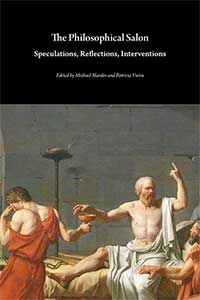
Open Access book: The Philosophical Salon from @openhumanities

Worth a read I think… There’s a free PDF, follow the link to Open Humanities Press website.

The Philosophical Salon: Speculations, Reflections, Interventions

edited by Michael Marder and Patricia Vieira

Through the interpretative lens of today’s leading thinkers, The Philosophical Salon illuminates the persistent intellectual queries and the most disquieting concerns of our actuality. Across its three main divisions–Speculations, Reflections, and Interventions–the volume constructs a complex mirror, in which our age might be able to recognize itself with all its imperfections, shadowy spots, even threatening abysses and latent promises. On the cutting edge of philosophy, political and literary theory, and aesthetics, this book courageously tackles a wide array of topics, including climate change, the role of technology, reproductive rights, the problem of refugees, the task of the university, political extremism, embodiment, utopia, food ethics, and sexual identity. It is an enduring record of an ongoing conversation, as well as a building block for any attempt to make sense of our world’s multifaceted realities.

Contributors: Robert Albritton, Linda Martín Alcoff, Claudia Baracchi, Geoffrey Bennington, Jay M. Bernstein, Costica Bradatan, Jill Casid, David Castillo, Antonio Cerella, Anna Charlton, Claire Colebrook, Sarah Conly, Nikita Dhawan, William Egginton, Roberto Esposito, Mihail Evans, Gary Francione, Luis Garagalza, Michael Gillespie, Michael Hauskeller, Ágnes Heller, Daniel Innerarity, Jacob Kiernan, Julia Kristeva, Daniel Kunitz, Susanna Lindberg, Jeff Love, Michael Marder, Todd May, Michael Meng, John Milbank, Warren Montag, T. M. Murray, Jean-Luc Nancy, Kelly Oliver, Adrian Pabst, Martha Patterson, Richard Polt, Gabriel Rockhill, Hasana Sharp, Doris Sommer, Gayatri Spivak, Kara Thompson, Patrícia Vieira, Slavoj Žižek.

Reblog> Ways to make safety pin solidarity actually safer

Nice piece by Sara Koopman:

I have posted repeatedly on this blog about people wearing different things to signal solidarity of various sorts. I research how people build alternative securities through solidarity – so I have been following the debates about recent attempts to create safety by wearing safety pins.

If you are in the US, and maybe even Canada, you have probably heard about wearing a safety pin to signal solidarity for safety in the face of a hateful attack. But I will start with a brief explanation for global readers, since I recently presented on it at a workshop in Brussels and no one had heard of it. This was all the more surprising since it was a workshop on ‘Nurturing solidarity in diversity’ put on by the DieGem research group (see their paper on that page about their work, Putting flesh to the bone).People started wearing safety pins in the UK after Brexit, in response to a huge rise in anti-immigrant attacks. It was inspired by the by the #illridewithyou movement in Australia, in which people offered to take public transportation with Muslims fearing a backlash after a Muslim gunman held people hostage in a cafe in 2014. I believe the initial idea was to signal something like ‘I will step in to create safety’ in the case of an anti-immigrant attack.

Read the rest of the post here.

CFP> Science, Technology & the Politics of Knowledge in Global Affairs

via dmf.

CfP: Science, Technology, and the Politics of Knowledge in Global Affairs

CALL FOR PAPERS

Science, Technology, and the Politics of Knowledge in Global Affairs

An Interdisciplinary Graduate Conference at the Buffett Institute for Global Studies

Northwestern University, Evanston IL 

March 30-31, 2017

Keynote: Sheila Jasanoff, Harvard Kennedy School

Organizing Committee: Kevin Baker, Savina Balasubramanian, and Omri Tubi

Scientists, state actors, international institutions, and lay activists vie for credibility and legitimacy to both frame and control global issues. Science and technology are routinely cast into a supporting role to bolster their claims. From nuclear energy in the battle against climate change to the politicization of “big data;” from new information technologies in emerging regimes of global surveillance to the use of randomized controlled trials in international development research – scientific and technological expertise operate as instruments of power and authority, which can serve to legitimate or contest new forms of global governance and intervention.

The Buffett Institute’s second annual graduate student conference will investigate expert knowledge in contemporary global affairs, looking at the ways this knowledge is created, invoked, circulated, and contested in the international political arena. We invite graduate students to present work that explores questions such as: How do various international actors attempt to position themselves as credible participants in global politics? Under what conditions does expert knowledge come to be seen as legitimate on the global stage? How and why do global issues become understood as primarily technical, rather than political? In what ways do international actors frame these issues and what must be done about them? How is scientific and technological expertise marshaled or ignored in processes of claims making and action to structure interventions into global “problems?” And, finally, how do these practices organize, sustain, or challenge structures of global inequality and power?


Possible topics include but are not limited to:

  • The politics of climate change, climate science, and environmental security
  • The rise of actuarial and genetic approaches to global crime
  • Biosecurity, global health, and the regulation of infectious disease
  • Globalized technologies of risk and quantification
  • The technologization of global finance and economic markets
  • The politicization of social and computational science in an age of “big data”
  • New regimes of information and global surveillance
  • The changing nature of international development interventions
  • The constitution of transnational lay expertise in global social movements

We invite graduate students across the humanities and social sciences to submit abstracts of no more than 250 words by December 15, 2016using the submission link on the conference webpage: http://buffett.northwestern.edu/programs/grad-conference/. There will be no deadline extensions. Accepted presenters will be notified by January 5 and papers are due to faculty discussants by March 7. The Buffett Institute will provide hotel accommodations and will subsidize travel costs (fully for US-based graduate students and partially for international students). Please direct all queries to the Graduate Organizing Committee at: buffettgradconference@northwestern.edu.

David Harvey on post-neoliberalism, Trump, infrastructure, sharing economy, smart city

Via Deterritorial Investigations Unit.

David Harvey talking to Evgeny Morozov, in the first few minutes he addresses the issue of the claims being made about the end of globalisation/neoliberalism. The conversation then quickly ranges over the gig economy and what Guy Standing calls the ‘precariat’ (it’d be interesting to stage that conversation!) and then a brief statement question about ‘smart’ cities (Harvey is dismissive). Worth watching.

Where’s the geography in the ‘end of globalisation’ trope pushed by the commentariat?

[T]here are abundant signs that localism and nationalism have become stronger precisely because of quest for security that place always offers in the midst of all the shifting that [globalisation] implies – The Condition of Postmodernity (adapted), David Harvey, p. 306.

Globalisation as ‘…a hegemonic ideology supporting the necessity and inevitability of the free movement of capital and goods, helped to create the institutional conditions which then contributed to making the free movement of capital and goods a reality’ – Paul Hirst “The global economy – myths and realities.” (1999), p. 424.

Actually existing globalisation is not the globalisation of neoliberal visions, the Utopia of friction-free global markets or Internet-driven virtual worlds, but the contingent and unsteady symbiosis of imperfectly transnational networks, institutions and firms, and the ‘ramshackle diversity’ of international bureaucracies, states, police, mafias and other sources of power struggling for shifting territorial authority in the post-cold war world. – Gerard Ó Tuathail “Political geography III: dealing with deterritorialization.” (1998) p. 87.

An all-to-brief and idle thought: Whatever happened to critique of ‘globalisation’? There was a time not long ago when commentators would’ve been on the side of those they seek to blame for voting for Brexit and Trump… the apparent ‘losers’ in the last thirty-odd years of ‘globalisation’ (or, perhaps, more specifically what Peter Dicken called a new international division of labour in his “Global Production Networks” framework in Global Shift).

When critical discussion of globalisation was a thing in geography people like David Harvey and Doreen Massey had something to say about this… indeed, this used to be a staple of a geography sylabus. I can’t help wondering what Massey would say about the last six months… Nevertheless, I haven’t seen any kind of comment by Harvey (if there has been, please point to what I’ve missed in the comments below).

Critical reflections on the rise of economic globalisation, the rise of TNCs, global commodity chains, off-shoring and so on brought about a critical discourse of globalisation that seems to be missing from the current commentary. Instead, we seem to see a conflation of a generalised (to the point of being unclear) idea of ‘neoliberalism’ and ‘globalisation’ and, depending on your standpoint, the recent popular vote for Brexit in the UK and the narrow victory of Trump are meant to signify a backlash to this. Perhaps because of the toxic racist and misogynistic undertones of the ‘Leave’ and Trump campaigns, some commentators seem to be implying that actually the status quo of economic globalisation and ‘neoliberalism’ should’ve been retained (i.e. vote of ‘remain’ & Clinton, resulting in TTIP etc ). Maybe (I hope) I’m misreading the arguments (I’m not getting much sleep due to baby/child sleeplessness!), maybe this is a plea for global solidarity, but maybe, also, the rush to get into print is leading to forms of scapegoating too…

Either way, it seems to me that it might be prudent for more of us to revisit ‘globalisation’ in our research and teaching (I have no doubt that there is some great work going on that I don’t know about here).