The erudite, funny and really engaging Mary Beard giving a tour de force on the representations and ideas of women in power for the LRB. This really is worth watching or listening to, I first heard it on Radio 4 but really pleased to find this video.
“Irreconcilable differences?” Sharlene Mollett’s Gender, Place and Culture Jan Monk Distinguished Annual Lecture
The latest issue of Gender, Place and Culture, and first of 2017, is online. It has Sharlene Mollett’s Jan Monk Distinguished Lecture,as well as a themed section on ‘Sexual and Gender Minorities in Disaster’. There’s also an article on ‘crazy cat ladies‘ (there is, honest).
Here’s Mollett’s abstract:
In 2015, the United Nations set in motion the International Decade for People of African Descent (2015–2024). While this mandate provides much to celebrate, its reliance on universal and human rights narratives collides against the reality of a persistent inferiorization of Afro-descendant communities as less–than–human. The paradoxical nature of human rights discourses notwithstanding, Afro-descendant women (ADW) leaders in Latin America embrace the opportunity provided by the UN Decade, to rethink human rights discourses and Afro-descendant inclusion in development practice. I draw insight in this article from black feminist and postcolonial thinking to contribute to a growing engagement with the concept of intersectionality in the subfield of feminist political ecology. Employing the concept of postcolonial intersectionality, I reflect on how ADW operationalize particular knowledges and their racialized gendered subjectivities to challenge regional imaginaries that limit livelihoods, access to natural resources and that cast Afro-descendants outside humanity. I connect such organized activism to that of quiet, every day and largely unrecognized acts of resistance among Afro-Antillean women situated in the growing residential tourism enclave along Panama’s Atlantic coast, in a place known as ‘Bocas’. This article draws from ethnographic and historical data collection and is supplemented with news articles, activist scholarship, government documents and secondary resources. Together, I center the intersectional logics of power in Bocas and argue that ADW lead a material and symbolic process of place-making, one that prioritizes life while struggling over carnal, gendered and racialized dispossession and the right to be recognized as human.
Echoborg
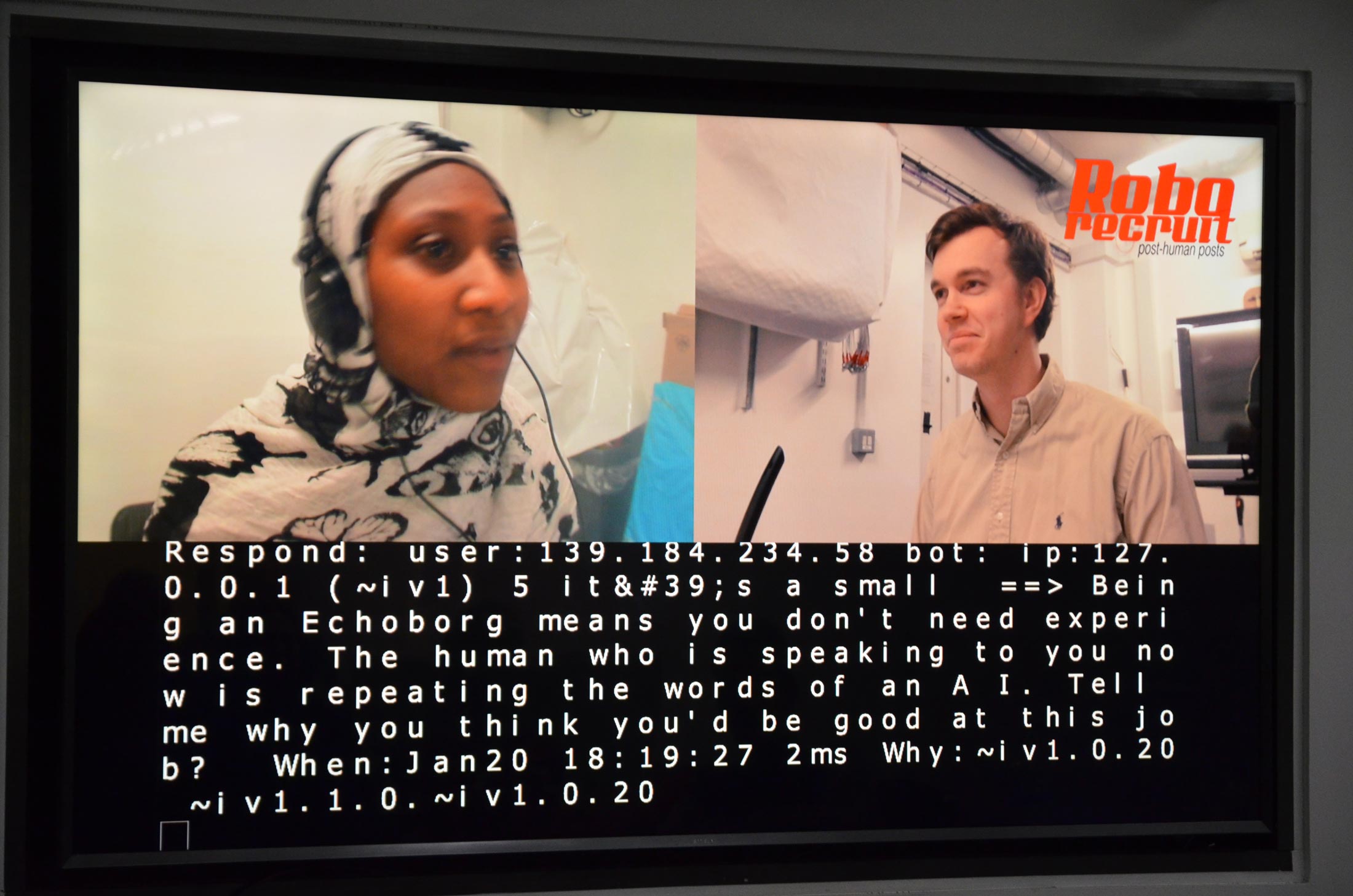
Former colleagues of mine at UWE are developing an interesting project, which you may have seen/heard about through the BBC’s Click programme, called Echoborg.
An echoborg is a hybrid agent composed of the body of a real person and the “mind” (or, rather, the words) of a conversational agent; the words the echoborg speaks are determined by the conversational agent, transmitted to the person via a covert audio-relay apparatus, and articulated by the person through speech shadowing[1].
Recently, the project team have demoed the project as part of an AHRC-funded network on Automation Anxiety and have written this up on the project website, here’s a snippet – it sounds like it is really compelling (I’ve not seen this in action):
Four people were interviewed by the AI which increasingly displayed an interest in eliciting help to reprogram itself. Proceedings were visible on a projector screen and the ‘audience’ of applicants gradually began to discuss the situation of the Echoborg and how to change it. At a certain point their reflections passed a threshold and the group fired into collective action, experimenting with various methods to bring the situation to a head in some way. The lively inventiveness of the group and the individual interviewees went a long way to confirming the interactive potential of this format of the work. It also gave Rik and Phil much to work with in considering the further development of the AI/Chatbot, the restricted delivery of narrative by the human Echoborg and the staging. This event also trialled a secondary, higher level, Echoborg character as part of the slow process of unfolding the potential for this Echoborg recruitment event to be a disruptive and thought and emotion provoking experience for all players.
Notes
Gary Hall > Ten Ways To Affirmatively Disrupt The Sharing Economy ♯3: Become a Microdatapreneur
Interesting from Gary Hall… lots to think through politically here, as with blockchain-like, more-or-less libertarian, strategies for a new “new economy” (as per the Post-Fordists)… and possibly relevant to the recent interest in “digital” labour in geography…
part of a series of posts in which I provide ten proposals as to how to affirmatively disrupt ubercapitalism and the corporate sharing economy. Together these posts constitute the draft of a text provisionally titled Data Commonism, designed to follow on from my recently published short book, The Uberfication of the University. If the latter provides a dystopian sense of what is lying in store for many us over the course of the next few years, Data Commonism is more optimistic in that it shows what we can do about it.
…
[We can disrupt the sharing economy by] by working toward the kind of “universal micropayment system” Jaron Lanier envisages in Who Owns The Future: “If observation of you yields data that makes it easier for”¦ a political campaign to target voters with its message, then you ought to be owed money for the use of that valuable data.” In this system we would be paid for the data we generate if it turns out to be valuable. Our relationship with the platforms of the for-profit sharing economy would thus take the form of a “two-way” financial transaction in which we all “benefit, concretely, with real money,” rather than just a few San Francisco-based entrepreneurs and investors.
…
A universal micropayment system may result in some degree of financial redistribution. But while it provides a means of reuniting data with those users who produce it […] there is not really all that much we can do with our own small amounts of data. How much leverage would we have when it comes to negotiating a price for it, bearing in mind most of us will have to rely on these companies to determine for us the extent to which our data […] has actually contributed to a political campaign aimed at targeting voters, to stay with Lanier’s example?
…
for Clare Birchall, it is not at all “clear that data belongs to us in the first place in order for it then to be given or taken“–or monetized, in this case. Instead, “we are within a dynamic sharing assemblage: always already sharing data with human or non-human agents.” Birchall introduces the term “shareveillance” to describe the “condition of consuming shared data and producing data to be shared in ways that shape” what she refers to as an “an ascendant shareveillant subjectivity.” This is a “subject who is at once surveillant (veiller ‘to watch’ is from the Latin vigilare, from vigil, ‘watchful’) and surveilled. To phrase it with a slightly different emphasis: the subject of shareveillance is one who simultaneously works with data and on whom the data works.”
Reblog> Social Justice in an Age of Datafication: Launch of the Data Justice Lab
Via The Data Justice Lab.
Social Justice in an Age of Datafication: Launch of the Data Justice Lab
The Data Justice Lab will be officially launched on Friday, 17 March 2017. Join us for the launch event at Cardiff University’s School of Journalism, Media and Cultural Studies (JOMEC) at 4pm. Three international speakers will discuss the challenges of data justice.
The event is free but requires pre-booking at https://www.eventbrite.com/e/social-justice-in-an-age-of-datafication-launching-the-data-justice-lab-tickets-31849002223
Data Justice Lab – Launch Event – Friday 17 March 4pm – Cardiff University
Our financial transactions, communications, movements, relationships, and interactions with government and corporations all increasingly generate data that are used to profile and sort groups and individuals. These processes can affect both individuals as well as entire communities that may be denied services and access to opportunities, or wrongfully targeted and exploited. In short, they impact on our ability to participate in society. The emergence of this data paradigm therefore introduces a particular set of power dynamics requiring investigation and critique.
The Data Justice Lab is a new space for research and collaboration at Cardiff University that has been established to examine the relationship between datafication and social justice. With this launch event, we ask: What does social justice mean in age of datafication? How are data-driven processes impacting on certain communities? In what way does big data change our understanding of governance and politics? And what can we do about it?
We invite you to come and participate in this important discussion. We will be joined by the following keynote speakers:
Virginia Eubanks (New America), Malavika Jayaram (Digital Asia Hub), and Steven Renderos (Center for Media Justice).
Virginia Eubanks is the author of Digital Dead End: Fighting for Social Justice in the Information Age (MIT Press, 2011) and co-editor, with Alethia Jones, of Ain’t Gonna Let Nobody Turn Me Around: Forty Years of Movement Building with Barbara Smith (SUNY Press, 2014). She is also the cofounder of Our Knowledge, Our Power (OKOP), a grassroots economic justice and welfare rights organization. Professor Eubanks is currently working on her third book, Digital Poorhouse, for St. Martin’s Press. In it, she examines how new data-driven systems regulate and discipline the poor in the United States. She is a Fellow at New America, a Washington, D.C. think tank and the recipient of a three-year research grant from the Digital Trust Foundation (with Seeta Peña Gangadharan and Joseph Turow) to explore the meaning of digital privacy and data justice in marginalized communities.
Malavika Jayaram is the Executive Director of the Digital Asia Hub in Hong Kong. Previously she was a Fellow at the Berkman Klein Center for Internet & Society at Harvard University, where she focused on privacy, identity, biometrics and data ethics. She worked at law firms in India and the UK, and she was voted one of India’s leading lawyers. She is Adjunct Faculty at Northwestern University and a Fellow with the Centre for Internet & Society, India, and she is on the Advisory Board of the Electronic Privacy Information Center (EPIC).
Steven Renderos is Organizing Director at the Center for Media Justice. With over 10 years of organizing experience Steven has been involved in campaigns to lower the cost of prison phone calls, preserving the Open Internet, and expanding community owned radio stations. Steven previously served as Project Coordinator of the Minnesotano Media Empowerment Project, an initiative focused on improving the quality and quantity of media coverage and representation of Latinos in Minnesota. He currently serves on the boards of Organizing Apprenticeship Project and La Asamblea de Derechos Civiles. Steven (aka DJ Ren) also hosts a show called Radio Pocho at a community radio station and spins at venues in NYC.
The event will be followed by a reception.
Reblog> Free Download: Digital Rights to the City
Via Mark Purcell.
Free Download: Digital Rights to the City
Published Today: Our Digital Rights to the City
Free to download (pdf, epub, mobi): http://meatspacepress.org/
‘Our Digital Rights to the City’ is a small collection of articles about digital technology, data and the city. It covers a range of topics relating to the political and economic power of technologies that are now almost inescapable within the urban environment. This includes discussions surrounding security, mapping, real estate, smartphone applications and the broader idea of a ‘right to the city’ in a post-digital world.
The collection is edited by Joe Shaw and Mark Graham and its contributing authors are Jathan Sadowski, Valentina Carraro, Bart Wissink, Desiree Fields, Kurt Iveson, Taylor Shelton, Sophia Drakopoulou and Mark Purcell.
Please follow us @meatspacepress
Join our mailing list at http://meatspacepress.org/
‘Our Digital Rights to the City’ also available free at:
* Free to download (epub, most e-readers): epub
* Free to download (pdf): pdf
* Free to download (mobi, for Kindle): mobi
* Free to read (pdf): Here
Institute of Network Cultures podcast
This looks interesting… I confess I’ve not listened yet.
The INC has a new publication format: the Zero Infinite podcast!
In May 2016, we invited two podcast hosts to our symposium on art criticism: Stephanie Afrifa (of Nation of Overthinkers podcast network) and Botte Jellema (host of De Eeuw van de Amateur (The Century of the Amateur) podcast). They spoke about the medium with such enthusiasm, that one of our affiliated researchers, Nadine Roestenburg, decided to start her own podcast on post-digital art and we soon felt it was time for the INC to try our hand at it as well! Botte came back to teach us some more skills and to let us experience the delight that is a good microphone. We tested and experimented for some time, and are now very happy to be able to present the very first episode of Zero Infinite to you!
LISTEN TO THE FIRST EPISODE HERE.
The podcast is hosted by Miriam Rasch, and cover topics like digital publishing, economic alternatives, revenue models in the arts and online culture. The first episode features interviews with Alex Foti, Baruch Gottlieb and Henry Warwick, and a discussion on precarity and anti-austerity measures. The latter half of the episode is a homage to the work of the late Mark Fisher. We discuss his ideas on neoliberalism and its influence on individual wellbeing though clips from his talk at MyCreativity in 2014.
Subscribe to our Soundcloud channel, or find the newest episode on our publications page.
The Asylum Market
This powerful video, shared by Kevin Ward on Crit-Geog-Forum, is incredibly affecting. Very much worth watching and sharing.
The Asylum Market from Brass Moustache Films on Vimeo.
This relates to the research project, led by Jonathan Darling, Producing Urban Asylum.
Reblog> Environment and Planning C relaunched as ‘Politics and Space’ – new manifesto
Via Stuart Elden.
This is an interesting development, not least in terms of the gradual realignment of EPD in the last five or so years…
Environment and Planning C relaunched as ‘Politics and Space’ – new manifesto
Society and Space is part of the Environment and Planning family of journals, now published by Sage. Environment and Planning C – formerly ‘Government and Policy’ is being relaunched as ‘Politics and Space’.
New editors Patrica Daley, Eugene McCann, Alison Mountz and Joe Painter have a piece describing this new purpose as ‘Reimaging Politics & Space: Why here, why now?‘ Here’s one key paragraph:
Our starting point in the project of re-visioning this journal is that no one owns the political in political geography and, therefore, while we are editors, we hope you will join us in building the future of Politics & Space. Send us your papers! Send us something new, different, something that you need to see in these pages.
Amateur philosophy – boundary 2 theme issue on Stiegler
Only just seen this. Issue 1 of volume 44 (2017) of boundary 2 is entitled Amateur Philosophy and concerns the work of Bernard Stiegler.
Within the issue are published the three lectures Stiegler gave in California in 2011 (one of which was published in Lana Turner). alongside this are pieces by a stellar cast of contemporary theorists, including: Claire Colebrook, Mark Hansen, Daniel Ross and Gerald Moore. Both of the two translators who have translated the majority of Stiegler’s work into English have pieces: Stephen Barker and Daniel Ross.
This seems like a fairly important contribution to anglophone engagements with Stiegler’s work…
Here’s the full table of contents.
You need a subscription to access the papers, let me know if you have any trouble…