On his blog, Alexander Galloway addresses some recent discussion he has had as part of a public seminar series on the nonhuman in relation to various ways in which we might reason-ably determine what counts as ‘nonhuman’. Here he uses two forms or categories of reason: the ‘apophatic’ and the ‘cataphatic’:
The cataphatic “tries to obtain the nonhuman through a method of affirmation, that is, affirmation of already knowable traits of whatever kind, human or otherwise. This is a method of affirmative or inflationary reason… Cataphatic nonhumanism does something similar: we are sentient, thus forests are probably sentient too. People form parliaments, so it makes sense to assemble a parliament of things. Humans have rights, so why not chimps as well? This approach to nonhumanism claims, in essence, that “humans seem to operate in such and such a way, thus we affirm the same quality in other worldly entities.””
The apophatic stems from “theological rationalism is a conception of the nonhuman obtained via negation or subtraction (of already knowable worldly traits of whatever kind). This is a method of negative or deflationary reason… Here the nonhuman is no longer a form of superlative nature as it was with cataphaticism — the nonhuman as “the All“ — but instead the nonhuman is the absence of nature; the nonhuman, literally, is not. (In other words, it is “the Not.”)”
I’m not up on contemporary debates about the nonhuman in geography (or anywhere, frankly) but this seems like an interesting critical device to consider in relation to some of the arguments about ‘nonhuman’ and ‘more-than-human’ geographies…
In response to a crisis of political legitimation, the “spectre” of urban solidarity looms; minorities in cities recognise that national and international rights are “out of joint.” In a way, we now need to read Derrida’s idea of “villes-refuges“ in conjunction not only with Lefebvre’s right to the city, but also with the former’s earlier Spectres of Marx, where he spoke of a “New International”; “a profound transformation,” Derrida called it, “projected over the long term, of international law, of its concepts and field of intervention.” This New International is “a link,” Derrida said, an affinity, a suffering and hope, still discreet, almost secret, without status or title, contract or coordination, party or country, national community or common belonging to a class.
We’re not yet sure what this International really is; we can’t name it anything positive. But it’s there nonetheless, we know it’s there, hope it’s there, out on the horizon, if we can look that far. We know it’s more needed than ever before, needed everywhere. It’s a ghostly dream-thought of a new status for the city, a right to and of the city, a will to belong to a democratic urban webbing, a solidarity of confederated assemblies interrogating the essence of politics and the role of the nation-state: just what is a citizen of the urban, a citadin(e) of the twenty-first century? Progressives will have their work cut out in this challenging year ahead. Meantime, à la tienne, Henri!”¦
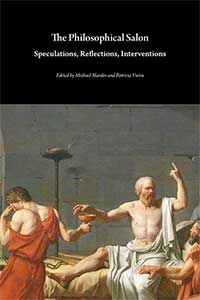
Through the interpretative lens of today’s leading thinkers, The Philosophical Salon illuminates the persistent intellectual queries and the most disquieting concerns of our actuality. Across its three main divisions–Speculations, Reflections, and Interventions–the volume constructs a complex mirror, in which our age might be able to recognize itself with all its imperfections, shadowy spots, even threatening abysses and latent promises. On the cutting edge of philosophy, political and literary theory, and aesthetics, this book courageously tackles a wide array of topics, including climate change, the role of technology, reproductive rights, the problem of refugees, the task of the university, political extremism, embodiment, utopia, food ethics, and sexual identity. It is an enduring record of an ongoing conversation, as well as a building block for any attempt to make sense of our world’s multifaceted realities.
Contributors: Robert Albritton, Linda MartÃn Alcoff, Claudia Baracchi, Geoffrey Bennington, Jay M. Bernstein, Costica Bradatan, Jill Casid, David Castillo, Antonio Cerella, Anna Charlton, Claire Colebrook, Sarah Conly, Nikita Dhawan, William Egginton, Roberto Esposito, Mihail Evans, Gary Francione, Luis Garagalza, Michael Gillespie, Michael Hauskeller, Ãgnes Heller, Daniel Innerarity, Jacob Kiernan, Julia Kristeva, Daniel Kunitz, Susanna Lindberg, Jeff Love, Michael Marder, Todd May, Michael Meng, John Milbank, Warren Montag, T. M. Murray, Jean-Luc Nancy, Kelly Oliver, Adrian Pabst, Martha Patterson, Richard Polt, Gabriel Rockhill, Hasana Sharp, Doris Sommer, Gayatri Spivak, Kara Thompson, PatrÃcia Vieira, Slavoj Žižek.
‘Disrupting the Humanities: Towards Posthumanities’ consists of a selection of video articles by Johanna Drucker, Mark Amerika, Erin Manning, Monika Bakke, Endre Dányi, Lesley Gourlay, Silvio Lorusso, Niamh Moore, Karen Newman, SØren Pold, Craig Saper, Sarah Kember, and Iris van der Tuin.
This special issue of the Journal of Electronic Publishing is based on ‘Disrupting the Humanities’. This was a series of seminars exploring research and scholarship in a posthumanities context organised by the Centre for Disruptive Media at Coventry University in the UK. Disrupting the Humanities both critically engaged with the humanist legacy of the humanities, and creatively explored alternate and affirmative possible futures for the humanities. The series was accompanied by a wiki that is still available here: http://disruptivemedia.org.uk/wiki/
‘Posthumanities: The Dark Side of “The Dark Side of the Digital”’
Adema and Hall have written a 10,000 word opening essay, discussing the conceptual premises that underly this special issue. Engaging with various discourses around the digital humanities, the essay outlines the experimental mode in which the videos included in the issue have been edited – as well as pointing to the idea of “posthuman humanities”.
Link: http://dx.doi.org/10.3998/3336451.0019.201
A table of contents for this special issue of the Journal of Electronic Publishing is provided below.
—–
Disrupting the Humanities: Towards PosthumanitiesThe Journal of Electronic Publishing (JEP)
PART ONE – Creating Posthumanities: Disrupting Humanities Methodologies
Part one of Disrupting the Humanities consists of a radical exploration of new posthumanist methodologies that take into account the agency of technologies and other non-human actants involved in modern forms of knowledge production.
PART TWO – Performing Posthumanities: Disrupting Humanities Aesthetics
Part two looks at the ways in which research is mediated and performed. It focuses on a reconsideration of the aesthetics of scholarship, including the “aesthetics of bookishness.” In doing so it investigates the potential of more post-digital, hybrid and multimodal forms of knowledge creation.
PART THREE – Circulating Posthumanities: Disrupting Humanities Institutions
Part three of Disrupting the Humanities provides a critical examination of how research is disseminated and shared, be it by publication to peers or to students in a pedagogical setting, or by adopting practices of radical openness and experimentation to challenge the normative and often print-based (neo)liberal humanist assumptions of how scholars in the humanities communicate.
Some really interesting work from the Tactical Team looking at the ways in which different people and their skills and knowledges move in and out of government and the ‘Alphabet empire’. Worth a full read, but here’s a snippet to whet the appetite…
The Alphabet Empire by Tactical Tech and La Loma as shown in The Glass Room in New York. Based on openly available information, this 3-D infographic combines a quote from its chairman, Eric Schmidt, with a mapping of its acquisitions and investments.
By Google’s own admission, the company, like many others, cultivates close relationships with governmental bodies and public officials. Google disclosed that in 2015 it spent over €4 million on lobbying the European Union – considerably more than the €1 million on lobbying spent just three years previously in 2012.
But some of Google’s relationships with public bodies and officials come with a smaller price tag: Over the past ten years at least 80 people have been identified to have moved jobs between Google and European governments.
It’s this “revolving door” that formed the basis of our investigation. We started out with a number of questions: who were these people who had moved from Google to government or vice versa? Where exactly did they move from and to, and when? And most importantly how many of these questions could we find answers to using open, publicly-available information?
The organizers of A&SM#3 welcome proposals for 15min presentations and artworks that interpret and explore the affective, feely and emotional encounters with social media grasped through the following themes:
Experience
Engagement
Entanglement
Presentations and artworks can widely interpret each theme, but preference will be given to proposals that respond in two ways.
Firstly, the organizers are particularly interested in creative responses (academic and artistic) to recent social media events – the US election, for example. So proposals might address how the Trump win allows us to develop a fresh understanding of shared experiences, emotional engagements or new entanglements with social media.
Secondly, we ask presenters and artists to consider how their approach to affect and social media can be put to work in an education context. For example, how can the potential of affect theory reach out across teaching practices and develop novel understandings of the political nature and transformative possibilities of teaching.
The academic part of this call is open to experienced scholars, new researchers and postgrad students from across the disciplinary boundaries of affect studies and related areas of study interested in theorizing and working with emotion and feelings in a social media context. We welcome a good mixture of innovative conceptual and methodological approaches.
The Sensorium Art Exhibit will interweave the conference proceedings and bring it to a close with a special show, alongside free drinks and nibbles.
I have posted repeatedly on this blog about people wearing different things to signal solidarity of various sorts. I research how people build alternative securities through solidarity – so I have been following the debates about recent attempts to create safety by wearing safety pins.
If you are in the US, and maybe even Canada, you have probably heard about wearing a safety pin to signal solidarity for safety in the face of a hateful attack. But I will start with a brief explanation for global readers, since I recently presented on it at a workshop in Brussels and no one had heard of it. This was all the more surprising since it was a workshop on ‘Nurturing solidarity in diversity’ put on by the DieGem research group (see their paper on that page about their work, Putting flesh to the bone).People started wearing safety pins in the UK after Brexit, in response to a huge rise in anti-immigrant attacks. It was inspired by the by the #illridewithyou movement in Australia, in which people offered to take public transportation with Muslims fearing a backlash after a Muslim gunman held people hostage in a cafe in 2014. I believe the initial idea was to signal something like ‘I will step in to create safety’ in the case of an anti-immigrant attack.
Science, Technology, and the Politics of Knowledge in Global Affairs
An Interdisciplinary Graduate Conference at the Buffett Institute for Global Studies
Northwestern University, Evanston IL
March 30-31, 2017
Keynote: Sheila Jasanoff, Harvard Kennedy School
Organizing Committee: Kevin Baker, Savina Balasubramanian, and Omri Tubi
Scientists, state actors, international institutions, and lay activists vie for credibility and legitimacy to both frame and control global issues. Science and technology are routinely cast into a supporting role to bolster their claims. From nuclear energy in the battle against climate change to the politicization of “big data;” from new information technologies in emerging regimes of global surveillance to the use of randomized controlled trials in international development research – scientific and technological expertise operate as instruments of power and authority, which can serve to legitimate or contest new forms of global governance and intervention.
The Buffett Institute’s second annual graduate student conference will investigate expert knowledge in contemporary global affairs, looking at the ways this knowledge is created, invoked, circulated, and contested in the international political arena. We invite graduate students to present work that explores questions such as: How do various international actors attempt to position themselves as credible participants in global politics? Under what conditions does expert knowledge come to be seen as legitimate on the global stage? How and why do global issues become understood as primarily technical, rather than political? In what ways do international actors frame these issues and what must be done about them? How is scientific and technological expertise marshaled or ignored in processes of claims making and action to structure interventions into global “problems?” And, finally, how do these practices organize, sustain, or challenge structures of global inequality and power?
Possible topics include but are not limited to:
The politics of climate change, climate science, and environmental security
The rise of actuarial and genetic approaches to global crime
Biosecurity, global health, and the regulation of infectious disease
Globalized technologies of risk and quantification
The technologization of global finance and economic markets
The politicization of social and computational science in an age of “big data”
New regimes of information and global surveillance
The changing nature of international development interventions
The constitution of transnational lay expertise in global social movements
We invite graduate students across the humanities and social sciences to submit abstracts of no more than 250 words by December 15, 2016using the submission link on the conference webpage: http://buffett.northwestern.edu/programs/grad-conference/. There will be no deadline extensions. Accepted presenters will be notified by January 5 and papers are due to faculty discussants by March 7. The Buffett Institute will provide hotel accommodations and will subsidize travel costs (fully for US-based graduate students and partially for international students). Please direct all queries to the Graduate Organizing Committee at: buffettgradconference@northwestern.edu.
David Harvey talking to Evgeny Morozov, in the first few minutes he addresses the issue of the claims being made about the end of globalisation/neoliberalism. The conversation then quickly ranges over the gig economy and what Guy Standing calls the ‘precariat’ (it’d be interesting to stage that conversation!) and then a brief statement question about ‘smart’ cities (Harvey is dismissive). Worth watching.



 Call for presentations and artworks

