Why WIRED’s future never arrives – David Karpf

Promotional image for the 1995 film Hackers

Quite a good piece on the Wired website reflecting upon 25 years of predictions about the future in the pages of that magazine (though I’m not sure the exonerating final paragraph rings true). Worth a read…

Looking back at WIRED’s early visions of the digital future, the mistake that seems most glaring is the magazine’s confidence that technology and the economics of abundance would erase social and economic inequality. Both Web 1.0 and Web 2.0 imagined a future that upended traditional economics. We were all going to be millionaires, all going to be creators, all going to be collaborators. But the bright future of abundance has, time and again, been waylaid by the present realities of earnings reports, venture investments, and shareholder capitalism. On its way to the many, the new wealth has consistently been diverted up to the few.

By now, the digital revolution isn’t just the future; it has a history. Digital technology runs our economy. It organizes our daily lives. It mediates how we learn information, tell each other stories, and connect with our neighbors. It’s how we control and harass and encourage one another. It’s a tool of both surveillance and resistance. You can almost never be entirely offline anymore. The internet is setting the agenda for the world around us.

The digital revolution’s track record suggests that its arc doesn’t always bend toward abundance—or in a straight line at all. It flits about, responding to the gravitational forces of hype bubbles and monopoly power, warped by the resilience of old institutions and the fragility of new ones. Today’s WIRED seems to have learned these lessons.

25 years of wired predictions: why the future never arrives – David Karpf

Pitching the ‘automative imagination’

Still from the video for All is Love by Bjork

I’ve got a draft book proposal. I think I know where it’s going. I’ve also had a go at securing funding (yes, I’m not holding my breath) to support writing the book and hopefully produce an associated podcast – more on that another time.

It’s perhaps foolhardy or overly optimistic but I want to share the gist of the pitch here. I’d really welcome feedback or suggestions and can share a fuller version of the proposal if you happen to be interested – please get in touch via email.

The Automative Imagination

Automation is both a contemporary and enduring concern. The ‘automative imagination’ is a way to articulating different habits of considering and discussing automation.  I am not using the neologism ‘automative’ to assert any kind of authority but rather as a pragmatic tool. Other words do not fit – to speak of an ‘automated’ or ‘automatic’ imagination does not describe the characteristics of automation but suggests the imagining is itself automated, which is not the argument I am seeking to make. This book explores how automation is imagined as much as it is planned and enacted. 

The ways in which automation is bound up with how everyday life is understood is under-examined. Expectations are fostered, with examples drawing upon popular culture and mythology, without the bases for these expectations being sufficiently scrutinised. This book examines precisely the foundations of the visions of automation we are invited to believe. Through the original conceptual lens of the ‘automative imagination’ I interrogate and thematically categorise the forms of imagination that underpin contemporary discussion and envisioning of automation. The contribution of this book is the identification and analysis of the double-bind between the widespread envisioning of an automated future, always-to-come, and the power of such visions, and those who propose them, over the ongoing projects to automate various aspects of contemporary life.

The book is organised around the theoretical framework, emerging from initial research, consisting of five figures: ‘progress’, the ‘machine’, the ‘master’/‘slave’, the ‘idiot’ and the ‘monster’. Each of these figures forms the spine of the four substantive chapters of the monograph. ‘Progress’ is popularly figured as an economic and socio-cultural force of ‘ages’, ‘revolutions’ and ‘waves’ often tied to particular technologies and plays out in cities, at work and at home. The apparatus of the ‘machine’ is often figured as the driver of change – the near-autonomous mechanisms of factories, governments and institutions are seen as both the engines and regulators of change. Members of society are figured, therefore, as either ‘master’ of or ‘enslaved’ by autonomous technology – both at work and at home. The apparent autonomy of these technologies is said to divorce citizens from knowledge of how to work and live, rendering them ‘idiots’, whilst at the same time the errors of these autonomous systems repeatedly feature in the news as somehow ‘idiotic’. Finally, and perhaps most enduringly, the abstract figure of technology as a ‘monstrous’ other to ‘the human’ occupies a significant place in the collective imagination.

The Automative Imagination demonstrates that automation, and how it functions, is imagined to focus in five interlinked geographical contexts: the city (or region), the home, the factory (or workplace), the institution and ‘in transit’. These interlinked geographies are not chapters themselves but rather form the fundamental context of the five thematic chapters of the monograph and features as central threads that weave together the conceptual narrative of the book. The contemporary ‘automative imagination’ seen through theoretical lens of the five figures and their interlinked geographical contexts is a paradox of fantasy and uniformity. The book concludes by arguing for developing more pluralised and situated imaginings of automation and offering resources for doing so.

The central methodological framework for the completion of this project is a critical reading across genres of key contemporary and archival texts. The Automative Imagination develops novel theoretical perspectives for investigating the formation of the ‘automative imagination’. These novel perspectives, organised through the five figures outlined above, are developed in the intersections of deconstruction as a method of critical thinking, feminist technology studies’ examinations of the social shaping of technology and pragmatist interrogations of the ‘everyday’ and ‘ordinary’.

This synthesis attends to the normative and situated nature of the ‘automative imagination’, through analyses of particular texts. The texts that form the basis of the analysis span three categories: academic, archival and film. Through preparatory research, a range of discourses of automation have already been identified within economics and the social sciences that provide some of the rationale for contemporary visions of automation. These are critically read together with archival newspaper and trade journal articles, novels and fiction & non-fiction films. The ground work for this analysis is already completed – identifying key sources and gathering archival materials and an initial systematic literature review of consultancy, non-governmental organisation and think tank reports.

The Automative Imagination speaks to a range of contemporary academic and policy agendas, in the UK, the EU and globally, not least the UK government’s and World Economics Forum’s ‘Fourth Industrial Revolution’ agendas. The contribution of the book is novel in the formulation of theoretical resources for understanding how automation is imagined and what work those imaginings is doing in the world.

Future of labour governance – a podcast with Jennifer Bair

Glitched Rosie the Riveter poster


From the really interesting Futures of Work journal(?)/project/website…

In a world dominated by the emergence of global supply chains, where the state-based system of labour governance has struggled to deal with the expanding influence of transnational corporations, how can workers resist exploitative labour practices and organise a future (or futures) of regulation that would guarantee decent work for all?
Jennifer Bair joins Huw Thomas in the studio to discuss the challenges and opportunities of cross border labour governance and organisation in the contemporary global economy.

Jennifer Bair – Futures of Work

‘Recognition’ for peer review

A glitched image of a typewriter

I must confess. I did that lazy thing by asking on Twitter for something perhaps I could’ve found out with a little more effort (I have also been relatively lax at actually writing this blogpost about it!). However, it actually resulted in something interesting. 

I had just completed a (peer) review for a journal published by Sage and was asked if I wanted to sign up for “Publons” a system that supposedly let you gain ‘recognition’ for your peer reviewing. So, I did sign up but then thought: “hang on…” and this prompted by question on Twitter:

Click through to read the replies. It’s a great sharing of knowledge and expertise around the process of peer review, with plenty of contributions from colleagues with positions as editor in various journals. For example, this from Martin Coward begins to get at some of the issues.

I won’t try to summarise, or indeed embed, all of the things that were said, please do click through for the whole exchange. I do want to, very briefly, reflect upon this longstanding concern with making peer review ‘work’. The concerns that “Publons” purports to address are real. Peer review is the life-blood of academic publishing but is assumed, rather under-valued (by publishers, some colleagues and institutions) and, it seems, the constant frustration of editorial board members. As my former colleague Prof. Martin Weller has observed this labour represents rather a lot of unrecognised and under-appreciated investment.

An attempted ‘technological fix’ is, of course, not new. There have been various attempts to think about this over the years. When I was working with Martin on ‘digital scholarship’ (see his excellent open access book) the trial of an ‘open’ peer review system for Nature was a relatively recent talking point. 

It is not a novel argument but it seems to me that unless and until academics, publishers and institutions stop thinking about lots of forms of labour as a part of a perceived ‘exceptionalism’ and ‘privilege’ of academic life (which I think, if it did ever exist for a few people, is long gone) we are more-or-less doomed to rehearse this debate ad infinitum.

‘Workers fear automation’

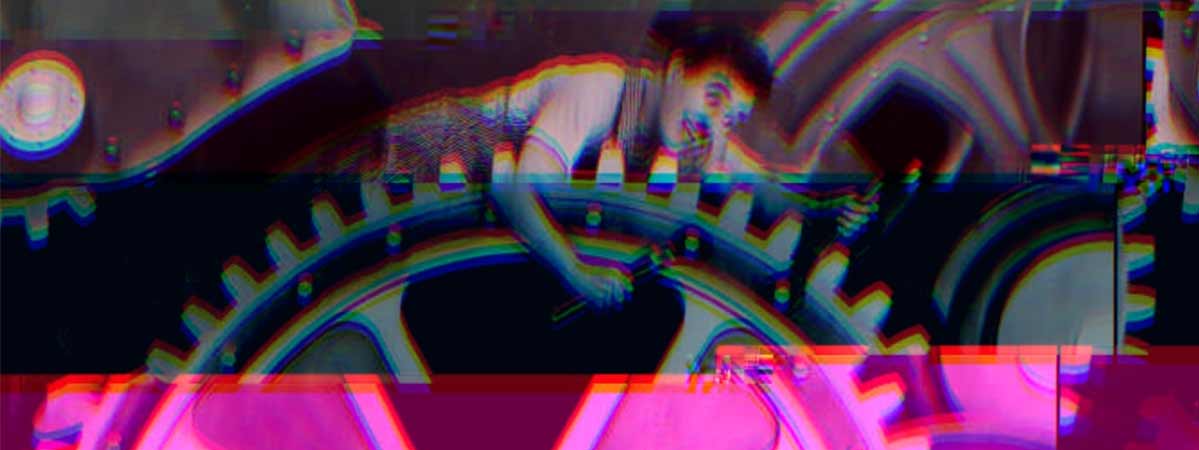
Charlie Chaplin in Modern Times

I’m doing some archival digging… I guess we’re all historical geographers at some level 🙂

For your consideration:

An article from The Guardian website, 6th August 2018.
An article from The Times, 8th March 1955.

40 years of automation anxiety in the UK through BBC clips [video]

Industrial factory robot arms

I’ve just done a rough edit of some snippets from BBC programmes that I think shows an interesting pattern to the ways that automation has been discussed by the UK national broadcaster over the last 40 years. In each case, automation is a significant issue – it needs to be urgently addressed, but that hasn’t yet happened.

Out of the three programmes, the first two are fairly significant in their onward influence.

The first, the 1978 “Now the Chips Are Down” Horizon episode was reportedly a significant influence for the BBC’s own Computer Literacy Project, which spawned the BBC Micro Computer.

The second, the 1980 (middle of three) episode(s) of “The Silicon Factor” was a part of the Computer Literacy Project. Alongside the three-part series, the producers created a report (for the BBC Continuing Education Department): “Microelectronics“, which was commissioned by the outgoing late-1970s Labour government’s Department for Education and the Manpower Services Commission. I thoroughly recommend watching the programmes and looking at the report if you’re interested in the histories of computing and automation in the UK.

The third, as far as I know – less significant in it’s onward influence, is a 2015 episode of Panorama: “Could a Robot Do My Job?” Interesting here because the rhetoric is nearly identical to that of “The Silicon Factor” – we need to take advantage of the revolution.

I’ve got more to say about this and I need to do a bit more thinking but wanted to share, because I think it’s interesting! This video (or a revised version) will form a part of my paper for a double session on ‘New Geographies of Automation(?)‘ at the RGS-IBG conference in August 2018 concerning the ways that we imagine automation.

“How will you manage fallout from [robot] displaced labor?” KPMG

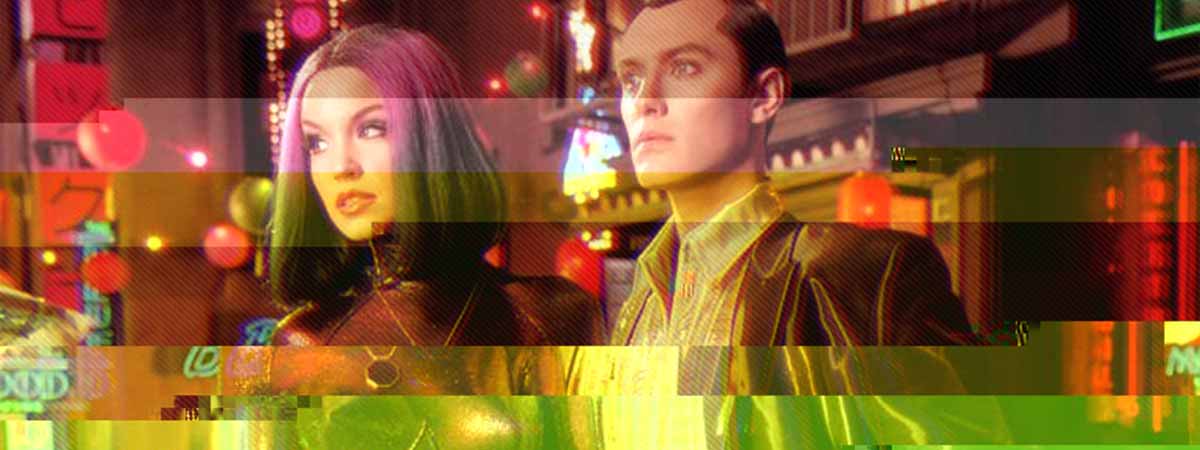
Gigolo Jane and Gigolo Joe robots in the film A.I.

From KPMG’s Strategic Visions on the Sourcing Market 2016, p. 32. Via Jamie Peck’s excellent Offshore.

How will you manage fallout from displaced labor?

The automation of human jobs may cause some unrest, so prepare to have honest, open discussions with your organization. Resistance may come not only from the workers in automatable roles but also from directors who may fear erosion in their span of control, as they potentially go from managing employees to managing bots.


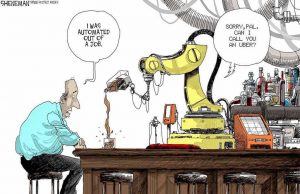
Cartoon about automation by Drew Sheneman

CFP The Body Productive

Gilbreth motion studies light painting

Saw this via Twitter. Looks good.

Call for Papers

How are bodies produced under capitalism?

How, in turn, does capitalism make bodies productive?

How is the body (and knowledge of the body) shaped by demands of production, consumption and exchange, and how can these logics be resisted, challenged and overcome?

These are the questions at the heart of François Guéry and Didier Deleule’s Productive Body. First published in French in 1972, The Productive Body asks how the human body and its labour have been expropriated and re-engineered through successive stages of capitalism. The Productive Body challenges us to rethink the relationships between the biological and the social; the body and the mind; power and knowledge; discipline and control. Finally, it invites us to think about the body as a site of resistance and revolutionary potential.

corpsbody

At this one-day, interdisciplinary conference, we invite scholars and activists to assess the contribution of The Productive Body, and to address its relevance as a theoretical tool for understanding and challenging contemporary ideologies of bodily health, efficiency and productivity.

We invite submissions from scholars, activists and artists for 20-minute papers, or 10-minute provocations on the relationships – past and present – between capitalism, work and the body. Collaborative papers are welcome, and proposals for longer workshops and panel discussions will also be considered. Please contact the organisers if you are unsure. Proposals that explore or are inspired by any of the following areas are welcome:

  • Critical responses to Guéry and Deleule – the biological, the social, and the productive
  • Materialist vs. discursive approaches to the history of the body
  • Conceptualising discipline in Marx and Foucault
  • The body as an object of discipline vs. the body as a site of dissent
  • The psychology and corporeality of activism, organising and resistance
  • Hierarchies of gender and race in the division of labour
  • (Re)productive bodies; intimate and emotional labour, sex work, body work
  • How are ideas of health and disability shaped by the demands of wage labour?
  • How do queer bodies disrupt or challenge logics of productivity? How are queer bodies in turn, commodified or appropriated by capital?
  • How do the demands of productivity complicate/interact with the body as a site of intimacy?
  • Biopolitics and neoliberalism
  • Body-machines – technology and automation; robotics, cybernetics and transhumanism; digital surveillance, ‘lifelogging’ and the ‘quantified self’
  • Counterproductive bodies: pre-capitalist, non-capitalist, and post-capitalist bodies

Please send abstracts of no more than 300 words to thebodyproductive@gmail.com by 24th August 2018. Submissions are especially encouraged from graduate students, early-career researchers, and groups typically underrepresented in the academy.