How to survive “disruption” – interview with Bernard Stiegler (translation)

In a recent interview with the French-language Swiss newspaper (or at least the web version) Le Temps, Bernard Stiegler addresses some of the key issues underlying his most recent book (not yet in translation) concerning disruption. Addressing in one sweep the ideological uses of the term by those involved in technological entrepreneurialism (especially in the US) and the wider sense in which (as he has previously argued) Stiegler sees a form of widespread dispossession of knowledge, of life skills and indeed of livelihood across Europe through the rapid political, social and technological changes to work and everyday life – Stiegler continues to argue for his favoured political response: an economy of contribution.

Of interest here, perhaps, is the brief discussion of his (and, I think, Ars Industrialis‘) collaboration in the creation of a Chair of Innovation [one of a number of proposed ‘research chairs’] to be based in Plaine Commune an urban unitary authority, or greater Paris borough (established through the creation of Metropolitan Greater Paris [Métropole du Grand Paris] as one of the nine Établissements publics territoriaux or boroughs/unitary authorities) on the Northern fringe of Paris that is designated as le Territoire de la Culture et de la création, or ‘the borough for creativity and culture‘. As I understand it Stiegler proposes Plaine Commune as ‘territoire contributif‘ – a sort of region of contribution [a territory or zone delineated as an area in which the economy of contribution might take precedence, along the same lines as ‘free trade zones‘ perhaps, but with a very different ethics/politics]. The principle role of the ‘chair’ is to oversee the pilot of a kind of basic or citizens’ income (broadly akin to a universal basic income) that Stiegler suggest will be implemented through a formal agreement of ‘contribution’ – whereby the income is granted on the premise that the young people given it will use it to subside their own personal development, in turn making them greater contributors to society.

As always, I have done my best to clarify and offer original French terms where I think it helps but done so in square brackets. I welcome comments and suggestions about this translation – please understand it to be a ‘rough’ version, I am nowhere near fluent enough for this to be considered particularly authoritative!

[See the original in French here].

How to survive “disruption”

The vacuity of the “data economy” or the revitalisation of our societies in a contributory mode? For Bernard Stiegler it’s time to choose …

Bernard Stiegler does not define disruption within the five hundred pages that begin with “Inshallah” and end with “we must dream”. The term, borrowed from nuclear physics, and in particular, experiments in closed rooms suggestively called “tokamaks” denotes a “sudden onset of instability”. In the jargon of our digital age the word now means the ability of an innovation to destabilize entire sectors of the economy and society. It is also worth noting that in the (not unrelated) terminology of the American Medical Association, a “disruptive physician” is a practitioner whose deplorable behavior undermines the health of those around him. So, we’re all clear then.

Bernard Stiegler does not define disruption because that is not his objective. His new book is placed in the disruption: the subject is us, who are totally enveloped within it – all of us, with our “processes of individuation” devastated by the conversion of our interior being into data that is delivered for automatic calculation. All of us, with our “protentions” (that is to say “the desire and expectation of the future”) short-circuited by algorithms. All of us, who face the “hegemonic becoming of disinhibition” [désinhibition devenue hégémonique] exemplified by the repulsive figure of Dominique Strauss-Kahn. We are all looking for tools to perform a split, the stakes of which are everything: on one side the void, on the other, if all goes well, the “reconstruction of a true society” [reconstitution d’une véritable société]. This is the conclusion of the French philosopher, theorist and practitioner of innovation, pioneer of digital and socio-technical thinking – and also, in previous lives, owner of a jazz club and former prison inmate, as he as highlighted himself – a combination of analysis with lived experience, which is, in this way, faithful to the foundations of phenomenology.

“How to not go mad?” Asks the subtitle of his book, and how did we arrive at such a question becoming inescapable? Via a long and winding path for society, answers Stiegler, that passes through “the inversion of the Enlightenment project” and leads to the “ultra-liberal capitalism” of the present, born from conservative revolutions that work towards the “pure and simple liquidation of public power”. Also, via a long technological path that has remained unthought since Plato, because philosophy essentially refuses to think technics. To represent the point where digital disruption converges with the climate crisis, Stiegler offers the testimony of a fifteen year old boy called Florian: “We no longer dream of having a family, of having children, a profession, ideals, because we are convinced that we are the last generation”. What is to be done? Surrender to madness? Allow suicidal thoughts to creep into the crevices of our minds like ivy? Let’s see…

Le Temps: Is the situation you describe the product of technology itself, or rather of the socio-political context?

Bernard Stiegler: When computing technologies can go four million times faster than us there are associated structural effects. However, we can use these tools in alternative ways to servicing the data economy. In any case, the web was not, initially, designed for capturing data: it was a space for publication, whose success was related to the opportunity to participate in public life through publication. In the Renaissance, printing opened out a public space that we call the Republic of Letters. The web potentially opens a new space that one can call the Digital Republic. The is what happened at first but quickly, and especially in the ten years since the introduction of social networks, the internet has become a system for capturing behaviour, for the development of what the Belgian lawyer Antoinette Rouvroy calls algorithmic governmentality, by which she means the control of individuals by algorithms.

– Is it still possible to split away from this?

– It is not only possible it is absolutely essential. The computational system as it functions today produces a standardisation, a homogenisation of existential spaces, which leads to a destruction of society. Increasingly, people are seen as the mediated reports of algorithms, and these are substituted for social systems. This results in a loss of a sense of existence that causes frustration, violence and madness, which is to say: despair and desensitisation [denoétisation]: the destruction of cognitive capacities. At an economic level, with the development of automation we see the destruction of more than half of the jobs in Europe and the United States. If we do not want to also thereby destroy half of the purchasing power, and thus consumption and economic activity, we must redistribute income outside of salaried employment, which exists less and less.

– We understand you have a plan…

– It shall be necessary to redistribute the gains made through automation through what we can call a contributory income, remunerating people who augment their capacities to act, in the sense understood by the Indian economist Amartya Sen. At the moment I am developing a project in the Seine-Saint-Denis district, which has more than 430,000 inhabitants, working with their unitary authority [l’établissement public territorial] Plaine Commune. Within the authority, we are creating a Chair of Contributive Research, in partnership with universities and businesses and with the support of three ministers. Primarily, this relates to the question of distributing a contributory income amongst several hundred young people drawn at random, whom we will support through a formal agreement [with them] based upon their acquisition of knowledge. The latter need not be purely academic, we are also speaking here of life skills [savior-vivre] and practical know-how [savoir-faire] in areas that could be [for example] sport or cooking.

In a famous study, Amartya Sen wondered why adult male mortality was higher in the New York neighbourhood of Harlem than in Bangladesh. In answering the problem he put forward an explanation based on [the idea of] collective knowledge that, he said, gave the Bangladeshis an ability to withstand incomparably greater adversity. In the Western world, people are thoroughly proletarianised: they no longer have [such] knowledge [savoirs], they only have the skills to operate a supermarket checkout, accounting software or financial data tools. They are therefore no longer capable of innovating [produire du changement], they only perpetuate the standardised nature of the system. A contributory income, on the contrary, remunerates people who acquire and enhance their capacities to enrich the social. We are also in favour of an unconditional income: both of these devices [dispostifs] are complimentary.

– So, in this way, there can be a future “in the disruption”…

– It is never too late for effective action [pour bien faire]. It is absolutely essential to develop an economy of contribution, using the algorithms that are already exploiting the data economy, that does not reject disruption, because that serves no purpose, because the reality of disruption is something nobody can prevent. This demands a new form of public power and a new European politics that develops an alternative model for these technologies. We must urgently reconstruct an ecology of dreams [une écologie du rêve], of thought [pensée], and social relations, and it must be created through experimentation, rather than solely through theorisation. Today we are in processes of denial, people do not want to hear talk of the extreme gravity of the situation. Yet as soon as there are real prospects [of change], they will [finally] be able to discuss it.

Bernard Stiegler, «Dans la disruption. Comment ne pas devenir fou?» (Editions Les Liens qui libèrent, 480 p.)

The Museum of Contemporary Commodities in EXETER

The Museum of Contemporary Commodities

Just a quick note to let you know that the brilliant Paula Crutchlow has brought “The Museum of Contemporary Commodities” (MoCC) to Exeter for the majority of May.

There’s lots going on, much of it creative and interesting – so if you’re in Exeter or nearby: come and visit!

Two immediate things this week:

RIGHT NOW!: help re-create the internet in paper with Artist Louise Ashcroft from 11 -2 in the Exeter University Forum.

TOMORROW: sign up to do a data walkshop with Alison Powell from the LSE on Saturday from 10-1. Places have to be booked, and the Eventbrite page is here https://www.eventbrite.com/e/mocc-data-walkshop-tickets-24464719635

Please do visit the MoCC website for lots more events and activities taking place this month and visit the shop:

87 Fore St,
Exeter
EX46RT

Open 10:00-18:00pm Weds-Sat, 4th-21st May.

In Disruption – new book by Bernard Stiegler

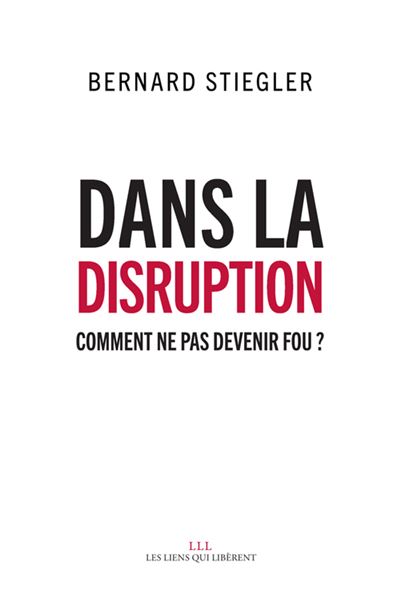
Yet another new book by Bernard Stiegler has been published in French recently: Dans la Disruption – Comment ne pas devenir fou?
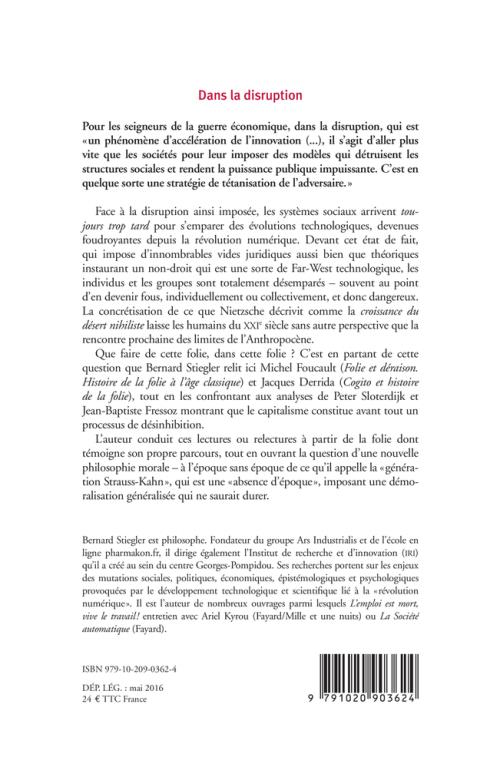
One might translate this as: “In Disruption – How do we not go mad?”

Here’s the front and back covers, and I offer a quick translation of the back cover blurb…


For the lords of economic war disruption is “a phenomenon of the acceleration of innovation (…) which is going to happen more quickly in societies that allow them to impose programmes that destroy social structures and render public power impotent. This is a kind of strategy of tetanising one’s adversary”.

Facing the disruption thus imposed, social systems always arrive too late to seize technological evolution, now thundering ahead in the digital revolution. Faced with this state of affairs, which requires countless legal and theoretical loopholes establishing a lawlessness which is a kind of techonlogical Wild-West, individuals and groups are totally lost, often to the point of going mad, individually or collectively, and therefore becoming dangerous. The concretisation of what Nietzsche described as a growing desert of nihilism leaves 21st Century humans with no other perspective than facing the next of the limits of the Anthropocene.

What can be done with such madness, in such madness? It is by starting with this question, that Bernard Stiegler rereads Michel Foucault (Madness and civilisation: A history of insanity in the Age of Reason) and Jacques Derrida (Cogito and the History of Madness) while confronting Peter Sloterdijk and Jean-Baptise Fressoz’s analyses of capitalism as above all a process of disinhibition.

The author conducts these readings or re-readings starting from the forms of madness which reflects his own course, opening out the question of a new moral philosophy – in an age without age [l’époque sans époque], which he calls the “Strauss-Kahn generation”, that is a “lack of age” [“absence d’époque”], which imposes a general demoralisation that cannot last.

Reblog> Launch Event: Researching Alternative Worlds: New political orientations in Geography

I’m taking part in the launch event of the Bristol Geography MSc Society & Space blog alongside some excellent and distinguished alumni of the course. It promises to be an interesting event!

The Official Launch of the Society and Space MSc Blog

4.00pm, Hepple Lecture Theatre, School of Geographical Science, University of Bristol

Register here

alternative worlds cover photos-1

On Wednesday 27th April, we will be officially launching the Society and Space MSc blog with a panel discussion event bringing together Society and Space alumni to discuss a common concern to all of their work – the role of academia in creating alternative social worlds. The Society and Space MSc Course is the principle Human Geography research training Master’s programme within the School of Geographical Sciences at the University of Bristol. As a Master’s degree that emphasises social and political theory, the programme trains students to think about social and cultural geographies from a critical perspective while also interrogating the political and ethical components inherent to these geographies. The programme has produced a range of alumni who have, in the course of their research, continue to contemplate and develop the issues, theories and debates they first encountered on the Master’s programme.

To officially launch the Society and Space blog, we have invited back Society and Space alumni – including James Ash, Emma Roe, Sam Kinsley, Nathan Eisenstadt, Owain Jones and Julian Brigstocke – to take part in a panel discussion centred upon pressing questions concerning our role as researchers in mapping alternative social worlds. What is the role of academic research in investigating, creating and sustaining alternative social worlds? When is academia useful and effective? What are we doing wrong, and what should we be doing more of?

Although a Master’s programme in Cultural Geography, the Society and Space MSc attracts students from a range of backgrounds and a variety of disciplines, such as journalism, English literature, philosophy, fine art and cultural studies. Due to the wide spectrum of backgrounds and interests of those who enrol in the course, as well as the dynamic nature of Human Geography as a subject, the contents covered in the Society and Space programme stimulate a range of conversations about the nature of sociality, the world we live in, and potential futures that may lie ahead of us. We expect that this diversity and broad outlook will be reflected in the work our speakers will present and the discussions that ensue. In addition to being a highly theoretical course, there is a strong, grounded political and ethical focus to the Master’s programme. Consequently, the issues debated, discussed and encountered throughout the Society and Space course are in direct conversation with ‘real’ issues – today’s hot topics and current political and ethical debates. In a context of austerity and the neoliberalisation of academia, the role of academia in researching and co-creating an alternative future is surely one such topic.

Alternative Worlds Poster-1

For a taste of the themes that the panel discussion will traverse, please have a look at abstracts provided by some of our panellists:

Dr James Ash, University of Newcastle

In this short reflection I offer one way of thinking about how we frame social science research questions. In doing so I want to caution against approaches which, however well meaning, centre on ‘big’ problems, framed in a general sense in relation to the concept of world. While issues such as climate change, poverty, homelessness and debt, amongst myriad others are undoubtedly real, there is an issue when assuming that a set of general problems are experienced within a shared horizon of meaning that is implied in the use of the term world. Rather than framing social problems in terms of big or small, or general or particular, I want to argue that such problems can be more productively framed in terms of what Simondon terms the abstract and the concrete. Drawing upon vignettes from the research design of an ESRC project on debt and digital interfaces, I demonstrate how Simondon’s work can be applied to specific societal problems.


Dr Nathan Eisenstadt, University of Bristol 

In this brief intervention I reflect on my doctoral work exploring paradoxes of freedom enacted in contemporary anarchist spaces. I propose that while performed inconsistently and in contradictory ways, the liberatory and egalitarian character of these practices lies in their capacity for an undoing of oneself with the help of compassionate others. Wonderful as this may sound – it has its edges. In closing I call attention to the failure of self-reflection and attempts to make spaces ‘safer’ when collectively established norms are radically transgressed.


Dr Sam Kinsley, University of Exeter

Computation is being used, within and without academia, to make ever grander and more detailed claims about our world. Yet, the (many) ‘worlds’ that emerge from what are generically referred to as ‘algorithms’ can be seen to fall foul of well-known fallacies of empiricism, in relation to their supposed lack of theoretical basis and apparent exhaustive reach. So, in light of grand claims made on behalf of ‘big data’ research and a contemporary predilection for the study of ‘algorithms’, I argue for a critical interrogation of the forms of world-ing propounded by such an ‘algorithmic imaginary’. In so doing, I suggest we reflect on what can be called a dialectic of ‘stupidity’ and ‘knowledge’, following Bernard Stiegler (2015), that undergirds our contemplation of such world-ings. My aim here is to tackle the inherent politics of this logic of worlds and how critical social scientists might engage.


Professor Owain Jones, Bath Spa University

My short presentation will reflect upon my experience of being in the first (very small) cohort of the MSc and then also devising and teaching the Nature and Society module from 2003-2006. I did not do an academic degree but an arts practice based degree so the MSc really marked my ‘conversion’ to academia and to geography. I can say without any exaggeration that doing the course was a life transforming and enhancing experience (as university (PG) education should be). The very possibility of imagining and enacting alternative worlds was very much part of that. My subsequent academic and professional life stands upon the very strong foundations put in place by the MSc and I think this is the case for many others too. I will offer some reflections upon why the course was so effective in this way. In part this was simply about being in a centre of excellence where there was a powerful intellectual momentum in which the conceptual and imaginative tools for questioning the trajectories of modernity were set out . But it was also about openness, spirit and collegiality with the staff and PG cohorts.

In addition to the panel discussion – which will be followed by time for audience questions – there will be a brief introduction by the Society and Space Blog Editors, before our very own Dr JD Dewsbury will recount his experience as first a student and then a lecturer on the MSc and map out how the course has changed and developed over the years.

The event will take place at 4.00pm, in the Hepple Lecture Theatre, School of Geographical Science, University of Bristol (see map). The discussion will be followed by a drinks reception. If you intend to attend (and we hope you do!), please confirm your attendance here.

We look forward to meeting you on 27th April.

The Editors

Stiegler: Stop the uberisation of society!

Posted below is a translation of a piece co-authored by Bernard Stiegler with Ariel Kyrou (journo),  Yann Moulier-Boutang (writer) and Bruno Teboul (Director of innovation at Keyrus) and published in Libération on the 10th April.

I suppose it doesn’t really propose anything especially novel, if you’re familiar with others involved in debates around “postcapitalism”, automation, worklessness and universal income (e.g. Srnicek and Williams, or Mason). What is perhaps novel is an application of the ideas in a distinctly European flavour, with examples in France and in the context of a much more robust unionised response to Uber (and the task/gig economy).

Anyway, it’s an interesting read I think…

The piece is rather conversational in tone and uses idioms I have only been able to infer (not being a fluent and native speaker) so it was quite difficult to translate, and so I’m pretty sure there are errors. As usual clarifications or original French are in [square brackets].

Stop the uberisation of society!

Libération, 10th April

The war by taxi companies against an Uber society cannot be reduced to the storyline of a film depicting an ancient evil battling benevolent forces of modernity. If on the one hand the participatory economy threatens our social structures, it can also, on the other, make possible a society with greater solidarity.

Since the first moves towards the draft Thévenoud law in June 2014[1], the urban transport soap opera has generated multiple variations on the theme of the standard storyline. On one side are the taxi federations, which have been labelled a horde of grumpy medieval malthusians by Uber, who in the opening of the second act of the performance of the trial of the 11th February demanded a whopping €100m in damages from Uber, on the other the ‘white knight’ of the new economic order, the high-tech Robin Hood of its pleb users whose UberPop service enables simple fellows in search of employment the opportunity to offer at cut-price their talents for automotive locomotion, between February 2014 and July 2015. This tale of jokers against modernisers is more attractive than the G7, queen of opaque rentier sorcery, who could not turn themselves with the wave of a magic wand into the cinderella of Parisian Transport.

Except that the movie script of the ancient evil against the benevolent ‘disruptors’ rings as hollow as any Hollywood blockbuster: seen quickly, soon forgotten. It works in the short-term, like the groan of the indefinite vigil for a taxi at 3 o’clock in the morning in the banlieue, but it hardly takes us any distance towards solving the questions about the future of our society and the search for sustainable solutions to the crisis we are experiencing.

Let’s not misunderstand this scenario: the agonism presented by this contemporary drama [série du moment] is neither the ardent need to pit global start-ups against French corporatism [corporatismes franchouillards] nor its exact opposite, namely the obligation to defend the capitalism of tired old barons against the hyper-capitalism of the rulers of the digital future. No, the issue that should be obvious to everyone with a stake in the debate is the urgent need to think about the society we want, and then act in order to build it.

For why should we anoint an ‘uberisation of the economy’ without interrogating its ideology and long-term deleterious effects? Uber, which declares only a fraction of its profits in France thanks to a complex form of tax evasion through the Netherlands, Bermuda and Delaware, is participating in the liquidation of our social structures. It embodies a short circuit that threatens the fragile economic balance between taxation, social law, transport policy, infrastructure investment at the local level and the pensions system. Worse still: its social and economic logic foreshadows the advent of a futuristic no-man’s land in which the a priori ideal of liberty becomes monetised against an a posteriori generalised casualisation throughout society. Indeed, the rictus predatory behaviour of platforms like Uber, Lyft and others such as Amazon’s Mechanical Turk is founded upon a low intensity of capital, little infrastructure, a minimum of salaried employees with more independent or self-employed workers.

The uberisation process forms the first wave in the tsunami of automation. Its primary consequence will be a net loss of five million jobs in industrialised countries by 2020, according to a report published on the 18th of January by the oracles of the World Economic Forum in Davos, the shameless apostles of the “fourth industrial revolution”. This deeply unappealing assertion has been amplified by several studies in the last three years (by Oxford, MIT, the Breugel Institute and Roland Berger) which predict around 47% fewer people in employment by 2025. This slow but inexorable extinction of of the salaried world effects not only warehouse workers, supermarket cashiers and lorry drivers but also barristers, solicitors, journalists, those working in medicine, and so on. Why should it remain necessary to use human beings for tasks that are reducible to systematic procedures? Which in our data economy robots and algorithms will soon perform much more efficiently. The combination of robotics and ‘big data’, algorithms and network effects, is already transforming us into the involuntary gravediggers for salaried employment. Welcome to a world that is ultimately ‘flexible’, boosted by robotic automation [robotisation] and work on the meter. A world where users and customers constantly account for themselves, where each becomes their own big brother and where most of the activity in every market, like with car insurance, will increasingly play out more in an automated big data-driven fashion than according to laws or to forms of trust that are not based in calculation.

Nevertheless we should beware skewed perspectives: such a world is not inevitable. The digital gives us an opportunity to reconsider work not only in terms of jobs doomed to become ever more precarious, provoking anxiety about self-exploitation, but also as a part of a project for a contributory society in which salaried employment would be one means amongst many, rather than an end in itself. A company like TaskRabbit certainly creates use value through its platform of small on-demand jobs, but it keeps for itself and its shareholders the [accompanying] exchange value in the form of profit. In contrast, Loconomics is a co-operative owned by those who use it to advertise their services. Against the platforms of the so-called sharing economy (which it is in name only) Trebor Scholz endorses a ‘platform cooperativism’ [2] to build a society of commons that operates beyond solely economic and financial dimensions.

This shambles needs to be urgently addressed. Thinking in the long-term, this is political in the principal sense of the word. To buckle down to the future of work equally concerns: expertise in data to use and liberate ourselves from algorithms and a care for people without the need for machines; to classify work in a way that is both protective of our ways of life and much less administrative than today; to examine the establishment of an adequate basic income, structurally justified by massive unemployment due to automation and the coming slow death of employment; to experiment with the extension of the regime of casual work in the context of a true society of contribution, with the acquisition and sharing of knowledge by and between everyone; to study tax reform based upon the principles of a financial transactions tax [la taxe pollen], beginning with the establishment of a European tax on the flows of High Frequency Trading, to finance a universal income.

Rather than the two opposing and yet complimentary nightmares that are the integral uberisation of society and the sovereignist protection of the capitalism of yesteryear we prefer the realisation of a dream: to imagine, to experiment, to build, step by step, a freer society with greater solidarity; preferring disagreement to the brainwashing that has played out, historically, through the carrot and the stick, or, in our high-tech times, through a blind obedience to shiny artificial devices [l’obéissance aveugle à de rutilantes mécaniques artificielles et augmentées].

1. For more information on the Thévenoud law see this article – Sam.

2. See this article on Medium by Scholz.

VR… ‘das opium des volkes’? Adam Greenfield on Oculus

Nice blogpost by Adam a short-while ago reflecting on VR as a means of keeping the precariat/proletariat sated with simulation:

As VR’s leading developers straight-up admit in the piece, its function is to camouflage the inequities and insults of an unjust world, by offering the masses high-fidelity simulations of the things their betters get to experience for real. Here’s the money quote, no pun intended: “[S]ome fraction of the desirable experiences of the wealthy can be synthesized and replicated for a much broader range of people.” (That’s John Carmack speaking, for future reference.)

[…]

The idea that all we can do is accede to a world of permanent, vertiginous inequity – inequity so entrenched and so unchallengeable that the best thing we can do with our technology is use it as a palliative and a pacifier

All reminiscent of William Gibson’s rendering of the “Sim/Stim” industry in the Neuromancer trilogy… for example, this passage from the 23rd chapter of Count Zero (the 2nd book):

The interior of the JAL shuttle vanished in a burst of Aegean blue, and she watched the words TALLY ISHAM’S TOP PEOPLE expand across the cloudless sky in elegant sans-serif capitals.

Tally Isham had been a constant in the stim industry for as long as Marly remembered, an ageless Golden Girl who’d
come in on the first wave of the new medium. Now Marly
found herself locked into Tally’s tanned, lithe, tremendously comfortable sensorium. Tally Isham glowed, breathed deeply
and easily, her elegant bones riding in the embrace of a musculature that seemed never to have known tension. Ac- cessing her stim recordings was like falling into a bath of
perfect health, feeling the spring in the star’s high arches and
the jut of her breasts against the silky white Egyptian cotton
of her simple blouse. She was leaning against a pocked white balustrade above the tiny harbor of a Greek island town, a cascade of flowering trees falling away below her down a
hillside built from whitewashed stone and narrow, twisting
stairs A boat sounded in the harbor

“The tourists are hurrying back to their cruise ship now,” Tally said, and smiled; when she smiled, Marly could feel the smoothness of the star’s white teeth, taste the freshness of her mouth, and the stone of the balustrade was pleasantly rough against her bare forearms.

I continue to be surprised by the return to and rehabilitation of the Modernist vision of VR… perhaps I’m not cynical enough?!

A politics and economics of attention

Just before Christmas (and just before injuring myself) I took part in an ESRC-funded seminar concerning the politics and economics of attention, alongside my colleague Clive Barnett and others.

Jessica Pykett very kindly invited me to talk on the back of the theme issue of Culture Machine Patrick Crogan and I co-edited back in 2012.

There are slides from the talks plus an interesting commentary by Rupert Alcock now posted to the Behaviour Change and Psychological Governance website.

My slides are on ResearchGate…

Reblog> Digital Interfaces, Credit and Debt – new project from @ash_ecotechnics & @BenAndersonGeog

Not really sure how I missed this announcement last week but there you go… An interesting new ESRC-funded project led by James Ash concerning the growth of personal/’pay day’ loans (“High Cost, Short-Term Credit”) that are accessed through mediation, such as an ‘app’. Kudos to James and team for landing this with success rates with the ESRC as low as they are – a great achievement.

I’m sure it’ll be a great project!

Digital Interfaces, Credit and Debt

I am happy to formally announce that I am primary investigator on an ESRCfunded project entitled: ‘Digital Interfaces and Debt: understanding mediated decision making processes in high cost short term credit products’ with co-investigators: Dr Ben Anderson and Dr Paul Langley. 

This 18 month project (2016-2018) seeks to understand how consumers access HCSTC (High Cost Short Term Credit), such as cash and pay day loans through digital interfaces, on personal computers and mobile devices and in turn how these interfaces shape decision making processes regarding the purchasing of credit. The project proposes a novel approach to debt as an everyday phenomenon that is mediated through the relationship between technology and embodied practice. Understanding how people become indebted through digital interfaces is critical to analyzing and explaining contemporary indebtedness because 82% of cash and pay day loans, a key form of HCSTC, are now applied for and managed via digital interfaces on laptops, tablets and smart phones (Competition and Markets Authority, 2015). Through original empirical investigation with designers and users of mobile interfaces, debt support charities and financial regulators, the research will generate new evidence about everyday experiences of debt and indebtedness and contributes to important societal and academic debates about emerging forms of credit and problematic forms of economic subjectivity.

The project begins later this year and will have its own dedicated website and Twitter account, which will be publicized in due course.