Past event > Technology’s Limits: Automation, Invention, Labour, and the Exhausted Environment

Glitched image of a mural of Prometheus giving humans' fire in Freiberg

This looks like it was a fascinating event…

Workshop hosted by the Digital Life Research Program 

An abstract artwork of a light background with brown and red rectangles of various sizes.

Artwork by Stephen Scrivener Opens in a new window

Event Details

Date: Friday March 10, 2017
Time: 10am – 4.30pm
Venue: EB.G.21, Parramatta South campus

Among its many political preoccupations, 2016 was marked by an obsessive concern with the new powers of the machine to erase human labour and employment. Science fiction dystopias – among them, the French Trepalium and the Brazilian 3% – saddled older anxieties about a world without work to a more novel recognition of resource depletion and scarcity. Academic publishing houses, conference organisers, funding agencies and the press have responded with a deluge of content covering algorithms, automation and the Anthropocene. Meanwhile, a less conspicuous narrative about the decline of innovation has resurfaced with claims that the rate of fundamental new technology inventions is slowing and jeopardising long term global productivity returns. What happens when technology hits its limits? Velocity and volume excite machinic economies, but do little to confront some of the core problems and challenges facing planetary labour and life today.

This workshop brings together leading Australian scholars of technology and society with contemporary German and French reflections on the prevailing discourses of technology’s limits. Since the 1990s, Bernard Stiegler has been a leading philosopher and critic of technology, and in his recent book Automatic Society he directly tackles problems of automation and algorithms for the distribution of financial and social resources to populations increasingly bereft of economic capital and political agency. Building upon Frankfurt School critical theory and Kittlerian media theory, contemporary German critique intersects with similar questions by combining investigations of epistemology, history and the technical. The Australian take on these European developments is simultaneously appreciative and critical, though often oriented toward more regional conditions that arise in part due to different economic, cultural and political relations with Asia.

The morning session of the workshop will introduce current theoretical European work on technology. Daniel Ross will develop a critical introduction to Bernard Stiegler, whose recent work in Automatic Society and In the Disruption continues to mount a wide-ranging and provocative critique of technology. Armin Beverungen will then offer an overview of his research on algorithmic management and high-frequency trading, with Ned Rossiter introducing logistical media as technologies of automation and labour control. In the afternoon, Gay Hawkins will outline her theoretical interest in nonhuman and technical objects and their irreducible role in making humans and ecologies. A key empirical example will be the history of plastic and the emergence of its technical agency and capacity to reconfigure life. Nicholas Carah will follow with a discussion of his latest work on algorithms, brand management and media engineering. The workshop will close with an audience-driven panel session and discussion. These interventions will be held in conjunction with a close reading of the key texts below.

Register

Attendance numbers will be limited so please register in advance. No registration fee required.

RSVP by 7 March on Eventbrite Opens in a new window

Speakers

  • Armin Beverungen
    Junior Director at the Digital Cultures Research Lab (DCRL) at Leuphana Universität Lüneburg & Visiting Fellow, Institute for Culture and Society, Western Sydney University
  • Nicholas Carah
    Author of Brand Machines, Sensory Media and Calculative Culture (2016)
  • Gay Hawkins
    Author of Plastic Water: The Social and Material Life of Bottled Water (2015)
  • Liam Magee
    Author of Interwoven Cities (2016)
  • Nicole Pepperell
    Author of Dissembling Capital (forthcoming, 2017)
  • Daniel Ross
    Translator of Bernard Stiegler’s Automatic Society (2016) and numerous other works
  • Ned Rossiter
    Author of Software, Infrastructure, Labor: A Media Theory of Logistical Nightmares (2016).

Co-chairs: Liam Magee and Ned Rossiter, co-convenors of the Institute for Culture and Society’s Digital Life research program.

Recommended Readings

Frank Pasquale (2017), Duped by the Automated Public Sphere Opens in a new window
Lee Rainer and Janna Anderson [Pew Research Center] (2017), Code-Dependent: Pros and Cons of the Algorithm Age Opens in a new window
Bernard Stiegler (2012), Die Aufklärung in the Age of Philosophical Engineering (opens in a new window)
Bernard Stiegler (2015), Escaping the Anthropocene Opens in a new window
Bernard Stiegler (2015), On Automatic Society Opens in a new window
Sonia Sodha [The Guardian] (2017), Is Finland’s basic universal income a solution to automation, fewer jobs and lower wages? Opens in a new window

Related Readings

Bruce Braun (2014), A New Urban Dispositif? Governing Life in an Age of Climate Change Opens in a new window
Nick Dyer-Witheford (2013), Contemporary Schools of Thought and the Problem of Labour Algorithms (opens in a new window)
Victor Galaz (2015), A Manifesto for Algorithms in the Environment Opens in a new window
Victor Galaz et al. (2017), The Biosphere Code Opens in a new window
Orit Halpern (2015), Cloudy Architectures Opens in a new window
Erich Hörl (2014), Prostheses of Desire: On Bernard Stiegler’s New Critique of Projection Opens in a new window
Yuk Hui (2015), Algorithmic Catastrophe: The Revenge of Contingency (opens in a new window)
International Labour Organisation (2016), ASEAN in Transformation Opens in a new window
Lilly Irani (2015), The Cultural Work of Microwork Opens in a new window
MIT Technology Review (2012), The Future of Work Opens in a new window
Cathy O’Neill (2016), How Algorithms Rule Our Working Lives Opens in a new window
Elaine Ou (2017), Working for an Algorithm Might Be an Improvement (opens in a new window)
The Guardian (2016), Robot Factories Could Threaten Jobs of Millions of Garment Workers Opens in a new window
Tommaso Venturini, Pablo Jensen, Bruno Latour (2015), Fill in the Gap. A New Alliance for Social and Natural Sciences Opens in a new window

Agenda

  • 10:00 –10:10: Liam Magee, Ned Rossiter: Welcome and Introduction
  • 10:10–11:10: Daniel Ross
  • 11:10–11:30: Q&A
  • 11:30–11:45: Coffee
  • 11:45–1:00: Armin Beverungen, Ned Rossiter
  • 1:00–2:00: Lunch
  • 2:00–3:15: Gay Hawkins, Nicholas Carah
  • 3:15–4:15: Panel discussion responding to automation: Dan / Gay / Nicholas / Armin / Nicole – Liam & Ned to chair
  • 4:15–4:30: Closing thoughts, future actions

Reblog> Three new OHP books from: Brian Massumi; Steven Connor; and Érik Bordeleau, Toni Pape, Ronald Rose-Antoinette and Adam Szymanski

open access spelled out with books

Via Gary Hall. All of the books are available for free download. Follow links below.

We are pleased to announce the release this month of two new titles in Open Humanities Press’ Immediations series:***

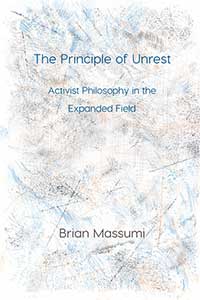
Brian Massumi’s The Principle of Unrest explores the contemporary implications of an activist philosophy, pivoting on the issue of movement. Movement is understood not simply in spatial terms but as qualitative transformation: becoming, emergence, event.

Available for free download at:

http://www.openhumanitiespress.org/books/titles/the-principle-of-unrest/


***

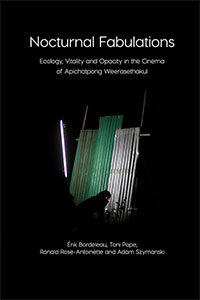
Nocturnal Fabulations/Fabulations nocturnes by Érik Bordeleau, Toni Pape, Ronald Rose-Antoinette and Adam Szymanski with an Introduction by Erin Manning.

This collective, bi-lingual project is animated by a shared curiosity in the pragmatics of fabulation and its speculative gesture of bringing forth a people to come. In an encounter with Apichatpong’s cinematic dreamscape, the concepts of ecology, vitality and opacity emerge to articulate an ethos of fabulation that deframes experience, recomposes subjectivity and unfixes time.Available for free download at:

English: http://www.openhumanitiespress.org/books/titles/nocturnal-fabulations/

French: http://www.openhumanitiespress.org/books/titles/fabulations-nocturnes/

***

We are also pleased to announce the latest book in the Technographies series:

Steven Connor’s Dream Machines

Dream Machines is a history of imaginary machines and the ways in which machines come to be imagined. It considers seven different kinds of speculative, projected or impossible machines: machines for teleportation, dream-production, sexual pleasure and medical treatment and cure, along with ‘influencing machines’, invisibility machines and perpetual motion machines.

“This is an engaging and imaginative exploration of various forms of writing, thinking, and fantasizing about dream machines, an endlessly fertile topic probed here from just about every possible angle “¦ a major intervention into current understandings of technology, literature, and identity.”

Matthew Rubery – Queen Mary University of London

“”¦ a deeply original contribution to the history and philosophy of technology and the cultural history of the imagination “¦”Laura Salisbury – University of Exeter

Available for free download at:

http://www.openhumanitiespress.org/books/titles/dream-machines/

With our best wishes,

Sigi, David, Gary

The Priority of Injustice – Almost ready…

The Priority of Injustice – BarnettMy colleague Clive Barnett has blogged an update concerning his latest book The Priority of Injustice, with the blurb – see below.

“This original and ambitious work looks anew at a series of intellectual debates about the meaning of democracy. Clive Barnett engages with key thinkers in various traditions of democratic theory and demonstrates the importance of a geographical imagination in interpreting contemporary political change.

Debates about radical democracy, Barnett argues, have become trapped around a set of oppositions between deliberative and agonistic theories–contrasting thinkers who promote the possibility of rational agreement and those who seek to unmask the role of power or violence or difference in shaping human affairs. While these debates are often framed in terms of consensus versus contestation, Barnett unpacks the assumptions about space and time that underlie different understandings of the sources of political conflict and shows how these differences reflect deeper philosophical commitments to theories of creative action or revived ontologies of “the political.” Rather than developing ideal theories of democracy or models of proper politics, he argues that attention should turn toward the practices of claims-making through which political movements express experiences of injustice and make demands for recognition, redress, and repair. By rethinking the spatial grammar of discussions of public space, democratic inclusion, and globalization, Barnett develops a conceptual framework for analyzing the crucial roles played by geographical processes in generating and processing contentious politics.”


Simondon and Technics event recordings

Glitched image of a mural of Prometheus giving humans' fire in Freiberg

If you were not in Kingston earlier this week but have a desire to be part of the ‘next big thing in theory’, or you’re actually interested in the philosophy of technology, it appears that the talks were recorded… via dmf / Stuart Eldon.

Simondon on Technics: On the Mode of Existence of Technical Objects

Please join the Centre for Research in Modern European Philosophy (CRMEP) for a workshop to discuss Gilbert Simondon’s 1958 On the Mode of Existence of Technical Objects, finally now translated into English in its complete form.

Speakers: Andrea Bardin (Brunel University), Giovanni Carrozzini (CIDES, MSH Paris-Nord), Xavier Guchet (Paris 1 Sorbonne), Cécile Malaspina(translator), Simon Mills (De Monfort University), Pablo Rodriguez (University of Buenos Aires)

The 2016 English translation of Gilbert Simondon’s 1958 On the Mode of Existence of Technical Objects finally introduces the Anglophone reader to a complete version of the French philosopher’s great work: a complex crossover between ontology, epistemology, psycho-sociology and the philosophy of technology. With the participation of international specialists on Simondon’s writings, this workshop aims to explore the main themes of Simondon’s philosophy of technology, connecting them to the relational ontology of communication processes outlined in Individuation in the Light of the Notions of Form and Information.

Embarrassing ourselves… translations and mental flounderings

A glitched image of a typewriter

A colleague shared this fascinating and perhaps difficult piece in the LARB by the highly regarded Derrida scholar Geoffrey Bennington on the publication of the anniversary edition and revised translation of Of Grammatology by Gayatri Chakravorty Spivak, with a new ‘Introduction’ by Judith Butler. I really encourage anyone with an interest in Derrida’s work, in language and in translation to read this article, I think it’s really quite something.

What is perhaps extraordinary about Bennington’s incisive analysis of the new edition is the acute nature of the problems he reveals with translating Derrida’s insight, which Bennington asserts: “is quite simple, yet in its very simplicity hard to grasp”. For “il n’y a pas de hors-textes“ is just as apposite to the issues Bennington highlights as it is to the understanding of Derrida’s wider project.

I won’t attempt to précis what is an erudite and rigorous article that also necessarily confronts some perceived (it appears fairly) problems and/or errors in understanding on the parts of Butler and Spivak. In this regard, it’s also worth paying attention to the footnotes…

Reblog> Ordinary digital humanities – event with @rodgers_scott

Another interesting event, this time with Scott Rodgers at Birkbeck.

Ordinary digital humanities: Free event at Birkbeck, 15 May 2017

Apple_II_IMG_4212In a couple of weeks’ time I am happy to be hosting an event as part of Birkbeck Arts Week on the subject of ‘Ordinary Digital Humanities’, featuring a talk from Lesley Gourlay (UCL Institute of Education). The publicity blurb below has more than enough information, I suspect, for you to get the idea. The event comes in significant part out of discussions we’ve been having through Satellite, an experimental subcommittee in the School of Arts at Birkbeck focused on exchanging information and perspectives on the critical, creative, academic and pedagogical dimensions of learning technologies.

Ordinary Digital Humanities
The everyday life of digital technologies in pedagogy

15 May 2017, 6pm, Keynes Library, 43 Gordon Square, WC1H 0PD (part of Birkbeck Arts Week)

Book your free place at: https://www.eventbrite.co.uk/e/ordinary-digital-humanities-the-everyday-life-of-digital-technologies-tickets-33211361075

When one hears the term ‘digital humanities’ what likely comes to mind are innovative applications of computational techniques and technologies to humanities research as well as pedagogy. Or, conversely, the application of concepts and philosophies rooted in the humanities toward the study of emergent digital objects.

There are reasons however to think about the digital humanities in a more ordinary sense, beyond ‘cutting edge’ research or pedagogy. In the introduction to her book How We Think, N. Katherine Hayles suggests that in order to understand the implications of digital technologies for the humanities, we must first consider the ‘low level’ implications of digital technologies for academic life. For instance, the widespread normalisation of email, department websites, software applications, web searches, social media, and much more. For Hayles, a ‘digital humanities’ is more than just innovative new approaches to research and pedagogy. It is also inherently about transformations to the cognitive and embodied environments of academic life at the level of the habitual or everyday.

This forum considers the banal dimensions of the digital humanities, focusing specifically (though not exclusively) on pedagogical practice. It begins with an opening lecture from Dr Lesley Gourlay (abstract below), followed by responses from Dr Grace Halden and Dr Tim Markham from Birkbeck, University of London. We will not only survey the everyday ways digital technologies are being used, and are asserting themselves, in academic life; but also, how humanities and other scholars might respond to the apparent opportunities and intrusions wrought by digitisation.

The event will be followed by a wine reception.

Flickering texts and the writing body: posthuman perspectives on the digital university

Dr Lesley Gourlay, Reader in Education and Technology, UCL Institute of Education

As digital technologies become increasingly central in our day-to-day lives, we see profound changes in how we search for information, communicate with others, and express ourselves. The university is also changing, as digital media becomes more central via online resources for distance learning, but also throughout the traditional campus, through the mainstream use of digital media for teaching, library provision and academic reading and writing. This has not only changed approaches to academic teaching, it has also fundamentally altered how we seek resources and how we read and generate new knowledge through writing and interaction. Drawing Hayle’s notion of ’embodied virtuality’, this talk will explore this theme, analysing data from a research project which looked in detail at how a small group of students approached their studies over a six-month period, using drawings, photography and interviews to form an in-depth understanding of their day-to-day lives as students, and how they navigate the complex digital and material landscape of the contemporary university. It looks at how texts change when they move between paper-based and the digital, how students navigate the complexities of multiple devices and formats, how they make spaces for writing and knowledge while on the move, and how they form part of ‘posthuman’ networks of digital devices and material objects in order to engage in their studies. Taking a historical perspective, the talk concludes that textual practices have always been central to how higher education is organised and how we understand ‘knowledge’, and considers how digital media might continue to change what we call ‘the university’.

A ‘new realism’ and post-truth

A glitched image of a typewriter

In a recording of a very lively double-header presentation by Maurizio Ferraris and Martin Scherzinger which has been podcast by Data & Society there’s some interesting discussion of Ferraris’ formulation of a ‘new realism‘ (which is sort of sympathetic to but perhaps distinct from speculative realisms) in relation to how we might understand ‘truth’ and truth claims and so how we might understand how ‘understanding’ works in relation digitally mediation.

Both Ferraris and Scherzinger are entertaining speakers but Scherzinger in particular offers some very incisive comments around how we can understand the sorts of manoeuvres different people are making around the constitutions and discussion of ‘theory’ (taken in its most general understanding).

Anyway… it’s an interesting listen:

Post-Truth and New Realities: Algorithms, Alternative Facts, and Digital Ethics

Radical Philosophy 2.0

via Stuart Elden.

An encouraging announcement on the Radical Philosophy website that the journal will return. I’ve copied a bit below but read the whole statement here.

With its 2017 re-launch, Radical Philosophy will remain, as it has always been, a collectively edited, self-published and self-produced journal – but one with, we hope, a renewed editorial energy and a more radical, collaborative openness (if with no less philosophical rigour or critical bite). Among the things that our readers can look forward to, starting with issue 2.01, is a redesigned website, built by our new in-house engineering collective, through which we will be publishing all our content in a freely available form, as well as a redesigned print version of the journal. At the same time, from January 2018 the archive of the last forty-five years of Radical Philosophy will be made fully open with downloadable pdfs of everything that we have published since 1972.