Observation from Iraq: The Nokia IED trigger

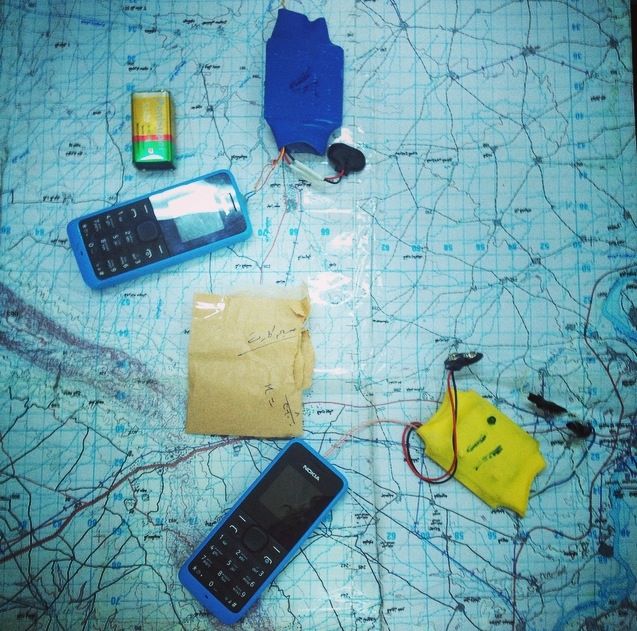
A friend of mine is a journalist for France 24 and is currently in Iraq covering the conflict with IS. His Facebook posts are extraordinary, very powerful, and I wanted to share one of them. So, courtesy of my friend in Iraq (and with his permission), here is a post (verbatim) concerning the use of Nokia 113 phones as IED detonation triggers:


These phones and wires are the remote control detonation devices left behind by Islamic State forces.

The initial activation has a 6 minute timer, after which the fuse becomes “live”.

Then a simple phone call is enough to detonate the explosive charge.

The IS choose this model of Nokia because its battery lasts 10 days. That’s basically a slow fuse that lasts a week and a half.

It’s not failsafe. One phone had 8 missed calls – 8 failed detonation attempts. The Peshmerga commander who found that one says the only jamming device he has is protection from above.

Improvised Explosive Devices are one of the biggest threats the peshmerga face, as the jihadists concede territory.

The fear of bombs has slowed their progress into hostile territory. The Islamists melt away like wraiths, leaving their IEDS to strike blindly at the Peshmerga.

Novels read between April and June 2014

In April I blogged about the books I had read in the first three months of 2014. I haven’t offered an update for the second three months, until now.

I found that I read far less and also dipped in and out of things and so caught up with a few short stories I had wanted to read as well as resorting to some poorly-chosen, slightly pulp-y, fiction. I mostly binged on Charles Stross’ entertaining brand of science fiction, which I find an entertaining form of escapism. All of my reading has moved to the Kindle I bought earlier this year – mostly cos its back-lit and therefore doesn’t wake a sleeping baby…

So, first, I ended up finishing Ian McEwan’s Sweet Tooth in April – some interesting characters and a peculiar use of the statistical curiosity called the Monty Hall problem as a plot device makes for an entertaining read.

Subsequently I read:

  • MaddAddam, Margret Attwood – the third novel in the Oryx and Crake cycle, with some gaps filled in the story, as mostly told in The Year of the Flood, interspersed within the post-apocalyptic ‘present’. I was rather disappointed with this book, it wasn’t a particularly satisfying read and the characters were less vital than the previous books. The ending, as with any apocalyptic tale, is rather depressing.
  • Overtime, Charles Stross – a funny little short story, playing on the theme of Father Christmas as a nightmarish supernatural ‘Bringer of Gifts’, in the world of Stross’ paranormal spy agency The Laundry.
  • High Time to Kill (007), Raymond Benson – after reading Boyd’s Bond book earlier in the year and having previously given Faulks’ and Deaver’s 007 novels a go (on planes) I tried Raymond Benson’s modern Bond. Absolute cack. Not recommended!
  • Down on the farm, Charles Stross – another amusing short story in the Laundry cycle (pun intended) in which the protagonist Bob has to visit the funny farm apparently run to house those who have looked into the abyss a little too often, but all is not as it seems.
  • Equiod, Charles Stross – Lovecraft and parasytic unicorns. Disturbing and darkly humorous. Another Laundry short story.
  • Neptune’s Brood, Charles Stross – space opera meets hedge fund economics in a fast-paced and entertaining sci-fi novel. Good bit of escapism.
  • A Tall Tail, Charles Stross – the final short story (for me) by Stross published by Tor that explores bonkers rocket fuel chemistry to invite you to rethink Chernobyl.
  • The Ghost, Robert Harris – a well-written fast-paced conspiracy-thriller in which a ghost writer is brought in to help an ex-prime minister write his auto-biography to a tight deadline. Lots of non-too-subtle and critical allusion to Tony Blair, but entertaining and very easy to read. Also a film with Ewan McGregor apparently.
  • King Rat, China Miéville – a weird and unsuccessful Gaiman-like exploration of the nether-regions of London. I thought this poorly-written and rather derivative. Not recommended.
  • The 100 year old man who climbed out of the window and disappeared, Jonas Jonasson – a very entertaining story, full of action and good characters in which a seemingly-frail 100 year old man reflects on a remarkable life while escaping his old folks home. Well worth a read. Also now a film – I have no idea how they could have realised this..!

That’s it for April – June. I am now reading lots of Simon Brett’s Charles Paris mysteries, which are good fun.

(Anti)Prometheanism

Unfortunately, I don’t have the time to discuss this in detail, or offer a slightly different Epimetheus-oriented reading à la Bernard Stiegler, but Alberto Toscano’s piece on anti-Prometheanism struck me as quite interesting, not least in relation to the Accelerationist manifesto put forth by Williams & Srnicek. Here’s the final paragraph but it’s worth reading the whole thing…

For better and for worse, the world we inhabit is an immense accretion of dominations, the living labours of centuries mortified into the massive infrastructures that channel our daily lives, natural processes at once subsumed and refractory, and a vast accumulation of ends, endings and extinctions heterogeneous to original plans, when plans there were. In this regard, any politics today which is not merely a vapid accompaniment to dispossession and degradation, whether it claims the legacy of painstaking reform, desperate conservation, or comprehensive revolution, cannot but confront the ‘Promethean’ problem of articulating action and knowledge in the perspective of totality. To the extent that we regard Prometheus as ‘the most eminent saint and martyr in the philosophical calendar’, emblem of servitude refused to abstract and alienated powers (God, State, Money, Capital), then Promethean should be a proud adjective for those who consider revolution not as a passionate attachment to some flash of negation or other, but as a process of undoing the abstract social forms that constrain and humiliate human capacities, along with the political agencies that enforce these constraints and humiliations.

Novels read in the first three months of 2014

I’ve seen others review their year of reading fiction on blogs but I don’t think I’d actually remember all of the books I read in a year, so I thought I’d write a more modest list of the novels I’ve read in the first three months of the year. Hopefully this isn’t too embarassing!

I bought a Kindle in February and so many of these were read as e-books and bought in the failure of willpower through fatal ‘one-click’ purchasing…

  • A Place of Greater Safety, Hillary Mantel – lengthy examination of the beginnings of the French Revolution, focusing on Danton, Demouslins and Robbespiere as protagonists. I learned an awful lot about the revolution”¦ but blimey its long!
  • Rates of Exchange, Malcolm Bradbury – 1980s comic novel satirising both the sham iliac nature of then-Soviet satellite states and attempts at cultural exchange, with a bumbling academic as the protagonist. Quite funny, but not as good as Bradbury’s subsequent novel Dr Criminale.
  • The Apocalypse Codex, Charlie Stross – fourth in the Laundry Files series: a darkly comical commingling of Len Deighton and HP Lovecraft. Laugh-out-loud funny at points and brilliantly paced.
  • Bedsit Disco Queen, Tracey Thorne – an understated wonderfully written tour de force of an autobiography with some great observations about life in the 80s. Wholeheartedly recommended.
  • Bertie’s Guide to Life and Mothers, Alexander McCall Smith – the 9th in the ‘44 Scotland Street‘ series that began, serialised, in the pages of The Scotsman. I have a soft spot for several of the ongoing characters.
  • Solo, William Boyd – a James Bond novel, quite entertaining and quick to read.
  • Dirk Gently’s Holistic Detective Agency, Douglas Adams – hadn’t read these until now, quite entertaining. I was surprised at how different the TV series of the same name turned out to be…
  • The Long Dark Tea-Time of the Soul, Douglas Adams – the Dirk Gently sequel.
  • Bitter Seeds – Ian Tregillis – first in the paranormal spy/war series – ‘The Milkweed trilogy‘. I found this by looking for books similar to Stross’ Laundry series and came across this conversation between Stross and Tregillis, so I tried the books out.
  • The Coldest War, Ian Tregillis – see above.
  • Necessary Evil, Ian Tregillis – see above.
  • Sweet Tooth, Ian McEwan – historical spy novel, with some compelling characters.

I’m happy to receive suggestions for books to read, I have a fairly eclectic taste!

Questioning the ‘gamified’, ‘pop-up’ city

It seems to be de rigueur to offer ‘smart’, compelling projects or visions of a particular kind of participation in the fabric of the contemporary city through the buzz- concepts/ words of ‘gamification’ or ‘pop-up’. I just want to offer a quick observation of the political problems that might identified with these ideas.

First, gamification proposes that what are considered to be otherwise mundane tasks should be rendered entertaining by introducing the ‘mechanics’ of a game into their operation. This seems principally to be the use of simple, reproducible functions such as attributing ‘points’ for given actions and introducing competition by creating a leaderboard. This, perhaps, in part stems from the ease with which one can, using digital media – especially through apps on mobile phones,  reductively quantify a given action and then create a system for comparing those numbers. However, this is neither a meaningful representation of or intervention in those activities apparently being ‘gamified’.

At best ‘gamification’ is running a simplified (reductive) model of a system alongside given activities and pretending the two converge or at least are someway related or relevant. At worst it is the automisation of people in a servile relationship with a mechanism for data acquisition that has been integrated into a system or set of practices that they need or (used to) enjoy. For, more often than not, ‘gamification’ happens in order to facilitate the capture of information about a group of people using a system or service. In this way it can be argued that gamification is, following Ian Bogost, a form of deception. Indeed Bogost argues, following Harry Frankfurt, that if “bullshit is used to conceal, to impress or to coerce”, then “gamification is bullshit”. “Unlike liars, bullshitters have no use for the truth. All that matters to them is hiding their ignorance or bringing about their own benefit” (Bogost). Given this understanding of gamification, these ‘mechanics’ are not opening out participation but are rather attempting to subjugate people. The darker and more cynical end of that argument is that, in fact, gamification is a means by which you enrol people into a form of unpaid work as the producers of data desirable to the authors of the system, which is rather like what Maurizio Lazzarato has called ‘immaterial labour‘.

I am certainly not arguing against creating playful systems – I am all for systems that take play seriously, for example see Hello Lampost and other creative and playful interventions into urban experience. I delight in the unexpected and serendipitous and value things that may facilitate that, but reducing that to ‘flat pack’ suites of algorithms to be crowbarred into pre-existing systems is, for me, rather undesirable.

Second, the ‘pop-up‘ model of business is the short-term injection of a business in an otherwise unused or perhaps unusual space, for example: an empty shop or a tent on municipal green space. This is often couched as the use of otherwise ‘wasted’ spaces and perhaps an enabling of a fledgling or experimental business through low-cost accommodation. Or, as ‘Popup Britain’ has it, to: “offer a co-working, co-funded space for brands to experiment with physical retail, test the market and gain face-to-face customer feedback”. Now, shrugging off the marketing speak, these things may be true, but it seems common sense that when commercial occupancy rates climb again councils and landlords will be far less willing to provide such space, the experiments then end and the risky workers are ousted.

My main issue with this model is not the risk of post-austerity commercial revanchism (although that may well be a real risk) but the rehashing of precariousness as a good. The assumption appears to be that small or new business owners must wilfully make themselves precarious, or in the case of ‘cultural’ pop-ups that the staff should be happy to offer their services for a token cup of coffee etc., and remain precarious labour (which seems to have been the case in some of the pop-up things I’ve been in).

Now, there is a realpolitik to this – I understand that regardless of the precarity pop-ups still represent an opportunity for some artists and social enterprises that otherwise may not exist. Nevertheless, once the rents and occupancy return should these artists and social enterprises simply be expelled from the revived thoroughfares and forgotten?

So, it’s not the control and use of desirable-again spaces, that is merely symptomatic of the broader issue. ‘Pop-ups’ seem to me to be founded on the assumption that it is not only ok but desirable to create a whole class of precarious creative worker and that, rather than reward them, we should enforce that precariousness and package it as desirable.

To inject a smidgeon of theory, both ‘gamification’ and ‘pop-ups’ could be critically understood, at their worst, as strategies of ‘proletarianization‘ (following Bernard Stiegler) – a curtailment not only of skilled knowledge (savour faire), and the time to cultivate it, but also of the development of life skills (savour vivre) amongst the populace – creating unthinking consumers. A traditional Marxian critique would also possibly identify both ‘gamification’ and ‘pop-ups’ as the constitution of a form of ‘surplus labour‘ and maintaining a ‘reserve army of labour‘.  This is not the realisation of a grand evil plan by the big Other, ‘the bankers’ or ‘the bourgeoisie’, but rather a logic, which has developed with and through capitalism, that we have all internalised and recapitulated and in some way indentured ourselves with.

A couple of questions arise then: Surely gamification has a limited shelf-life before it becomes passé? How long will people subject themselves to quantification and competing against one another for less-than-meaningul ‘points’? Are pop-ups simply using precarious cultural labour as window dressing for vacant shops? Both of these questions point to a third: Who or what counts in these processes and how can they be taken seriously?

It is possible to imagine creative and interesting ways of living together but, I would argue, just because certain (short-term) strategies are popular it doesn’t necessarily mean we should all jump in.

New arrival & blogging less frequently

I am not one for advertising personal information but I thought it might be worth recording here that blogging is and will continue to happen less frequently because of the recent arrival of a new member of my family. So, if you find what I already infrequently blog here of interest – please bear with me.

“Crossovers” – performance dialogues

I stumbled across the Performance Matters ‘Crossovers‘ series of films through Twitter a little while ago and wanted to post something about what looks like a really interesting set of films that stem from productive practice-based research projects. Performance Matters, as an umbrella for a number of projects, is led by Gavin Butt (Goldsmiths), Adrian Heathfield (Roehampton) and Lois Keidan (Live Art Development Agency).

‘Crossovers’ is a series of films/dialogues that attempt to reflect”the potential of marginal artforms and intense ideas within popular media.” In particular, the series of film/dialogues between Adrain Heathfield and a number of interesting contemporary philosophers/theorists look really good:

Writing Not Yet Thought, Hélène Cixous with Adrian Heathfield.The acclaimed author discusses the practice of writing alongside its relation to painting, music and philosophy. See here for details of the Writing Not Yet Thought DVD.

Transfigured Night, A Conversation with Alphonso Lingis.  An exchange between the celebrated American philosopher Alphonso Lingis and Adrian Heathfield. See here for details of the Transfigured Night film and DVD.

No Such Thing As Rest, A Walk with Brian Massumi. Setting thoughts and conversation in constant motion, Adrian Heathfield encounters the philosopher and cultural theorist while walking the streets of Montreal. See here for details of the No Such Thing As Rest DVD.

A nice trailer for the film/dialogue with Massumi is available on vimeo, which I wanted to share here:

No Such Thing as Rest: a walk with Brian Massumi [Trailer] from Adrian Heathfield on Vimeo.

Apparently there is also a film/dialogue with Bernard Stiegler, which would be interesting to see.

Living books about life, Open Humanities Press

A year on from the publication of the ‘Paying Attention‘ theme issue of Culture Machine, the excellent Open Humanities Press published journal, I’ve been poking around the various linked websites and stumbled on the Living books about life site, which is really interesting.

The JISC-funded, OHP published website offers 24 open access ‘living books’, curated by a range of innovative scholars to ‘bridge the gap between the humanities and the sciences’:

All the books in the series are themselves ‘living’, in the sense that they are open to ongoing collaborative processes of writing, editing, updating, remixing and commenting by readers. As well as repackaging open access science research — along with interactive maps, visualisations, podcasts and audio-visual material — into a series of books, Living Books About Life is thus engaged in rethinking ‘the book’ itself as a living, collaborative endeavour in the age of open science, open education, open data and e-book readers such as Kindle and the iPad.

In the series there’s a Bioethicsâ„¢ book, curated by Joanna Zylinska, with a range of open access readings thematically organised, ‘biomanufacturing and biopatenting’ for example, as well as some artistic reflections in video and text form. There are also living books curated by David Berry on ‘Life in code and software‘, Steven Shaviro on ‘Cognition and decision‘ and Claire Colebrook on ‘Extinction‘. There’s lots to explore and I would encourage people to take a look… perhaps there should be one on ‘attention’?!

Guardian Continues Radical Thinker Series with Videos on Critchley, Horkheimer and More

Reblogged from Critical Theory:

Earlier this week The Guardian and Verso launched their “Radical Thinkers” video series, which aims to explain radical philosophy in short 3-4 minute videos. Since its inception earlier this week, a video has been released every day.

Today’s video tackles Simon Critchley’s “Infinitely Demanding“ and his thoughts on politics and anarchism.

Stella Sandford focuses on Willhelm Reich’s thoughts, especially on Marxism, psychoanalysis and patriarchy.

Esther Leslie discusses Marx Horkheimer’s “Critique of Instrumental Reason“ and the emergence of psuedo individuality.

Really interesting videos that provide some welcome critical engagement with philosophy (that is not Daniel Dennett) in a prominent British forum, albeit the left-leaning preserve of the self-identified middle classes that is the Grauniad (of which, of course, I am a reader ;-).

Andrew Barry’s new book: Material Politics

Stuart Elden has highlighted on his blog that a new book by Andrew Barry entitled ‘Material politics: disputes along the pipeline‘ is forthcoming in the RGS-IBG book series, its currently set for release in September.

Andrew Barry is a thoughtful commentator on the politics intimately concerned with technology and, one might say, technics. His book ‘Political Machines’ was of significant help to me during my PhD work for thinking through how we can conceptualise the sorts of politics that emerge within institutions or networks focused on ‘innovation’ in technology.

Perhaps more importantly, Barry is also one of a still-limited number of social scientists engaging with the work of the philosopher Isabelle Stengers. In fact, his talk at the recent ‘Politics and Matter‘ event held by the University of Bristol’s geography department offered an excellent and rigorous exegesis of Stengers’ project of ‘cosmopolitics’, which, as he suggested, is not easy.

This new book clearly draws upon some of the thinking that Barry has been engaged in around these themes, as the blurb on the book’s web page demonstrates:

In Material Politics, author Andrew Barry reveals that as we are beginning to attend to the importance of materials in political life, materials has become increasingly bound up with the production of information about their performance, origins, and impact.
* Presents an original theoretical approach to political geography by revealing the paradoxical relationship between materials and politics
* Explores how political disputes have come to revolve not around objects in isolation, but objects that are entangled in ever growing quantities of information about their performance, origins, and impact
* Studies the example of the Baku-Tbilisi-Ceyhan oil pipeline – a fascinating experiment in transparency and corporate social responsibility – and its wide-spread negative political impact
* Capitalizes on the growing interdisciplinary interest, especially within geography and social theory, about the critical role of material artifacts in political life