Silicon Valley’s libertarian capitalism and Burning Man

I’m a fan of Fred Turner’s work – especially his book From Counterculture to Cyberculture that charts the shift from hippy-like communalism to libertarian cyberculture by Stewart Brand and a few other Californian countercultural torch-bearers associated with the Whole Earth enterprise.

In the book Turner outlines the ways in which the rhetorics of a kind of collectivised, networked utopian society became a rationale for a non-hierarchical way of living using internet technologies and a basis for offering strategic business advice about how these new technologies would ‘disrupt’ the status quo of contemporary life (and thus are a business opportunity). The book is, of course, more nuanced than that and it is well-worth a read!

In a separate journal article, around the same time, Turner charts out how a similar logic underlies the Burning Man festival and how this resonates with the core beliefs of those at the top of Google. Peer production and re-finding the social value of your labour using the kinds of communal working models that came out of the counter/cyber- culture nexus emerges as a key value at Burning Man, as people make and share and gain notoriety & kudos accordingly. But the article sort of paints too-rosy a picture of the benevolence and horizontalism of Burning Man.

For, we can also see how the ethos of peer production and forms of free labour has been something that Google has exploited from day one (they don’t make ‘content’, they index it and sell adverts alongside it back to us, who make it). And as the Valley millionaires increasingly use Burning Man as the highlight of their social calendar, and do not sully their own hands in ‘contributing’ to the festival but employ others to do so, we can see how that exploitation spreads…

In a recent article in Jacobin Keith Spencer compellingly articulates how this exploitation of forms of communalism is the basis for the creation of a wealthy elite constructing themselves as the benevolent harbingers of a different kind of society.

Burning Man foreshadows a future social model that is particularly appealing to the wealthy: a libertarian oligarchy, where people of all classes and identities coexist, yet social welfare and the commons exist solely on a charitable basis.

Its worth reading all of the above, but definitely read Spencer’s piece in Jacobin.

IEEE story: “Computer Scientists Find Bias in Algorithms”

The IEEE Spectrum website reports ‘Computer Scientists Find Bias in Algorithms‘ [no! really?!], which makes me chuckle after (finally) recently getting down some thoughts about how we variously talk about and may study the things we call algorithms.

The following excerpt demonstrates the ways in which a particular understanding of acceptable knowledge (i.e. ‘science’, to the exclusion of other ways of knowing the world) and a kind of anthropomorphic slip reveal how even the idea of ‘bias’ here is firmly situated in a particular discursive regime:

Understanding how an algorithm becomes biased is fascinating, says Venkatasubramanian. The bias is germinated innocently enough within a simple processing system, and develops in a carefully controlled setting. But the self-improving nature of learning algorithms raises concern. Venkatasubramanian and his colleagues wonder whether we can ever trust the fairness of algorithms. To that end, they have begun stockpiling relevant information about where and how they go wrong. He also hopes that the study will help lawmakers understand how algorithms and big data should be treated in a legal case.

Many people believe that an algorithm is just a code, but that view is no longer valid, says Venkatasubramanian. “An algorithm has experiences, just as a person comes into life and has experiences.”

Amazon as the exemplar of authoritarian employment..?

Just a quick post to park two related things here on the blog in order to return to them…

First: this story on Fusion:

The Amazon Way: Why the data-driven workplace is a nightmare  which describes a corporate culture driven by personal and collective analytics that overrule any consideration of hard-to-measure or qualitative considerations… and how that is prosecuted through a hellish kind of managerialism.

Second: This list/story on The Grauniad:

Why the workplace of 2016 could echo Orwell’s 1984 which essentially lists any and all kinds of personal surveillance technologies–currently marketed as ‘quantified self’ and other kinds of self-knowledge tools–and packages them up into some kind of nightmare version of the Amazon managerialism explored above.

What’s interesting? I think its interesting how a particular version/vision of the future of work plays out between these stories that strays close to a form of technological determinism and exemplifies an influential way that ideas about work, and how it may change, are being discussed.

Reblog> A litmus test for the internet of things

Alexandra Deschamps-Sensino blogged this really interesting ‘test’ to check if something is part of the IoT, or not – and what is it if not..?

I don’t have time to write about this now, but it resonates with the ThingTank project by Chris Speed et al. that I blogged about a little while ago…

A litmus test for the internet of things

It’s taken me about 2 months to work out how to show the differences between products that companies say are iot and those that possibly aren’t. I suspect I actually need to explain it but I’d rather have a good conversation on Twitter about it so I can tweak things accordingly.

For clarity, a lock means it’s proprietary.
No lock means it’s open source.
Absence of means its not provided by the company directly.

designswarm_iotlitmustest2

For these companies you, walking down the street, are a data point

I’ve been collecting the promotional videos of various companies that surveil ‘public’ spaces to garner information that, using the logics applied to web analytics, they see as valuable commercial intelligence.

The rationale that is common throughout is that the aggregate crowd on the street, in a shopping centre, or in any form of apparently ‘public’ space are fair game for surveillance measurement and in turn address (albeit by their commercial partners – retailers etc. etc.). In fact, this is merely a technical or perhaps social problem – not a political one. It’s a technical problem for them because as the chap from Placemeter says “it’s all data” and its ‘waiting’ to be harvested. It’s a social problem for them only insofar as it’s about improving ‘services’ for us as consumers (not as citizens, as families or any other part of our skein of identity). It is NOT a political problem for them – it’s not an issue of who has the right to the city, who has a right to privacy or what might constitute reasonable expectations of any of those things. It certainly is never couched in terms of there needing to be governance of these activities – at least in these kinds of videos.

So, the videos are interesting artefacts of the formulation of what pervasive media/ubiquitous computing and smart cities look like and how they are performed…

A reasonable article about Placemeter is in/on the Guardian Cities section.

‘Wide’, not ‘big’, data

Saw this article a while ago on the NetworkWorld website, not sure if it’s a more broadly adopted concept – but the idea of ‘wide’ data appeals. Can’t remember if Rob Kitchin addresses it in his excellent book The Data Revolution… will have to check!

(I’m blogging this so I can finally close the tab in my browser!)

Why businesses should focus on wide data, not big data

In these heady days of big data, a lot of organizations treat data collection like a Pokémon game: Gotta catch it all. But Dane Atkinson, CEO of cross-platform marketing analytics specialist SumAll says most organizations need to think wide, not big, when it comes to data.

“The real impact of data always comes from the intersection of different data sets,” Atkinson says. “You don’t get into the earth shattering discoveries until you start to link disparate data sets.”

This idea of ‘wide’ data is what some marketing people have called ‘horizontals’ – the ability to stitch together different kinds of data to create a particular kind of value proposition (see Irene Ng’s book on this…)

Reblog> Online resources to help students summarize journal articles and write critical reviews

Stuart Elden points to a post by Raul Pacheco-Vega on his blog that has some good resources to help students summarise what they read and to think about how to critically review other people’s work.

Online resources to help students summarize journal articles and write critical reviews

The courses I teach tend to be very practical and applied. My teaching philosophy is founded on helping my students acquire employable skills. Writing solid, robust, concise and easy-to-read analytical summaries should be an acquired tool that they then can transfer to other fields. Politicians, bureaucrats and high-level people in government that I’ve talked to have always considered summarizing information a great tool that undergraduate and graduate education should provide. Yet, the online resources I found to help students summarize journal articles and write critical reviews left me wanting.

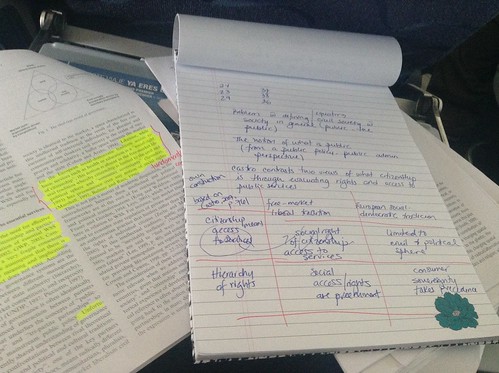
AcWri handwritten notes and journal article reading

There are, of course, plenty of resources. But reading a vast majority of them always left me with a feeling that either they were too long for students to get through (in addition to the relatively high reading load I am assigning for each of my courses), or too focused on the mechanics and too little on the routine-building strategy. So I took to Twitter and Facebook to ask whether someone had found an online resource that would help my students learn how to summarize journal articles. Here are a few suggestions:

a) Dr. Karen Beckwith (Case Western Reserve University) shared with me her handouts on critical reading. Professor Beckwith is incredibly generous and I’m sure she would share them with you if you requested them. They are very useful because they are tailored to each specific course she teaches. She also has a guideline on how to learn from movies.

b) John McMahon (CUNY) shared with me some of his handouts, which are posted online, including this one on critical reading and note-taking. John and I have a different view on highlighting journal articles, and I will write a blog post on this soon.

c) Tressie McMillan Cottom (Virginia Commonwealth University) shared with me her notes from a grad seminar with Regina Werum at Emory University. Professor McMillan Cottom’s notes are a summary of how to read a sociology article.

d) Dr. Neenah Luna-Estrella (NEU) suggested the following books to help students learn how to read and summarize scholarly (and not so scholarly) works. Not online resources, but still, very good ones.

Pyrczak, F. (2014). Evaluating research in academic journals (6th ed.). Glendale, CA: Pyrczak Publishing.

Harris, R. A. (2011). Using Sources Effectively (3rd ed.). Glendale, CA: Pyrzak Publishing.

e) Online resources that I found valuable:
– University of the Fraser Valley Writing Centre’s guide to summarizing an article – this is particularly good because UFV is primarily undergraduate teaching.
– Donna Vandergrift ‘s handout actually gives a guideline for students on which content should be written in each paragraph. This kind of detailed guidance is fundamental.
– This guide on how to read a journal article is a bit long, but it does have some additional references that you can look at.

f) Karra Kshimabukuro shared the guide to writing a Rhetorical Precis, which is a tool that others had suggested we should look at, and apparently, (what I call “analytical summaries”may be rhetorical precis too :) (thanks Theresa MacPhail for reminding me of this!)

I’m happy to continue compiling resources if you want to drop a comment on this post or send me an email (sometimes my commenting system isn’t the best).

Reblog> Data and the City

Mike Batty blogs about the ‘Data and the City’ event that is being convened by Rob Kitchin and the Programmable City team.

Data and the City

data-city
The Programmable City Project is holding a meeting on Data and the City in Maynooth from August 31- September 1st. You can get Rob Kitchin’s and Mike Batty’s papers from this blog but the programme is diverse and the Project web site contains details of the various contributions. I argue in my paper that we need to redefine big data in terms of the tools we use to interpret it and that size is not the main criterion as quite modest data sets in cities, particularly those dealing with transport and flows, are too large for most of current tools which involve statistical manipulation and visualisation. Here are two of the papers to be presented:

Michael Batty: Data About Cities: Redefining Big, Recasting Small

Rob Kitchin: Data-Driven, Networked Urbanism

The image above was produced by Stephan Hugel and Flora Roumpani from their animation of tweets in London Using City Engine. Click here for the movie.

Reblog> New paper: Data-driven, networked urbanism

This looks good –– added to my ‘to read’ pile 🙂

New paper: Data-driven, networked urbanism

A new paper, ‘Data-driven, networked urbanism’, has been published by Rob Kitchin as Programmable City Working Paper 14.  The paper has been prepared for the Data and the City workshop to be held at Maynooth University Aug 31th-Sept 1st.

Abstract
For as long as data have been generated about cities various kinds of data-informed urbanism have been occurring.  In this paper, I argue that a new era is presently unfolding wherein data-informed urbanism is increasingly being complemented and replaced by data-driven, networked urbanism.  Cities are becoming ever more instrumented and networked, their systems interlinked and integrated, and vast troves of big urban data are being generated and used to manage and control urban life in real-time. Data-driven, networked urbanism, I contend, is the key mode of production for what have widely been termed smart cities.  In this paper I provide a critical overview of data-driven, networked urbanism and smart cities focusing in particular on the relationship between data and the city (rather than network infrastructure or computational or urban issues), and critically examine a number of urban data issues including: the politics of urban data; data ownership, data control, data coverage and access; data security and data integrity; data protection and privacy, dataveillance, and data uses such as social sorting and anticipatory governance; and technical data issues such as data quality, veracity of data models and data analytics, and data integration and interoperability.  I conclude that whilst data-driven, networked urbanism purports to produce a commonsensical, pragmatic, neutral, apolitical, evidence-based form of responsive urban governance, it is nonetheless selective, crafted, flawed, normative and politically-inflected.  Consequently, whilst data-driven, networked urbanism provides a set of solutions for urban problems, it does so within limitations and in the service of particular interests.

Key words: big data, data analytics, governance, smart cities, urban data, urban informatics, urban science

Download PDF