A dream of an algorithm – Agnieszka Zimolag

Photo by: Agnieszka Zimolag

A compelling piece on the Institute of Network Cultures‘ “long forms” website by Agnieszka Zimolag entitled “A dream of an algorithm” explores “our” relation to “technology, or (to my mind) technics as the co-constitutional (and originary [not essential]) relation between what we call, in common sense terms, “the human” and”technology”.

Technology is my reflection. Just as if I never see myself unless I look in the mirror, the same goes for technology. Once I plug, once i turn on the devices, I look at my comforting reflection, I can finally become one with my own image. The perception of the self becomes a continuum, a reassurance of my own existence. Zimolag

It’s a beautiful essay and well worth reading/ looking at in full – the images are lovely and there’s some thoughtful prose reflecting upon this relation. I guess where I’d differ from Zimolag is her implied assertion that the technology, what it does/can do somehow comes after ‘the human’; that technology does something to “us” (humans) that alters us. I can see why, in the face of rapid technological change, we might figure things in this way. Nevertheless, I’m inclined to insist that there never was a “human” somehow separate from “technology”. We have an ‘aporetic origin’ in Derrida & Stiegler’s terms, we continually perform the coming to being of “the human”.

As I’ve observed elsewhere, the theory of technogenesis offered by a range of anthropologists and philosophers is the idea that humans and technology co-evolved together, that you do not get one without the other. Humans are irreducibly distinct because of the reflexive transmission of complex cultures made possible by technics and the ‘exteriorization’ of thought. Both Stiegler and Derrida argue that the mental interior is only recognized as such with the advent of the technical exterior: our conscious self-knowledge is only possible with the ability to exteriorize thought as a trace, commonly as language and gesture. Stiegler explains this aporia of origin as a paradox: ‘The paradox is to have to speak of an exteriorization without a preceding interior: the interior is constituted in exteriorisation’ (Stiegler, Technics and Time 1, p. 141).

Technics can be thought of as a technogenetic ‘double-bind’ between being both constitutive and a supplement of ‘the human’. The interior and exterior, and with them the contemporary understanding of the experience of being human and what we understand to be technology, are mutually co-constituted and continue to be so.

In opposing ‘technology’ and ‘the human’, the apparently immaterial ‘algorithm’ and apparently concrete human, we either oppose technically mediated experience to other forms of experience or we oppose our technical life to other, apparently ‘natural’, forms of exis- tence. Either way, we risk reasserting old, problematic binaries: human/technology and nature/society.

To bring this back to ‘algorithms’ and their devices, following Zimolag – they are not our ‘others’. these technologies discussed and depicted in Zimolag’s beautiful essay are materially of and with us, they are perhaps not so much the ‘reflection’ she asserts (above) but rather a mirror that we ourselves have crafted through which to look upon ourselves, but, precisely in doing so, the “we” is irrevocably altered to include the mirror. The knowledge born from coming to know our own images, in Zimolag’s metaphor, is irreducibly tied to technics.

Behaviourism, productivity & the ‘quantified self’

metronome.gif

Steven Poole, in the New Statesman, on “How the craze for Apple Watches, Fitbits and other wearable tech devices revives the old and discredited science of behaviourism“:

Arguably, this authoritarian strand of behaviourist thinking is what morphed into the subtly reinforcing “choice architecture” of nudge politics, which seeks gently to compel citizens to do the right thing (eat healthy foods, sign up for pension plans) by altering the ways in which such alternatives are presented.

By contrast, the Apple Watch, the Pavlok and their ilk revive a behaviourism evacuated of all social concern and designed solely to optimise the individual customer. By ­using such devices, we voluntarily offer ourselves up to a denial of our voluntary selves, becoming atomised lab rats, to be manipulated electronically through the corporate cloud. It is perhaps no surprise that when the founder of American behaviourism, John B Watson, left academia in 1920, he went into a field that would come to profit very handsomely indeed from his skills of manipulation – advertising. Today’s neo-behaviourist technologies promise to usher in a world that is one giant Skinner Box in its own right: a world where thinking just gets in the way, and we all mechanically press levers for food pellets.

Echoes a common trope of theorising “subjectiv(is)ation” as a process (often labelled “neoliberal”, for good value) that gets done to a being/person… which gets entangled in an all-encompassing ‘labour theory of value’ but that’s a longer discussion…

To love, to love me, to love us ~ on political division and suffering

I dedicate this [post] to the electors of [both sides of the EU referendum], to whom I feel close. I feel close to them because they are people who suffer and cause me to suffer. They cause me to suffer because in the proximity of their suffering, I feel them infinitely distanced from me–I feel infinitely far from them. I feel that this distance is our lost community. This distance is paradoxically the vanishing point of our common suffering and, a such, our proximity. What is common to us is the feeling of absolute separation. But this concerns not only our common suffering, but also the suffering that separates us. If I feel close to those people who suffer while they also make me suffer, if I suffer with them, I do not suffer only because they make me suffer. I suffer also with them from that which makes them suffer.

–Bernard Stiegler, To Love, to Love Me, to Love Us: From September 11 to April 21, in Acting Out (Stanford University Press, 2009), page 38 – adapted [1].

I hesitate to post following the EU referendum here in the UK. I hesitate because of the vehemence of negative expression that has come in it’s wake. We have seen a groundswell of responses, many of which, and from all sides or none of the political spectrum, have been divisive – from horrifying expressions of hatred of ‘others’ to the patronising and derogation of those we find to have different and apparently opposing views. The repeated (and, in extremis, violent) admonition of ‘them’, those to whom one attributes blame, feels, to me, worrying.

In such a climate, and in the face of a level of uncertainty that we all find uncomfortable but that will have been the hallmark of this period five years hence, our collective sense of any form of ‘we’ is challenged: we all suffer.

It is this suffering that can (re)constitute a collective, as Bernard Stiegler argues: “On this path we must cast all doubt aside to fight the imminent possibility of the total atomisation of the we” (Stiegler, 2009: page 82).

If the current climate of recrimination and the disavowal of the other half of the population (for it was a very close vote 51.9/48.1) persists, if we continue to disown one another, that atomisation is, it seems to me, a risk.

“What more than anything is evil is OUR renunciation of thought in favour of the denunciation of evil. What is evil is the we, disquieted about the future of the we, that renounces critique and invention or, in other words, combat” (Stiegler, 2009: page 82).

By all means, we should act, but this action should, I feel, be in solidarity, without fear of those we have seen as other, to try to face the future together. I argue this means we must reject denunciation, we must argue in good faith, we must press the case for a just and fair future for us all – where the stakes are precisely to argue what counts as justice and fairness in an emerging state of affairs.

Note 1: I recognise that in the original quote Bernard Stiegler is speaking of the electors of the Front National. Let me be clear: I am not, in any way, seeking in this case to compare any electors in the 2016 referendum on UK membership of the EU to the Front National. I use  this quote because I admire and value the ethos Bernard Stiegler is expressing.

Reblog> Yuk Hui @digital_objects at Birkbeck on ‘For a Realism of Relations: The Case of Digital Objects’

via Scott Rodgers –

Yuk Hui – For a Realism of Relations: The Case of Digital ObjectsThe Vasari Research Centre for Art and Technology at Birkbeck is pleased to welcome Yuk Hui on 17 June, 2016 (3pm to 4pm in the Birkbeck Cinema)

In this talk, Yuk Hui will discuss his recent book On the Existence of Digital Objects, which is an investigation of digital objects in light of the proliferation of computational ontologies, and situates this phenomenon within both the history of philosophy and computation. This central thesis of the book is to develop a theory of relations in order to understand objects and to politicize the existence of digital objects, by drawing from Simondon, Heidegger and Husserl.

The talk will be followed by a response from Vasari Research Centre director Joel McKim and a Q&A with the audience.

Yuk Hui is currently research associate at the Institute of Culture and Aesthetics of Digital Media of Leuphana University Lüneburg; previous to that, he was postdoctoral researcher at the Institute for Research and Innovation of the Centre Pompidou in Paris. He is editor (with Andreas Broeckmann) of 30 Years after Les Immatériaux: Art, Science and Theory (2015), and author of On the Existence of Digital Objects (prefaced by Bernard Stiegler, University of Minnesota Press, 2016).

Registration: https://www.eventbrite.co.uk/e/yuk-hui-for-a-realism-of-relations-the-case-of-digital-objects-tickets-25647236575

Critical and Creative Ethnography After Human Exceptionalism. Brilliant new publication from @annegalloway

Amidst the slog of marking a shining jewel-like piece of inspiration appeared in my inbox – one of my academic heroes Anne Galloway shared a draft of what is a fantastic chapter for a brilliant book, which is set to be published later this year (what a great editorial team too!). Anne has posted about this on her lab’s blog, so I am reposting some of that post… however, go and read it on the More-than-human Lab blog!

I’m pleased to announce that The Routledge Companion to Digital Ethnography, edited by Larissa Hjorth, Heather Horst, myself & Genevieve Bell, will be published later this year.

For the companion I also contributed a chapter called “More-Than-Human Lab: Critical and Creative Ethnography After Human Exceptionalism.”

Anne shares the introductory paragraph, which I think wonderfully performs precisely the ethos of praxis she explores in the chapter:

Haere mai. Welcome. This story starts with an introduction so that the reader can know who I am, and how I have come to know what I know. My name is Anne Galloway. My mother’s family is Canadian and my father’s family is British. Born and raised outside both places, for the past seven years I have been tauiwi, or non-Māori, a settler in Aotearoa-New Zealand. I have always lived between cultures and have had to forge my own sense of belonging. Today I am in my home, on a small rural block in the Akatarawa Valley of the Tararua ranges, at the headwaters of the Waikanae River, on the ancestral lands of MuaÅ«poko (Ngāi Tara) & Ngāti Toa, with my partner, a cat, seven ducks, five sheep–four of whom I hope are pregnant–and a multitude of extraordinary wildlife. The only way I know how to understand myself is in relation to others, and my academic career has been dedicated to understanding vital relationships between things in the world. Most recently, I founded and lead the More-Than-Human Lab, an experimental research initiative at Victoria University of Wellington. Everything I have done has led me to this point, but for the purposes of this chapter I want to pull on a single thread. This is a love story for an injured world, and it begins with broken bones”¦

Anne offers more excerpts and explanation in her blogpost and her full reference list (so please do read it!).

I did however want to share a brief snippet of one of the many bits I love from the chapter:

As more technological devices connect people to things in the world, and as more data are collected about people and things, digital ethnography stands to make an important contribution to our understanding of constantly shifting relations. When combined with speculative design that translates realist narratives into fantastic stories, I also believe we can inject hope into spaces, times and relations where it seems most unlikely.

For me,  Anne’s reading of a feminist ethics of care: for knowledge for our ‘selves’ and for our decentred place in the vital soup of our (transindividuated) becoming, as a part of contemporary ethnographic praxis is really valuable and we would all do well to involve ourselves in the conversation which Anne invites.

The image at the top comes from Anne’s twitter feed, it’s one of her own sheep:

The Museum of Contemporary Commodities in EXETER

The Museum of Contemporary Commodities

Just a quick note to let you know that the brilliant Paula Crutchlow has brought “The Museum of Contemporary Commodities” (MoCC) to Exeter for the majority of May.

There’s lots going on, much of it creative and interesting – so if you’re in Exeter or nearby: come and visit!

Two immediate things this week:

RIGHT NOW!: help re-create the internet in paper with Artist Louise Ashcroft from 11 -2 in the Exeter University Forum.

TOMORROW: sign up to do a data walkshop with Alison Powell from the LSE on Saturday from 10-1. Places have to be booked, and the Eventbrite page is here https://www.eventbrite.com/e/mocc-data-walkshop-tickets-24464719635

Please do visit the MoCC website for lots more events and activities taking place this month and visit the shop:

87 Fore St,
Exeter
EX46RT

Open 10:00-18:00pm Weds-Sat, 4th-21st May.

Reblog> Improvised Publics :: Control and Calculation :: Inheriting Liberation :: 6-17 June 2016

This event looks really interesting, check out the website for more information…

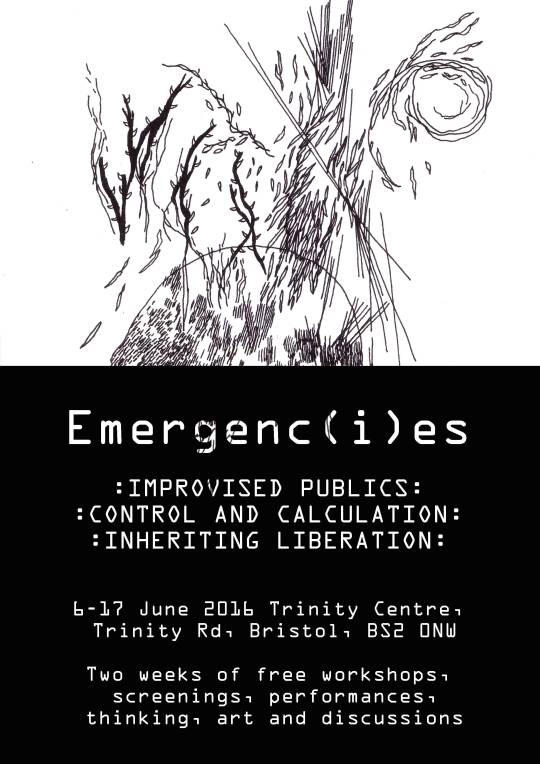
Emergenc(i)es – an event in Bristol between 6th and 17th June

Emergenc(i)es is an invitation to consider the emergency of the current historical moment.

The exhibition will dwell in the question of emergence within emergency.

Performance, education activities, visual art, screenings, installations, workshops and a library-cum-pharmacy will create time and space to diagnose, explore and understand the world we live in.

Enter – Relate – Improvise – Diagnose – Inherit – Public – Liberate – Gather

All activities are free to attend, thanks to generous funding from Awards for All.

In Disruption – new book by Bernard Stiegler

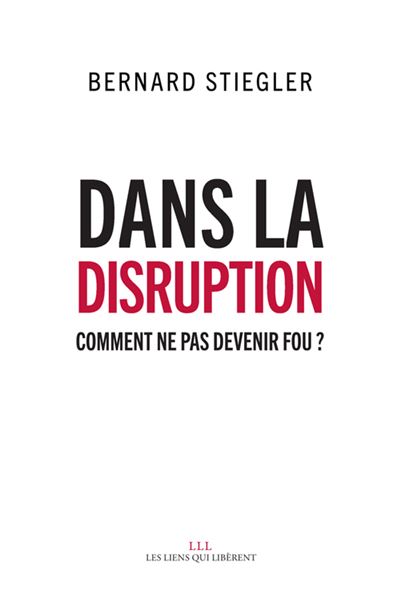
Yet another new book by Bernard Stiegler has been published in French recently: Dans la Disruption – Comment ne pas devenir fou?
One might translate this as: “In Disruption – How do we not go mad?”

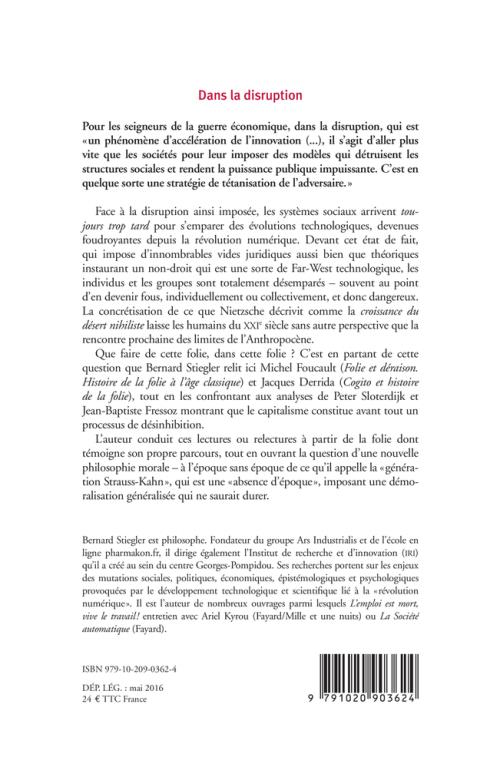
Here’s the front and back covers, and I offer a quick translation of the back cover blurb…


For the lords of economic war disruption is “a phenomenon of the acceleration of innovation (…) which is going to happen more quickly in societies that allow them to impose programmes that destroy social structures and render public power impotent. This is a kind of strategy of tetanising one’s adversary”.

Facing the disruption thus imposed, social systems always arrive too late to seize technological evolution, now thundering ahead in the digital revolution. Faced with this state of affairs, which requires countless legal and theoretical loopholes establishing a lawlessness which is a kind of techonlogical Wild-West, individuals and groups are totally lost, often to the point of going mad, individually or collectively, and therefore becoming dangerous. The concretisation of what Nietzsche described as a growing desert of nihilism leaves 21st Century humans with no other perspective than facing the next of the limits of the Anthropocene.

What can be done with such madness, in such madness? It is by starting with this question, that Bernard Stiegler rereads Michel Foucault (Madness and civilisation: A history of insanity in the Age of Reason) and Jacques Derrida (Cogito and the History of Madness) while confronting Peter Sloterdijk and Jean-Baptise Fressoz’s analyses of capitalism as above all a process of disinhibition.

The author conducts these readings or re-readings starting from the forms of madness which reflects his own course, opening out the question of a new moral philosophy – in an age without age [l’époque sans époque], which he calls the “Strauss-Kahn generation”, that is a “lack of age” [“absence d’époque”], which imposes a general demoralisation that cannot last.