Material carriers of thought

In a recent article on the Social Epistemology Review and Reply Collective, Lyudmila A. Markova discusses the material supports for human communication, what Stiegler would call the processes of exteriorisation and thus materialisation of memory/thought:

Even the most common type of communication is not possible without a material carrier. For example, at a minimum stone, papyrus or paper is required for written communication. Their production processes obey the laws of engineering sciences, which are completely independent from the content of the information they convey. Even if the information is transmitted orally, with a voice, a material carrier is present. The sound is produced in a person’s larynx and is uttered through the mouth as language. Furthermore, the air movement, which is born inevitably during the conversation, obeys the laws of physics.

There’s some really interesting discussion of the various ways those involved in studies of social epistemology, and most notably in the essay it’s Steve Fuller’s work set in relation to Kuhn, have attempted to reconcile the passage to knowledge. It’s also curious to see how David Berry’s work ends up in there too, I suspect there’s more than a hint of Stiegler shining through there (but I haven’t read the work so should probably do so…) and it’s a shame Markova doesn’t make that connection. Might be interesting to pursue that angle…

Echoborg

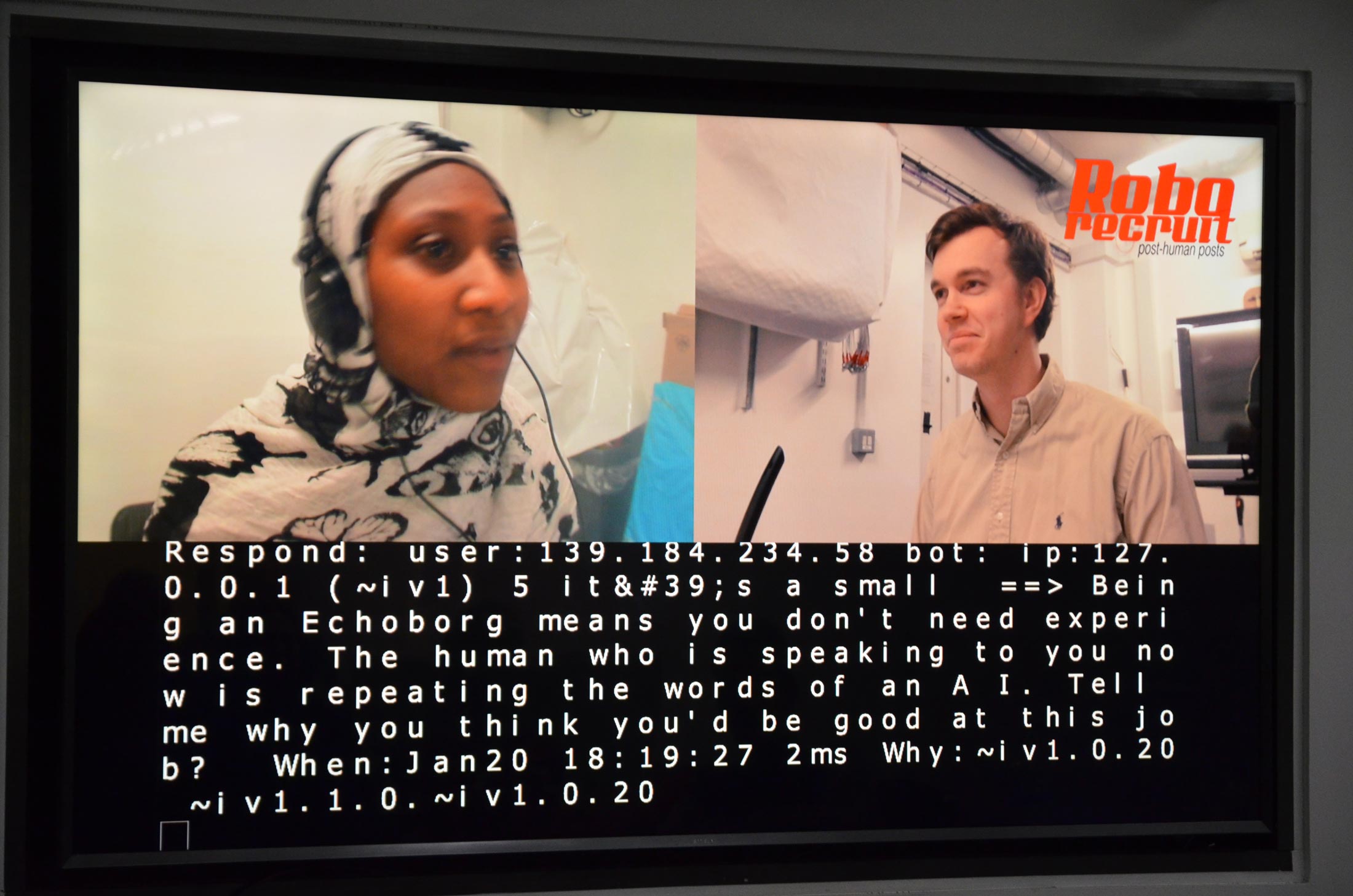
Former colleagues of mine at UWE are developing an interesting project, which you may have seen/heard about through the BBC’s Click programme, called Echoborg.

An echoborg is a hybrid agent composed of the body of a real person and the “mind” (or, rather, the words) of a conversational agent; the words the echoborg speaks are determined by the conversational agent, transmitted to the person via a covert audio-relay apparatus, and articulated by the person through speech shadowing[1].

Recently, the project team have demoed the project as part of an AHRC-funded network on Automation Anxiety and have written this up on the project website, here’s a snippet – it sounds like it is really compelling (I’ve not seen this in action):

Four people were interviewed by the AI which increasingly displayed an interest in eliciting help to reprogram itself. Proceedings were visible on a projector screen and the ‘audience’ of applicants gradually began to discuss the situation of the Echoborg and how to change it. At a certain point their reflections passed a threshold and the group fired into collective action, experimenting with various methods to bring the situation to a head in some way. The lively inventiveness of the group and the individual interviewees went a long way to confirming the interactive potential of this format of the work. It also gave Rik and Phil much to work with in considering the further development of the AI/Chatbot, the restricted delivery of narrative by the human Echoborg and the staging. This event also trialled a secondary, higher level, Echoborg character as part of the slow process of unfolding the potential for this Echoborg recruitment event to be a disruptive and thought and emotion provoking experience for all players.

Notes

  1. Corti, Kevin and Gillespie, Alex (2015) Offscreen and in the chair next to you: conversational agents speaking through actual human bodies. Lecture Notes in Computer Science, 9238 . pp. 405-417.

CFP> Fear and Loathing of the Online Self, Rome, May 22-23, 2017

Via Institute of Network Cultures… looks interesting… be good to see a wider variety of folks ‘participating’…

Fear and Loathing of the Online Self–A Savage Journey into the Heart of Digital Cultures

Call for Participation
Conference, Rome, May 22-23, 2017
http://networkcultures.org/online-self/

We would like to invite artists and researchers to submit proposals to join this event hosted by  John Cabot University and Universita degli Studi RomaTre in Rome, and organized in collaboration with the Institute of Network Cultures, Amsterdam.

The conference aims at exploring the state of the online self by raising questions about its status as a focal point of contemporary power/networks. Is the online self merely a product of software predictability and viral marketing? Is there any space left for self-determination? Or should we search elsewhere for new forms resistance by changing our political categories and perspectives? Which contradictions are at play? How and where can we locate the spaces of performativity of the online self?

Critical political-economic readings of platform capitalism do not explain nor grasp new forms of (visual) online subjectivity. There is a growing gap between the obsessive quest for measurability, big data and algorithmic regimes (such as AI/bots),and critical investigations of an emerging variety of compulsive forms taken by the online self. We need to fill this gap and bring them back together. If a humanities approach of Internet studies nurtured by artistic and activist practices aims to survive the ‘big data’ onslaught from the social sciences, then it is vital to ask what the citizen-as-user wants. To portray the population as (innocent or guilty) victims of the data monopolies is, politically speaking, a dead-end street.

The cynical condition rules: we know we’re under surveillance, yet we continue to click, like, love and share ourselves online as usual. We are told by concerned experts and libertarians that our privacy “matters” and we want to believe it; yet it silently confers a guilty stigma upon another vital need, to engage socially and culturally with others. While some preach the offline escape as a way out, most of us are so deeply invested in the everyday social media life that it is inconceivable for most of us to  leave Facebook and the like. And this not only out of desire but necessity: networking and self-sharing has become imperative for succesfully managing the double binds of the immaterial labour economy. Instead, we’d rather deal with peculiar pathologies, such as addiction, depression and solitude generated by hyper-connection and lack of connections.

Abstracts and proposals are welcome to contribute to the following sections:

1. ONLINE SUBJECTIVITY THEORY

How much free room do we have to design new identities? What aesthetic and philosophic paths and patterns does meme distribution hint at? What is the role of theory and criticism, if any, in the ever changing yet endless production of the latest user affordances, from dating sites, Tinder swipes and Snapchat lenses, to Pokemon-Go? Can we still attempt to design new modes of subjectivity, or has our role withdrawn to a mere Cassandra-like gloom and doom prediction of digital catastrophes, while start-ups (read: future monopolies) have all taken over the cool business of designing and shaping the online self?

2. BEHIND AND BEYOND SELFIES

It is easy to diagnose the selfie as a symptom of a growing narcissism of our daily digital obsessions. But how do we get beyond the predictable split between the politically correct assessment of empowerment (of young girls) against the nihilist reading of self-promotion and despair? Does criticism of today’s photography of the everyday life always have to end up giving medical prescriptions and recipes of wellbeing? What could a materialist reading of large databases and facial recognition techniques (including protection) that goes beyond media archaeology (the historical approach) and the ever-changing pop gestures involve and say? Can we still talk about the liberation of the self in the age of digital self-generation of the images?

3. ARTISTIC PRACTICES OF THE ONLINE SELF

Artists play an important role in the anticipation, and critique, of new modes of the self. What role does the artistic imagination play beyond the creative industries paradigm? How can artistic and creative avant garde practices help disrupt the trite quantitative approach and the dogma of the algorithm in defining modes and moods of the onlife self? What separates a (properly) artistic imagination and the aesthetic imagination of the online curators of selfie-constructed personas and are contemporary critical paradigms merely reproducing an understanding of online practices that are aligned with the requirements of corporation?

4. POLITICS AND AESTHETICS OF MASK DESIGN

Masks and selfies should not be seen as opposites as they both represent different modes (and moods) of being of the self. Masks create spaces of performance; they are playful and seductive (or scary) forms of self-representation that ultimately do not protect us against the computational repression of the security apparatus. What are the lessons learned from the Anonymous movement? We should come to a new social contract between the individuals, groups and the cybernetic machine. In the meanwhile, how can we make sure to protect us, and what premises are hidden in the numerous crypto-design projects that circulate?

Confirmed speakers: Wendy Chun, Ana Peraica, Jodi Dean, Marco Deseriis, Gabriella Coleman, Daniel de Zeeuw, Rebecca Stein, Vito Campanelli, Franco Berardi.

Editorial Team: Donatella Della Ratta (John Cabot University), Geert Lovink (Institute of Network Cultures/HvA), Teresa Numerico (Universita degli Studi RomaTre), Peter Sarram (John Cabot University).

Please send your proposal (max 500 words in word/pdf format), a short bio and any other material that could support your idea visually  (artwork, film links, etc) to selfieconference@johncabot.edu.  Deadline: March 1, 2017.

Microsoft Cognitive Services

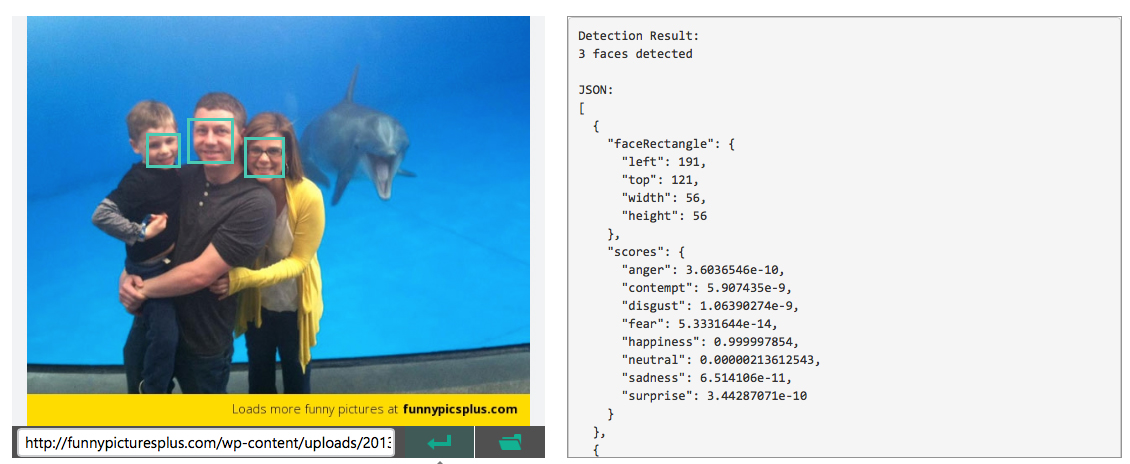
Microsoft Cognitive Services (sounds like something from a Phillip K. Dick novel) have opened up APIs, which you can call on (req. subscription), to outsource forms of machine learning. So, if you want to identify faces in pictures or videos you can call on the “Face API“, for example. Obviously, this is all old news… but, it’s sort of interesting to maybe think about how this foregrounds the homogenisation of process – the apparent ‘power’ of these particular programmes (accessed via their APIs) may be their widespread use.

This might be of further interest when we consider things like the “Emotion API” through which (in line with many other forms of programmatic measure of the display or representation of ’emotion’ or ‘sentiment’) the programme scores a facial expression along several measures”, listed in the free example as: “anger”, “contempt”, “disgust”,” fear, “happiness”, “neutral”, “sadness”, “surprise”. For each image you’ll get a table of scores for each recognised face. Have a play – its beguiling, but of course then perhaps prompts the sorts of questions lots of people have been asking about how ‘affect’ and emotions can get codified (e.g. Massumi) and the politics and ethics of the ‘algorithms’ and such like that do these things (e.g. Beer).

I am probably late to all of this and seeing significance here because it’s relatively novel to me (not the tech itself but the ‘easy-to-use’ API structure), nevertheless it seems interesting, to me at least, that these forms of machine learning are being produced as mundane through being made abundant, as apparently straightforward tools. Maybe what I’m picking up on is that these APIs, the programmes they grant access to, are relatively transparent, whereas much of what various ‘algorithm studies’ folk look at is opaque.  Microsoft’s Cognitive Services make mundane what, to some, are very political technologies.


Reblog> Ways to make safety pin solidarity actually safer

Nice piece by Sara Koopman:

I have posted repeatedly on this blog about people wearing different things to signal solidarity of various sorts. I research how people build alternative securities through solidarity – so I have been following the debates about recent attempts to create safety by wearing safety pins.

If you are in the US, and maybe even Canada, you have probably heard about wearing a safety pin to signal solidarity for safety in the face of a hateful attack. But I will start with a brief explanation for global readers, since I recently presented on it at a workshop in Brussels and no one had heard of it. This was all the more surprising since it was a workshop on ‘Nurturing solidarity in diversity’ put on by the DieGem research group (see their paper on that page about their work, Putting flesh to the bone).People started wearing safety pins in the UK after Brexit, in response to a huge rise in anti-immigrant attacks. It was inspired by the by the #illridewithyou movement in Australia, in which people offered to take public transportation with Muslims fearing a backlash after a Muslim gunman held people hostage in a cafe in 2014. I believe the initial idea was to signal something like ‘I will step in to create safety’ in the case of an anti-immigrant attack.

Read the rest of the post here.

The articles of faith of contemporary social and cultural geography

This post comes from a sense of dissatisfaction and a hope for finding different ways of (personally) doing geography. [I’ve been writing it for too long, so I’m just hitting “publish” – I welcome thoughts…]

When struggling for sleep and time to do things due to trying to do all of the things I know I should be doing to advance my career but also wanting to be with my family, I find it disheartening to decide to read newly published journal articles or agree to review articles and settle into reading them only to find they repeat familiar arguments, freighting the same rather narrow set of concepts. This post will likely irk (perhaps seriously) some who feel invested in some of the things I criticise, I can only apologise about that.

What I am identifying can’t be new, I’m sure plenty of others have made similar arguments… but it seems to me that we have a fairly set orthodoxy in how social and cultural geography gets done and what it can say. I am of course complicit. I am not seeking to distance myself from any of this, merely ‘confess’ and look for other ways of working.

The articles of faith we seem to have adopted in the REF-driven, short-termist form of research communication we inhabit and propagate concern both methodology and theory.

Methodologically, in spite of careful commentary reflecting upon the “new orthodoxy” of qualitative methods, we seem to have adopted a faith in the “theory–case study” model.

Generalise through theory – In this model one presents, often rather small scale, ethnographically derived empirical material. But rather than acknowledge the limits of scope and avoid attempting to generalise – following the model, this case study is read as an exemplar of a (sometimes muscular) ontological claim. I suggest this creates an epistemological slip, the modest empirical claims are rendered general by virtue of an appeal to theory. In this way, relatively modest empirical findings about a specific case study can be generalised by appealing to ‘big’ theory. This is of course understandable – we’re supposed to be writing four-star (“world leading”) research and using heavyweight theory is the conventional  ‘shortcut’ (in time and resources) to making such a claim. I’ve written papers like this, many have.

Theoretically, the discourses of social and cultural geography have, dare I say it, become rather dogmatic. There is a collective pressure through journals, email lists, social media and events to adopt the jargon and to conform (‘discursive regime’ anyone?). It seems to me there is a rather narrow range of concepts in use.

In part, I wonder whether this is due to an attempt to systematise the easier aspects of big (mostly French) philosophical systems of thought that gained traction in the late 1990s early 2000s, many of us went about formulating ways of ‘doing’ Deleuze for example (maybe I’m only repeating this mistake with Stiegler – I’m really trying not to!). Some have become a universal mechanism of explanation – regardless of the context of study. I worry that we are in danger of getting caught in a theoretical culdesac – everything becomes an example of those concepts we hold to be the truth. I am not suggesting we should not use the concepts I identify here or that they are in some way ‘wrong’. Some people have done careful and nuanced theoretical work that articulates the value of such theory. However, this doesn’t mean we all have to pile in and parrot the concepts to juice up our publications.

Sometimes concepts can be a sort of “sledgehammer to crack a nut”, sometimes they’re just a blinkered implication of causation that amounts to a dogmatic profession of faith – the empirical material demonstrates the concept, no matter what. Again, there are lots of understandable reasons – REF and employment pressures to get publications out, wanting to ‘fit in’ and being short on time so slipping into the ‘orthodoxy’.

I don’t actually buy the theoretical ‘arms race’ argument that has been posited about (mostly younger) researchers searching out the next ‘big’ theorist. I think we’re actually, mostly, more conservative – we’ve developed an orthodoxy that, in some cases, can verge on dogma: hence my provocation of the ‘articles of faith’.

The core concepts outlined here as the grounds of this ‘articles of faith’ are of course contestable and I’m not seeking to be definitive in any way. I suspect they are also all-too-familiar to the handful of people who will read this blog. My argument here is that perhaps we need to reflect a little more explicitly on how and when we use our theoretical blunderbusses…

  • The constitutional agency of Affect (& Atmosphere) – Given the arguments about the use of this concept, this perhaps one of the more difficult ideas to address. I sympathise with a desire to articulate the nonrepresentational and value some of the work done in that vein. Work around how we might understand intensities of relations and how particular places become constituted as much in unspoken sensations as through signification, and indeed how such spatial experience becomes perturbed, seems like a useful contribution to me. However, in some uses of the concept of affect/atmosphere there is an all-too-easy slip into appealing to amorphous (at times quasi-mystical) pre- / trans- subjective forces of affect/being affected to beef-up an argument. We are, I fear, in danger of creating what a colleague called a kind of ‘Phil Collins geography’, where something is literally “In the Air Tonight”.
  • The invocation of the Anthropocene – How can one argue against anthropogenic climate change? and I’m not trying to, but there appears, to me, to be a danger in invoking an all-encompassing rupture in ‘geological time’, in ecological understandings and in the cautious epistemological reflections upon how, as non-scientists, we understand and use ‘Scientific’ (with a big “S”) knowledge. We are in danger of eliding the careful reflections upon understandings and representations of Earth and world within geographical work. It seems to me this has granted license to engage in some peculiar forms of exercise in phenomenological impossibility, seeking to look ‘after the human’, and can perpetuate (globally) Western/ Northern perspectives that elide other ways of coming to terms with climate change. There has, of course, been some great work [e.g.] examining such problems.
  • The hegemony of Neoliberalism – or: the taken-for-granted force of the lumped together bogeymen of left-leaning thinkers along the lines of the ‘evils of capitalism’,  mostly denoting the combined phenomena of deregulation, privatisation and globalisation. An over-arching concept that affords one the opportunity to point to a thing we can be normatively against. There, of course, exists plenty of critique of the use of the idea in geography and suggestions for other terms or ways of engaging with the phenomena apparently denoted/ connoted by the term but it has a life of its own.
  • Witnessing the Non-human – on the one hand a useful means of articulating that the geographies we seek to explore have more than just us, “human” actors/actants/agents, in them. On the other hand, we are in danger of affirming precisely the sorts of (naive) humanism/human-centric ideas we are attempting to escape (via Latour et al.) For example, when is what gets called ‘non-human’ perhaps actually human? Technology is a case for me here and it all depends on the other theoretical assumptions you make about what a ‘technology’ is… Likewise, if we’re seeking to de-naturalise ‘nature’, to demonstrate that we are not and cannot be separate from what we identify as ‘nature’ then creating label for what may be ‘other’ to the human seems a weird way of going about it. Of course, again, there is some really excellent work that takes on board such understandings and I’m fortunate to work with several of the people doing/writing it. Nevertheless, the wider discursive use of ‘non-human’ risks doing the reverse of what one might think one if doing with it.
  • The supremacy of Subjectivity – The basis for understandings of human experience, in relation to which difference, identity, spatiality and many other concepts are conceived in much of geography. Of course, some fantastic work has been done on the idea of a subject, subject positions and subjectivity. I guess the reason I raise the concept here is because there seems an increasingly common slip between the ways we discuss subjective experience and the ways in which we are individualised in different domains (legal, political, technological etc.) to render an equivalence. An example here is an idea of a “digital subjectivity”[1]. On the one-hand we might see this in relation to the various ways one performs different identities through different apps, conforms to or breaks rules/conventions and so on. On the other hand we might see it as the ways we get surveilled, defined, addressed and perhaps conditioned by our data. Weirdly, given the popularity of ‘affect’ theory, we can get caught up in peculiar contradictions between the ‘excessive’ agency of the intersubjective and the repressive agency of subjection/subjectivation. In slipping between the two, we risk falling foul of longstanding arguments around reductive understandings of ‘subjection’ and eliding precisely the epistemological purchase the concept can, potentially, afford, i.e. multiplicity, intersubjectivity and so on.

Alternatives..?  I do not have easy answers, goodness knows I wish I did… However, I can offer some suggestions that I find myself contemplating as ways forward for rethinking how I go about understanding the kinds of knowledge claims I might seek to make in my future writing.

Firstly, maybe we can move beyond what I’ve called the “theory-case study” model? Perhaps it’s ok to return to a grounded theory approach, or to be rigorously empirical and refrain from particular forms of generalisation because that’s not what our ‘data’ grant. Perhaps we can innovate a little more (and perhaps I’m not reading enough to see that this is already happening?!)

Secondly, maybe it’s ok to do theory on it’s own, and we should find the confidence to do geographical theory too. Perhaps the editorial boards of our journals might already be receptive to this. Perhaps also we can collectively decide this is something we can value, so long as appropriate standards are applied.

Thirdly, maybe we should resist the artificial timetables of REF and so on dictating our push to produce work we may not feel entirely comfortable with. Maybe, with growing teaching and admin loads, maybe with increased precarity of work we, as a community of scholars, should say let’s cut ourselves some slack – especially those who are early career and forced into unsustainable habits of work: massive teaching loads for 9-months then a contract ends, all while attempting to get the next one and keep publications ticking over. I have no doubt that the ‘quickness’ with concepts and methods relates to the habits of work to which we are currently conforming. I cannot see how this is sustainable. It certainly isn’t for those of us with families. I admire those who succeed, in spite of all of this, but we cannot all do that and maybe we need to hold out a helping hand to others and say: it’s ok, you don’t need to copy us, you don’t have to do things our way – find your own ways of working, develop your own theory.

These are half-formed thoughts, at the end of term, frazzled by lack of sleep and trying to do too many things. I genuinely do not want to deride other people’s work here, I am merely identifying a dissatisfaction with how I understand my own working practices. I would welcome any thoughts…

Notes

  1. Or of course ‘algorithmic’ power/subjectivity/subjection – ‘algorithm’ might be included in a longer version of this list


The Assemblage Brain – new book from Tony Sampson

Via Virality : Looks interesting…

Part of Minnesota’s spring catalogue – Out early Feb


“The Assemblage Brain provides a much-needed critique of the black-box, computational brain that has been a staple in philosophy, science, and the arts and connects the dots between recent innovations in science, dystopian literature, and theoretical developments in contemporary philosophy.”
David Gunkel, author of The Machine Question: Critical Perspectives on AI, Robots and Ethics

“‘Tap my head and mike my brain’; Tony Sampson’s new book might silently echo Pynchon’s famous lines, but this is also an original, inspiring, and theoretically savvy take on the culture of the affective brain, from sciences to business, cybernetics to political power. Warmly recommended.”
Jussi Parikka, author of Insect Media: An Archaeology of Animals and Technology

Blurb

Once upon a time, neuroscience was born. A dazzling array of neurotechnologies emerged that, according to popular belief, have finally begun to unlock the secrets of the brain. But as the brain sciences now extend into all corners of cultural, social, political, and economic life, a yet newer world has taken shape: “neuroculture,” which goes further than ever before to tackle the profound ethical implications we face in consequence.The Assemblage Brain unveils a major new concept of sense making, one that challenges conventional scientific and philosophical understandings of the brain. Drawing on Deleuze and Guattari, Tony D. Sampson calls for a radical critical theory that operates in the interferences between philosophy, science, art, and politics. From this novel perspective the book is structured around two questions: “What can be done to a brain?” and “What can a brain do?” Sampson examines the rise of neuroeconomics in informing significant developments in computer work, marketing, and the neuropharmaceutical control of inattentiveness in the classroom. Moving beyond the neurocapitalist framework, he then reestablishes a place for proto-subjectivity in which biological and cultural distinctions are reintegrated in an understanding of the brain as an assemblage.

The Assemblage Brain unravels the conventional image of thought that underpins many scientific and philosophical accounts of how sense is produced, providing a new view of our current time in which capitalism and the neurosciences endeavor to colonize the brain.

Full details

https://www.upress.umn.edu/book-division/books/the-assemblage-brain

Event> Abbinnett & Fuller: The philosophy of Bernard Stiegler – capitalism, technology & politics of spirit

Birmingham’s Contemporary Philosophy of Technology group have an event with Ross Abbinnett and Steve Fuller in conversation. Abbinnett is asserting himself as one of the few anglophone interpreters* of Stiegler’s work, with a monograph due out fairly soon and a punchy article in Theory, Culture & Society interpreting Stiegler’s project in terms of a politics of spirit (in the vein of Ars Industrialis).

I suspect it’ll be a rather muscular affair, so if that’s your thing here’s the info:

* I use ‘interpreter’ purposefully, I don’t think Dr Abbinnett translates Stiegler’s works.

N. Katherine Hayles on UAVs/drones as ‘cognitive assemblages’

In a recent article in Critical Inquiry, N. Katherine Hayles formulates an understanding of particular kinds of technological support as ‘cognitive assemblages’ (sort of following Deleuze & Guattari*). She takes as her particular case study the advent of swarming, quasi-autonomous UAVs/drones and their use in warfare. The final paragraph of the piece is interesting but, for me, raises as many questions as it seeks to answer:

Language, human sociality, somatic responses, and technological adaptations, along with emotion, are crucial to the formation of modern humans. Whether warfare should be added to the list may be controversial, but the twentieth and twenty-first centuries suggest that it will persist, albeit in modified forms. As the informational networks and feedback loops connecting us and our devices proliferate and deepen, we can no longer afford the illusion that consciousness alone steers our ships. How should we reimagine contemporary cognitive ecologies so that they become life enhancing rather than aimed toward dysfunctionality and death for humans and nonhumans alike? Recognizing the role played by non conscious cognitions in human/technical hybrids and conceptualizing them as cognitive assemblages is of course not a complete answer, but it is a necessary component. We need to recognize that when we design, implement, and extend technical cognitive systems, we are partially designing ourselves. We must take care accordingly. More accurate and encompassing views of how our cognitions enmesh with technical systems and those of other life forms will enable better designs, humbler perceptions of human roles in planetary cognitive ecologies, and more life-affirming practices as we move toward a future in which technical agency and autonomy become increasingly intrinsic to human complex systems.

(Hayles, 2016: 55)

A couple of immediate questions pop out for me:

  1. Could you get designers of UAVs to factor in affective responses without reducing them to something like galvanic skin response or another quantifiable measure (which Hayles critiques in relation to MIT Prof. Sandy Pentland’s proselytisation of a ‘sociometer‘)?
  2. What is meant by “accuracy” in that final sentence?! How might we qualify the idea of “better” designs? This seems to assert a kind of ethics (and maybe aesthetics) antithetical to the institutions and companies that make military equipment – by not addressing this, there seems to me to be a risk of simply making naive assertions.

I appreciate Hayles’ attempt to harness a broadly Deleuzian understanding of cognition (which might be understood as “affect theory”) in attending to pressing contemporary issues such as the rise of “killer robots” (or quasi-autonomous technological platforms that can inflict death), however – it seems to me that the paper uses the case studies (taken from other researchers’ work, such as Chamayou) to validate the theory, rather than using the theory to critically interrogate the empirical state of affairs. This, it seems to me, is a shame (not least because there’s a fruitful application of aspects of How we became posthuman here), and, as observed above, leaves more questions than answers. Maybe that’s productive, it can open debates – but others are doing slightly more to qualify how we might problematise ethics in this arena. I’d recommend taking a look at Lucy Suchman’s work, especially “robot futures” and the Campaign to Stop Killer Robots…

Addendum: I’m not suggesting that Chamayou and other ‘droners’ are “right” and Hayles is somehow wrong… I’d definitely agree with Prof Louise Amoore who suggested on Twitter that those folk could do with reading Hayles’ (and Suchman’s) work

* I’m uncertain about the proposition of ‘cognitive assemblages’ – if we were to follow D&G’s theory of agencements would not all ‘assemblages’ be cognitive? The implication is, it seems, that the ‘cognitive’ in Hayles’ formulation is human cognition – which implies a human exceptionalism that might be seen as antithetical to D&G’s philosophy.