Digital geographies – two new articles

I have two new articles broadly concerning ‘digital geographies’ at different stages in the publication process. This represents a long-held interest I have held in the various ways we can think about and study ‘the digital’. In particular, these are the first articles to come out of a strand of my research which aims to advance understandings of the materialities that underpin digital geographies. In particular, this research focuses on the emergence of what have been called ‘spatial media’, the devices and systems we increasingly use to mediate our activities and way-finding in everyday life. Conceptually, this work significantly draws on my ongoing engagement with the work of the philosopher of technology Bernard Stiegler.

The first article is in Geography Compass: ‘Beyond the screen’ addresses the different ways in which we can study ‘life online’, drawing together a range of methodological strands to demonstrate how geographical thinking can inform and enhance social scientific research concerning the internet, particularly in relation to the articulation of spatial experience and knowledge. I am grateful to my colleague Gail Davies for suggesting that I write this piece for Geography Compass, which is an excellent resource for scholars at all stages of their careers. Thus paper was published in the August 2013 issue of Geography Compass and so can be found on the journal website. I also have a pre-press version available here.

The second article will be coming out in Progress in Human Geography: ‘The Matter of Virtual Geographies’ revisits the articulation of ‘virtual’ geographies and reviews recent discussion within geography of digitally mediated activity. The aim of the article is to argue for a greater attention to the material conditions of ‘the digital’. This is achieved by articulating a theory of ‘technics’–the co-constitutive relation between the human and the technical,–and ‘transduction’–the iterative modulating and translation of a sociotechnical milieu from one state to another–through the philosophy of Bernard Stiegler. This article expands on existing work in geography, such as Kitchin & Dodge’s excellent ‘Code/space’, that is pushing for more sophisticated understandings of software, code, and the plethora of increasingly sophisticated systems and devices with which we mediate ourselves and our (spatial) experience of everyday life. I am happy to share pre-print copies of this paper, please contact me if you’re interested.

Annemarie Mol – cultivating bodies [video of talk]

Professor Annemarie Mol gave one of the keynotes at this year’s Emotional Geographies conference entitled: ‘Feeling, wording, eating. On cultivating bodies’. I did not attend the conference so it is great to see a video made available, and so swiftly:

The talk offers an expansive understanding of embodied subjectivity, with the extension of the senses that are cultivated and extended through the various material, economic, medical practices. A complex entanglement of spatial configurations thus constitutes the embodied subject Mol offers. Her challenge to the audience is how one might formulate methods not only for studying but also engaging in ‘cultivation’.

I came to this video thanks to Rebecca Sandover.

Economies of Contribution, RGS-IBG 2013 session

Along with Matt Wilson and James Ash, I am co-convening (and chairing) a session at the RGS-IBG annual conference concerning the ways in which we might theoretically and empirically address what Bernard Stiegler has called the economy of contribution. Following James’ post, I thought I’d post the blurb and the running order here.

Economies of Contribution, Paper Session

‘Rather, a pathway to genuine growth must be refound, a growth running counter to the mis-growth [mécroissance] that consumerism has become, and a growth which would consist in a renaissance of desire. Such a rebirth would be achieved by implementing an economy of contribution, an economy for which “to economize“ means “to take care,“ and an economy within which care cultivates associated milieus.’ Stiegler 2010, For A New Critique of Political Economy, p. 108, original emphasis

How might growth be re-imagined as a ‘taking care’? What are the particular spaces and spacings in which such economizations are already occurring? How are re-imaginings of value, consumption, contribution and production re-configured through networked and spaced activities, communities, and infrastructures? We invite papers and other provocations exploring emerging social, political, cultural, economic and biophysical geographies with a particular focus on shifting conceptualizations of technological-mediated consumptions and productions.

Taking an impetus from the work of Bernard Stiegler, this session concerns the rapid changes brought about by networked technologies within economic arenas and how such changes demand broadened and/or revised understandings of consumption, production and value. Of course, a number of economic commentators and theorists have raised the advent of the internet, and particularly the world wide web, as a socio-technical phenomenon that demands that we rethink our understandings of economics. The conjunction of consumption and production, the distribution of the means of production, and the growth of positive externalities have all been raised as benefits of a new technically enabled economy (Benckler, Lessig, Shirky). Equally, the effectively infinite reproducibility of digital media has troubled the economic models of established creative industries, from newspapers to record producers and film studios (Leadbeater, Lessig, Zittrain). New modes of technical interaction between consumers, service providers and industry also ask questions about the bases of value and cost of products and services (Beller, Marazzi, Stiegler).

Novel forms of economic model and activity are active in a range of settings, but it is also important to note these economic paradigms, practices and social theoretical accounts do not always or easily gel. By inviting a range of positions to be collected together in this session we aim to interrogate their geographies and promote not so much a revision of economic geography, but rather a sense of opportunity for an expansive and inclusive engagement with the political economy.

Papers:

Enforced Flexibility: The Opportunities and Challenges of Changing Models of Distribution and Contribution Daniel Cockayne (University of Kentucky)

New economies of residential energy demand reduction Heather Lovell (University of Edinburgh), Martin Pullinger (Lancaster University / ESRC Sustainable Practices Research Group / ARCC-Water Project), Nigel Goddard (University of Edinburgh)

Contributing urban space: a genealogy of the High Line Ate Poorthuis (University of Kentucky)

Online Artmaking and Community Building Ruth Catlow (Furtherfield)


Review of ‘Code/space’ by Kitchin & Dodge

I submitted a review of Rob Kitchin and Martin Dodge’s Code/space, in slightly revised form, for a review symposium in the relatively new journal ‘Dialogues in Human Geography‘. I thought I’d share an earlier version here, just to give a flavour of some of the things I’ve been thinking about…

Kitchin, Rob and Dodge, Martin 2011 Code/Space: Software and everyday life, Cambridge, MA, MIT Press

Rob Kitchin and Martin Dodge’s Code/space has been rightly celebrated in a number of reviews (Adey 2013; Wilson 2012; Zook 2012) and with the Association of American Geographers’ Meridian Award for outstanding scholarly work in Geography in 2011. Code/space offers a future-oriented glossary for the understanding and description of the increasingly technical, ongoing reconfiguration of everyday life.

Building from a longstanding and prolific writing partnership (see the Code/space bibliography), in the book Kitchin and Dodge offer a really useful engagement with code and software via geographical sensibilities. They describe a range of examples of the ways in which software is integral within and modulates the spacings and places of (largely Western capitalist) everyday life.

Code/space offers a rigorously argued framework of concepts for understanding software in everyday life. Furthermore, the book hones this framework through case studies concerning air travel, the home and consumption. In the final, impassioned, and more speculative, section of the book, the authors engage their theoretical framework with the speculative ruminations of urbanist Adam Greenfield concerning ‘everyware‘, the proposition of ubiquitous computation embedded into the fabric of the everyday urban environment. To conclude, Kitchin and Dodge offer a manifesto for the emerging discourse and disciplinary context of ‘software studies’ that insists on an ontogenetic understanding of the capacities of code.

Code/space is valuable for two reasons. First, it elaborates a useful and very clear conceptual framework, drawing on contemporary philosophies of technology. Second, and importantly, it brings into conversation a range of important work concerning digital technology that has previously been somewhat distant: geographers concerned with the ‘automatic production of space’ (like Stephen Graham, Nigel Thrift, Matt Wilson and Matt Zook); computer scientists studying human-computer interaction (such as Paul Dourish) and humanities scholars critically reflecting on computation and software (like David Berry, Matt Fuller and Lev Manovich).

Software code, in the terms of Code/space, is perhaps the best example of the human ability not only to produce other entities and forms of spatial experience but more significantly to create things that in themselves produce space–that are ontogenetic. The agency of software must be understood, following the book, as its quasi-generative properties, accomplished through code, which Kitchin and Dodge call ‘secondary agency’, following Adrian Mackenzie (in his book Cutting Code).

Code, in Kitchin and Dodge’s terms, is both a process and a product, both a means of systematically calculating the world and an operational grammar for action, or ‘worlding’, as Nigel Thrift has suggested. To account for this capacity Code/space offers a taxonomy of coded entities: coded objects, coded infrastructures, coded processes and coded assemblages.

Kitchin and Dodge thereby describe the distinction between ‘coded spaces’ and ‘code/space’. Whereas there are many examples of software and code augmenting the production of space, which the authors call ‘coded spaces’, there are increasing examples of the modulation of and making anew of spatial experience through code, which are ‘code/spaces’.

Building from space conceptualised as ‘constantly brought into being as an incomplete solution to an ongoing relational problem’, Kitchin and Dodge offer an account of forms of space that are co-constituted with software, because code ‘modulates the conditions through which space is beckoned into being’. It is this reiterative and transformative modulation that forms one of the central theoretical tenets of Code/space – conceptualised as ‘transduction’.

The conceptualisation of ‘code/space’ and the account of ‘transduction’ are the foremost of a number of significant contributions that Kitchin and Dodge make in this book. Indeed, the former is arguably a particular empirical category of the latter. Code/space is accordingly something of a watershed moment, for geography, in the operationalisation of the work of the philosopher Gilbert Simondon. He was a significant influence on the work of Gilles Deleuze, Bruno Latour, Brian Massumi and Bernard Stiegler, amongst others.

Simondon was a philosopher of technology, or more accurately of the human-technology relation in terms of ‘technogenesis’. The theory of technogenesis is that humans and technology co-evolved together, that you do not get one without the other. It is this form of human-technology relation that is being described when we consider the processes of transduction described by Kitchin and Dodge, themselves drawing the concept from Adrian Mackenzie who translates it from Simondon. Transduction, in Simondon’s terms, decentres the human, it is

a procedure of the mind as it discovers”¦ [that] consists in following being in its genesis, in carrying out the genesis of thought at the same time as the genesis of the object is carried out (Simondon, translated in Combes 2013).

In offering a kind of ‘Simondonian’ analysis of software and everyday life, Code/space strikes directly at the heart of the question of what it means to be human in an age of a perceived increase in technological agency. The account of the human here is not one of miraculous separation from nature, or from technology. It is a case of imbrication and becoming with a wealth of other entities. This is not a deterministic relation, for the authors, precisely because: ‘The nature and transduction of code/space is then never fixed, shifting with place, time and context (social, political and economic relations and situations). Code/spaces are relational, emergent, and peopled’.

As Kitchin and Dodge suggest in the fourth chapter, in the formation of code/spaces and the en-coding of parts of everyday life, we are negotiating the ongoing reformulation of what it is to be human. Indeed, this resonates with the account of technogenesis that is firmly established in other disciplinary contexts (for example in the work of philosopher Mark Hansen, literary theorist Katherine Hayles, sociologist Adrian Mackenzie and philosopher Bernard Stiegler).

While the major theoretical contribution of the book is the work synthesising accounts of transduction, a substantial portion of the book is given over to case studies of how code/spaces emerge in everyday life. Chapters seven to nine provide three case studies of air travel, the home and consumption. Those familiar with the prolific output of this writing partnership will recognise some of the content of these chapters, although the detail has been updated. Equally, the analysis has been translated into the new lexicon put forward by the book. This works to the extent that the project here is clearly to advance a form of ‘software studies’, though it could prove bewildering to some (there is a helpful glossary at the back).

The empirically based analyses draw out something like a dialectic of software, with its potential to both empower and control, which the authors carefully unpick in the mode of the later Foucault. Genealogies of the various assemblages of actors and discursive regimes in which code/spaces consist are critically discussed to demonstrate how and where labour, power and values are variously located.

In the penultimate chapter the analysis takes a distinctly speculative direction. The authors consider future code/space in the guise of the ‘everyware’ (following Adam Greenfield) of ubiquitous computing, a long-held aim for computation embedded into the fabric of everyday life (following Mark Weiser). Kitchin and Dodge entertain a significant range of speculations about a world of ‘everyware’, from enthusiasm for a prospective empowerment of citizens, to opposition of an increased ‘securitisation’ through ‘sousveillance’.

However, despite a well argued and impartial discussion of these themes there remains a tacit acceptance of these visions of ‘everyware’ without much critical reflection upon the source and reasoning behind the speculation. The ‘powerful discursive regime’ that the authors argue supports the embedding of software into everyday life and the implementation of ‘everyware’ should also be recognised to include speculative discourse (see some of my research). Thus there remains cause for further critical reflection upon such governmentalised representations of the uses of computation.

Code/space offers a wealth of examples of the transformations of everyday life through the transductive capacities of software and code. It is not only a snapshot of contemporary technogenesis with and through computation, and a critical response to such observations. It is also a rallying cry for further critical research in the shape of the concluding manifesto for software studies. Many geographers may ignore or skim the concluding manifesto, focusing instead on the case studies of chapters seven to nine. However, in many ways it is in the concluding chapter that we find Kitchin and Dodge’s challenge to geography.

The ‘digital’ is the latest significant step in the processes of the discretisation of knowledge and memory external to the body, as Bernard Stiegler forcefully shows, and code is precisely its ontogenetic vanguard. Following Stiegler, to study code and software, is to study the latest stage in the spatialisation of time-based forms. To transform the temporal flow of speech and gesture into discrete forms, such as text and mechanical movements, makes them spatial objects: they are constituted in various material forms (from sheets of paper to silicon chips). The transductive power of code can accordingly be understood as the latest phase in the process of what Stiegler, following the linguist Sylvan Auroux, calls ‘grammatisation‘, which describes:

all technical processes that enable behavioural fluxes or flows to be made discrete”¦ and to be reproduced, those behavioural flows through which are expressed or imprinted the experiences of human beings (speaking, working, perceiving, interacting and so on). If grammatisation is understood in this way, then the digital is the most recent stage of grammatisation, a stage in which all behavioural models can now be grammatised and integrated through a planetary-wide industry of the production, collection, exploitation and distribution of digital traces [see Stiegler’s broader work].

Software code is thus the ‘grammar’ of an increasing range of objects and activities of everyday life. Read through Stiegler Code/space echoes his formidable challenge for conducting ‘digital studies‘. Kitchin and Dodge invite us to study (and offer the analytical tools to do so) the ongoing, and increasingly automated, spatialisation of knowledge and the forms of space they reciprocally produce.

Andrew Barry’s new book: Material Politics

Stuart Elden has highlighted on his blog that a new book by Andrew Barry entitled ‘Material politics: disputes along the pipeline‘ is forthcoming in the RGS-IBG book series, its currently set for release in September.

Andrew Barry is a thoughtful commentator on the politics intimately concerned with technology and, one might say, technics. His book ‘Political Machines’ was of significant help to me during my PhD work for thinking through how we can conceptualise the sorts of politics that emerge within institutions or networks focused on ‘innovation’ in technology.

Perhaps more importantly, Barry is also one of a still-limited number of social scientists engaging with the work of the philosopher Isabelle Stengers. In fact, his talk at the recent ‘Politics and Matter‘ event held by the University of Bristol’s geography department offered an excellent and rigorous exegesis of Stengers’ project of ‘cosmopolitics’, which, as he suggested, is not easy.

This new book clearly draws upon some of the thinking that Barry has been engaged in around these themes, as the blurb on the book’s web page demonstrates:

In Material Politics, author Andrew Barry reveals that as we are beginning to attend to the importance of materials in political life, materials has become increasingly bound up with the production of information about their performance, origins, and impact.
* Presents an original theoretical approach to political geography by revealing the paradoxical relationship between materials and politics
* Explores how political disputes have come to revolve not around objects in isolation, but objects that are entangled in ever growing quantities of information about their performance, origins, and impact
* Studies the example of the Baku-Tbilisi-Ceyhan oil pipeline – a fascinating experiment in transparency and corporate social responsibility – and its wide-spread negative political impact
* Capitalizes on the growing interdisciplinary interest, especially within geography and social theory, about the critical role of material artifacts in political life

ESRC benchmarking review places UK Human Geography at the top

Over on his blog Pop Theory, Clive Barnett points out that the ESRC have completed an international benchmarking exercise that argues strongly that British Human Geography is world-leading. As Clive says: ‘say it loud, say it proud’, heh. This news has also featured heavily in my twitter stream this morning…

Clive suggests this is the take-home paragraph:

“Our unanimous conclusion from the evidence presented to us is that human geography in the UK is innovative, vibrant, and in most sub-fields is the world leader. Its students and staff are gifted and committed, its research outputs are disproportionately influential, read and referenced throughout the English-reading world – and, in translation, beyond. It is radically interdisciplinary and with the spatial turn in the humanities and social sciences has become an exporter of ideas and faculty to other disciplines. In the 1960s and 1970s the overseas export of geographers was substantial, and though slower today and more likely to be two-way, this trade in academic knowledge continues. UK geographers have an art not only for innovation but also for synthesis and a large number of the seminal publications (books as well as articles) continue to have a UK origin. So too among the major disciplinary journals – the UK publishes more than its share. Bibliometric indicators reveal that both in volume and in citation impact UK human geography exceeds the scores of other countries and almost all UK comparator social sciences. Cumulatively, this evidence supports the conclusion that human geography as a whole in the UK ranks first in the world.”

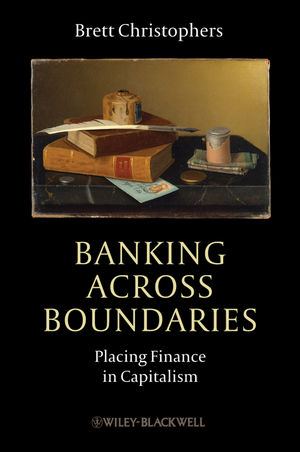
Brett Christophers – Banking Across Boundaries

Over on his blog Progressive Geographies, Stuart Elden highlights that Brett Christophers’ book Banking Across Boundaries has been published:
Banking across boundaries, book by Brett Christophers

Brett Christophers’s new book Banking Across Boundaries: Placing Finance in Capitalism has just been published. It’s part of the Antipode Book Series, and comes with glowing endorsements from David Harvey, Mary Poovey and Leonard Seabrooke.

There are excerpts available to read on the Wiley-Blackwell page for the book.

Clive Barnett on varieties of ‘the political’

In a recent post over on his blog, Pop Theory, Clive Barnett has written an excellent critical reflection upon the meanings and uses of ‘the political’ in social scientific discussion and political philosophy, as well as the various ways in which politics and the political are characterised, frequently dyadically. The post is set in the context of reflecting upon the growth in the supposition of the ‘post-political’ and Barnett’s healthy skepticism about it. I particularly like this passage:

Methodologically, the analysis of our post-political condition depends on a weird slippage – when one finds an example of partisan political action making use of consensual rhetoric, or of a political action culminating in a decision being made in the favour of some interests rather than others, or at the expense of others, then what you have found, it turns out, is not politics being done at all, but the end of politics, the closing down of the properly political. One would have thought that it’s not that difficult to recognise that politics is a game that turns on different ways of relating the partisan and the common, the partial and the universal, the specific and the general, at the level of rhetoric and action; dare one say it, even the consensual and the a(nta)gonistic (that’s what compromise, bargaining, deal-making are after all). One might also think that the literature on the politics/the political distinction has some interesting ways of understanding the dynamics of those relations. One would have thought, too, that the fact that some people end up being better at politics than others – that it’s a game of winners and losers – could be understood as an important part of the game, worthy of some analytical attention, and not just interpreted as being an effort to end of the game.

I found the three varieties of discussion of the political that Barnett characterises a useful analytic for reflecting upon my own work and how I’d situate it, not least in terms of Barnett’s critique of the trend towards studies of “the politics of–”, of which I am certainly guilty. Its also interesting to reflect on what it might mean to talk about politics on the context of research given the increasing pressure to make knowledge ‘exchangeable’ and ‘transferable’…

Theorising space & spatiality – Dialogues in Human Geography

In a recent issue of  the journal Dialogues in Human Geography there is a fascinating edited transcript of a panel session (from the 2010 AAG conference) with a fairly stellar group of speakers offering their reflections on the theorisation of space and spatiality. The contributions are from Gunnar Olsson, Eric Sheppard, Nigel Thrift and Yi-Fu Tuan. The article and the conference session from which it originates were put together by Martin Jones and Peter Merriman, from Aberystwyth. This is something like compulsory reading for students of geography, at all stages of career! I’ve copied below the abstract. Unfortunately the article requires a subscription to be accessed.

This article is an edited transcript of a panel discussion on ‘Space and Spatiality in Theory’ which was held at the Annual Meeting of the Association of American Geographers, Washington, DC, April 2010. In the article, the panel map out some of the challenges for thinking, writing and performing spaces in the 21st century, reflecting upon the emergence of new ways of theorizing space and spatiality, the relationship between writing, action and spacing, and the emergence of distinctive spatialized ontologies (e.g. ‘movement-space’) which appear to reflect epistemological and technological shifts in how our worlds are thought, produced and inhabited. The panellists stress the importance of recognizing the partial nature of Anglophone theoretical approaches, and they argue for more situated and modest theories. They also reflect upon the importance of a wide range of disciplinary knowledges and practices to their thinking on the spatialities of the world, from philosophy and the natural sciences to art and poetry.

New article: Futures in the making: practices to anticipate ubiquitous computing

Hot on the heals of the recent theme issue of Culture Machine that I co-edited with my colleague Patrick Crogan, I have a new article coming out in a theme issue of Environment and Planning A stemming from sessions at the 2010 RGS-IBG conference concerning  geographies of the future. This article, entitled ‘Futures in the making’, translates and re-thinks, in a slightly more nuanced way, some of the findings of the fourth chapter of my PhD thesis. Continue reading “New article: Futures in the making: practices to anticipate ubiquitous computing”