Reblog> Addiction, excess and artists: strategies of resistance

A still from the Black Mirror episode "the entire history of you"

Via Tony Sampson. Looks like a great event from Furtherfield >>

Addiction, excess and artists: strategies of resistance

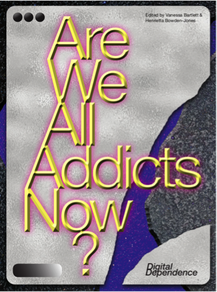
Are We All Addicts Now? Symposium and Book Launch.

Are we all addicts now?Date: Tuesday 7th November, 6.30 – 9pm

Venue: Central St Martins, University of the Arts London, 1 Granary Square, London, N1C 4AA

Tickets for the event are now available so please feel free to share this info.

http://www.furtherfield.org/programmes/event/are-we-all-addicts-now-symposium-and-book-launch

Here’s the blurb for the panel I’ll be talking on

Addiction, excess and artists: strategies of resistance

Techniques such as neuro-marketing are used online to keep users on device, driving endless circulation and drawing profits from every click. While many artists have celebrated overstimulation and digital excess, others incorporate strategies of resistance into their practice. In a hyper digital world, what are the possibilities for defying techniques such as neuro-marketing, nudging and gamification and what role can artists play in these acts of resistance? 

Reader in Digital Culture Tony D. Sampson explores neuro-marketing and digital addiction 

Artists Katriona Beales and Fiona MacDonald : Feral Practice discuss strategies of resistance from the AWAAN exhibition

Artist and writer Emily Rosamond on reputation addiction and how to resist it 

Museum of Contemporary Commodities – Exhibition Rd, Kensington 24-27 Aug.

Next week, in advance of the RGS-IBG annual conference, the Museum of Contemporary Commodities (MoCC) will join the other museums in South Kensington on Exhibition Rd. MoCC is the brainchild of artist-activist-researcher Paula Crutchlow and promises to build on the provocative and inspiring work undertaken as part of the project over the last three years. I strongly encourage anyone in London next week to pop into the Royal Geographical Society to take a look.

I’m very privileged to be on Paula’s PhD committee. This is fantastic work – even if you cannot make it to Exhibition Rd, please do look at the MoCC website.

Museum of Contemporary Commodities: valuing what we buy today as the heritage of tomorrow

Museum of Contemporary Commodities at the Royal Geographical Society, London.The Museum of Contemporary Commodities (MoCC) is an art-geography research and exhibition project investigating the deep links between data, trade, place and values that shape our everyday lives. This lively set of digital activities will be hosted in the Pavilion at RGS-IBG. Staffed by our friendly MoCC Invigilators, you will be able to browse the most valued exhibits, take our quiz, add something to the museum yourself and consult with the updated Mikayla 3.0 – our networked talking doll guide to all things MoCC. Two research and conversation events will also contribute to our continuing public conversations around the deep connections between data, trade, place and values.

All the events are free to attend. All are welcome. Please join us to re-value contemporary commodity culture one thing at time!

Exhibition open: Thursday 24 August-Sunday 27 August 2017, 10.00am-4.00pm

Additional events on Friday 25 August:

Data walkshop with data activist Alison Powell, LSE: 10.00am-12.30pm
Building on MoCC walkshops in Finsbury Park and Exeter, Alison will be investigating data mediations in the direct vicinity of the RGS-IBG through a process of rapid group ethnography. No experience necessary. Please book here.

Our Future Heritage: curating contemporary commodity cultures: 2.00pm-4.00pm
A public conversation event hosted in the Museum of Contemporary Commodities shop-gallery space at the RGS-IBG. With contributions from: MoCC co-founders Paula Crutchlow and Ian Cook, Senior Curator V&A Corrinna Gardner, Cultural Geographer Merle Patchett, Music Sociologist Lee Marshall, and researcher, publisher and curator D-M Withers. Please book here.

MoCC was co-founded by artist-researcher Paula Crutchlow from Blind Ditch and Geographer Ian Cook from followthethings.com and University of Exeter. The project is being developed in partnership with Furtherfieldand a growing number of artists, academics, technologists and members of the public.

Our early prototypes and events have been kindly supported by All Change Arts, Islington Turkish, Kurdish and Cypriot Women’s Group, Islington Council, Exeter City Council, Art Week Exeter, Exeter Scrapstore, Exeter Phoenix, Exeter CVS, St Sidwells Community Centre, Exeter Library, Art Week Exeter. With many thanks to the Royal Geographical Society (with the Institute of British Geographers) for their support with this 2017 exhibition. MoCC is funded by Arts Council England, University of Exeter and the Economic and Social Science Research Council.

To find out more, please visit http://www.moccguide.net/ or follow MoCC on Twitter at @moccofficial and on Instagram at @moccguidemikayla

Reblog> Thresholds – A pop-up symposium

Via Thresholds. Looks like an interesting event…

Thresholds – A Pop-Up Symposium

We are holding an event as part of our ‘Thresholds’ project on the 22nd of September 2017:

This event platforms scholars working across the humanities and social sciences around the theme of ‘thresholds’. It explores perspectives on the liminal edges of everyday, organisational and social life. What and who reside beyond or within different types of thresholds? Who has to cross thresholds? What prevents people or things crossing? How does power operate through different thresholds? How do thresholds articulate with limits, extremes, dangers and tipping points? These are just some of the questions explored in this one day symposium.

Thresholds is intended to bring together diverse disciplines including sociology, politics, history, anthropology, women’s studies, critical management, human geography, social policy. The format will be a short papers (10mins) followed discussion.

Further details, bookings and call for papers are available here.

Reblog> So what about Politics?–Call for contributions (iMAL Brussels, Nov. 3/4, 2017)

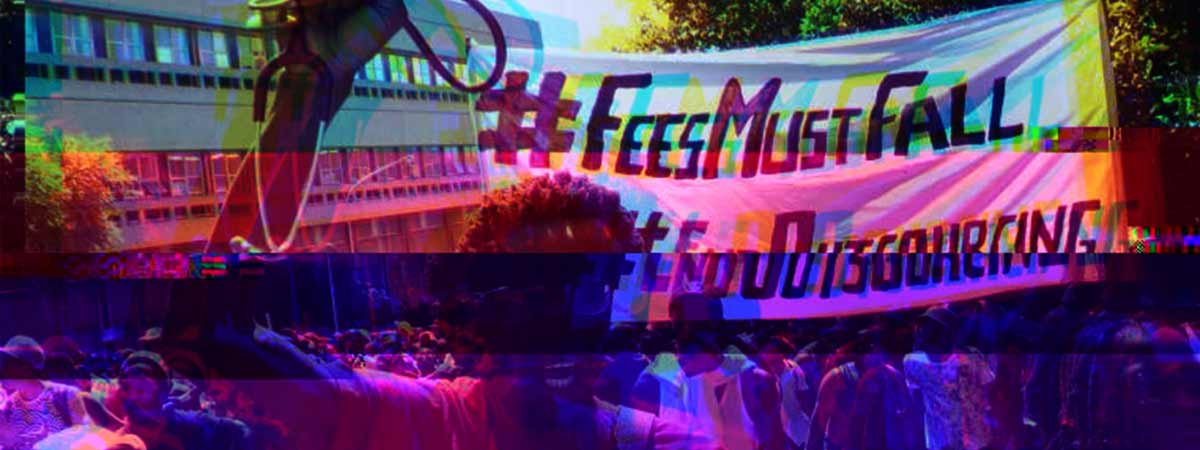
south african students protest with hashtag banners

From INC.

So what about Politics?–Call for contributions (iMAL Brussels, Nov. 3/4, 2017)

“If the past 10 years have been about discovering post-institutional social models on the Web, then the next 10 years will be about applying them to the real world.” Chris Anderson, 2010, www.wired.com)

So, what about politics? (November 3/4 2017 @  iMAL, Brussels)  looks at initiatives that could be seen as the avant-garde of a new political era. In a critical period of crisis in our political systems, we welcome artists, activists, academics, and everyone using innovative technological tools to reclaim political processes or to shape new forms of organisation, from local collectives to global movements.

As  Rebecca Solnit says, “It’s equally true that democracy is flourishing in bold new ways in grassroots movements globally”, and “There is far more politics than the mainstream of elections and governments, more in the margins where hope is most at home.” How does this apply to the margins of our technological imagination? Which tools and practices are being dreamed of, tested and explored?

What is the impact of today’s Internet-inspired post-institutional thinking on the practice of political action? For this we focus on tactics, tools and visions of grassroots initiatives, as well as on changing government policies and strategies.

iMAL wants to invite its guests to look beyond the often-perceived neutrality of technology and unveil underlying narratives. The symposium revolves around questions such as: What are the politics of a P2P society? How can we perceive a network as a real “distributed agora”? What can we learn from artist- or activist-led experiments focusing on collectivity and political agency? And most important: What are the concrete tools and initiatives today that really try to facilitate and use new forms of agency such as liquid democracy, e-governance, civic intelligence, platform cooperativism and autonomous self-organisation?

OPEN CALL: Digital culture and technology. But what about politics?

This is an open call for contributions by artists, activists, technologists, designers, researchers, citizen initiatives, collectives or groups to the symposium ‘So, what about politics?’. The event will be held on November 3-4, 2017 in Brussels at iMAL, the Brussels-based center for digital cultures and technology.

Send your proposal to SoWhatAboutPolitics@imal.org
Deadline: September 1st, 2017

This Open Call is not restricted to specific kinds of contributions. You can send us proposals for a lecture, workshop, performance, installation”¦ Day 1 of the symposium will be focusing on lectures and presentations. Day 2 is reserved for participatory activities such as Open Assembly Lab or Workshops.Proposals will be selected according to their relevance and feasibility (logistics, budget).

The symposium is curated by Bram Crevits in collaboration with Yves Bernard (iMAL.org). This event is organised by iMAL (Brussels center for Digital Cultures and Technology) in collaboration with the Institute of Network Cultures (Amsterdam), Medialab Prado (Madrid) and KASK/School of Arts (Ghent).

After the symposium Blockchain.Fact.Fiction.Future in 2016, So what about Politics? continues our exploration of how society can be improved with the digital world. So what about Politics? is supported by Saison des Cultures Numériques 2017, Ministery of Culture (Fédération Wallonie-Bruxelles).

Past event > Technology’s Limits: Automation, Invention, Labour, and the Exhausted Environment

Glitched image of a mural of Prometheus giving humans' fire in Freiberg

This looks like it was a fascinating event…

Workshop hosted by the Digital Life Research Program 

An abstract artwork of a light background with brown and red rectangles of various sizes.

Artwork by Stephen Scrivener Opens in a new window

Event Details

Date: Friday March 10, 2017
Time: 10am – 4.30pm
Venue: EB.G.21, Parramatta South campus

Among its many political preoccupations, 2016 was marked by an obsessive concern with the new powers of the machine to erase human labour and employment. Science fiction dystopias – among them, the French Trepalium and the Brazilian 3% – saddled older anxieties about a world without work to a more novel recognition of resource depletion and scarcity. Academic publishing houses, conference organisers, funding agencies and the press have responded with a deluge of content covering algorithms, automation and the Anthropocene. Meanwhile, a less conspicuous narrative about the decline of innovation has resurfaced with claims that the rate of fundamental new technology inventions is slowing and jeopardising long term global productivity returns. What happens when technology hits its limits? Velocity and volume excite machinic economies, but do little to confront some of the core problems and challenges facing planetary labour and life today.

This workshop brings together leading Australian scholars of technology and society with contemporary German and French reflections on the prevailing discourses of technology’s limits. Since the 1990s, Bernard Stiegler has been a leading philosopher and critic of technology, and in his recent book Automatic Society he directly tackles problems of automation and algorithms for the distribution of financial and social resources to populations increasingly bereft of economic capital and political agency. Building upon Frankfurt School critical theory and Kittlerian media theory, contemporary German critique intersects with similar questions by combining investigations of epistemology, history and the technical. The Australian take on these European developments is simultaneously appreciative and critical, though often oriented toward more regional conditions that arise in part due to different economic, cultural and political relations with Asia.

The morning session of the workshop will introduce current theoretical European work on technology. Daniel Ross will develop a critical introduction to Bernard Stiegler, whose recent work in Automatic Society and In the Disruption continues to mount a wide-ranging and provocative critique of technology. Armin Beverungen will then offer an overview of his research on algorithmic management and high-frequency trading, with Ned Rossiter introducing logistical media as technologies of automation and labour control. In the afternoon, Gay Hawkins will outline her theoretical interest in nonhuman and technical objects and their irreducible role in making humans and ecologies. A key empirical example will be the history of plastic and the emergence of its technical agency and capacity to reconfigure life. Nicholas Carah will follow with a discussion of his latest work on algorithms, brand management and media engineering. The workshop will close with an audience-driven panel session and discussion. These interventions will be held in conjunction with a close reading of the key texts below.

Register

Attendance numbers will be limited so please register in advance. No registration fee required.

RSVP by 7 March on Eventbrite Opens in a new window

Speakers

  • Armin Beverungen
    Junior Director at the Digital Cultures Research Lab (DCRL) at Leuphana Universität Lüneburg & Visiting Fellow, Institute for Culture and Society, Western Sydney University
  • Nicholas Carah
    Author of Brand Machines, Sensory Media and Calculative Culture (2016)
  • Gay Hawkins
    Author of Plastic Water: The Social and Material Life of Bottled Water (2015)
  • Liam Magee
    Author of Interwoven Cities (2016)
  • Nicole Pepperell
    Author of Dissembling Capital (forthcoming, 2017)
  • Daniel Ross
    Translator of Bernard Stiegler’s Automatic Society (2016) and numerous other works
  • Ned Rossiter
    Author of Software, Infrastructure, Labor: A Media Theory of Logistical Nightmares (2016).

Co-chairs: Liam Magee and Ned Rossiter, co-convenors of the Institute for Culture and Society’s Digital Life research program.

Recommended Readings

Frank Pasquale (2017), Duped by the Automated Public Sphere Opens in a new window
Lee Rainer and Janna Anderson [Pew Research Center] (2017), Code-Dependent: Pros and Cons of the Algorithm Age Opens in a new window
Bernard Stiegler (2012), Die Aufklärung in the Age of Philosophical Engineering (opens in a new window)
Bernard Stiegler (2015), Escaping the Anthropocene Opens in a new window
Bernard Stiegler (2015), On Automatic Society Opens in a new window
Sonia Sodha [The Guardian] (2017), Is Finland’s basic universal income a solution to automation, fewer jobs and lower wages? Opens in a new window

Related Readings

Bruce Braun (2014), A New Urban Dispositif? Governing Life in an Age of Climate Change Opens in a new window
Nick Dyer-Witheford (2013), Contemporary Schools of Thought and the Problem of Labour Algorithms (opens in a new window)
Victor Galaz (2015), A Manifesto for Algorithms in the Environment Opens in a new window
Victor Galaz et al. (2017), The Biosphere Code Opens in a new window
Orit Halpern (2015), Cloudy Architectures Opens in a new window
Erich Hörl (2014), Prostheses of Desire: On Bernard Stiegler’s New Critique of Projection Opens in a new window
Yuk Hui (2015), Algorithmic Catastrophe: The Revenge of Contingency (opens in a new window)
International Labour Organisation (2016), ASEAN in Transformation Opens in a new window
Lilly Irani (2015), The Cultural Work of Microwork Opens in a new window
MIT Technology Review (2012), The Future of Work Opens in a new window
Cathy O’Neill (2016), How Algorithms Rule Our Working Lives Opens in a new window
Elaine Ou (2017), Working for an Algorithm Might Be an Improvement (opens in a new window)
The Guardian (2016), Robot Factories Could Threaten Jobs of Millions of Garment Workers Opens in a new window
Tommaso Venturini, Pablo Jensen, Bruno Latour (2015), Fill in the Gap. A New Alliance for Social and Natural Sciences Opens in a new window

Agenda

  • 10:00 –10:10: Liam Magee, Ned Rossiter: Welcome and Introduction
  • 10:10–11:10: Daniel Ross
  • 11:10–11:30: Q&A
  • 11:30–11:45: Coffee
  • 11:45–1:00: Armin Beverungen, Ned Rossiter
  • 1:00–2:00: Lunch
  • 2:00–3:15: Gay Hawkins, Nicholas Carah
  • 3:15–4:15: Panel discussion responding to automation: Dan / Gay / Nicholas / Armin / Nicole – Liam & Ned to chair
  • 4:15–4:30: Closing thoughts, future actions

Reblog> Workshop: Reshaping Cities through Data and Experiments

Smart City visualisation

This looks interesting (via Programmable City):

Workshop: Reshaping Cities through Data and Experiments

When: 30th May 2017 – 9.30am to 3.30pm
Where: Maynooth University, Iontas Building, Seminar Room 2.31

The “Reshaping Cities through Data and Experiments” workshop is part of the Ulysses research exchange programme jointly funded by Irish Research Council and the Ambassade de France. It is organized in collaboration with researchers from the Centre de Sociologie de l’Innovation (i3-CSI) at the École des Mines in Paris – David Pontille, Félix Talvard, Clément Marquet and Brice Laurent – and researchers from the National Institute for Regional and Spatial Analysis (NIRSA) in Maynooth University, Ireland – Claudio Coletta, Liam Heaphy and Sung-Yueh Perng.

The aim is to initiate a transdisciplinary discussion on the theoretical, methodological and empirical issues related to experimental and data-driven approaches to urban development and living. This conversation is vital in a time when cities are increasingly turning into public-private testbeds and living labs, where urban development projects merge with the design of cyber-infrastructures to test new services and new forms of engagement for urban innovation and economic development. These new forms of interaction between algorithms, planning practices and governance processes raise crucial questions for researchers on how everyday life, civic engagement and urban change are shaped in contemporary cities.

Read the full blogpost on the Programmable City site.

Reblog> Ordinary digital humanities – event with @rodgers_scott

Another interesting event, this time with Scott Rodgers at Birkbeck.

Ordinary digital humanities: Free event at Birkbeck, 15 May 2017

Apple_II_IMG_4212In a couple of weeks’ time I am happy to be hosting an event as part of Birkbeck Arts Week on the subject of ‘Ordinary Digital Humanities’, featuring a talk from Lesley Gourlay (UCL Institute of Education). The publicity blurb below has more than enough information, I suspect, for you to get the idea. The event comes in significant part out of discussions we’ve been having through Satellite, an experimental subcommittee in the School of Arts at Birkbeck focused on exchanging information and perspectives on the critical, creative, academic and pedagogical dimensions of learning technologies.

Ordinary Digital Humanities
The everyday life of digital technologies in pedagogy

15 May 2017, 6pm, Keynes Library, 43 Gordon Square, WC1H 0PD (part of Birkbeck Arts Week)

Book your free place at: https://www.eventbrite.co.uk/e/ordinary-digital-humanities-the-everyday-life-of-digital-technologies-tickets-33211361075

When one hears the term ‘digital humanities’ what likely comes to mind are innovative applications of computational techniques and technologies to humanities research as well as pedagogy. Or, conversely, the application of concepts and philosophies rooted in the humanities toward the study of emergent digital objects.

There are reasons however to think about the digital humanities in a more ordinary sense, beyond ‘cutting edge’ research or pedagogy. In the introduction to her book How We Think, N. Katherine Hayles suggests that in order to understand the implications of digital technologies for the humanities, we must first consider the ‘low level’ implications of digital technologies for academic life. For instance, the widespread normalisation of email, department websites, software applications, web searches, social media, and much more. For Hayles, a ‘digital humanities’ is more than just innovative new approaches to research and pedagogy. It is also inherently about transformations to the cognitive and embodied environments of academic life at the level of the habitual or everyday.

This forum considers the banal dimensions of the digital humanities, focusing specifically (though not exclusively) on pedagogical practice. It begins with an opening lecture from Dr Lesley Gourlay (abstract below), followed by responses from Dr Grace Halden and Dr Tim Markham from Birkbeck, University of London. We will not only survey the everyday ways digital technologies are being used, and are asserting themselves, in academic life; but also, how humanities and other scholars might respond to the apparent opportunities and intrusions wrought by digitisation.

The event will be followed by a wine reception.

Flickering texts and the writing body: posthuman perspectives on the digital university

Dr Lesley Gourlay, Reader in Education and Technology, UCL Institute of Education

As digital technologies become increasingly central in our day-to-day lives, we see profound changes in how we search for information, communicate with others, and express ourselves. The university is also changing, as digital media becomes more central via online resources for distance learning, but also throughout the traditional campus, through the mainstream use of digital media for teaching, library provision and academic reading and writing. This has not only changed approaches to academic teaching, it has also fundamentally altered how we seek resources and how we read and generate new knowledge through writing and interaction. Drawing Hayle’s notion of ’embodied virtuality’, this talk will explore this theme, analysing data from a research project which looked in detail at how a small group of students approached their studies over a six-month period, using drawings, photography and interviews to form an in-depth understanding of their day-to-day lives as students, and how they navigate the complex digital and material landscape of the contemporary university. It looks at how texts change when they move between paper-based and the digital, how students navigate the complexities of multiple devices and formats, how they make spaces for writing and knowledge while on the move, and how they form part of ‘posthuman’ networks of digital devices and material objects in order to engage in their studies. Taking a historical perspective, the talk concludes that textual practices have always been central to how higher education is organised and how we understand ‘knowledge’, and considers how digital media might continue to change what we call ‘the university’.

Reblog> digital geographies event

May be of interest… via Gillian Rose.

The Digital Geographies Working Group of the Royal Geographical Society with the Institute of British Geographers is holding its first event. It’s got lots of various kinds of short presentations, opportunities to engage and interact so it should be fun and productive.RevolutionEvolutionImpostion_2903.jpg

The event will be at the Royal Geographical Society in London on 30 June and if you have any kind of interest in studying or doing geography digitally, you’re very welcome to attend. You can book now, here, and the panel sessions will also be livestreamed on the day.

Reblog> Archiving the City/ The City as Archive

Via .

Archiving the City/ The City as Archive

Registration is now open for this event in the UK, co-organised by Gareth Millington (University of York) who is also an assistant editor of JUCS:

Archiving the City/ The City as Archive

Thursday 16 March 2017, University of York, UK 10.00am-6.00pm

Confirmed keynote speakers: Sharon Macdonald (Humboldt), Paul Jones (Liverpool), Rebecca Madgin (Glasgow) and Graeme Gilloch (Lancaster).

This event, hosted by the Centre for Modern Studies and supported by the Department of History and Department of Sociology at University of York, considers the cultural forms through which the modern city is archived. It critically examines the different ways–via institutions, public art, collective practice, and more–in which urban history and memory are organised and presented in contemporary culture. It also engages with how the spaces and architecture of the city may themselves present as an archive, offering up reminders of social and cultural processes, imaginaries, struggles and events.

The symposium engages with Henri Lefebvre’s (2014) argument that the reign of the city is ending; that the city now only exists as an image and an idea. In addition, the importance of heritage in gentrification processes and the museification of the historic urban core reveals, at least in part, the sense of loss through which that the modern metropolis is remembered. This connects more broadly with Derrida’s (1996) notion of ‘archive fever’, which, he understands, is part of a compulsive, repetitive culture; a ‘homesickness’ born of a ‘nostalgic desire to return to the origin’ (ibid: 167). Through keynote speakers and panels the symposium will explore perspectives that make links between contemporary archiving processes, city museums, visual culture, heritage urbanism, ‘authenticity’ and the cultural regeneration of historic urban spaces.

Registration costs £10.00. You can book your place here: http://store.york.ac.uk/product-catalogue/centre-for-modern-studies/conferences

Talk: ‘imagining automation’, part of ‘Human centred design in the age of automation’

I’m doing a talk on 25th October for the ‘SW Futurists’ meet-up. The event is called “Human centred design in the age of automation” and I’ll be talking about how ‘automation’ gets imagined and what kinds of power or agency those imaginings might have.

There are two speakers, the other is Lucas Godfrey a design researcher at Edinburgh – who had a hand in inviting me to speak. 

There’s web page for the event on meetup.com with descriptions of both talks.

The blurb for my talk is here:

Imagining automation 
We are told that we face the widespread automation of jobs, that we are increasingly subject to ever more complex and intrusive ‘algorithmic’ surveillance and that complex computational systems, such as Google’s search, know us better than we know ourselves. What are the bases of such claims? How much do they say about the world we live in? and do such claims say more about the stories we tell about digital technologies? By talking through some examples, ranging from ill-fated chatbots to production lines and missions to Mars I invite you to consider with me some possible answers to these questions. In doing so, I hope we can reflect a little more on the power of the stories we tell about technology and how such power gets exercised.