Checkout @TOPOSExeter for some great art & events

TOPOS Exeter show: art-articles

This is post is really an invite, from the cultural geographers at Exeter, to an exhibition & associated events that are taking please this week at TOPOS on St. Sidwell’s street – with input and support from Prof John Wylie (Head of Geography at Exeter), and from Ian Cook et al. and Paula Cutchlow’s magnificent Museum of Contemporary Commodities.

TOPOS is a distinctive space for artistic installation/ exhibition/ discussion in Exeter, hosted and run by Volkhardt Mueller and is well worth a visit. So, please do!

This week’s new exhibition, Art-Articles, by Berlin artist Konstantin Bayer, offers a set of installations and objects which comment upon, and invite direct exploration of, contemporary encounters with commodification, originality, materiality and nature. See the link below for details of Bayer’s distinctive approach and products:

There will be a private viewing at TOPOS on Wed May 11th 17.30 – 18.30, and the exhibition will have regular opening hours in the days following (details here). There will also be a conversation/discussion event at TOPOS, on the themes of Landscape, Art & Commodity, Friday May 13th, 18.00 – 21.00

Please visit the TOPOS website for details of how to find it. And consider following them on Twitter for more information.

And here is a link to book a place at the discussion event on Friday: https://www.eventbrite.co.uk/e/topos-conversation-art-landscape-commodity-tickets-25235555225

The Museum of Contemporary Commodities in EXETER

The Museum of Contemporary Commodities

Just a quick note to let you know that the brilliant Paula Crutchlow has brought “The Museum of Contemporary Commodities” (MoCC) to Exeter for the majority of May.

There’s lots going on, much of it creative and interesting – so if you’re in Exeter or nearby: come and visit!

Two immediate things this week:

RIGHT NOW!: help re-create the internet in paper with Artist Louise Ashcroft from 11 -2 in the Exeter University Forum.

TOMORROW: sign up to do a data walkshop with Alison Powell from the LSE on Saturday from 10-1. Places have to be booked, and the Eventbrite page is here https://www.eventbrite.com/e/mocc-data-walkshop-tickets-24464719635

Please do visit the MoCC website for lots more events and activities taking place this month and visit the shop:

87 Fore St,
Exeter
EX46RT

Open 10:00-18:00pm Weds-Sat, 4th-21st May.

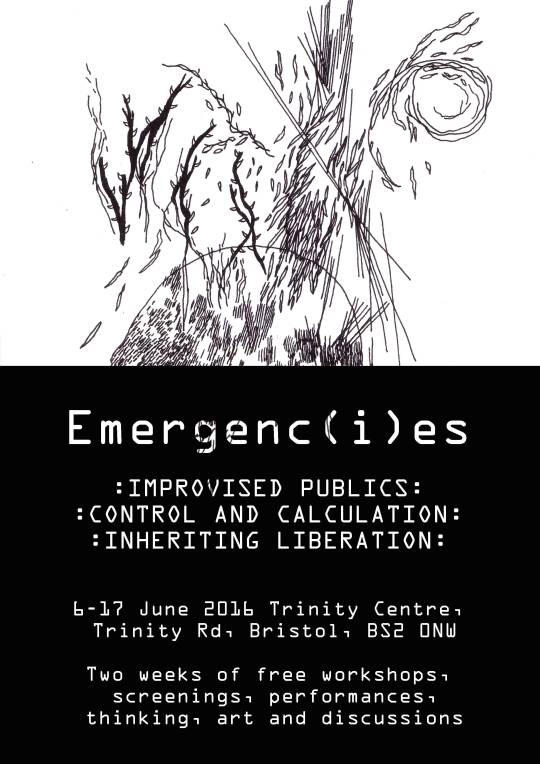
Reblog> Improvised Publics :: Control and Calculation :: Inheriting Liberation :: 6-17 June 2016

This event looks really interesting, check out the website for more information…

Emergenc(i)es – an event in Bristol between 6th and 17th June

Emergenc(i)es is an invitation to consider the emergency of the current historical moment.

The exhibition will dwell in the question of emergence within emergency.

Performance, education activities, visual art, screenings, installations, workshops and a library-cum-pharmacy will create time and space to diagnose, explore and understand the world we live in.

Enter – Relate – Improvise – Diagnose – Inherit – Public – Liberate – Gather

All activities are free to attend, thanks to generous funding from Awards for All.

Reblog> Launch Event: Researching Alternative Worlds: New political orientations in Geography

I’m taking part in the launch event of the Bristol Geography MSc Society & Space blog alongside some excellent and distinguished alumni of the course. It promises to be an interesting event!

The Official Launch of the Society and Space MSc Blog

4.00pm, Hepple Lecture Theatre, School of Geographical Science, University of Bristol

Register here

alternative worlds cover photos-1

On Wednesday 27th April, we will be officially launching the Society and Space MSc blog with a panel discussion event bringing together Society and Space alumni to discuss a common concern to all of their work – the role of academia in creating alternative social worlds. The Society and Space MSc Course is the principle Human Geography research training Master’s programme within the School of Geographical Sciences at the University of Bristol. As a Master’s degree that emphasises social and political theory, the programme trains students to think about social and cultural geographies from a critical perspective while also interrogating the political and ethical components inherent to these geographies. The programme has produced a range of alumni who have, in the course of their research, continue to contemplate and develop the issues, theories and debates they first encountered on the Master’s programme.

To officially launch the Society and Space blog, we have invited back Society and Space alumni – including James Ash, Emma Roe, Sam Kinsley, Nathan Eisenstadt, Owain Jones and Julian Brigstocke – to take part in a panel discussion centred upon pressing questions concerning our role as researchers in mapping alternative social worlds. What is the role of academic research in investigating, creating and sustaining alternative social worlds? When is academia useful and effective? What are we doing wrong, and what should we be doing more of?

Although a Master’s programme in Cultural Geography, the Society and Space MSc attracts students from a range of backgrounds and a variety of disciplines, such as journalism, English literature, philosophy, fine art and cultural studies. Due to the wide spectrum of backgrounds and interests of those who enrol in the course, as well as the dynamic nature of Human Geography as a subject, the contents covered in the Society and Space programme stimulate a range of conversations about the nature of sociality, the world we live in, and potential futures that may lie ahead of us. We expect that this diversity and broad outlook will be reflected in the work our speakers will present and the discussions that ensue. In addition to being a highly theoretical course, there is a strong, grounded political and ethical focus to the Master’s programme. Consequently, the issues debated, discussed and encountered throughout the Society and Space course are in direct conversation with ‘real’ issues – today’s hot topics and current political and ethical debates. In a context of austerity and the neoliberalisation of academia, the role of academia in researching and co-creating an alternative future is surely one such topic.

Alternative Worlds Poster-1

For a taste of the themes that the panel discussion will traverse, please have a look at abstracts provided by some of our panellists:

Dr James Ash, University of Newcastle

In this short reflection I offer one way of thinking about how we frame social science research questions. In doing so I want to caution against approaches which, however well meaning, centre on ‘big’ problems, framed in a general sense in relation to the concept of world. While issues such as climate change, poverty, homelessness and debt, amongst myriad others are undoubtedly real, there is an issue when assuming that a set of general problems are experienced within a shared horizon of meaning that is implied in the use of the term world. Rather than framing social problems in terms of big or small, or general or particular, I want to argue that such problems can be more productively framed in terms of what Simondon terms the abstract and the concrete. Drawing upon vignettes from the research design of an ESRC project on debt and digital interfaces, I demonstrate how Simondon’s work can be applied to specific societal problems.


Dr Nathan Eisenstadt, University of Bristol 

In this brief intervention I reflect on my doctoral work exploring paradoxes of freedom enacted in contemporary anarchist spaces. I propose that while performed inconsistently and in contradictory ways, the liberatory and egalitarian character of these practices lies in their capacity for an undoing of oneself with the help of compassionate others. Wonderful as this may sound – it has its edges. In closing I call attention to the failure of self-reflection and attempts to make spaces ‘safer’ when collectively established norms are radically transgressed.


Dr Sam Kinsley, University of Exeter

Computation is being used, within and without academia, to make ever grander and more detailed claims about our world. Yet, the (many) ‘worlds’ that emerge from what are generically referred to as ‘algorithms’ can be seen to fall foul of well-known fallacies of empiricism, in relation to their supposed lack of theoretical basis and apparent exhaustive reach. So, in light of grand claims made on behalf of ‘big data’ research and a contemporary predilection for the study of ‘algorithms’, I argue for a critical interrogation of the forms of world-ing propounded by such an ‘algorithmic imaginary’. In so doing, I suggest we reflect on what can be called a dialectic of ‘stupidity’ and ‘knowledge’, following Bernard Stiegler (2015), that undergirds our contemplation of such world-ings. My aim here is to tackle the inherent politics of this logic of worlds and how critical social scientists might engage.


Professor Owain Jones, Bath Spa University

My short presentation will reflect upon my experience of being in the first (very small) cohort of the MSc and then also devising and teaching the Nature and Society module from 2003-2006. I did not do an academic degree but an arts practice based degree so the MSc really marked my ‘conversion’ to academia and to geography. I can say without any exaggeration that doing the course was a life transforming and enhancing experience (as university (PG) education should be). The very possibility of imagining and enacting alternative worlds was very much part of that. My subsequent academic and professional life stands upon the very strong foundations put in place by the MSc and I think this is the case for many others too. I will offer some reflections upon why the course was so effective in this way. In part this was simply about being in a centre of excellence where there was a powerful intellectual momentum in which the conceptual and imaginative tools for questioning the trajectories of modernity were set out . But it was also about openness, spirit and collegiality with the staff and PG cohorts.

In addition to the panel discussion – which will be followed by time for audience questions – there will be a brief introduction by the Society and Space Blog Editors, before our very own Dr JD Dewsbury will recount his experience as first a student and then a lecturer on the MSc and map out how the course has changed and developed over the years.

The event will take place at 4.00pm, in the Hepple Lecture Theatre, School of Geographical Science, University of Bristol (see map). The discussion will be followed by a drinks reception. If you intend to attend (and we hope you do!), please confirm your attendance here.

We look forward to meeting you on 27th April.

The Editors

Reblog> Programme for Streams of Consciousness, Warwick, 21-22 April

Via Tony Sampson. All the names you’d expect/want to see and a few more… (can’t help finding it amusing that Thrift is opening the event).

It’d be interesting to hear what Rouvroy has to say…

Streams of Consciousness: Data, Cognition and Intelligent Devices

Download here short and full draft pdf versions of the programme

Register for the conference here 

Thursday 21st April


9.00 to 9.45: REGISTRATION AND COFFEE
9.45 to 10.00: OPENING ADDRESS
Nathaniel Tkacz, Centre for Interdisciplinary Methodologies, University of Warwick
10.00 TO 10.45: KEYNOTE SPEAKER 
Professor Nigel Thrift

10.45 to 13.00: PLENARY SESSION
Tony Sampson, University of East London 
Understanding Neurocapitalism or What Happens When Gramsci Does Human Computer Interaction
Nick Srnicek, Independent Researcher
The Eyes of the State
Antoinette Rouvroy, University of Namour (Video Conference)
Title TBC

13.00 to 14.00: LUNCH

14.00 to 16.00: BREAK OUT SESSIONS 
SESSION A: DATIFIED SELF
Sun-Ha Hong, University of Pennsylvania 
Data’s Intimacy: Machinic Sensibility and the Quantified Self
Elpida Prasopoulou, Coventry University 
The Body in the Internet of Things: An Auto-ethnography on Wearables
Aleksandra K. Przegalinska, Kozminski University 
Productivity 3.0: Mindtracking and the New Transparent Labour
Ana Viseu, Universidade Euroepia (TBC) 
Bodies, Data and the Question of Physiological Narcissism
SESSION B: ALGORITHMS, MODELS AND CALCULATIVE DEVICES
 
Nathan Coombs, University of Edinburgh 
Intractable Algorithms: Representational Uncertainty in the German High-Frequency Trading Act
Tyler Reigeluth, Université Libre de Bruxelles 
“Let’s misbehave!”: The politics of Behaving with Algorithm
Jérémy Grosman, University of Namour 
A Prediction, not an Oracle – Neural Network, between Algorithms and Metaphors
Charalampos Fytros, Lancaster University 
Mediating Solvency
SESSION C: EXPERIENCE, AFFECT, ATTENTION, INTERACTION
Miguel Prado, University of West England
Noise and Cognition in the Age of Big Data
Darshana Jayemanne, University of Melbourne
The Body Eclectic: Massively Multiplayer Mimesis
John McManus, Oxford University
Football Fans, Mimesis and the Enchanting Properties of Smartphone Use
Craig Hamilton, Birmingham City University 
Can Algorithms Make You Cry?: Popular Music and Machine-Derived Curation

16.00 to 16.15: COFFEE BREAK

16.15 to 18.30: PLENARY SESSION
Steve Fuller, University of Warwick 
Neuroscience as the Mind Instrumentalised: Telescope vs. Microscope
Michael Wheeler, University of Stirling 
The Knowledge Ecology: Epistemic Credit and the Technologically Extended Mind
Caroline Bassett, University of Sussex 
The Hubris of the ‘Artificial Intelligentsia’: Eliza and the Simulation of Smart

19.30: CONFERENCE DINNER

Friday 22nd April


09.00 to 11.00: PLENARY SESSION
Louise Amoore, Durham University 
Title TBC
David Berry, University of Sussex
Human Reason and Algorithmic Judgement
James Ash, Newcastle University 
The Interface Envelope: Power, Cognition and Gaming

11.15 to 11.30: COFFEE BREAK

11.30 to 13.10: BREAK OUT SESSIONS
SESSION A: PLATFORMS, INTERFACES AND SENSORS
Jacob Johanssen, University of Westminster 
Not Belonging to One’s Self: Affect and Alienation on Facebook’s Site Governance Page
Alex Gekker, Utrecht University
Numbers are Magic: Numerical User Interfaces and Disconnect
Heather Ford – Oxford Internet Institute
Ode to the Infobox
Alison Powell – London School of Economics and Political Science
A Goose in The Stream: Animals, ‘Accidents’ and Sensing Citizenships beyond the Calculative
SESSION B: ROBOTS, DRONES AND AI 
Tero Karppi, Marc Böhlen and Yvette Granata, SUNY Buffalo
Killer Robots and Cultural Techniques
Ramon Bloomberg, Goldsmiths College
Becoming Platform
Beatrice Fazi, University of Sussex
Can a Machine Think Anything New?
Marc Böhlen (Video Conference), Tero Karppi and Yvette Granata – SUNY Buffalo
Robot Control
SESSION C: AESTHETICS AND VISUALISATIONS
Roxana Fabius, Barad College
Business Intelligence and Aesthetic Criticality
Jonathan Gray, University of Amsterdam; Liliana Bounegru, University of Amsterdam, University of Groningen, University of Ghent; Stefania Milan, Amsterdam University; and Paolo Ciuccarelli Density Design, Politecnico di Milano 
Ways of Seeing Data
Lukasz Mirocha, University of Warsaw 
Challenging Technology Obfuscation Through Aesthetics of Real-time Visual Media: An Analysis of Glitches in Post-digital Consumer Mapping and Navigation Systems

13.10 to 14.00: LUNCH

PLENARY SESSION 14.00 to 16.15
Natasha Dow-Schüll, NYU (Video Conference)
From Mood Ring to MuseTM: Digital Sensor Technology and the Mediation of Sentience
Satinder Gill – Cambridge University 
Performing Knowledge: The Mediating Body
Will Davies – Goldsmiths College 
How Are We Now?: Mood as a Real-Time Indicator

16.15 to 16.30: COFFEE BREAK


PLENARY SESSION 16.30 to 17.15
Michael Dieter, University of Warwick
Title TBC
Jennifer Gabrys, Goldsmiths College
Digital Infrastructures of Withness: Constructing a Speculative “Smart” City

18.00 to 18.15: DISCUSSION AND CLOSING REMARKS

Reblog> Jane McAlevey: Workshop on Social Movement Unionism

This looks good. Another interesting event found through Mark Purcell…

Understanding power and strategy for effective organizing10am-5.30pm Tuesday 28 June 2016

University of Leeds,

Room 1.02, 20 Lyddon Terrace, Leeds, LS2 9JT
For map: http://tinyurl.com/zwoemdq

Attendance fees (includes lunch & refreshments) £20

NOTE: places are limited. You must register and pay in advance. Details can be found at www.buira.org

Jane McAlevey is well-known in the American labor movement as the hard-charging organizer who racked up a string of victories at a time when union leaders said winning wasn’t possible. In her book /Raising Expectations (and Raising Hell)/ Jane argues that labor can be revived, but only if the movement acknowledges its mistakes and fully commits to deep organizing, participatory education, militancy, and an approach to workers and their communities that more resembles the campaigns of the 1930s.In short, she advocates whole worker organising through social movement unionism.

Rather than building community-labour alliances, the whole worker organizing approach merges workplace and non-workplace issues into a tight blend. Jane had years of experience in community organizing prior to becoming a fulltime union organizer and negotiator and her approaches flow from the combined experience of union and community organizing. These methods have been successful in winning local political campaigns in addition to worker organizing campaigns.

Jane has recently completed her PhD and is currently teaching at Harvard University Law School on the Labor and Worklife Program.

This day-long workshop, supported by the *British Universities Industrial Relations Association,* is aimed at trade union an community activists who are interested in developing a greater understanding of the differences between organizing and mobilizing and how to undertake power analysis for effective organizing.

Workshop details

10am: Registration and refreshments

10.15am: introductions

10.30-1pm: morning workshops

1pm-2pm: Buffet Lunch: provided in attendance fee

2pm-5.50pm: afternoon workshops

Topics to be covered include:

·Core differences between organizing and mobilizing approaches.

·What is an organic leader?

·Differences between activists and leaders.

·Understandingpower: the relationship between strategies and power analysis.

This event is being sponsored by the British Universities Industrial Relations Association. Its annual conference on ‘Employment relations towards 2020 and beyond: reflection, prospects and opportunities’ will follow this workshop on 29 June–1^st July at The Carriageworks, Millennium Square, Leeds LS2 3AD.

If you wish to attend please contact Jane Holgate: j.holgate [at] leeds.ac.uk

Reblog> Postcapitalist Futures: Talk at Bristol

Via Mark Purcell…

The University of Bristol’s School of Geographical Sciences will host the 6th annual Bassett lecture on Tuesday 3rd May 2016 at 4pm.This year’s speaker is Nick Srnicek, who will be presenting under the title ‘Postcapitalist Futures’ (details below).

The lecture will take place in the Peel Lecture Theatre, School of Geographical Sciences, University Road, Bristol, BS8 1SS

Abstract:
What does the future of work hold? This talk will examine the current capitalist conjuncture, outlining the changing technological and economic conditions of work. The social democratic era of good jobs, it will be shown, is over – and the left must grapple with this shift. In place of full employment, we should be arguing for full unemployment. This talk will try and show both why this is necessary, and how this is possible.

Biography

Nick Srnicek is the co-author, with Alex Williams, of both Inventing the Future: Postcapitalism and a World Without Work (Verso, 2015) & “#ACCELERATE MANIFESTO for an Accelerationist Politics” (2013). He is the co-editor of The Speculative Turn (Re.press, 2011 with Levi Bryant and Graham Harman) and is currently working on a new book entitled Postcapitalist Technologies (Polity, forthcoming).

The Bassett Lecture:

The Bassett Lecture is held every year in honour of Dr. Keith Bassett, a critical geographer and long-time Senior Lecturer in the School of Geographical Sciences. Though formally retired, Dr. Bassett continues to write, teach, and contribute to the intellectual life of the School and University. The lecture series recognizes Dr. Bassett’s work and contributions in the fields of social and geographical theory, critical geographies of political economy, urbanism, social movements and social justice, political ecology, and critical socio-legal studies.

All Welcome!

No booking required, for enquiries contact: tom.keating [at] bristol.ac.uk

A politics and economics of attention

Just before Christmas (and just before injuring myself) I took part in an ESRC-funded seminar concerning the politics and economics of attention, alongside my colleague Clive Barnett and others.

Jessica Pykett very kindly invited me to talk on the back of the theme issue of Culture Machine Patrick Crogan and I co-edited back in 2012.

There are slides from the talks plus an interesting commentary by Rupert Alcock now posted to the Behaviour Change and Psychological Governance website.

My slides are on ResearchGate…

Highly recommended: Theatrical magic and the agenda to enchant the world

Some great articles in the ‘Online Early’ section of Social & Cultural Geography (as Mary Gilmartin tweeted today) and one jewel amongst them is a great new paper from Charlie Rolfe on theatrical magic, ‘unreal experiments’ and the agenda to enchant the world.

Charlie gave an early version of this in what was a tour de force seminar at Exeter Geography and I highly recommend reading the article!

Here’s the abstract:

This paper addresses the agenda of enchantment as it relates to contemporary theatrical magic (those deliberately enigmatic activities that are performed, experienced and commercialized as a form of entertainment). Magic practice is regularly constructed along a particular teleology: ‘action → effect of impossibility → affect of astonishment’. The paper supplements this teleology in four sections. First, a discussion of magicians’ knowledge and the ignorance required for participant-spectators to apprehend effects of impossibility and become astonished. Second, an examination of two forms of reason: one, an investigation into hidden ‘secrets’; the other, a perception of superficial ‘effects’. Third, a critique of the figure of the magician and its disputed role within magic practice. Fourth, a presentation and discussion of three empirical vignettes – professional magician Jay Sankey’s ‘Unreal Experiments’ – which advocate an evental logic with an experimental ethos; thus, enacting a critique of the figure and teleological structure of practice, and posing a challenge to rethink and invitation to expand theatrical magic practice. In conclusion, the paper highlights some of the ways in which theatrical magic participates in the agenda to enchant the world that has so gripped social science.

Event> The Politics and Economics of Attention (14/12)

Both Clive Barnett and I will be speaking at the sixth seminar in the Behaviour Change & Psychological Governance series (funded by the ESRC) which is being held at the University of Bristol on the 14th of December.

I’ll be revisiting some of the things Patrick Crogan and I wrote about back in 2012 in the themed issue of Culture Machine we co-edited following an ESF-funded conference on attention in 2010. My move forward is probably being a little more critical in my thinking about what constitutes the process of valuing attention (critically reflecting on why a Labour Theory of Value might not quite fit) and thinking (with the work of Bernard Stiegler) about how the socio-technical systems that attempt to economise (something that gets called) attention are a kind of pharmakon (an indeterminacy, originating from the idea of a drug as both poison and cure). By looking at some examples I hope to offer some suggestions about how we might understand what’s going on (in networked technology systems in particular) when an attempt is made to place a financial value on ‘attention’.