“algorithmic governance” – recent ‘algorithm’ debates in geography-land

Over on Antipode’s site there’s a blog post about an intervention symposium on “algorithmic governance” brought together by Jeremy Crampton and Andrea Miller, on the back of sessions at the AAG in 2016. It’s good that this is available open access and, I hope, helpful that it maybe puts to bed some of the definition wrangling that has been the fashion. Obviously, a lot draws on the work of geographer Louise Amoore and also of political theorist Antoinette Rouvroy, which is great.

Reading through the overview and skimming the individual papers provokes me to comment that I remain puzzled though by the wider creeping use of an unqualified “non-human” to talk about software and the sociotechnical systems they run/are run on… this seems to play-down precisely the political issues raised in this particular symposium – that the kinds algorithms concerned in this debate are written and maintained by people, they’re not somehow separate or at a distance… It’s also interesting to note that a sizeable chunk of the debates concern ‘data’ but the symposium doesn’t have “data” in the title, but maybe ‘data–’ is passé… 🙂

I’ve copied below the intro to the post, but please check out the whole thing over on Antipode’s site.

Intervention Symposium: “Algorithmic Governance”; organised by Jeremy Crampton and Andrea Miller

The following essays first came together at the 2016 AAG Annual Meeting in San Francisco. Jeremy Crampton (Professor of Geography at the University of Kentucky) and Andrea Miller (PhD candidate at University of California, Davis) assembled five panellists to discuss what they call algorithmic governance – “the manifold ways that algorithms and code/space enable practices of governance that ascribes risk, suspicion and positive value in geographic contexts.”

Among other things, panellists explored how we can best pay attention to the spaces of governance where algorithms operate, and are contested; the spatial dimensions of the data-driven subject; how modes of algorithmic modulation and control impact understandings of categories such as race and gender; the extent to which algorithms are deterministic, and the spaces of contestation or counter-algorithms; how algorithmic governance inflects and augments practices of policing and militarization; the most productive theoretical tools available for studying algorithmic data; visualizations such as maps being implicated by or for algorithms; and the genealogy of algorithms and other histories of computation.

Three of the panellists plus Andrea and Jeremy present versions of these discussions below, following an introduction to the Intervention Symposium from its guest editors (who Andy and Katherine at Antipode would like to thank for all their work!).

Read the whole post and see the contributions to the symposium on the Antipode site.
Reblog> CFP – Online Vitriol: Advocacy, Violence, and the Transforming Power of Social Media

Call for Papers

Online Vitriol: Advocacy, Violence, and the Transforming Power of Social Media

A Joint Conference of the International Graduate Centre for the Study of Culture & the Zentrum für Medien und Interaktivität, Giessen, Germany
Wednesday June 29th – Saturday July 1st, 2017 (optional opening lecture by dr. Sarah Kendzior on the evening of June 28th)
For whom:
Researchers in the fields of culture and (digital) media, and related fields

Professionals dealing with online advocacy and social media presence of their organization

Journalists and others dealing with social media and (violent) online discourse

PhD and MA students in culture and media studies

Conference aim:
To employ our collective knowledge, experience, research and intelligence to arrive at a conceptual and practical understanding of the medial and cultural dynamics of online vitriol.

To work towards “A Rough Guide to Online Vitriol: Dealing with Violence and Activism on Social Media in Theory and Practice” (working title). To be published later.

Social media have become inescapable, and they have an overwhelming impact on sociality and public life. Platforms such as Facebook, YouTube, and Instagram give rise to a diverse range of discourses and communication styles. This conference wants to understand the power of social media, not only – as it has often been perceived – as democratizing, but also as powerful vehicles for politically driven bullying and violence. Relevant to people, organizations, and other agents across twenty-first-century society, this topic is increasingly studied from a range of disciplines and perspectives. Virtually everyone has to deal with social media and the discourses it enables and produces. But while the technology exists and seems at first sight intuitively accessible, the agency, dynamics and ethics of social media platforms are not yet well-understood.
‘Trolls for Trump’, online virus ‘scares’, fake news – social media discourse has become a formidable, yet elusive, political force. This conference wants to begin to address some of the issues around the power of online vitriol, by studying discourses, metaphors, media dynamics, and framing on social media. What is it? How does it work? What does it do? And how can it be addressed or countered?
To fruitfully question the political impact of contemporary communication structures and discourses, the conference goes beyond the traditional presenter/audience dichotomy. Instead, it works towards producing a book for academics and professionals confronted with social media violence, provisionally titled “A Rough Guide to Online Vitriol: Dealing with Violence and Advocacy on Social Media in Theory and Practice”. The conference combines academic theorizing with perspectives from professionals active in media, communication, the public sector and journalism, so as to arrive at conceptually rigorous and useful conclusions to guide our own and our organizations’ use of social media.
Possible topics
Bringing together media and communication specialists from various professions (e.g. public sector, press, NGOs) and cultural and media studies students and scholars, the aim is to create crosspollination between theoretical approaches from cultural and media studies on the one hand, and practical challenges and experiences ‘from the field’ on the other.
Possible topics include, but are not limited to:
Privacy and surveillance through social media platforms

Liveness and online temporalities

Tweeting while female

Clickbait as political activism

Shares, likes, profile clicks and other platform-specific metrics

The impact of Facebook’s platform structure and changing algorithms on what can be expressed

‘Communicative capitalism’ and the dynamics of online virality

Politics of trolling and reporting

Representing social media in popular culture

How ‘new’ are online communication practices?

Framing narratives and ideals in a potentially hostile environment

Practical
The conference is free of charge. However, we ask that, during the conference, all participants agree to be offline, and try to be fully present and contemplative.
We welcome proposals of papers, case studies, ideas, and discussion topics from scholars and professionals in the listed fields, as well as related areas of specialization. Please submit a 300-word abstract and a short biography (100 words) to Sara Polak (s.a.polak@hum.leidenuniv.nl), Rahel Schmitz (rahel.schmitz@gcsc.uni-giessen.de), and Ann-Marie Riesner (ann.m.riesner@gcsc.uni-giessen.de) by May 15th, 2017.

Reblog> Workshop: Reshaping Cities through Data and Experiments

Smart City visualisation

This looks interesting (via Programmable City):

Workshop: Reshaping Cities through Data and Experiments

When: 30th May 2017 – 9.30am to 3.30pm
Where: Maynooth University, Iontas Building, Seminar Room 2.31

The “Reshaping Cities through Data and Experiments” workshop is part of the Ulysses research exchange programme jointly funded by Irish Research Council and the Ambassade de France. It is organized in collaboration with researchers from the Centre de Sociologie de l’Innovation (i3-CSI) at the École des Mines in Paris – David Pontille, Félix Talvard, Clément Marquet and Brice Laurent – and researchers from the National Institute for Regional and Spatial Analysis (NIRSA) in Maynooth University, Ireland – Claudio Coletta, Liam Heaphy and Sung-Yueh Perng.

The aim is to initiate a transdisciplinary discussion on the theoretical, methodological and empirical issues related to experimental and data-driven approaches to urban development and living. This conversation is vital in a time when cities are increasingly turning into public-private testbeds and living labs, where urban development projects merge with the design of cyber-infrastructures to test new services and new forms of engagement for urban innovation and economic development. These new forms of interaction between algorithms, planning practices and governance processes raise crucial questions for researchers on how everyday life, civic engagement and urban change are shaped in contemporary cities.

Read the full blogpost on the Programmable City site.

Reblog> Ordinary digital humanities – event with @rodgers_scott

Another interesting event, this time with Scott Rodgers at Birkbeck.

Ordinary digital humanities: Free event at Birkbeck, 15 May 2017

Apple_II_IMG_4212In a couple of weeks’ time I am happy to be hosting an event as part of Birkbeck Arts Week on the subject of ‘Ordinary Digital Humanities’, featuring a talk from Lesley Gourlay (UCL Institute of Education). The publicity blurb below has more than enough information, I suspect, for you to get the idea. The event comes in significant part out of discussions we’ve been having through Satellite, an experimental subcommittee in the School of Arts at Birkbeck focused on exchanging information and perspectives on the critical, creative, academic and pedagogical dimensions of learning technologies.

Ordinary Digital Humanities
The everyday life of digital technologies in pedagogy

15 May 2017, 6pm, Keynes Library, 43 Gordon Square, WC1H 0PD (part of Birkbeck Arts Week)

Book your free place at: https://www.eventbrite.co.uk/e/ordinary-digital-humanities-the-everyday-life-of-digital-technologies-tickets-33211361075

When one hears the term ‘digital humanities’ what likely comes to mind are innovative applications of computational techniques and technologies to humanities research as well as pedagogy. Or, conversely, the application of concepts and philosophies rooted in the humanities toward the study of emergent digital objects.

There are reasons however to think about the digital humanities in a more ordinary sense, beyond ‘cutting edge’ research or pedagogy. In the introduction to her book How We Think, N. Katherine Hayles suggests that in order to understand the implications of digital technologies for the humanities, we must first consider the ‘low level’ implications of digital technologies for academic life. For instance, the widespread normalisation of email, department websites, software applications, web searches, social media, and much more. For Hayles, a ‘digital humanities’ is more than just innovative new approaches to research and pedagogy. It is also inherently about transformations to the cognitive and embodied environments of academic life at the level of the habitual or everyday.

This forum considers the banal dimensions of the digital humanities, focusing specifically (though not exclusively) on pedagogical practice. It begins with an opening lecture from Dr Lesley Gourlay (abstract below), followed by responses from Dr Grace Halden and Dr Tim Markham from Birkbeck, University of London. We will not only survey the everyday ways digital technologies are being used, and are asserting themselves, in academic life; but also, how humanities and other scholars might respond to the apparent opportunities and intrusions wrought by digitisation.

The event will be followed by a wine reception.

Flickering texts and the writing body: posthuman perspectives on the digital university

Dr Lesley Gourlay, Reader in Education and Technology, UCL Institute of Education

As digital technologies become increasingly central in our day-to-day lives, we see profound changes in how we search for information, communicate with others, and express ourselves. The university is also changing, as digital media becomes more central via online resources for distance learning, but also throughout the traditional campus, through the mainstream use of digital media for teaching, library provision and academic reading and writing. This has not only changed approaches to academic teaching, it has also fundamentally altered how we seek resources and how we read and generate new knowledge through writing and interaction. Drawing Hayle’s notion of ’embodied virtuality’, this talk will explore this theme, analysing data from a research project which looked in detail at how a small group of students approached their studies over a six-month period, using drawings, photography and interviews to form an in-depth understanding of their day-to-day lives as students, and how they navigate the complex digital and material landscape of the contemporary university. It looks at how texts change when they move between paper-based and the digital, how students navigate the complexities of multiple devices and formats, how they make spaces for writing and knowledge while on the move, and how they form part of ‘posthuman’ networks of digital devices and material objects in order to engage in their studies. Taking a historical perspective, the talk concludes that textual practices have always been central to how higher education is organised and how we understand ‘knowledge’, and considers how digital media might continue to change what we call ‘the university’.

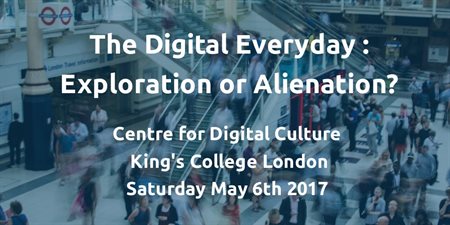
Digital Everyday – conference at KCL this weekend

This looks interesting… via Tony Sampson

THE DIGITAL EVERYDAY CONFERENCE

Location
Strand Campus – King’s College London
Category
Conference/Seminar
When
06/05/2017 (10:30-18:30)
Contact
Please direct enquiries to digitalculture@kcl.ac.uk

Sign up to the CDC mailing list here

The conference is paid and registration is essential. Registration closes midday on 4 May.

The Digital Everyday: Exploration or Alienation?

This international conference aims at exploring the digital everyday, understood as the transformation of everyday life practices brought about by digital technology. From how we buy, walk around, get a cab, love, break up, go to bed, meet new people and sexual partners to the way we rate services, turn on the fridge, exercise, eat, use social media and apps, Big Data is reshaping some of the most basic activities in our lives.

The conference will explore these digitally enabled transformations by looking at a number of domains affected by these shifts, for instance: of work and leisure, of friendship and love, of habits and routines. We will also explore a number of overarching dynamics and trends in the digital world that contribute to these transformations, including: processes of digital individualisation and aggregation; the elisions of spatial and temporal barriers; trends towards quantification and datafication; and the dialectic between control and alienation.

Please click here to see the full programme 

(Please note that refreshements will be provided but delegates will need to get their own lunch)

Image

A ‘new realism’ and post-truth

A glitched image of a typewriter

In a recording of a very lively double-header presentation by Maurizio Ferraris and Martin Scherzinger which has been podcast by Data & Society there’s some interesting discussion of Ferraris’ formulation of a ‘new realism‘ (which is sort of sympathetic to but perhaps distinct from speculative realisms) in relation to how we might understand ‘truth’ and truth claims and so how we might understand how ‘understanding’ works in relation digitally mediation.

Both Ferraris and Scherzinger are entertaining speakers but Scherzinger in particular offers some very incisive comments around how we can understand the sorts of manoeuvres different people are making around the constitutions and discussion of ‘theory’ (taken in its most general understanding).

Anyway… it’s an interesting listen:

Post-Truth and New Realities: Algorithms, Alternative Facts, and Digital Ethics

A few cultural geographies of tech

As it’s/they’re now a sort of trend, here’s a few recently published papers that offer some  cultural geographies of tech…

Being in a mediated world: self-tracking and the mind–body–environment

Sarah Pink, Vaike Fors

Self-tracking is an increasingly ubiquitous everyday activity and therefore is becoming implicated in the ways that everyday environments are experienced and configured. In this article, we examine theoretically and ethnographically how the digital materiality of these technologies mediates and participates in the constitution of people’s tacit ways of being in the world. We argue that accounting for the presence of such technologies as part of everyday environments in this way offers new insights for non-representational accounts of everyday life as developed in geography and anthropology and advances existing understandings of these technologies as it has emerged in sociology and media studies.

The GoPro gaze

Phillip Vannini, Lindsay M Stewart

During 2014–2015, we produced a short video documentary, titled The Art of Wild, which focused on the audiovisual practices of outdoor adventurers. This short written report reflects on an idea inspired by the video: the GoPro gaze. Enacted by increasingly sophisticated, portable and affordable recording audiovisual technologies such as the GoPro Hero camera, the ‘GoPro gaze’ entails not just the pursuit of pleasures derived from adventure and nature-based travel, but also the production and distribution of professional-quality independent videos for Internet audiences. Based on a series of ‘go-along’ interviews with adventure travelers/athletes/artists, this article and the accompanying video prompt us to reflect on how the affective pleasures and technological affordances of the ‘GoPro gaze’ trouble the established idea of the ‘tourist gaze’.

The lit world: living with everyday urban automation

Sarah Pink & Shanti Sumartojo

In this article, we develop and advance the concept of the lit world by bringing together literatures about everyday lighting, automation in everyday life and human perception, along with our ethnographic research into people’s experience of automated lighting in Melbourne, Australia. In doing so we formulate and argue for an approach to automation that situates it as part of everyday mundane worlds and acknowledges its entanglement with the emergent and experiential qualities of everyday environments as they unfold. We demonstrate this through the example of automated lighting, understood as a situated technology that has contingent effects and participates in the making of particular ways of seeing and feeling the world. We thereby argue for an account of automation that reaches beyond its potential for the management of human (and other) behaviour, to ask how the qualities and affordances of automated technologies might seep out of their intended domains, and create new perceptual and experiential opportunities. In a context where automation is increasingly prevalent in everyday life, such attention to the experience and use of automated technologies which already exist on a large scale is needed. Urban lighting is an example par excellence of automation in the world because it has a long history beyond the recent association of automated technologies with code and digital infrastructures. As scholars debate how automated technologies will become part of our future digital lives, understanding how people live in a lit world offers a starting point for considering how we might live with other anticipated algorithmic forms of automation.

Songs “written by AI” from SonyCSL

Songs written by Sony CSL’s “AI”…

From the Sony CSL “flow machines” website:

Flow Machines is a research project funded by the European Research Council (ERC) and coordinated by François Pachet (Sony CSL Paris – UMPC).

The goal of Flow Machines is to research and develop Artificial Intelligence systems able to generate music autonomously or in collaboration with human artists.
We do so by turning music style into a computational object. Musical style can come from individual composers, for example Bach or The Beatles, or a set of different artists, or, of course, the style of the musician who is using the system.

Their “Deep Bach” thing was doing the rounds at the end of last year, so I presume there will be more to come.

A Universe Explodes. A Blockchain book/novel

Blockchain visualisation

Thanks to Max Dovey for the tip on this…

This seems interesting as a sort of provocation about what Blockchain says/asks about ownership perhaps, although I’m not overly convinced by the gimmick of changing words such that the readers unravel, or “explode” the book… I wonder whether The Raw Shark Texts  or These Pages Fall Like Ash might be a deeper or maybe I mean more nuanced take on such things… however, I haven’t explored this enough yet and it’s good to see Google doing something like this (I think?!)

Here’s a snip from googler tea uglow’s medium post about this…

It’s a book. On your phone. Well, on the internet. Anyone can read it. It’s 20 pages long. Each page has 128 words, and there are 100 of the ‘books’ that can be ‘owned’ . And no way to see a book that isn’t one of those 100. Each book is unique, with personal dedications, and an accumulation of owners, (not to mention a decreasing number of words) as it is passed on. So it is both a book and an cumulative expression of the erosion of the self and of being rewritten and misunderstood. That is echoed in the narrative: the story is fluid, the transition confusing, the purpose unclear. The book gradually falls apart in more ways than one. It is also kinda geeky.

Reblog> digital geographies event

May be of interest… via Gillian Rose.

The Digital Geographies Working Group of the Royal Geographical Society with the Institute of British Geographers is holding its first event. It’s got lots of various kinds of short presentations, opportunities to engage and interact so it should be fun and productive.RevolutionEvolutionImpostion_2903.jpg

The event will be at the Royal Geographical Society in London on 30 June and if you have any kind of interest in studying or doing geography digitally, you’re very welcome to attend. You can book now, here, and the panel sessions will also be livestreamed on the day.