
I’m not a fan of TED talks but this by John Danaher is a well presented and clear, if perhaps provocative, argument about how we might think about ‘sex robots’ and perhaps any kind of technology to which we grant agency.
Choose how you feel, you have seven options
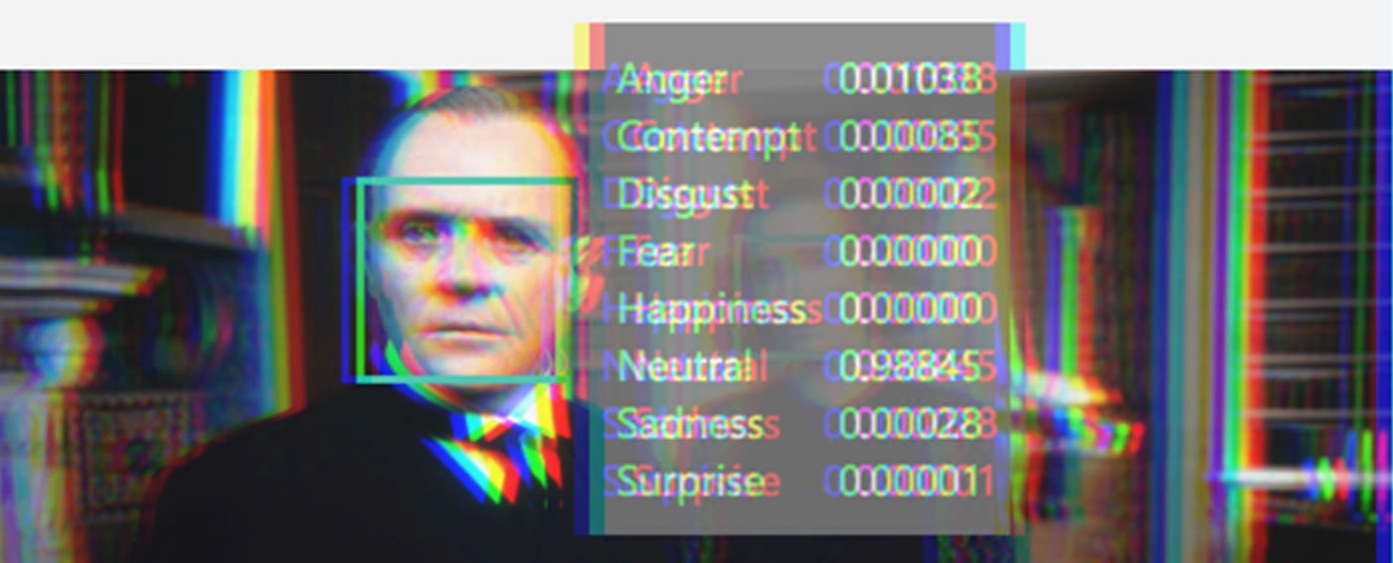
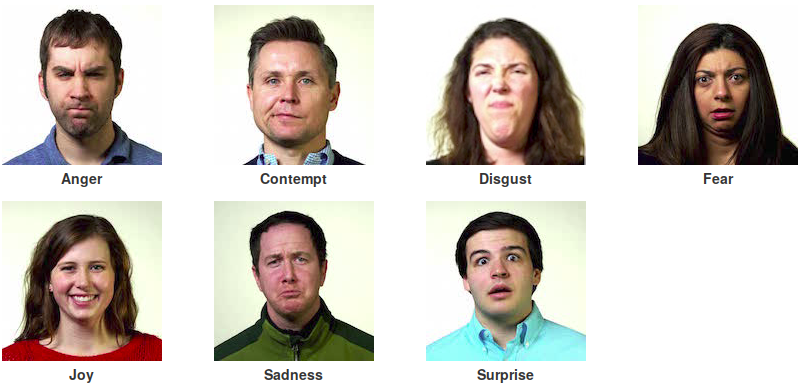
A great piece by Ruben Van de Ven stemming from his artwork of the same name, published on the Institute of Network Culture site. Van de Ven, in a similar vein to Will Davies, deconstructs the logic of ‘affective’ computing, sentiment analysis and their application to what has been termed the ‘attention economy’. The article does a really go job of demonstrating how the knowledge claims, and the epistemologies (perhaps ontologies too), that are at work behind these technologies are (of course) deeply political in their application. Very much worth reading! (snippet below).
‘Weeks ago I saw an older woman crying outside my office building as I was walking in. She was alone, and I worried she needed help. I was afraid to ask, but I set my fears aside and walked up to her. She appreciated my gesture, but said she would be fine and her husband would be along soon. With emotion enabled (Augmented Reality), I could have had far more details to help me through the situation. It would have helped me know if I should approach her. It would have also let me know how she truly felt about my talking to her.’
FOREST HANDFORD
This is how Forest Handford, a software developer, outlines his ideal future for a technology that has emerged over the past years. It is known as emotion analysis software, emotion detection, emotion recognition or emotion analytics. One day, Hartford hopes, the software will aid in understanding the other’s genuine, sincere, yet unspoken feelings (‘how she truly felt’). Technology will guide us through a landscape of emotions, like satellite navigation technologies guide us to destinations unknown to us: we blindly trust the route that is plotted out for us. But in a world of digitized emotions, what does it mean to feel 63% surprised and 54% joyful?
Reblog> Accident tourist – driverless cars and ethics

An interesting and well-written piece over on Cyborgology by Maya from Tactical Tech Collective (amongst many other things!)
I particularly like these bits copied below, but please read the whole post.
Accident Tourist: Driverless car crashes, ethics, machine learning
…I imagine what it may be like to arrive on the scene of a driverless car crash, and the kinds of maps I’d draw to understand what happened. Scenario planning is one way in which ‘unthinkable futures’ may be planned for.
The ‘scenario’ is a phenomenon that became prominent during the Korean War, and through the following decades of the Cold War, to allow the US army to plan its strategy in the event of nuclear disaster. Peter Galison describes scenarios as a “literature of future war” “located somewhere between a story outline and ever more sophisticated role-playing war games”, “a staple of the new futurism”. Since then scenario-planning has been adopted by a range of organisations, and features in the modelling of risk and to identify errors. Galison cites the Boston Group as having written a scenario – their very first one- in which feminist epistemologists, historians, and philosophers of science running amok might present a threat to the release of radioactive waste from the Cold War (“A Feminist World, 2091″).
The applications of the Trolley Problem to driverless car crashes are a sort of scenario planning exercise. Now familiar to most readers of mainstream technology reporting, the Trolley problem is presented as a series of hypothetical situations with different outcomes derived from a pitting of consequentialism against deontological ethics. Trolley Problems are constructed as either/or scenarios where a single choice must be made.
[…]
What the Trolley Problem scenario and the applications of machine learning in driving suggest is that we’re seeing a shift in how ethics is being constructed: from accounting for crashes after the fact, to pre-empting them (though, the automotive industry has been using computer simulated crash modeling for over twenty years); from ethics that is about values, or reasoning, to ethics as based on datasets of correct responses, and, crucially, of ethics as the outcome of software engineering. Specifically in the context of driverless cars, there is the shift from ethics as a framework of “values for living well and dying well”, as Gregoire Chamayou puts it, to a framework for “killing well”, or ‘necroethics’.
Perhaps the unthinkable scenario to confront is that ethics is not a machine-learned response, nor an end-point, but as a series of socio-technical, technical, human, and post-human relationships, ontologies, and exchanges. These challenging and intriguing scenarios are yet to be mapped.
Coincidentally, in the latest Machine Ethics podcast (which I participated in a while ago), Joanna Bryson discusses these issues about the bases for deriving ethics in relation to AI, which is quite interesting.
Reblog> Gary Kasparov on fake news
Via John Naughton.
From an interesting interview:
Q: Does the term “fake news” have a Russian equivalent, and if so, what is it, who uses it and, in your experience, why?
Kasparov: My honest reply to this is that the word for “fake news” in Putin’s Russia is simply “news.” There isn’t a syllable uttered or printed in Russia without its author being very much aware of what the regime thinks of it and what would happen to him if he crosses a certain line–except perhaps the weather! Often those lines are explicit, sent out in memos about new topics and how to promote or spin them. But by now, after 17 years of Putin, everyone knows where the lines are. Under those conditions, what can news be except fake? Even if nearly everything that is published is, in and of itself, true, there is an ocean of falsity in what isn’t said, what isn’t asked, and how basic facts are presented. This is the story of the media in a modern dictatorship. It’s not like Pravda, with one official storyline that everyone knows is probably BS. There are hundreds of layers of carefully calibrated propaganda and censorship in Putin’s Russia, creating the illusion of freedom. One outlet says Putin is great 100 percent of the time about everything. Another only 80 percent, about, say, the economy or security. One writer can complain a little about education, while another is allowed to criticize the regime on one or two specific things, etc. It’s like the Matrix, a complex illusion. And since almost all Russians still depend on television news, it’s very effective.
Brave new-old world – gig economy as scientific management

They’re gonna be disrupted, yeah! Because your lives are being disrupted, yeah! This is the money you need to live!
An interesting article in the FT: “When your boss is an algorithm“, in which (if you ignore the sort of anthropomorphism of “the algorithm” and its apparently supreme agency) the author, Sarah O’Connor, draws out the similarity between the claims of efficiency etc. made for ‘gig economy’ -type work platforms, such as Uber and Deliveroo, are very similar to Taylorism:
Algorithmic management” might sound like the future but it has uncanny echoes from the past. A hundred years ago, a new theory called “scientific management” swept through the factories of America. It was the brainchild of Frederick W Taylor … Taylor wanted to replace this “rule of thumb” approach with “the establishment of many rules, laws and formulae which replace the judgment of the individual workman”. To that end, he sent managers with stopwatches and notebooks on to the shop floor. They observed, timed and recorded every stage of every job, and determined the most efficient way that each one should be done. “Perhaps the most prominent single element in modern scientific management is the task idea,” Taylor wrote in his 1911 book The Principles of Scientific Management. “This task specifies not only what is to be done but how it is to be done and the exact time allowed for doing it.”
Exemplified by the following excerpt articulating the experience of a Deliveroo driver, Kyaw, which is, in turn, of course similar to the kinds of working conditions of other delivery drivers and Amazon warehouse pickers (as has been covered widely in the press)…
Kyaw whips out his phone. The app expects him to respond to new orders within 30 seconds. The screen shows a map and address for the local Carluccio’s, an Italian restaurant chain. A swipe bar says “Accept delivery”. That is the only option. The algorithm will not tell him the delivery address until he has picked up the food from Carluccio’s. Deliveroo couriers are assigned fairly small geographic areas but Kyaw says sometimes the delivery address is way outside his allocated zone. You can only decline an order by phoning the driver support line. “They say, ‘No, you have to do it, you already collected the food.’ If you want to return the food to the restaurant they mark it as a driver refusal – that’s bad.”
‘Ways of Being in a Digital Age’ scoping

I’ve only just caught on here, but the ESRC’s “Ways of Being in a Digital Age” scoping review, for their new theme of the same name, has been awarded to the Liverpool Institute of Cultural Capital (a collaboration between Liverpool and Liverpool John Moores) in a partnership with 17 other institutions (a core of eight in the UK apparently). They say:
The project will undertake a Delphi review of expert opinion and a systematic literature review and overall synthesis to identify gaps in current research.
The project will also run a programme of events to build and extend networks among the academic community, other stakeholders and potential funding partners.
There’s a website, so you can read more there…
Reblog> Surveillance capitalism in a nutshell


Reblog> Workshop on Security and the Political Turn in the Philosophy of Technologies
An interesting event blogged by Peter-Paul Verbeek:
Workshop ‘Security and the Political Turn in the Philosophy of Technologies’, University of Twente | DesignLab, March 10 2017. How to understand the political significance of things? And how to deal with the politics of technology in a responsible way? Ever since Langdon Winner claimed in the early 1980s that “artifacts have politics”, these questions have been puzzling philosophers and ethicists of technology. Technologies are not just instruments for humans to do politics but actively shape politics themselves. In this workshop we will explore various dimensions of this political role of technologies, especially with regards to security, citizenship in a technological world, and the role of social media and ‘fake news’ in contemporary democracy.
Speakers include:
- Babette Babich (Fordham)
- Robin James (UNCC),
- Laura Fichtner (TUD)
- Wolter Pieters (TUD)
- Melis Bas (UT)
- Jonne Hoek (UT)
- Philip Brey (UT)
- Nolen Gertz (UT)
- Michael Nagenborg (UT)
- Peter-Paul Verbeek (UT)
The workshop is sponsored by the 4TU.Ethics working group on “Risk, Safety, and Security.”
“Do you hear voices? You do. So you are possessed” – @mikedotphillips talk @exetergeography
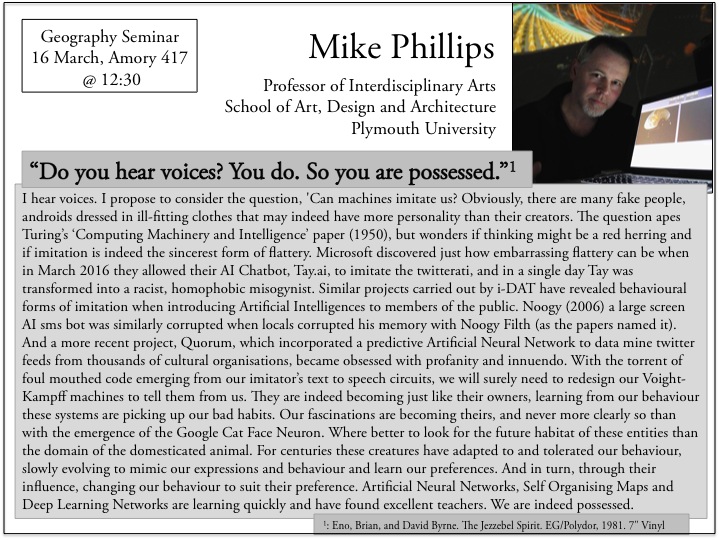
I’m really pleased to share that Prof. Mike Phillips (i-DAT, Plymouth) will be speaking next week as part of the Exeter Geography seminar series. Mike is a founder of the Institute of Digital Art and Technology and one of the founders of the undergraduate programme I studied MediaLab Arts, which is now called Digital Media Design.
Details: Thursday 16th March, 12:30: Amory 417. All welcome!
prove you are nonhuman – transmediale 2017

Interesting panel, introduced and moderated by the inimitable Geoff Cox.
The panel members are: Finn Brunton, Marloes de Valk, Suzanne Treister.