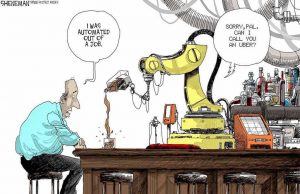
The automation of human jobs may cause some unrest, so prepare to have honest, open discussions with your organization. Resistance may come not only from the workers in automatable roles but also from directors who may fear erosion in their span of control, as they potentially go from managing employees to managing bots.
This post contains some tabs I have had open in my browser for a while that I’m pasting here both to save them in a place I may remember to look and to share them with others that might find them of interest. I’m afraid I don’t have time, at present, to offer any cogent commentary or analysis – just simply to share…
Untold A.I. – “What stories are we not telling ourselves about A.I?”, Christopher Noessel: An interesting attempt to look at popular, sci-fi stories of A.I. and compare them to contemporary A.I. research manifestos and look at where we might not be telling ourselves stories about the things people are actually trying to do.
WEF on the Toronto Declaration and the “cognitive bias codex”: A post on the World Economic Forum’s website about “The Toronto Declaration on Machine Learning” on guiding principles for protecting human rights in relation to automated systems. As part of the post they link to a nice diagram about cognitive bias – the ‘cognitive bias codex‘.
RSA report on public engagement with AI: “Our new report, launched today, argues that the public needs to be engaged early and more deeply in the use of AI if it is to be ethical. One reason why is because there is a real risk that if people feel like decisions about how technology is used are increasingly beyond their control, they may resist innovation, even if this means they could lose out on benefits.”
Artificial Unintelligence, Meredith Broussard: “In Artificial Unintelligence, Meredith Broussard argues that our collective enthusiasm for applying computer technology to every aspect of life has resulted in a tremendous amount of poorly designed systems. We are so eager to do everything digitally—hiring, driving, paying bills, even choosing romantic partners—that we have stopped demanding that our technology actually work.”
Data-driven discrimination: a new challenge for civil society: A blogpost on the LSE ‘Impact of Soc. Sci.’ blog: “Having recently published a report on automated discrimination in data-driven systems, J?drzej Niklas and Seeta Peña Gangadharan explain how algorithms discriminate, why this raises concerns for civil society organisations across Europe, and what resources and support are needed by digital rights advocates and anti-discrimination groups in order to combat this problem.”
‘AI and the future of work’ – talk by Phoebe Moore: Interesting talk transcript with links to videos. Snippet: “Human resource and management practices involving AI have introduced the use of big data to make judgements to eliminate the supposed “people problem”. However, the ethical and moral questions this raises must be addressed, where the possibilities for discrimination and labour market exclusion are real. People’s autonomy must not be forgotten.”
I came across Janelle Monáe‘s work a while ago, through Twitter, I was really taken by the video for “Many Moons“, which is beautiful. Metropolis, the album from which it is taken, is a really interesting blend of pop, sci-fi and perhaps afrofuturism, or at least forms of sci-fi that don’t conform to, or queer, standard Western/Global North sci-fi themes/norms. Some have argued Monáe’s videos blends American and African Sci-Fi themes (a teaser trailer for Dirty Computer was shown before cinematic performances of Black Panther) in a sort of queer aesthetic (that’s my reading of what longer pieces say anyway) and I think I can see it in several videos, though my knowledge of other work that might complement or contrast this is very limited.
In the “emotion picture” (what a beautifully evocative term) for the album Dirty Computer we’re presented with a rich and confident, feature length, work of art. I’m not currently able to dedicate the time to offer a lengthier visual analysis, I’m simply going to post the video, below. All I can say, really, is: wow.
Employment generation is crucial to spreading the benefits of economic growth broadly and to reducing global poverty. And yet, emerging economies face a contemporary challenge to traditional pathways to employment generation: automation, digitalization, and labor-saving technologies. 1.8 billion jobs—or two-thirds of the current labor force of developing countries—are estimated to be susceptible to automation from today’s technological standpoint. Cumulative advances in industrial automation and labor-saving technologies could further exacerbate this trend. Or will they? In this paper we: (i) discuss the literature on automation; and in doing so (ii) discuss definitions and determinants of automation in the context of theories of economic development; (iii) assess the empirical estimates of employment-related impacts of automation; (iv) characterize the potential public policy responses to automation; and (v) highlight areas for further exploration in terms of employment and economic development strategies in developing countries. In an adaption of the Lewis model of economic development, the paper uses a simple framework in which the potential for automation creates “unlimited supplies of artificial labor” particularly in the agricultural and industrial sectors due to technological feasibility. This is likely to create a push force for labor to move into the service sector, leading to a bloating of service-sector employment and wage stagnation but not to mass unemployment, at least in the short-to-medium term.
I’ve had a sort of moment of realisation this morning that a bunch of tabs I’ve had open, saved, reopened (etc etc) for the past few months are all more-or-less about doing speculative work around A.I., automation and suchlike.
This is interesting for me cos I wrote a PhD (and I am by no means the only one) about rationales for and forms of speculative practice in computing R&D (my fieldwork for this was, soberingly, now approximately ten years ago). It’s also interesting cos I have, in the last eight or so years, pitched for funding to do this sort of work and miserably failed three times.
I think what interests me most is the ways in which story telling is more-or-less the method. I’m not sure how good we are at this, as academics. There’s some good work that analyses speculative things, such as architects visualisations, but I’m not sure I’ve seen much work doing speculation that is not design-oriented. I am not seeking to criticise speculative design practices, I really admire that work, I just wonder if there is a way of de-centring the ‘design’ bit to engage in broader forms of ‘speculation’. I’m also not sure how one can tread the line between evoking particular kinds of scenario/ story (or dare I say imaginative geography) and affirming them. Likewise, I don’t think it is sufficient to simply refer to Black Mirror – it’s fun but it’s not the only way of doing speculation about technology (as afrofuturism demonstrates). I don’t think we want to merely replicate the sorts of ‘visioning’ practices of the likes of Microsoft, Samsung or Beko, not because they’re not interesting but because I’d like to think academics doing this kind of thing want to critically reflect on, not simply propose (or impose!), possibilities. Playful examples that I think are successful include Superflux’s excellent “Uninvited Guests” – though again, this is perhaps more design-oriented: it’s more about the function in relation to the individual rather than the kinds of world that are necessary for those functions to work.
I do not claim any special insight here – I’m curious about speculative methods – they seem to have some analytical/ explanatory/ critical power but also that also seems to be rather hard to negotiate. In practice, I think you may have to be in the right context, and I’m not convinced academic geography is (without quite a bit of work, given particular kinds of disciplinary assumptions and proclivities – happy to be proven wrong!), and you may have to work with non-academic partners in a way I am not skilled in doing. Good examples, I think, are work like Anne’sCounting Sheep project, which is a canonical example of interesting and provocative speculative design. As I’ve said – I’m not so sure about where non-design-oriented work sits and how this is, or can be, done well. I’m interested in some of the attempts anyway, and here’s some examples, listed below.
UPDATE: Sam Hind shared this piece from Warwick concerning issue mapping techniques that allowed for speculative reflection on driverless cars:
This made me also think of the speculative policy making practices that arose from “Open Policy” work at the British Cabinet Office’s PolicyLab, which I think involved folks from Strange Telemetry and Superflux.
Crafting stories of technology and progress: five considerations, Cian O’Donavan & Johan Schot – From Technology Stories the website of the Society for the History of Technology comes this brief post that refers to the longer report from the International Panel on Social Progress concerning the fairly classic Science and Technology Studies issue of how to tell stories about “progress” without necessarily resorting to (unreflexive) forms of determinism. There are four ‘stories’ by several researchers linked from this article that address a number of issues:
Economic Science Fictions, edited by William Davies – I’m not really sure why the “science” is in the title but there we go… From the blurb: “Rooted in the sense that our current economic reality is no longer credible or viable, this collection treats our economy as a series of fictions and science fiction as a means of anticipating different economic futures.”
Future Perfect conference/event, coordinated by Data & Society – characterised as “speculative fiction in the public interest” this event was first run in 2017 as an invitation-only thing but had an open call in 2018. From the 2018 event blurb: “Future Perfect is an annual workshop and conference dedicated to different approaches to understanding, living in, and challenging dominant narratives of speculative fiction in a time where powerful actors in technology and politics treat the future like a foregone conclusion.”
Robot Futures, Illah Reza Nourbakhsh – “Future robots will have superhuman abilities in both the physical and digital realms. They will be embedded in our physical spaces, with the ability to go where we cannot, and will have minds of their own, thanks to artificial intelligence. In Robot Futures, the roboticist Illah Reza Nourbakhsh considers how we will share our world with these creatures, and how our society could change as it incorporates a race of stronger, smarter beings.”
This superb video and poetry by the excellent Joy Buolamwini calls attention to the ongoing deeply problematic issues of racial biases in automated facial recognition systems. The associated site: http://www.notflawless.ai/ is very much worth visiting (and sharing!) too.
This keynote from the NIPS 2017 conference by Kate Crawford is excellent – a good resource for anyone interested in thinking and communicating about the issues of bias in AI.
I’ve been following up some links concerning the experiment that the philosopher Bernard Stiegler has been instrumental in setting up in the Greater Paris borough of Seine-Saint-Denis as part of a sort of ‘special trade/economic’ area that has government funding called Plaine Commune.
I’ve (roughly) translated two pieces, below, which offer a little more detail on how the territoire contributif model might work and the sorts of things going on in Plaine Commune. First is short piece from Le Parisien talking about what the project is and a bit of the ‘how’ and ‘when’. Second is an interview with Bernard Stiegler by a staff writer for The Conversation – France specifically about Plaine Commune.
As I have written elsewhere, Stiegler has proposed Plaine Commune as a ‘territoire contributif‘ – a sort of region of contribution [a territory or zone delineated as an area in which the economy of contribution might take precedence, along the same lines as ‘free trade zones‘ perhaps, but with a very different ethics/politics]. The principle role in this enterprise is the role of the (academic professorial) ‘Chair of economies of contribution’, who is charged with overseeing the pilot of a kind of basic or citizens’ income (broadly akin to a universal basic income, though see the discussion below) that Stiegler suggest will be implemented through a formal agreement of ‘contribution’ – whereby the income is granted on the premise that the people given it will use it to subside their own personal development, in turn making them greater contributors to society.
Anyone who has been around or studied or even simply read about political projects that are led by well-meaning academics may well be fairly suspicious or cynical about such a scheme. It seems the project has not been without issues either, with (as far as I can tell) some of the governmental funding falling short of expectations and thus cuts to planned activities had to be made (there were PhD studentships planned but these it seems may have been cut).
If we are to be charitable we might applaud Stiegler for attempting to put into place his ideas about contributory – economies, incomes, territories and so on. I am also sympathetic to the issues of funding and so on that they’re having to wrangle with – doing this kind of work is hard. The project is still in train so it remains to be seen how it plays out. Nevertheless, I have a few questions.
First, the project is positioned as a means of helping local residents of a given area and yet a lot of the funding seems to be directed towards academic work that must be, in part, institutionally based – I wonder how this works out? Where does the ‘Professor of Contribution’ actually sit – where’s their office?
Second, I’m curious about the relationship between the processes and practices labelled as ‘contributory’ and the techniques and technologies from long-standing engaged/ participatory democracy activities, e.g. GovLab, MySociety and others. How is ‘participatory’ employment/economics different?
Third, towards the end of the interview, below, Stiegler claims that the aim is not to build a specific local economy but to ultimately transform the macro-economy, but we don’t really get any detail about how you get from Plaine Commune to the whole of France. It would be good to see more on that.
Finally, the tools that are suggested, and have been created through the Institute for Research and Innovation at the Pompidou Centre are very pedagogical – concerned with shared or collaborative learning, in the vein of educational technology – and so it would be good to understand if that is the sole focus or whether the toolset will broaden and if so how?
Anyway… please find below the two (rough) translations. As usual I have included in square brackets original French, where I’m unsure of the translation, or clarifications. I have also maintained, in the Conversation piece, all of the original francophone hyperlinks unless there is a clear anglophone alternative.
The borough [territoire] of Plaine Commune* wants to trial a “contributory income”. The project is still in the hands of researchers and, if it takes place, it will not begin in the near future. The concept is supposed to respond to the massive loss of salaried jobs, due to automation and the growth and spread of digitisation. “According to a study, three million jobs will disappear by 2025,” notes the philosopher Bernard Stiegler, who works on the project for the borough [territoire]. This Wednesday, he presented the outline, in Saint-Denis, alongside Patrick Braouezec, president (Front de gauche) of Plaine Commune. The latter was commissioned in May 2015 by the Ministers of Economy and Higher Education to discuss the issue.
The contributory income, unlike a universal income, could be paid to a part of the population, on the condition that they perform, in one way or another, a service to society. Bernard Stiegler distinguishes here (salaried) “employment” from “work” (accomplished outside of any contract). And he cites the example of the ‘intermittents du spectacle’ [see: https://www.redpepper.org.uk/intermittent-support-how-cuts-are-hitting-artists-in-france/] “who continue to work when they are not employed by a director, by improving their abilities”.
Who could be involved in this contributory income, in a territory where poverty affects nearly one in three households? Nothing is stopped but Bernard Stiegler and Patrick Braouezec cite areas such as sport, music, street food, mobile mechanics [mécaniques sauvages] … There needs to be a way “to allow the entire population to feel their work is recognised, while also enabling young people who have skills without qualifications to contribute to society” says Patrick Braouezec.
With the support of the Ministry of Higher Education, last Autumn a Chair of Contributive Research was created at the Maison des sciences de l’homme in Saint-Denis. Orange and Dassault Systems are participating in the research, alongside the Institute of Research and Innovation headed by Bernard Stiegler. A report is delivered to the ministers concerned today. The implementation of the experiment cannot be decided upon before the elections: “In June, we will take up where we left off [reprendrons notre bâton de pèlerin],” insists Patrick Braouezec.
* Plaine Commune is something like a borough within the suburban department (a governmental and legislative geographical authority within France) of Seine-Saint-Denis, which is a part of what gets referred to as “Greater Paris“.
A [demographically] young and economically dynamic territory facing mass unemployment and the challenges of social and cultural diversity is the location where, at the request of Patrick Braouezec, the president of Plaine Commune, the philosopher Bernard Stiegler is initiating an unprecedented and ambitious experiment: to make this community – which brings together nine cities of Seine-Saint-Denis – a “Contributory Learning Territory”. It will carry out contributory “research-action” projects, including the inhabitants; in the long term, it will be a question of setting up a contributory income to differently distribute wealth at a time when automation makes work precarious. In November 2016, a new Chair of Contributory Research joined the principle researchers, created within the Maison des Sciences de l’Homme (MSH-North Paris). The Conversation France met the philosopher [Bernard Stiegler] to learn more about this initiative, where new ways of doing research and reflections upon the nature of the work of tomorrow interact.
What is the purpose of this project?
It is a question of inventing a “French disruption” and to make the Plaine Commune borough, which is not privileged but shows a striking dynamism, into a laboratory, a school, a avant-garde location, including appropriating so-called smart cities [originally in English with “villes intelligentes” appended] – but not to become a smart city as it is defined today, and to us seems unbearable, unacceptable and probably bankrupt. It is about installing a true urban intelligence.
We are launching a process of borough-wide experimentation with a view to generating and supporting real social innovation opening the way to a new macro-economy where industrialists, financiers, universities, artists, governments and local politicians work in concert, and with the inhabitants, in this indispensable political and economic reinvention. The objective is ultimately to set up an economy based on a “contributory income”, which is based in particular on the principle of a gradual extension of the system for intermittents du spectacle into other activities.
When did this project take shape?
In December 2013, following the “The new age of automation” colloquium held at the Pompidou Centre, which focused on the effects of digital technology in the development of the data economy. I had discussions with industrialists and the president of Plaine Commune, Patrick Braouezec: we take very seriously the Oxford and MIT analyses which predict a job collapse because 47% of jobs current in the United States would be automatable, 50% in France, etc. – the Roland Berger corporation anticipate three million jobs will be lost in ten years. Something has to be done.
A minimum wage is not a solution on its own. If the issue of automation and job loss is taken seriously, new production processes and criteria for redistributing wealth must be developed.
Why is the distinction between work and employment essential?
If automatable work disappears, we can celebrate: this type of job consists of applying prescribed procedures by systems that mechanically control employees. The work is done more and more outside of employment. The pianist practices his scales in the same way that the mathematician practices his maths: outside of employment … Thus, to work is to first increase one’s abilities – and these abilities are what can bring a wealth to the world that is not yet present.
We borrow the concept of capacity to the Indian economist Amartya Sen. He has highlighted something significant that is the basis of our reflection: he showed that in Bangladesh, even during a period of famine, development indicators and life expectancy were higher than those of Harlem. Amartya Sen, who is interested in communities, not just individuals, has shown how these communities maintain what they call “capabilities“.
A capability is knowledge – a life-skill as well as know-how or intellectual knowledge. Many people in Harlem have lost this because they are caught in a process of proletarianization by patterns of production or consumption. In the twentieth century, the know-how of the worker disappears then it is the turn of the life-skills of the consumer, who begins to adopt prefabricated behaviours by marketing firms. Ultimately, Alan Greenspan himself declares before the Congressional Budget Committee that he has “>lost his economic knowledge!
Why Seine-Saint-Denis?
Principally, there is, the president of Plaine Commune, Patrick Braouezec’s keen interest, for over ten years, in the work we are doing as part of the Institute for Research and Innovation and the Ars Industrialis Association which I chair. There is also the extraordinary economic dynamism of this borough, especially in the south of the department with this very strong urban dynamic around the Stade de France, a development begun twenty years ago.
In the northern suburbs are also two universities, Paris 8 and Paris 13, with several excellent groups, the Condorcet campus in whicha number of researchers and graduate schools in the social sciences, such as the EHESS [School for Advanced Studies in the Social Sciences], will be concentrated, and it is also an urban space where many artists settle. Ultimately it is a territory that must find solutions to deal with mass unemployment. Extrapolating figures from Roland Berger’s study [Roland Berger is a business consultancy firm], unemployment for the under-25s, which was 38% two years ago, is set to increase catastrophically in the next ten years. The consequences for Plaine Commune are likely to be unbearable.
There is therefore an imperative need to open up new perspectives on making an economically viable means of developing that might otherwise become apocalyptic. The nation has the duty to support such a development. We believe that the potential of this transformation must serve as an exemplar, the aim is not to develop a “local” economy here.
The regeneration area in Saint-Denis
How will the research component of the project be organized?
We identified a series of objectives with the elected officials and administrative staff of Plaine Commune. We have started a survey of a number of major stakeholders who validated the process and we are currently launching a Chair of Contributory Research whose first mission will be to produce a dossier to define the experimental scope of the project, in close collaboration with Plaine Commune.
In this context, we launched a call for applications for PhD studentships around a dozen themes, which closed on September 30, 2016. We initially had to select between 10 and 20 PhD students. The budgets allocated to us in 2016 by the Ministry of Research and Higher Education has not ultimately allowed us to hire doctoral students this year. We therefore recruited five researchers – in economics, political science, sociology, philosophy and education studies – into a one-year contract to start the work and put in place the methods of contributory research, which represents a whole series of constraints. Another researcher in psychoanalysis has been retained, who is self-financing.
In the first place, they will have to be able to explain the subject of their work to the inhabitants of Plaine Commune, whether they are fluent in French or not. We will of course help them by mobilizing actors, videographers, artists, media outlets … But they will have to make an effort to explain, even if their subject is theoretical. They will follow two seminars a week: one that I will lead and another that they will lead themselves, by presenting their work to one another and inviting [external] researchers or contributors. They will work together, share their notes and results, first with each other and then with the local residents.
Can you give a concrete example?
In the renovation of social housing, for example, a contribution economy for a building could be set up to create a “negentropic” – as opposed to entropic – environment which is also a site for building the skills of the inhabitants, in the style of the architect Patrick Bouchain [more information on Bouchain]. These are residents who innovate and produce sustainable value for themselves, as much as for the city.
More generally, what place is there for residents in this system [dispositif]?
For this project, which takes ten years to [attempt to] deeply change things, we hope to be able to involve the 400,000 inhabitants of Plaine Commune with this contributory research approach; it will start on a small scale to extend to what could be called a contributory democracy. The program is transdisciplinary, as all fields must be explored, such as sports for example. Here, the Stade de France is crucial and sport has been profoundly transformed by the digital in recent years. If we speak to the young people of Seine-Saint-Denis without being able to say anything about football, we will not get very far – especially as there is the prospect of the Olympic Games in 2024.
Why put digital at the heart of the project?
Because digital technology is changing all knowledge, and because knowledge is the key to the future. In 2008, Vincent Peillon, at the time Minister of Education, asked me to lead a group on the introduction of digital [technology] into school; I had then a little disappointed his cabinet by stating: “The digital is dangerous for schools”. I resigned pretty quickly. I’m working on these issues with Maryanne Wolf, an American neuropsychologist. She conducts accurate analyzes, based on medical imaging, and some of her findings are rather troubling.
I’m not saying that we do not need the digital in school, but I do say that it must be introduced deliberately. I continued to support this point of view, particularly at the National Research Agency where I sat for a few years; I had thus proposed to develop doctoral research in all fields to see what the digital “does” within disciplines. For it is not simply a new way of teaching or transmitting knowledge; it is first of all a means of producing knowledge, scientific objects; take nano-objects, for example, which are today entirely produced by the digital; biology and astrophysics also go through the digital, and in mathematics the conditions of proof are modified.
Digital technology is a scientific revolution on which no one works, because all the credits are put on innovation to develop the software and the interfaces of tomorrow … In 2008, I also told by a consultant of Vincent Peillon that it was necessary to adopt a rational attitude towards the digital world and to study it. He told me that I reasoned like an “intellectual” and that he needed quick results. I suggested that we could move forward through contributory research. That is to say, to bring digital into school by introducing, at the same time, research. I always cite Finland where all teachers in are obliged to do research – and this is clearly not insignificant in the quality of the results of this country. That’s what I call contributive research, it goes beyond the teaching profession and concerns the whole population.
What is the digital doing in research?
Digital technology is transforming all scientific activities, as the instruments of observation have been doing since the sixteenth century, passing through what Bachelard called phenomenotechnics [for further discussion]. Yet unlike previous scientific technologies, digital technology also modifies life-skills and know-how, that is to say, everyday life and social relations as well as linguistic skills, for example: these are the scientific objects that are changed.
We are also in a period where technology is evolving extremely fast; if we follow the normal circuits of scientific deliberation, we always arrive too late. This is “disruption“.
Faced with disruption, the social systems and the people who constitute them must also grasp technological development to become prescribers and practitioners, and not only consumers – and sometimes victims. The social system is being short-circuited, and so destroyed, by the technical system. To this end, we must do “concurrent engineering” [l’ingéniérie simultanée]; Thirty years ago, Renault and Volvo introduced such methods to accelerate the transfer of technology by working in parallel and not sequentially; it has become today what we call “agile development”. I have been practicing this for a long time, especially with engineers. For Plaine Commune, the idea is to elaborate – simultaneously with all the different stakeholders in the territory, including the industrialists – a debate, theoretical hypotheses, a required scientific oversight, and using action research methods.
What do you mean by action research?
This is a method developed in the United States in the 1940s by Kurt Lewin who used it in psychosociology; for him, when working with “subjects”, to use the vocabulary of psychologists, it is necessary that people themselves become researchers, because they are precisely subjects and not objects.
This method was then used in management, it is also why it is much criticized by the left and Marxists who see a method of integration and ultimately manipulation. Norway, in particular, has been advanced in transforming its industrial production tools. Action research has also been used in the field of psychiatry, such as at the Tavistock Institute in London.
We must mention here the works of François Tosquelles [this paper provides some context about Tosquelles], a refugee from the Spanish war who transformed a neglected psychiatric hospital in Lozère into a place that became experimental, somewhat by accident. Totally abandoned by the Vichy government in the 1940s, this hospital, like many others, had to face an extreme situation with patients dying of hunger. Tosquelles then completely reversed the situation by urging his patients to take hold of the state of affairs to make the hospital the object of care. The institution became the sick person to be cared for. This was the beginning of a revolution, which included Georges Canguilhem. At the Borde clinic Félix Guattari pursued this direction with Jean Oury.
Is there a place for industrialists in Plaine Commune?
Orange and Dassault Systèmes actively support us. Orange is seeking to develop local platforms and related local services, and together with the World Wide Web Consortium (W3C) we argue that we need to bring forward a new kind of web that cannot be transformed into a data economy. A contributory tool for people, not people serving the platform!
From Dassault Systèmes, whose engineering communities are already working on the contributory mode, there is a very strong interest for the research and experimentation that we carry out around the sharing of notes. They are also very sensitive to the problems of the contributory economy.
What will these new contributory tools consist of?
Tools [see the IRI website] for note-taking, for example, there is a system capable of making a contributory recommendations – allowing, through the algorithmic analysis of annotations, to recommend the work of other researchers, on various criteria, in order to emphasize convergences and divergences and thus activate the kinds of critical dynamics that make science. It is a kind of computer-assisted Socratic dialogue. When you have 24 students, it’s the teacher who does that; but it’s impossible with thousands of people.
The goal is also to develop new types of social networks that are built around a controversy or a common goal. This would connect not individuals but groups, restoring the social link. Today, social networks are antisocial; But this is not inevitable.
Mostly, then, it is about recreating links …
There is currently a big debate in California on big data and correlationist mathematics, the advances in which lead some to say that we will soon be able to do without theory: some, including Chris Anderson, claim that thanks to correlations theoretical elaboration becomes incidental. I am fiercely opposed to this delusional discourse, which is part of the basis of the data economy, and I criticise this in The Automatic Society.
Digital contributory technologies must be used not to bypass the decision of individuals and groups but to debate and consolidate decisions. The first time I thought about what could be a “truly smart city” , it was in the very small town of Loos-en-Gohelle with its mayor, Jean-François Caron, who ten years ago set up a system of sensors – for recording circulation, temperature, consumption – which does not trigger automated regulations managed by algorithms … rather they convene meetings of residents and associations.
How do you differentiate between contributory and collaborative?
[There is] a big difference. Collaborative is what enables working for free; it is the logic of the Uber, Amazon or Airbnb -type platforms where, progressively, under the pretext of sharing data, we create short circuits, we perform disintermediation, we completely deregulate and we become predatory because we have captured all of everyone’s data and we control all this in an occult way. It is a negative contribution; these platforms which redistribute nothing – neither money nor symbols [symbole] – proletarianise and de-symbolise [désymbolisent]. This is also a criticism that can be addressed to Google. I am thinking here of Frédéric Kaplan’s work which showed that the algorithmic exploitation of language by Google leads tendentially to a standardization of language, producing entropy.
A negative contributory economy is an economy that further aggravates the entropy of consumerism. Many people who work in the collaborative field and the sharing economy are doing very nice things but the collaborative economy is not yet qualified at the macro-economic level: it is only thought at the level of the firm, the small enterprise, and the problem is that it does not take all account for the issue of positive and negative externalities. As a result, it leads to the contrary of how it has been imagined.
It is to bring these issues to the macro-economic level that we have the ambition, in Plaine Commune, to contribute to the invention of a new national accounting plan [nouveau plan comptable national], obviously with other territories. The goal is not to remake the local economy, but an economy that is localized, externalisable and deterritorializable. In short, it is not a question of creating boundaries – but, rather, of creating limits: limits to the Entropocene that is the Anthropocene, and for a negentropic economy with a view to a Neganthropocene.
Two excellent pieces by Anab Jain and Lucy Suchman that I recommend you read if you’re interested in studying technology (not just AI) that reflect upon Google’s announcement of its ‘AI principles’ and its apparent commitment not to work on the US Government’s “project Maven”.
Here’s a couple of quotes that stood out, but you should definitely read both pieces:
The principle “Be accountable to people,” states “We will design AI systems that provide appropriate opportunities for feedback, relevant explanations, and appeal. Our AI technologies will be subject to appropriate human direction and control.” This is a key objective but how, realistically, will this promise be implemented? As worded, it implicitly acknowledges a series of complex and unsolved problems: the increasing opacity of algorithmic operations, the absence of due process for those who are adversely affected, and the increasing threat that automation will translate into autonomy, in the sense of technologies that operate in ways that matter without provision for human judgment or accountability. […]
Tackling the Ethical Challenges of Slippery Technology – Anab Jain
The overriding question for all of these principles, in the end, concerns the processes through which their meaning and adherence to them will be adjudicated. It’s here that Google’s own status as a private corporation, but one now a giant operating in the context of wider economic and political orders, needs to be brought forward from the subtext and subject to more explicit debate.
Given the networked nature of the technologies that companies like Google create, and the marketplace of growth and progress that they operate within, how can they control who will benefit and who will lose? What might be the implications of powerful companies taking an overt moral or political position? How might they comprehend the complex possibilities for applications of their products? […]
How many unintended consequences can we think of? And what happens when we do release something potentially problematic out into the world? How much funding can be put into fixing it? And what if it can’t be fixed? Do we still ship it? What happens to our business if we don’t? All of this would mean slowing down the trajectory of growth, it would mean deferring decision-making, and that does not rank high in performance metrics. It might even require moving away from the selection of The Particular Future in which the organisation is currently finding success.