Ocado automated fulfilment centre & automation promo videos

A warehouse worker and robot

Ocado, online groceries delivery service in the UK, some time ago pivoted into providing automation solutions for other retailers. They have a division, or separate company, called Ocado Technology, which offers other retailers systems for fulfilment centre automation: “Ocado Smart Platform” [buzzwords ahoy!]. So, while the above video is interesting, insofar as it demonstrates yet another not-exactly-hospitable factory-like code/space, what is perhaps more interesting is that this system seems to have been developed not only to fulfil Ocado orders in Wiltshire/Hampshire but also as an advert for what Ocado technology does. See this report from Reuters: Ocado’s robot army courts global food retailers.

Ocado have promoted previous automated systems through videos too. The same claims about ‘machine learning’ and so on were made about a fulfilment centre system that looks a lot more like an airport baggage sorting system around five years ago.

I’ve become mildly obsessed with these videos of automated factories and fulfilment centres – they have become a sort of genre unto themselves. There are clearly ways in which promotional videos–made by the equipment/tech firms responsible for creating the systems or the firm implementing them–get translated into video news stories. Likewise, there are ways of talking about the ‘robot’ nature of these things. All of this demonstrates our ongoing negotiation of norms of understanding, describing and rationalising the technology, it’s implementation and what it may or may not portend for work and so on. If you’ve read this blog in the last year you may remember I talk about this stuff as the formation/formalisation of an ‘automative imagination‘.

As a sort of throw-away aside – the displacement of labour involved by Ocado’s, and others’, systems of automation may well be important too. If you ramp up the capacity to ‘fulfil’ orders in the distribution centre then you need to expand the capacity to get them delivered. We don’t have driverless vehicles on our roads, yet, so this possibly means fewer pickers and packers and a lot more delivery drivers.

Seminar> Charis Thompson: On the Posthuman in the Age of Automation and Augmentation

Still from the video for All is Love by Bjork

If you happen to be in Exeter on Friday 11th May then I urge you to attend this really interesting talk by Prof. Charis Thompson (UC Berkeley), organised by Sociology & Philosophy at Exeter. Here’s the info:

Guest speaker – Professor Charis Thompson: On the Posthuman in the Age of Automation and Augmentation

A Department of Sociology & Philosophy lecture
Date 11 May 2018
Time 14:00 to 15:15
Place IAIS Building/LT1

Charis Thompson is Chancellor’s Professor, Gender and Women’s Studies and the Center for Science, Technology, Medicine and Society, UC Berkeley, and Professor, Department of Sociology, London School of Economics. She is the author of Making Parents; The Ontological Choreography of Reproductive Technologies (MIT Press 2007), which won the Rachel Carson Prize from the Society of the Social Studies of Science, and of Good Science: The Ethical Choreography of Stem Cell Research (MIT Press 2013). Her book in progress, Getting Ahead, revisits classic questions on the relation between science and democracy in an age of populism and inequality, focusing particularly on genome editing and AI.

She served on the Nuffield Council Working Group on Genome Editing, and serves on the World Economic Forum’s Global Technology Council on Technology, Values and Policy. Thompson is a recipient of UC Berkeley’s Social Science Distinguished Teaching Award.  In 2017, she was awarded an honorary doctorate from the National Science and Technology University of Norway for work on science and society.

SPA PGR Conference Committee
Maria Dede
Aimee Middlemiss
Celia Plender
Elena Sharratt

CFP> ‘The Spectre of Artificial Intelligence’

Still from George Lucas' THX1138

An interesting CFP for Spheres: Journal of Digital Culture. Heard through CDC Leuphana:

‘The Spectre of Artificial Intelligence‘

Over the last years we have been witnessing a shift in the conception of artificial intelligence, in particular with the explosion in machine learning technologies. These largely hidden systems determine how data is gathered, analyzed, and presented or used for decision-making. The data and how it is handled are not neutral, but full of ambiguity and presumptions, which implies that machine learning algorithms are constantly fed with biases that mirror our everyday culture; what we teach these algorithms ultimately reflects back on us and it is therefore no surprise when artificial neural networks start to classify and discriminate on the basis of race, class and gender. (Blockbuster news regarding that women are being less likely to get well paid job offers shown through recommendation systems, a algorithm which was marking pictures of people of color as gorillas, or the delivery service automatically cutting out neighborhoods in big US cities where mainly African Americans and Hispanics live, show how trends of algorithmic classification can relate to the restructuring of the life chances of individuals and groups in society.) However, classification is an essential component of artificial intelligence, insofar as the whole point of machine learning is to distinguish ‘valuable’ information from a given set of data. By imposing identity on input data, in order to filter, that is to differentiate signals from noise, machine learning algorithms become a highly political issue. The crucial question in relation to machine learning therefore is: how can we systematically classify without being discriminatory?In the next issue of spheres, we want to focus on current discussions around automation, robotics and machine learning, from an explicitly political perspective. Instead of invoking once more the spectre of artificial intelligence – both in its euphoric as well as apocalyptic form – we are interested in tracing human and non-human agency within automated processes, discussing the ethical implications of machine learning, and exploring the ideologies behind the imaginaries of AI. We ask for contributions that deal with new developments in artificial intelligence beyond the idiosyncratic description of specific features (e.g. symbolic versus connectionist AI, supervised versus unsupervised learning) by employing diverse perspectives from around the world, particularly the Global South. To fulfil this objective, we would like to arrange the upcoming issue around three focal points:

  1. Reflections dealing with theoretical (re-)conceptualisations of what artificial intelligence is and should be. What history do the terms artificiality, intelligence, learning, teaching and training have and what are their hidden assumptions? How can human intelligence and machine intelligence be understood and how is intelligence operationalised within AI? Is machine intelligence merely an enhanced form of pattern recognition? Why do ’human’ prejudices re-emerge in machine learning algorithms, allegedly devised to be blind to them?
  2. Implications focusing on the making of artificial intelligence. What kind of data analysis and algorithmic classification is being developed and what are its parameters? How do these decisions get made and by whom? How can we hold algorithms accountable? How can we integrate diversity, novelty and serendipity into the machines? How can we filter information out of data without reinserting racist, sexist, and classist beliefs? How is data defined in the context of specific geographies? Who becomes classified as threat according to algorithmic calculations and why?
  3. Imaginaries revealing the ideas shaping artificial intelligence. How do pop-cultural phenomena reflect the current reconfiguration of human-machine-relations? What can they tell us about the techno-capitalist unconscious? In which way can artistic practices address the current situation? What can we learn from historical examples (e.g. in computer art, gaming, music)? What would a different aesthetic of artificial intelligence look like? How can we make the largely hidden processes of algorithmic filtering visible? How to think of machine learning algorithms beyond accuracy, efficiency, and homophily?

Deadlines

If you would like to submit an article or other, in particular artistic contribution (music, sound, video, etc.) to the issue, please get in touch with the editorial collective (contact details below) as soon as possible. We would be grateful if you would submit a provisional title and short abstract (250 words, max) by 15 May, 2018. We may have questions or suggestions that we raise at this point. Otherwise, final versions of articles and other contributions should please be submitted by 31 August, 2018. They will undergo review in accordance with the peer review process (s. About spheres). Any revisions requested will need to be completed so that the issue can be published in Winter 2018.

>> Read more

Digital work and automation link dump

Charlie Chaplin in Modern Times

Ok. Whilst I was not blogging I kept finding things through twitter and reading blogs that I find interesting. I kept thinking “oh, I ought to write something about that”… the thing is, I haven’t had the time and I don’t have the time now. So… I’m going to do a sort of annotated link thingamajig so that I don’t lose these things (I have over 45 tabs open in Chrome on my phone, this is unworkable) and also to share and to maybe invite other people to comment on this stuff..?!

The future of work, a history by Kevin Baker – A relatively long piece of writing that charts a history of American worrying about the replacement of the human worker with machines. Some interesting historical details that help contextualise some of the alarmism today. What I like about this is that the piece ends by reminding us all that there are choices to be made, which are political, but it also highlights how inescapable forms of determinism are (as Sally Wyatt so expertly tells us).

Tech culture, unions and the blind spot of meritocracy by Wendy Liu in Technology and The Worker (#2) –an interesting piece by Wendy Liu that documents a conversation with Xavier Denis a former engineer at Shopify about what working in the US tech. market is like – the sorts of working conditions, norms and management practices.

Automation, skills use and training by Ljubica Nedelkoska and Glenda Quintin (OECD) — A report that builds upon and that authors claim improves assessments of the potential for the automation of particular kinds of work. “Beyond the share of jobs likely to be significantly disrupted by automation of production and services, the accent is put on characteristics of these jobs and the characteristics of the workers who hold them.” This contributes to the ongoing arguments around the likelihood or not of job/role/work automation.

What can machine learning do? Workforce implications by Erik Brynjolfsson (MIT) and Tom Mitchell (Carnegie Mellon) in Science – A short-ish “Insights” article that makes some fairly grandiose and sweeping claims about the ‘impacts’ of automation on the workforce (with an American focus). Some references are made but if you follow them up it seems to me that the statements they are used to support make fairly big leaps. This, in contrast to the OECD report, is a stoking of the now brightly burning fire of the imaginings of automation.

The Guardian view on automation: put human needs first – A Grauniad editorial that passes comment on the above OECD report. It’s interesting to see the reception, interpretation and sometimes misrepresentation (I don’t think that’s what the Graun are doing here) of these academic economic reports. This plays into the general, normative, discussions and senses of the risks and/or realities of automation (this is a part of what I want write a book about).


BBC Click offer a Twitter-length version of ‘what it’s like to work with robots’.

Dr Easy.

Shynola re-imagine/visualise the opening section of Matthew De Abaitua’s novel Red Men – a PKD-like imaginative exploration of the emergence of AI.

The Incomplete Vision of John Perry Barlow by April Glaser (Slate) – Reflecting upon Barlow’s “Declaration of the independence of cyberspace” and the rise of EFF following his death earlier this year. Fits nicely with Fred Turner’s work examining the hippy-libertarian nexus of Silicon Valley moguls. In many ways this gets at some of the ideological foundations and/or misgivings of automation talk.

Face Recognition Glasses Augment China’s Railway Cops by Bibek Bhandari (SixthTone) – An article about the alleged deployment of facial recognition through AR glasses for Chinese police. Predictable comparisons to “Black Mirror” and other forms of dystopianism.

The Ethics Advisory Group of the European Data Protection Supervisor Report on Data Ethics (2018) [PDF] – On the back of the GDPR and contemporary debates around privacy in light of perennial controversies with Facebook and others the Ethics Advisory Group published a report claiming that: “The objective of this report is thus not to generate definitive answers, nor to articulate new norms for present and future digital societies but to identify and describe the most crucial questions for the urgent conversation to come.” The report is written by J. Peter Burgess, Luciano Floridi, Aurélie Pols and Jeroen van de Hoven.

The network Uber drivers built by Alex Rosenblat – an article that addresses some of the ways that Uber drivers have collectively organised in order to manage working with a quasi-automated system in which the policies are not necessaerily in the best interests of the worker.

Artificial Intelligence Technology Strategy (Report of Strategic Council for AI Technology) ( a Japanese government report) [PDF] – A 25 page report written for the Japanese government. It’s fairly dry and dense and has some crazy Powerpoint-style diagrams but it is sort of interesting as a documenting of an apparently strategic governmental approach to “AI”.

Why the Luddites matter : Librarian Shipwreck – A good blogpost on who the Luddites really were and framing them as an interesting means of getting at how popular understandings of technology might be found wanting.

Sci-Fi doesn’t have to be depressing: welcome to Solar Punk by Tom Cassauwers – What if we don’t write dystopian science fiction but build imaginary worlds based on positive and affirmative uses of technology? That is the premise of what is called ‘Solar Punk’, as outlined here by Tom Cassauwers – who charts the movement with Sarena Ulibarri, an editor who is a key proponent of the sub-genre.

Our driverless future on CNN Money – a video feature on driverless cars with four episodes and a couple of additional videos. There’s some interesting interviews and it’s not all boosterism. It’s sort of emblematic of the current discourse on automation. If nothing else this is probably useful for teaching purposes as there are some clips that nicely sum up some of the key questions being asked.

In the mood for a comeback…

Foggy illuminated pier

So… not been blogging for a little while.

Finally feel like I can return to this now though. I’ll try and build momentum up again. Maybe even write more of my own thoughts rather than just curate things but we’ll have to see.

I have had a lot going on outside of work. I am not keen on the apparently  modish ‘confessional’ style of telling the world details of things that are uncomfortable or difficult so I’m not going to. Suffice it to say that since December things have generally been hard for me. I’m not asking for sympathy just explaining why there’s been no blogging. Work stuff for many of us has also been fraught. In some UK universities we’ve been on strike to attempt to protect our pension benefits, which the organisation supposedly representing our employers is attempting to change to our detriment. You can read more on this through the excellent ‘USSBriefs’. The strike deeply affected my teaching. My students were excellent but I have found it an emotionally fraught time.

I have tried to keep on top of things and I do have some stuff to talk about, but I confess it really is hard when my head is not really in it. Having said this, here’s what I’m thinking about…

Automation is still on the agenda for me. I am convening a double session at this years RGS-IBG conference. This will include me basically giving my pitch for a book: “The Automative Imagination” — there’s some text below [1] to give you sense of what that means. I had grand hopes of beginning a podcast this year to build on the ideas I had swirling around my head/laptop but with all that’s been going on – it seems like it’s all of sudden April and I’m still where I was at Christmas. I’d still like to do this though. If you’re interested in being a ‘guest’ please feel free to get in touch. I am keen!

How we theorise digital mediation in terms of spatial experience is something I will revisit in a talk next month. I will be speaking at the 2018 IRS Spring Academy on “Virtuality and Socio-Materiality”, which is the second of three ‘Spring Academies’ organised by the Leibniz Institute for Research on Society and Space (IRS) together with different academic partners and supported by the Volkswagen Foundation, with the overall title “Current Theoretical and Methodological Approaches”. I’m really grateful to Oliver Ibert and Karina Böhm at IRS who invited me and have been incredibly supportive. I have copied below my abstract [2]. I’m sort of interested in thinking about this a bit more with a view to maybe writing something about what theorising ‘the digital’ and ‘mediation’ means or can mean for geographyland, which, it seems to me, has a fairly peculiar way of doing that theorising at present.

[1] The Automative Imagination

Automation is imagined as much as it is planned and enacted. There are various kinds of cultural, economic and social forms of imagination that are drawn upon and generated when discussing how automation works and the kinds of future that may come as a result. The concept of an ‘automative imagination’ is proposed as a means of articulating these different, sometimes competing – sometimes complementary, orientations towards automation. The neologism ‘automative’ is not used here to assert discursive authority but rather as a pragmatic tool – to speak of an ‘automated’ or ‘automatic’ imagination does not describe the characteristics of automation but suggests the imagining is itself automated, which is not the argument I am seeking to make. My aim is not to validate/invalidate particular narratives of automation – but instead to think about how they are produced and what they tell us about how we tell stories about what it means to be ‘human’, who/what has agency and what this may mean for how we think politically and spatially.

[2] Worrying realities: Spatial theory and digital geographies

As practitioners of a ‘spatial science’ geographers frequently espouse forms of ‘spatial’ theory, yet the ambiguities of mediation through technologies produces enduring disagreements over the nature of that mediation. While prominent geographical theorists have asserted a relational nature of space on the one hand, on the other hand binaries of ‘real’/’virtual’ worlds remain common currency in the study and theorisation of ‘digital geographies’. There is a sense in which geographers concerned with ‘the digital’, or ‘the virtual’, continue to both worry and worry about the nature of ‘reality’. This talk addresses forms of theorising and problematising ‘the digital’ for geographical research. Rather than asserting a ‘correct’ form of theory, the concern here is to attempt to tease out productive ways to theorise whatever it is that we variously address as ‘cyberspace’, ‘the digital’, mediation and ‘the virtual’. The aim is to think about what it means to ‘do theory’ in relation to such concerns. Thus while there is necessarily an abstract side to such discussions, the kinds of theorising addressed will be grounded in examples taken from contemporary research and popular culture.


P.S. Title of the post comes from this…

Automating inequality – Virginia Eubanks and interlocutors [video]

Still from George Lucas' THX1138

This Data & Society talk by Virginia Eubanks on her book Automating Inequality followed by a discussion with Alondra Nelson and Julia Angwin is excellent. This seems like vital empirical analysis and insights that flesh out what is, perhaps, frequently gestured towards by ‘critical algorithm studies’ folks – ‘auditing algorithms’, analysing what’s in the black box, how systems function and what is their material and socio-economic specificity and what then can we learn about how particular forms of actually existing automation (and not simply abstract ideals) function.

Eubanks talks for the first 20-ish minutes and then there’s a discussion that follows. This is really worth watching if you’re interested in doing algorithm studies type work and in doing ‘digital geographies’ that don’t simply lapse into ontology talk.

A reminder: CFP > New Geographies of Automation? RGS-IBG 2018, Cardiff

Still from the video for All is Love by Bjork

A friendly reminder and invitation to submit ideas for the below proposed session for the RGS-IBG annual conference in late August in Cardiff.

My aim with this session is to convene a conversation about as wide a range of tropes about automation as possible. Papers needn’t be empirical per se or about actually existing automation, they could equally be about the rationales, promises or visions for automation. Likewise, automation has been about for a while, so historical geographies of automation, in agriculture for example, or policies for automation that have been tried and failed would be also welcome.

There all sorts of ways that ‘automation’ has been packaged in other rubrics, such as ‘smart’ things, cities and so on, or perhaps become a ‘fig leaf’ or ‘red herring’ to cover for unscrupulous activities, such as iniquitous labour practices.

I guess what I’m driving at is – I welcome any and all ideas relevant to the broad theme!

New Geographies of Automation?

Please send submissions (titles, abstracts (250 words) and author details) to me by 31st January 2018.

This session invites papers that respond to the variously promoted or forewarned explosion of automation and the apparent transformations of culture, economy, labour and workplace we are told will ensue. Papers are sought from any and all branches of geography to investigate what contemporary geographies of automation may or should look like, how we are/could/should be doing them and to perhaps question the grandiose rhetoric of alarmism/boosterism of current debates.

Automation has been the recent focus of hyperbolic commentary in print and online. We are warned by some of the ‘rise of the robots’ (Ford 2015) sweeping away whole sectors of employment or by others exhorted to strive towards ‘fully automated luxury communism’ (Srnicek & Williams 2015). Beyond the hyperbole it is possible to trace longer lineages of geographies of automation. Studies of the industrialisation of agriculture (Goodman & Watts 1997); Fordist/post-Fordist systems of production (Harvey 1989); shifts to globalisation (Dicken 1986) and (some) post-industrial societies (Clement & Myles 1994) stand testament to the range of work that has addressed the theme of automation in geography. Indeed, in the last decade geographers have begun to draw out specific geographical contributions to debates surrounding ‘digital’ automation. From a closer attention to labour and workplaces (Bissell & Del Casino 2017) to the interrogation of automation in governance and surveillance across a range of scales (Amoore 2013, Kitchin & Dodge 2011) – the processes and experiences of automation have (again) become a significant concern for geographical research.

The invitation of this session is for papers that consider contemporary discussions, movements and propositions of automation from a geographical perspective (in the broadest sense).

Examples of topics might include (but are certainly not limited to):

  • Promises of ‘smart’ and ‘intelligent environments
  • Identity, difference and machines
  • ‘Algorithmic’ places/spaces
  • Activism for/against automation
  • Autonomous weapons systems
  • Robotics and the everyday
  • Techno-bodily relations of automation
  • Working with robots
  • AI, machine learning and cognitive work
  • Automation and bias
  • Sovereignty, law-making and automated systems
  • Automated governance and policing
  • Boosterism and tales of automation
  • The economics of automation
  • Material cultures of robots
  • Mobilities and materialities of ‘driver-less’ vehicles

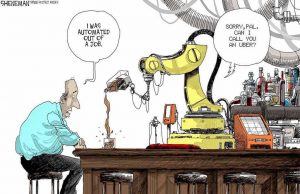
Cartoon about automation by Drew Sheneman

The Guardian of automation

Still from the video for All is Love by Bjork

I have been looking back over the links to news articles I’ve been collecting together about automation and I’ve been struck in particular by how the UK newspaper The Guardian has been running at least one story a week concerning automation in the last few months (see their “AI” category for examples, or the list below). Many are spurred from reports and press releases about particular things, so it’s not like they’re unique in pushing these narratives but it is striking, not least because lots of academics (that I follow anyway) share these stories on Twitter and it becomes a self-reinforcing, somewhat dystopian (‘rise of the robots’) narrative. I’m sure that we all adopt appropriate critical distance when reading such things but… there is a sense in which the ‘robots are coming for our jobs’ sort of arguments are being normalised and sedimented without a great deal of public critical reflection.

We might ask in response to the automation taking jobs arguments: who says? (quite often: management consultants and think tanks) and: how do they know? It seems to me that the answers to those questions are pertinent and probably less clear, and so interesting(!), than one might imagine.

Here’s a selection of the Graun’s recent automation coverage:

“Reconstructing the economy by rediscovering the value of knowledge” an interview with Bernard Stiegler [translation]

Bernard Stiegler being interviewed

In this short interview published inLibérationin March 2017, Bernard Stiegler reprises his argument for a contributory income, as is being trialled in the Plaine-Commune experiment. This is more or less the same argument and ideas presented in previous interviews I’ve translated, such as the Humanité interview, in which Stiegler attempts to provide the answer (albeit rather sweeping) to an incredibly gloomy prognosis of unemployment through full automation and peniary for the majority and with it the ever increasing loss of knowledge. Stiegler’ solution is the economic recognition of the value of work that currently is not captured economically. The device to achieve this is the contributory income, which unlike the Universal Basic Income seems to have a vague set of conditions attached.

The main idea here is Stiegler’s interesting distinction between what you get paid for and what you *do* – your employment [emploi] and your work [travail] – which gets to the heart of a whole host of debates (some that are quite long-running) around what we do that is or is not ‘work’ and how/whether or not it gets economically valued. It also builds on longstanding discussion about knowledge and care as a therapeutic relation [with each other, society, technology and so on] by Stiegler [see, for example, the Disbelief and Discredit series]. I think this may be useful for some of the critical attention to the gig economy and the ways in which people are responding to the current bout of automation anxiety/ ‘rise of the robots’ hand-wringing.

What is interesting to me about this interview is how little it moves on from Stiegler’s past articulations of this argument. There’s some sweeping generalisations about the extent and impact of automation based on questionable and contested sources (which I think does a disservice to Stiegler’s intellectual project). It is curious that the contributory income is still talked about in such vague terms. It is supposedly an active experiment in Plaine-Commune, so surely there’s a little more detail that could be elaborated? It would be interesting to see some more detailed discussion about this [sorry if I’ve missed it somewhere!].

The principle basis of the contributory income seems to be a fairly institutional (and as far as I can tell – peculiarly French) state programme for supporting workers in the creative industries. As in previous written work and interviews, Stiegler uses the idea of the “intermittents” or “intermittents du spectacle” to signify the idea of work that is subsidised through some form of state administered allowance, such as unemployment benefit. In France people working in the performing arts are entitled to claim for social security benefits designed for people without regular employment [as per the definition provided by Larousse online.]

So, here’s a fairly quick translation of the interview. As usual clarifications or queries about terms are in [square brackets]. I welcome comments or corrections!

Bernard Stiegler: “Reconstructing the economy by rediscovering the value of knowledge”

The philosopher Bernard Stiegler determines a difference between employment, which today is largely proletarianised, and work, which transforms the world through knowledge, and thus cultivates wealth.

Philosopher, Director of the Institute of Research and Innovation (IRI) of the Georges-Pompidou centre and founder of the Ars Industrialis association, Bernard Stiegler has for several years concerned himself with the effects of automation and robotisation. He has notably published The Automatic Society 1: The Future of Work (Fayard 2015) and In Disruption: How not to go mad?(Les liens qui libèrent, 2016). Today he is deeply engaged with a project which beings together nine towns in the Plaine-Commune territory, in Seine-Saint-Denis, to develop and experiment with a “contributive income” which would fund activities that go unrecognised but are useful to the community.

Amazon intends to gain a foothold in the groceries sector with cashier-less convenience stores, like in Seattle. Is automation destined to destroy jobs?

For 47% of jobs in the US, the response from the Massachusetts Institute of Technology is potentially “yes”. The remaining 53% cannot be automated because they are professional roles. They are not proletarianised: they are valued for their knowledge, which gives a capacity for initiative. What makes a profession is what is not reducible to computation, or rather reducible to the processing of data by algorithms. Not all jobs can therefore be automated. But this does not mean they are entirely removed from the processes of automation: everyone will be integrated into automatisms.

For you “employment” and “work” are not the same thing…

For two hundred and fifty years the model of industrial employment has been proletarianised employment, which has continued to grow. At first it was only manual workers, today it has largely exceeded the tertiary sector and affects nearly every task. More and more functions of supervision and even analysis have been proletarianised, for example by ‘big data’, doctors have been proletarianised – which means they are performing less and less of their profession. Proletarianised employment is sublimated by closed and immovable system. Work, on the contrary, transforms the world. So there is employment that does not produce work in this sense, rather the reverse: there is work outside of employment.

The big question for tomorrow is that of the link between automatisms, work outside of employment, and the new types of employment that enable the valroisation of work. The aim of contributive income is precisely to enable the reorganisation of the wealth produced by work in all its forms and cultivate, using the time freed up by automation, the forms of knowledge that the economy will increasingly demand in the anthropocene, this era in which the human has become a major geological factor. It is a case of surpassing the limits through an economy founded on the deproletarianisation of employment.

Optimistic discussions would like automation to free individuals, by eliminating arduous, alienating jobs. But today, it is mostly perceived as a threat…

It is a threat as long as we do not put in place the macroeconomic evolution required by deproletarianisation. The macroeconomy in which we have lived since the conservative revolution is a surreptitious, hypocritical and contradictory transformation of the Keynesian macroeconomics established in 1933. Contradictory because employment remains the central function of redistribution, whereas its reduction, and that of wages, drives the system as a whole towards insolvency.

Employment can no longer be the model for the redistribution of value. And this can no longer be limited to the relationship between use value and exchange value. Use value has become a value of usury, that is to say a disposable value that “trashes” the world – goods become waste, as do people, societies and cultures. The old American Way of Life no longer works: which is why Trump was elected… However if employment is destroyed it is necessary to redistribute not only purchasing power but also purchasing knowledge by reorganising all alternative employment and work.

In what way?

We must rebuild the economy by restoring value to knowledge. Proletarianised employment will disappear with full automation. We must create new kinds of employment, what we call irregular employment [emplois intermittents]. They will constitute intermittent periods in which instances of work that are not instances of employment are economically valued. The work itself will be remunerated by a contributory income allocated under conditions of intermittent employment, as is already the case in the creative industries.

In Intermittents et précaires [something like ~ Intermittent and precarious workers] Antonella Corsani and Maurizio Lazzarato that irregular workers in the creative industries [intermittents du spectacle] work mostly when they are not employed: employment is foremost a moment of implementing the knowledge that they cultivate outside of employment. We must encourage the winning back of knowledge, in every area [of work]. This implies on the one hand to evolve the relationship between individuals and education systems as well as professional associations lifelong learning and so on.

And, on the other hand, to precisely distinguish between information and knowledge. Automated systems have transformed knowledge into information. But this is only dead knowledge. To overcome the anthropocene we must resuscitate knowledge by inteligently practising information – through alternative periods of work and employment. Only in this way can we re-stabilise the economy, where the problems induced by climate change, for example, are only just beginning, and where vital constraint [contrainte vitale] is going to be exercised more and more as a criterion of value. It is a long term objective… But today, what should we do? Nobody can pull a rabbit out of their hat to solve the problem. We must therefore experiment. This is what we are doing with the Plaine-Commune project in Seine-Saint-Denis, which in particular aims to gradually introduce a contributory income according to the model of irregular work [l’intermittence]. With the support of the Fondation de France, we are working with residents in partnership with the Établissement public territorial [something like a unitary authority area?], Orange, Dassault Systèmes and the Maison des sciences de l’homme Paris-Nord [a local Higher Education Institution]–and through them the universities Paris 8 and Paris 13– in dialogue with small and medium enterprises, associations, cooperatives and mutual associations [les acteurs de l’économie sociale et solidaire], artists, cultural institutions. It’s a ten-year project.


CFP: RGS-IBG 2018 – New geographies of automation?

Still from the video for All is Love by Bjork

New Geographies of Automation?
Please send submissions (titles, abstracts (250 words) and author details) to me by 31st January 2018.

This session invites papers that respond to the variously promoted or forewarned explosion of automation and the apparent transformations of culture, economy, labour and workplace we are told will ensue. Papers are sought from any and all branches of geography to investigate what contemporary geographies of automation may or should look like, how we are/could/should be doing them and to perhaps question the grandiose rhetoric of alarmism/boosterism of current debates.

Automation has been the recent focus of hyperbolic commentary in print and online. We are warned by some of the ‘rise of the robots’ (Ford 2015) sweeping away whole sectors of employment or by others exhorted to strive towards ‘fully automated luxury communism’ (Srnicek & Williams 2015). Beyond the hyperbole it is possible to trace longer lineages of geographies of automation. Studies of the industrialisation of agriculture (Goodman & Watts 1997); Fordist/post-Fordist systems of production (Harvey 1989); shifts to globalisation (Dicken 1986) and (some) post-industrial societies (Clement & Myles 1994) stand testament to the range of work that has addressed the theme of automation in geography. Indeed, in the last decade geographers have begun to draw out specific geographical contributions to debates surrounding ‘digital’ automation. From a closer attention to labour and workplaces (Bissell & Del Casino 2017) to the interrogation of automation in governance and surveillance across a range of scales (Amoore 2013, Kitchin & Dodge 2011) – the processes and experiences of automation have (again) become a significant concern for geographical research.

The invitation of this session is for papers that consider contemporary discussions, movements and propositions of automation from a geographical perspective (in the broadest sense).

Examples of topics might include (but are certainly not limited to):

  • AI, machine learning and cognitive work
  • Automation and bias
  • Autonomy, agency and law-making
  • Automated governance
  • Boosterism and tales of automation
  • The economics of automation
  • Material cultures of robots
  • Mobilities and materialities of ‘driver-less’ vehicles
  • Robotics and the everyday
  • Techno-bodily relations of automation
  • Working with robots

Cartoon about automation by Drew Sheneman