Embarrassing ourselves… translations and mental flounderings

A glitched image of a typewriter

A colleague shared this fascinating and perhaps difficult piece in the LARB by the highly regarded Derrida scholar Geoffrey Bennington on the publication of the anniversary edition and revised translation of Of Grammatology by Gayatri Chakravorty Spivak, with a new ‘Introduction’ by Judith Butler. I really encourage anyone with an interest in Derrida’s work, in language and in translation to read this article, I think it’s really quite something.

What is perhaps extraordinary about Bennington’s incisive analysis of the new edition is the acute nature of the problems he reveals with translating Derrida’s insight, which Bennington asserts: “is quite simple, yet in its very simplicity hard to grasp”. For “il n’y a pas de hors-textes“ is just as apposite to the issues Bennington highlights as it is to the understanding of Derrida’s wider project.

I won’t attempt to précis what is an erudite and rigorous article that also necessarily confronts some perceived (it appears fairly) problems and/or errors in understanding on the parts of Butler and Spivak. In this regard, it’s also worth paying attention to the footnotes…

Reblog> Lesser known, or avoided, ‘truths’ of academic life

A glitched image of a typewriter

Stuart Elden points to a piece by Daniel McCormack in the Chronicle of Higher Education entitled “Some lesser-known truths about academe” which raises some interesting issues for consideration. I think the below in particular resonated with me…

Daniel McCormack, ‘Some Lesser-Known Truths About Academe‘ in The Chronicle of Higher Education. While this is a US focused piece, there is still much in here to consider for people in, or considering a career in higher education elsewhere. The writer is a post-doc in international politics who has decided to leave the sector.


Asking a professor whether you should pursue a Ph.D. is a little like asking The Rock – aka Dwayne Douglas Johnson, the world’s highest-paid actor last year – whether you should become an actor.

Once you enter a doctoral program, the main problem isn’t necessarily that you can’t finish. I know very few people who left graduate school because they weren’t smart enough to finish – it happens, but it’s rare. More often people leave because they just decide getting a Ph.D. isn’t for them. The truth is: It’s very difficult to understand what academic life is like until you actually try it, and lots of people try it and decide it’s not a good fit.

This, then, is why you should be wary of any advice you receive from professors about graduate school: It’s coming entirely from people who decided that academe was a good fit for them.

Radical Philosophy 2.0

via Stuart Elden.

An encouraging announcement on the Radical Philosophy website that the journal will return. I’ve copied a bit below but read the whole statement here.

With its 2017 re-launch, Radical Philosophy will remain, as it has always been, a collectively edited, self-published and self-produced journal – but one with, we hope, a renewed editorial energy and a more radical, collaborative openness (if with no less philosophical rigour or critical bite). Among the things that our readers can look forward to, starting with issue 2.01, is a redesigned website, built by our new in-house engineering collective, through which we will be publishing all our content in a freely available form, as well as a redesigned print version of the journal. At the same time, from January 2018 the archive of the last forty-five years of Radical Philosophy will be made fully open with downloadable pdfs of everything that we have published since 1972.

Call for Papers: “Charting trans and posthumanist imaginaries in future-making”

Rachael in the film Blade Runner

via SERRC.

Call for Papers: “Charting trans and posthumanist imaginaries in future-making”
(see Panel 53: http://sipsheff17.group.shef.ac.uk/index.php?option=24)Science in Public Conference, University of Sheffield 10th-12th July, 2017
Emilie Whitaker, University of Salford, e.m.whitaker@salford.ac.ukThe call for papers closes April 18, 2017.

Posthumanism and transhumanism are two emerging cultural movements that use recent developments in science and technology to challenge, in rather different ways, conventional conceptions of the human condition. Originally seen as more aligned with science fiction than science fact, they now straddle the divide, helped along with increasing media attention and capital investment. Whilst posthumanism continues to be theoretically explored within the social sciences and humanities, transhumanism remains an outlier to the academy. This is despite developments in science and technology which decouple traditional understandings of human/non- human action, agency, labour and capital. In this respect, both trans and posthumanism come very well adapted to our ‘post-truth’ times. We welcome submissions on this general theme, including the following topics:

  • Post- vs trans- humanist projections of the future of humanity, both utopic and dystopic
  • The appeal to post- and trans- humanist ideas and images in the general culture
  • Scientific bases – or not – for post- and trans- humanist knowledge claims
  •  The influence – or not – of post- and trans- humanist views on public policy
  • The place of capitalism in post- and trans- humanist imaginaries
  • The place of post- and trans- humanism in the academy: Do they bridge the ‘Ëœtwo cultures’?
  • How trans and post humanism conceive of the place of democracy in guiding the future
  • Exploration of how science communication invokes, borrows or rejects trans and posthumanist tropes.

We welcome ‘alternative’ contributions – for example, short pieces of prose or extracts of speculative near-future fiction – as well as empirically-based findings papers. We are also particularly keen to support early career researchers.

Academia.edu as an instrument of analytical discipline

Saw a paper, shared (perhaps ironically) on ResearchGate, concerning Academia.edu and the ways it can be seen as a means of self-discipline around ‘impact’, self-promotion and how these may relate reward and recognition. May be of interest to some…

“Facebook for Academics”: The Convergence of Self-Branding and Social Media Logic on Academia.edu

Brooke Erin Duffy and Jefferson D. Pooley.

Given widespread labor market precarity, contemporary workers–especially those in the media and creative industries–are increasingly called upon to brand themselves. Academics, we contend, are experiencing a parallel pressure to engage in self-promotional practices, particularly as universities become progressively more market-driven. Academia.edu, a paper-sharing social network that has been informally dubbed “Facebook for academics,” has grown rapidly by adopting many of the conventions of popular social media sites. This article argues that the astonishing uptake of Academia.edu both reflects and amplifies the self-branding imperatives that many academics experience. Drawing on Academia.edu’s corporate history, design decisions, and marketing communications, we analyze two overlapping facets of Academia.edu: (1) the site’s business model and (2) its social affordances. We contend that the company, like mainstream social networks, harnesses the content and immaterial labor of users under the guise of “sharing.” In addition, the site’s fixation on analytics reinforces a culture of incessant self-monitoring–one already encouraged by university policies to measure quantifiable impact. We conclude by identifying the stakes for academic life, when entrepreneurial and self-promotional demands brush up against the university’s knowledge-making ideals.

‘Ways of Being in a Digital Age’ scoping

I’ve only just caught on here, but the ESRC’s “Ways of Being in a Digital Age” scoping review, for their new theme of the same name, has been awarded to the Liverpool Institute of Cultural Capital (a collaboration between Liverpool and Liverpool John Moores) in a partnership with 17 other institutions (a core of eight in the UK apparently). They say:

The project will undertake a Delphi review of expert opinion and a systematic literature review and overall synthesis to identify gaps in current research.

The project will also run a programme of events to build and extend networks among the academic community, other stakeholders and potential funding partners.

There’s a website, so you can read more there…

Academic emotional labour

We are getting to the business end of our second term at my institution, when our final year students submit their dissertations, and we shift register looking towards field trips (our 2nd years go this weekend), exams and transitions – including of course graduation. This and some rather troubling conversations and various meetings through the term have got me thinking about the volume of emotional labour some of us perform. I say ‘some of us’ because, as with any organisation, some colleagues variously avoid it due to a range of reasons. Thus, some are faced with quite a bit of such work. Maybe these observations are a bit naive but this is where I currently find myself…

At the beginning of this academic year I ceased to be “Early Career”, in spite having only recently (3 years ago) getting back into geography – I spent three years (overlapping writing-up) as a post doc outside of the discipline. In the three years I’ve been in my current position, and beginning to learn how to teach, I have been surprised and at times overwhelmed by what others have labelled an ‘epidemic’ of mental health issues in universities. The complicated entanglements of anxiety and depression that a significant number of our students are contending with are worrying and at times heart-breaking. Some terms can be measured in the number of boxes of tissues I buy (not only for the students).

My experience has been that you get no training for this and, if you have not been an undergraduate for some time, the level of the issues our students are experiencing may feel utterly alarming and mystifying. I remember my time as an undergrad as pretty care-free and fun. It really saddens me how many of my tutees may well remember their time in a very different and perhaps largely negative way. Likewise, many of us in academia are wrestling with personal mental health issues and to be confronted with those of the students may well be very challenging.

So, what do I/you do, with no training and perhaps little experience of such things? Well, this is not meant to be advice but it gets me to the point I want to make: First things first – we are not counsellors. We are not trained to deal with these issues and can possibly make things worse ont better. Show empathy and sympathy, of course, but my strategy has also been to show respect for the student by explaining as tactfully as possible that they need to seek help from what we call “wellbeing services” and/or their GP. Many have already done this. A surprising number are already medicated.

So, personally, I end up listening, trying to discern the academic/administrative measures I have at my disposal that I can put in place to support the student’s needs and identify when I need help. Sometimes you get through the meeting, close the door and may have to have a cry yourself. Many colleagues will recognise this pattern and I’m not trying to dispense advice here but it does say something about work.

Many of us have a calculated workload, perhaps in a digitally accessible workload model (which some colleagues might suggest inculcates us into internalising the logic of institutional discipline for ourselves 😉 – if you look in that workload allocation the chances are there is figure somewhere that figures in office hours, personal tutor duties and so on. Often, the students you may be ‘supporting’ are not personal tutees but dissertation tutees as well, which is a different workload allocation – but probably not a big number. For some of us this workload figure may be accurate. For others this is a mere fraction of the workload experienced.

It would be easy to retort – “well, don’t take on the work”, don’t ‘pander’ to the students and stick rigidly to the time set out. Of course, with some authority (seniority, grant income buy-out etc.) you probably can do this. However, increasingly there is institutional pressure to improve metrics around student experience, to demonstrate the institution is ‘supportive’. As ‘frontline’ staff, academic tutors can bear a significant amount of responsibility for this.

So, this (potential) labour can be a catch-22: you do it, support students, deal with the related admin and your own emotional wellbeing and it may potentially affect other parts of your work that you value (i.e. research/writing time); or: do the minimum/ don’t do it and the work will be displaced to your colleagues (I don’t think it simply goes away) and you may risk being admonished for damaging the ‘student experience’.

Increasingly, such work is being pooled into particular roles – “senior tutors” of one kind or another: for a year group etc. Likewise, the extraordinary growth in applications for mitigation and the administrative side of the academic support for students with wellbeing issues involves a huge increase in work for our administrative colleagues – who are, in many institutions, increasingly embattled, disenfranchised and pulled in other directions.

It seems to me that the status quo is untenable. We cannot go on, we must go on. According to colleagues researching school-level education and those managing admissions, some students are arriving at university with these mental health issues already at an advanced stage, which seems to me a damning indictment of the ethos of the culture of our education system but also suggests we may need much more concerted responses to managing wellbeing from day one, somehow.

I don’t have the answers, but it seems to me that if we continue like this many of us face an ever-increasing student support workload that carries significant emotional cost. I try to remain positive – it is possible to put measures in place and there are dedicated colleagues in many institutions who are putting in place systems and taking difficult but necessary decisions about how to do this work. Nevertheless, I never imagined this would be such a big part of my job.

Public scholarship, or: profs should edit wikipedia

Over on Savage Minds Rex Golub has written a compelling provocation about the places of ‘public anthropology’ (which I think could probably be broadened to ‘public scholarship). He points out that it’s all very well writing letters to venerable broad sheet newspapers but that doesn’t necessarily achieve much. Instead, Professors (or academics more broadly) might better spend their time editing wikipedia pages because that is the prime site of the public sourcing, and contestation, of knowledge. I think its quite a compelling argument… not least when thinking about the current trend and push for demonstrating “impact”. Isn’t it quite “impactful” to be the person who attempts to ensure that the most widely used source of knowledge on a given topic is rigorously written/edited? There’s no academic brownie points in that though… no promotions or awards/rewards are going to be given on that basis!

What do you think?

…my issue is that anthropologists are doing public anthropology in the wrong places and in the wrong way because they don’t understand how social media works today and are seduced by an out-moded model of cultural capital that makes them feels heroic, but it isn’t actually efficacious.

The new public anthropology, on the other hand, is not glamorous, will not make you famous, can be emotionally uncomfortable, involves working in new and unfamiliar genres, and can change the world. A good example of this sort of public anthropology is editing Wikipedia

Wikipedia is ground zero for knowledge in the world today. Everyone uses it to look stuff up quickly. Everyone. Some people may take it more seriously than others, but because its content can be reused on other sites, what wikipedia says spreads everywhere. For better or for worse – I’d say for better – it’s the public record of the state of human knowledge at the moment. Unlike letters to the New York Times, Wikipedia gets read. Constantly. When you contribute to Wikipedia, you are concretely and immediately altering what the world knows about your topic of expertise.

Disciplining theory(?) – post-phenomenology(dot-org)

The website postphenomenology.org is an interesting resource, especially the bibliography compiled there (which perhaps implies an canon?), which got me returning to some thoughts I’ve had about how particular kinds of theory ‘travel’, how they co-opted and then, perhaps, disciplined. The website mentioned above is clearly, if not wholly explicitly, positioned within that interesting, apparently interdisciplinary, area of Science and Technology Studies – and one would think, then, that the reference list would take in a range of disciplinary debates, demonstrating how the ideas freighted by “post-phenomenology” have, perhaps, contributed to an interdisciplinary debate. Instead, it seem to me, the reference list demonstrates something like a kind of disciplining, whereby the journals and authors represented sit within what is de facto a particular field, potentially having not an open, interdisciplinary, debate but rather a fairly insular one. I don’t intend that observation as a slight to the compilers of what is a useful resource, I’m just interested in how the movement or spread of ideas can work – or, as Said says, how theory travels.

This cannot be uncommon, nor is it necessarily a normatively ‘bad’ thing. Recently I took part in a fascinating workshop on the generations of Southern theory – in relation to urbanism and in particular in relation to how this has historically played out through the empirical lens and academic institutions of South Africa. My colleague Clive Barnett highlighted that that set of debates has happened slightly differently (or perhaps not at all) in different but cognate disciplinary contexts. In the wake of Said and various others, Clive has, of course, written about such things – as have many others!

So, what should ‘post-phenomenological’ geographers do? Probably just carry on… One could try and forge the connections, but it of course takes effort and time etc etc. In the end, nobody ‘owns’ concepts and the theory will develop within different disciplinary contexts, albeit possibly siloed into particular journals and conferences. I suppose, it goes to show that when conversations become more than superficially interdisciplinary, taking in different points of view and contexts, it’s probably a precious moment…

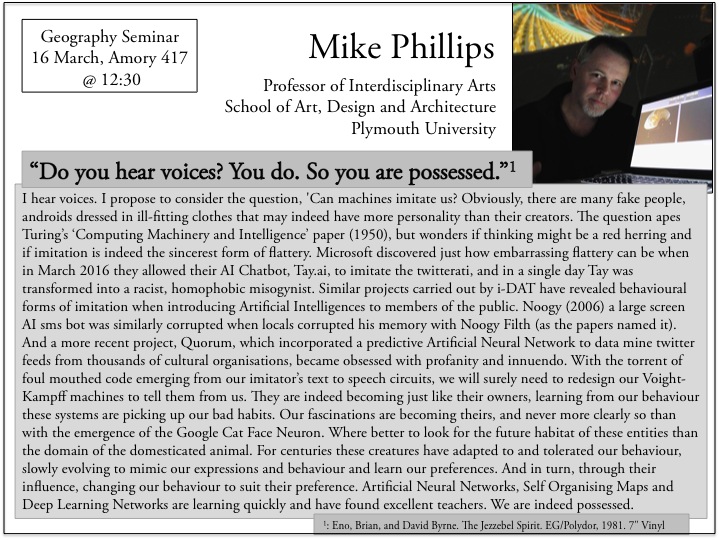
“Do you hear voices? You do. So you are possessed” – @mikedotphillips talk @exetergeography

I’m really pleased to share that Prof. Mike Phillips (i-DAT, Plymouth) will be speaking  next week as part of the Exeter Geography seminar series. Mike is a founder of the Institute of Digital Art and Technology and one of the founders of the undergraduate programme I studied MediaLab Arts, which is now called  Digital Media Design.

Details: Thursday 16th March, 12:30: Amory 417. All welcome!