
Financialisation of UK Higher Ed. & functional stupidity

The higher education sector across the anglophone parts of the world, amongst others, is in continuing crisis. At present that crisis is most visible in the UK through the proposed, and implemented, redundancy programmes, real-terms cuts to overall investment in research and ongoing (at present – annual) national level pay disputes between the largest academic trade union and the employers group.

As we lurch into the latest iteration or flavour of that crisis – the growth of (highly visible) redundancy programmes at Russell Group universities, and ongoing cuts at all universities nationwide, I have been involved in discussions that often return to the phenomenal critical work that arose throughout the 2018 USS pensions dispute, between academic staff in the UCU and the employers bodies Universities UK and the University and Colleges Employers Association, see especially USSBriefs. Re-reading the Brief written by Clive Barnett on the financialisation of UK higher education I was struck by the resonance of his final list of whole scale changes to higher education, not only in the UK, with the ongoing crisis today:

1. The financialisation of higher education is bringing about a sea-change in how the public purpose of higher education — and the role of students, teaching and research within it — are conceived.

2. The dispute over pensions discloses the integral relationship between the adoption of particular models of university financing and the consolidation of unaccountable systems of centralised and hierarchical management.

3. The central theme that connects the pensions dispute, capital investment programmes, and routine experiences of mismanagement in universities is risk: how it is conceptualised; how it should be measured and forecast; and whether and how it should be shared.
4. It is important to differentiate between the argument that higher education is currently an imperfectly functioning market that could be made more perfect, and the argument that it might not be a good idea to imagine it either should or could be in the first place.

The financialisation of Higher Education and the USS dispute – USSBriefs #16, Clive Barnett

We can substitute ‘dispute over pensions’ or ‘pensions dispute’ for ‘staffing cuts’:

  1. The financialisation of higher education is bringing about a sea-change in how the public purpose of higher education — and the role of students, teaching and research within it — are conceived.
  2. The dispute over staffing cuts discloses the integral relationship between the adoption of particular models of university financing and the consolidation of unaccountable systems of centralised and hierarchical management.
  3. The central theme that connects the staffing cuts, capital investment programmes, and routine experiences of mismanagement in universities is risk: how it is conceptualised; how it should be measured and forecast; and whether and how it should be shared.
  4. It is important to differentiate between the argument that higher education is currently an imperfectly functioning market that could be made more perfect, and the argument that it might not be a good idea to imagine it either should or could be in the first place.

Clive’s link to Stephen Toope the Cambridge VC’s piece is instructive, it clearly shows the distance between, broadly speaking, liberal values of academic freedom & the wider ‘positive externalities’ of higher education’s value and the pseudo-marketisation and narrow assetisation of universities and especially their students. In 2018 Toope observed:

for a generation now, politicians of all stripes have talked as if UK universities are broken, and hence in need of “market discipline”. They talk as if our students, smart and energetic people, are in need of protection. This is an own goal.

We are just beginning yet another review covering higher education that fails to get to the heart of concerns around the role of universities.  The focus should be on what values our society expects to see reflected in our universities, not just value for money. 

I suggest this argument remains just as pertinent (if not more) today, in 2026, as in 2018. It also illustrates, I think, the degrees to which the imagination of UK HE as a sector, a workforce and as a ‘good’ has been captured by management consultancies, selling ‘solutions’ to university leaders and government. This form of groupthink of management consultancy ‘solutionism’ to the knotty problems of higher education funding adopted by a self-selecting, and self-perpetuating, class of university ‘leaders’ (all steadily increasing their own salaries and aggrandising their titles, as ‘President’ for example) exemplifies what André Spicer calls ‘functional stupidity‘. indeed, many of the examples that come through in Spicer Alvesson’s wonderful book – The Stupidity Paradox – are directly observable in the actions and behaviour of university leaders, including (list adapted from here):

  • Executives who more interested in impressive power point shows than systematic analysis.
  • University leadership development initiatives which would not be out of place in a new age commune.
  • Universities employing technology firms more interest in keeping a positive tone than addressing real problems.
  • University leadership focused more on developing impressive strategies than educating students.
  • Central university executive departments obsessed with branding when all that counted was the price – see, for example, the recent rebranding exercises of many universities.
  • Universities throwing millions into ‘change exercises’ and then when they failed do exactly the same thing again and again

‘Functional stupidity’ is the condition of apparently ‘smart’ people being discouraged from critical thought and reflection. Spicer and Alvesson argue that these forms of stupidity are a paradox – it is perhaps ‘normal’ to think of stupidity as work, especially in institutions such as universities, as ‘bad’, and yet it can prove to be successful or useful. The growth of the university sector in the UK, for example, might demonstrate the successes of particular kinds of ‘functional stupidity’. Even so, and as Toope argues above, there comes a time when that functional stupidity needs to be urgently challenged. While the cuts to academic staff pensions were, largely, reversed in the pensions dispute, the wider trends of financialisation of higher education and the functional stupidity that, I argue, undergirds its remains. It is becoming ever more an existential matter for higher education in the UK.

What “counts” cannot always be counted, at least in the ways these forms of functional stupidity dictate. As colleagues in the Centre for Social Mobility at Exeter have so clearly articulated in a post for the Higher Education Policy Institute (here):

University leadership is stewardship as well as financial management: holding together measurable outputs and immeasurable goods, institutional sustainability and public purpose. While it may seem prudent to cut while institutions still have manoeuvring space rather than when that is the only choice, there is not only danger that universities cut too much; it is that they cut the things they do not know how to value – and that cannot be easily restored once lost.

Universities need to count carefully. But they must also remember what cannot be counted.

if those invested in universities, their students, staff and collaborators/partners, are not able to convince wider society to have the more fundamental conversation about what society wants from higher education, including, I would strongly argue, a serious rethink of tertiary level vocational education and training, then we risk losing the culture, expertise, institutions, vitality and so much more that universities and colleges contribute and nourish in society more than ever.

The urgent task for all who believe in the power of education as a social good is to wrestle back the imagination of what our society can and should do for and with higher education. It is not, yet, too late – but we are fast running out of time and capacity to avoid irreversible damage.

Career Development Research Fellowships -Oxford

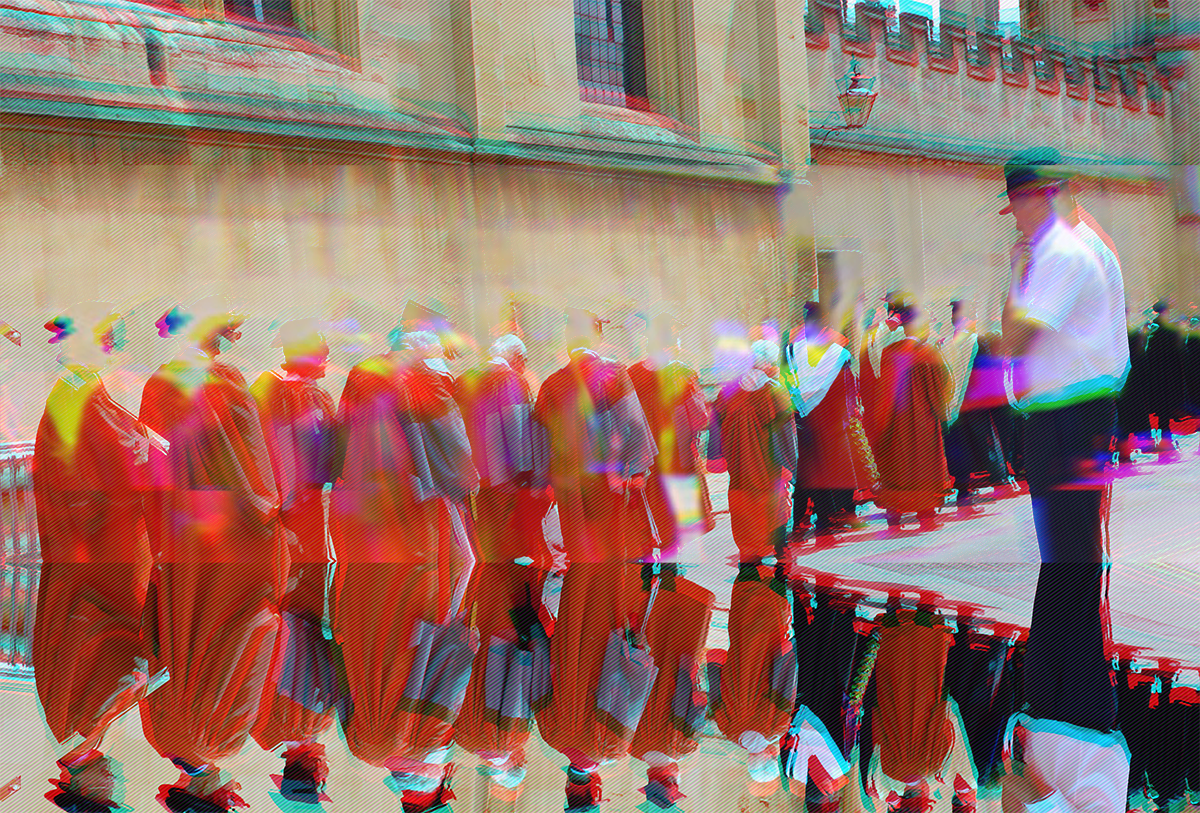
A glitched image of an academic procession outside an Oxford college

Gillian Rose recently shared these Career Development Research Fellowships on BlueSky and I thought I would share them here too. One of the specialisms encouraged in Human Geography.

Career Development Research Fellowships for full-time research offered by St John’s College to early career researchers who have recently completed or are close to completion of a doctorate (and will have submitted their thesis no later than three months before their start date of this post), or who have recently been awarded a doctorate. They provide an unrivalled opportunity to establish a research profile as a member of a collegiate community.

More details here.

Three Postdoctoral Research Positions

 Karin Schwiter at the University of Zurich recently shared three full-time postdoc or senior researcher positions in labour geography at the University of Zurich (for 4 years). They say they are: “looking for people excited by the possibility of doing a theoretically grounded and societally relevant research project that engages with underemployed workers in the UK, the Netherlands and Switzerland”. The job advert can be found here:

https://jobs.uzh.ch/job-vacancies/postdoc-or-senior-researcher-in-labour-geography/dca045f2-71df-47bc-9769-015b1986be53

Forbidden feelings. Or: things you don’t see on Linked In. 4 June.

As we come to the end of an academic year, emerge from underneath the ever growing heap of administration that tumbles on top of many university staff at this time of year, we can be, understandably, reflective. I have a few things ending, or that have ended, this academic year. A couple of milestones too.

My first time being a Principle Investigator came to an end at the beginning of the academic year – a role I had not expected to take on, yet, which was rewarding but hard. I became ‘PI’ because my colleague, and friend, Clive Barnett suddenly and unexpectedly died at the end of 2021. Through the Algorithmic Politics after Brexit project I learned about digital government in the UK, about many things I didn’t know about Brexit, and I learned how (not) to manage. One of my proudest moments associated with the project (though not really anything I did) was my friend and colleague Kuba Jablonowski’s appointment to a permanent Lectureship at Bristol – a really wonderful (‘unofficial’) outcome for the project and one I am certain Clive would have celebrated too.

My first peer reviewed article came out, at least as ‘Early Online’ anyway, since 2018. The paper is part of a theme issue in Environment and Planning D: Society & Space that originated in an event in Singapore convened by Weiqiang Lin, Peter Adey, Tina Harris and Dylan Brady about automation in the time of COVID-19. Somewhat ironically, I gave that original paper online, rather than in-person, because I actually had coronavirus (I’d love to finally go to Singapore one day). I took a long time getting that article over the finish line, with wonderful support from Weiqiang and Dylan in Singapore, as well as Federico Caprotti and Sean Carter at Exeter, because of the mental health issues that had influenced the preceding gap in publications.

This is absolutely not intended as a ‘poor me’ post. I am very sorry if I have got the tone wrong such that it comes across that way. Rather, I wanted to reflect on the things that happen in life that dictate or influence the pattern of a career, which are (for all sorts of reasons) not visible on a CV, or LinkedIn, or ORCID, or the other quasi- ‘official’ ways we present ourselves professionally. Sometimes it can feel like real ‘feelings’, not the humble bragging of social media, are forbidden. Sometimes a peculiar form of nihilism is mistaken for stoicism. We can seem to only see the prosaic sharing of ‘delighted’ announcements and not the fuller story.

Without wishing to over-share, I have a story that sits behind the lack of writing. I lost my father in 2018 after a long battle with non-alcohol-related liver disease. He had survived various treatments, a liver transplant and many setbacks. With two children born during the time of his illness, my wife and I both found it immensely challenging. Very soon after his death we contended with another family illness and bereavement in my wife’s family. The pandemic happened and all of us clapped, stayed indoors, eat out, went back indoors, knocked elbows, met on Teams and Zoom. Clive passed away. My former head of department and commuting companion (on trains to/from Bristol) Henry Buller also, very sadly, passed away due to cancer. Life happens. I didn’t write. I felt I couldn’t.

Colleagues can be very kind. Even those you don’t know well. I had a bad habit, in the days of Twitter (as was), of expressing my feelings in an un-guarded way and on more than one occasion – perhaps unprofessionally – I said I felt I wasn’t coping or that I was watching my career fizzle out. I received responses from colleagues offering support. I received some informal mentoring from one of them. Academic community matters. While there are, undoubtedly, more helpful and more professional ways of seeking help, I definitely recommend doing so.

I applied for a job, at a different university, a couple of years ago. In my CV and covering letter I made some reference to the gaps in my publication record and tried to offer a positive and ambitious plan for the future, rather than dwell on the past. I was not shortlisted. I requested feedback and was told that I needed to be explicit in providing reasons for the gaps, to explain why I had become PI after the project had already started. more recently, I applied for promotion and tried to learn from the feedback – to explain, in a professional manner, the gaps and to demonstrate my ambition. I received constructive feedback that I hope will help me work towards career advancement in the future.

There has been plenty of commentary about the perceived artificialness of self-promotion on social media and on professional profiles. There are LinkedIn jargon generators, a simple search brings up a lot of them, there are satirical commentaries and videos about self-promotion. My own bot, GeoCritBot (formerly of Twitter, now on BlueSky) was an attempt to satirise both the forms of self-promotion and also the kinds of academic jargon that we tend to use. It is, perhaps, all-too-easy to be cynical and even snide about such things – but I think I/we need to try to resist that temptation.

All of us, of course, have stories broader than the one told on a CV, or on LinkedIn. Some people succeed in academia even in profoundly difficult circumstances. Some people leave, sometimes without choosing to do so. Some of us are not, and don’t necessarily want to be, the stellar Professor. Most of us contend with ‘rejection’ regularly – for publication, for grants and, perhaps, for jobs. Some of us don’t embody the ‘vocation’ of academia, perhaps see it as ‘work’. Life events happen, we all have to deal with them. There can be, perhaps has to be, ways of telling some parts of these wider stories as work lives are complicated by the rest-of-life happening. I am not advocating for over-sharing, I am far too British(!), nor for radical transparency, although I do believe in ‘open’ research. I am not really able to offer any neat solution. I want to reflect on reflecting – to think about how not to feel negative about perceived fallings-short. Comparison can be the thief of fulfilment. ‘We’/’I’ can’t be ‘them’, but we can try to find ways to be a good ‘us’/’me’.

Celebrate your successes. Find ways to tell the story of adversity professionally and without underselling yourself. Celebrate other people’s successes too, however you feel comfortable about doing so (in a kind and professional manner). We can’t know some of the challenges people go through, often – we shouldn’t. However, even in a system that rewards individualism, that still reveres the ‘big name’, we can and should look for ways to advocate for and support one another, to work together, where we can. Solidarity is important.

Lastly, even when everything is hard, hold on to the little wins.

Forbidden feelings
A wha ya, a wha ya deal with

Forbidden Feelingz – Nia Archives.

Geography remains

Professor Peter Haggett

As professionals we claim only that we are privileged to devote ourselves to the field of geography. Neither we nor our academic predecessors discovered the field, nor have we been the only ones who have tilled it … We have never been more than a few of those who contributed to the growth of geographic knowledge. The interest is immemorial and universal; should we disappear, the field will remain.

Carl Ortwin Sauer, The Education of a Geographer (1956)

I am late to note the passing of Prof. Peter Haggett, a significant figure both at the University of Bristol and in Anglophone geography in the 20th century. There is an obituary for him on the University of Bristol website. I was a postgraduate ‘demonstrator’ teaching undergraduates spatial statistics in the Haggett laboratory throughout my PhD years at Bristol, one of the homes of the ‘quantitative revolution’ – not least because of Prof. Haggett being there. The above quote appears in the opening pages of Haggett’s (1990) book ‘The Geographer’s Art’ and seems appropriate to quote in recognising the significant contribution he made to the field. I have one book fro the significant library he slowly disposed of in his years as Emeritus professor, on the geography of telecommunications, taken from a table full of volumes that spanned a really diverse range of topics. I saw him only once, in a lecture in the re-inauguration of the Peel lecture theatre of the geography building, the oldest building of the university of Bristol. He was a modest man, keen to celebrate the work of others (in the lecture it was the second Chair of Geography at Bristol R.F. Peel) and alive to, and respectful of, the variety of standpoints within the discipline.

Kevin Cox, on his blog, offers some reflections on the extent of the ‘disruption’ the spatial science that Haggett pioneered was for our discipline and his words are very much worth reading*. Finally, in ‘The Geographer’s Art’, Haggett himself claimed that while ‘the study of geography at university will give scientific insight, provides skills [and] a philosophical framework for environmental and global problems’ that he believed

‘[geography’s] most precious gift is none of these. Geographical skills can enrich all the remaining years of one’s life so that what is seen is understood and appreciated’.

Geography remains. So, I hope, the memory of Prof Haggett’s contribution does as well.

* Incidentally, Cox’s book Making Human Geography is an excellent overview of the development of geography as a (modern) academic discipline.

Four-Year Postdoc Position on Contemporary US/Anglophone Science Fictions at the University of Basel 

A glitched image of lots of books all lying open and facing up towards the camera

This really interesting job opportunity appeared in my BlueSky feed today, so I am posting it in case it is of interest to anyone who reads this…

The full job outline is on the University of Basel website here.

Starting Date: 1.10.2025

Funded by the Claudine und Hans-Heiner Zaeslin-Bustany Foundation, the four-year project “Anglo Genres for Atlantic Futures: Contemporary Eco-Fictions, Campus Novels, and Science Fictions” is directed by Prof. Philipp Schweighauser. It encompasses two PhD subprojects working on eco-fictions and campus novels, respectively, and the postdoc subproject on contemporary US (and possibly other Anglophone) science fictions advertised here. The position will be filled by October 1, 2025.

Your position

The project as a whole is dedicated to exploring contemporary works in three popular literary genres that have emerged in the Anglophone world and deal with central social issues of today’s knowledge societies on both sides of the Atlantic: eco-fictions, campus novels and science fictions. Their themes include climate change, species extinction, and environmental pollution (eco-fictions); anti-intellectualism and the role of universities in knowledge societies (campus novels); and artificial intelligence, genetic engineering and (digital) surveillance (science fictions). Since these are popular texts that deal with urgent questions of American and European societies in the 21st century, the genuinely literary question of the social function of contemporary literature arises. Three of the most convincing answers to the question of the cognitive and social functions of fiction come from Victor Shklovsky (enstrangement/defamiliarization), Wolfgang Iser (literary anthropology), and Jane Tompkins (cultural work). Science fiction studies is a growing field that has generated stimulating intellectual interventions by thinkers such as Darko Suvin (cognitive estrangement), Fredric Jameson (the utopian vocation), Tom Moylan (utopia, dystopia, anti-utopia), and others. In this line, the subproject on science fictions will offer perspectives on the social implications of both fiction and technological innovation.

Your profile

Applicants have a PhD in English, American Literature, or related fields, and a number of publications. Please submit a proposal for your own four-year research subproject on contemporary US/Anglophone science fiction. These may be restricted to literature, but may also involve other media such as movies and TV series. Other theoretical frameworks than those mentioned above and other thematic foci of the fictions under consideration are, of course, welcome. The successful applicant will be expected to either write their second book or eight essays in peer-reviewed journals or essay collections-or a combination of the two.

Geography blogs?

A glitched image of a typewriter

Who still blogs? I guess I do… If nothing else to share things that seem interesting, which appears to be a strategy a few people employ. I can see from various WordPress subscriptions that I have that some colleagues still do. Maybe the moment passed (some time ago?!) but I can’t help feeling that there is still something worthwhile in writing in this sort of format – a sort of thinking out loud. My colleague Clive Barnett used to do this fantastically well on his site Pop Theory, which I am hopeful we will get back available online soon.

My question is an honest one though – who is blogging? Or writing a newsletter, which seems to have been a thing, but similarly died down a bit(?) I want to read ‘academic’ blogs or newsletters (or anything like that!) again, I think. Please get in touch with any recommendations.

“Geography” blogs that I currently follow (and people have posted to in the last 6 months) are:

As you can see there’s a few on substack now , which is an interesting platform – but I am not totally sure about (mostly due to the model of subscription), where once it was almost all WordPress. While I have focused on ‘geographers’ here that’s only because I had a list and I mostly rely on email subscriptions and the WordPress app, I used to use an RSS reader but fell out of the habit.

Who/what am I missing? Whose ‘blog’ or newsletter do you read that you enjoy? Please let me know!

Finally letting go of Twitter

Twitter

This is by no means a ‘hot’ take, if anything it is a moderately cool one. I finally deleted my Twitter/X accounts. I had several. One for me as an academic, one for a bot I created and one for a module I teach on Digital Geographies.

Loads of people have written about leaving X/Twitter, like journalists and organisations. Many have discussed moving to BlueSky, another very similar social network, linked for a time with one of the creators of Twitter – which in itself is not without issues. Others use Mastodon, but I haven’t found enough people to connect with on there.

I have been using BlueSky a bit. I have a Mastodon account and look occasionally. I also use LinkedIn a bit, as many academics seem to have shifted in that direction. However, with the latter it all feels a bit too much like a stream of announcements of other people being more successful, not that I’m not pleased for them, but its not always good for your own wellbeing. Also, there seems to be a shift to a sort of broadcast mentality, not sure how helpful it is though… This blog auto-posts to those three platforms as well, so maybe I am perpetuating that.

There was a period between around 2010 and 2016(ish) when I took a great deal of comfort and value from the networks I was involved in on Twitter. I was a postdoc between 2010-2013 outside of geography and I made a sort of academic ‘home’ for myself online with colleagues across a number of disciplines. When I joined my current department in 2013, I was part of a team that studied the uses of Twitter in the performance of controversy, in which we detailed some of the forms of community and network –making practices in which I had myself variously engaged. We argued (on p. 117), and I think this still holds:

These mediated communities clearly generate publics in terms of both who and what is being shared or passed on. We argue it is crucial to understand that digital media platforms themselves are performative, and participate in the shaping of a public. Furthermore, we argue that this epistemically situates issue ‘publicisation’ research differently, in novel and perhaps difficult, contexts. Rather than debate, or presuppose, the ontological character of ‘digital’ or ‘online’ debates, we instead attend to the ‘productive confusions’ of mediation.

We find ourselves in all sorts of different contexts, all sorts different ‘publics’, with and through digital platforms and have to puzzle out how to make sense of them. We collectively construct the norms as we go (as Nancy Baym has discussed), and for a time that seemed to work on Twitter, but contexts shift and can (and did!) radically change. The ‘home’ online that many, I think, felt and the sort of ‘public square’ that Twitter may or may not have performed (at least for journalists in the global North) has now gone. It wasn’t all great though. One of the reasons I created GeoCritBot was my frustration with people churning out announcements of papers and projects following what I perceived to be the currently trendy ideas, I was trying to satirise the ‘hot take’ almost identikit approach to quick scholarship. I am really not sure that it worked but it still exists, mostly for posterity.

Sometime it can be a mistake to dwell on the past, but I think it is also worthwhile remembering things that worked. For a brief period I learned from and connected with many others I wouldn’t have otherwise via Twitter and I am thankful for that. I have been lucky enough to be able to re-connect with people in-person at conferences and academic events but that costs money. In these uncertain times, I know that many of us just don’t get those opportunities. So the possibilites for connecting online become a bit more urgent and yet at the same time, in the current geopolitical climate, they have become very fraught. I can imagine that many of us are stumbling along trying to find ways to connect digitally. There’s plenty of scholarship that is addressing these changes out there and I won’t try to review that here. Instead, I simply wanted to (arbitrarily) mark the moment.

So grab your things and stumble into the night
So we can shut the door
And shut the door on terrible times
Oh
Yeah, do it right
And head again into space
So you can carry on
And carry on, and fall all over the place

Home– LCD Soundsystem

Lectureship at Southampton

Just saw this, shared by Brian Hracs, looks like a permanent position(?) and if so a good opportunity [update: this is fixed term]:

The School of Geography and Environmental Science is seeking to appoint a Lecturer in Human Geography. This appointment will provide cover for a research fellowship and will strengthen the Population, Health and Wellbeing (PHeW) and/or Economy, Society and Governance (ESG) research group(s). We particularly welcome applications from scholars active in one or both of the following areas:

  • Qualitative social geography, including use of ethnography, interviews, discourse analysis. Substantive interests relevant to this post include geographies of immigration; class, welfare and austerity; gender and sexuality.
  • Health geography, including social inequalities and associated health outcomes, especially as they relate to food; social environments; gender and sexuality; care.

Full details here: https://jobs.soton.ac.uk/Vacancy.aspx?ref=3066625WR

Job opportunities- “AI+ fellowships” at KCL

Still from the video for All is Love by Bjork

While rest of academia is struggling there are opportunities in the areas attracting “strategic” investment. King College London are one of many universities rushing to catch up with the AI juggernaut and there are some pretty exciting job opportunities as a result, full details here:

https://www.kcl.ac.uk/jobs/role/kings-ai-academic-fellowships

King’s is delighted to announce this prestigious new Academic Fellowship scheme for 20 outstanding researchers focused on AI development and application across all disciplines, including health, bioscience, physical sciences, social sciences, security, humanities, business and law.

This is for five years, with minimal teaching, leading to a full position. For those able to make a case around AI research this is a pretty good deal (for the U.K.).

I hope that people conducting research in the social sciences are considered and that there are researchers not only jumping on the bandwagon but genuinely getting to grips with the messy realities of AI who go for these positions. Goodness knows we need that kind of research.