
The British Academy have put online an audio recording of Prof. Cronon’s British Academy Lecture in Geography: Who reads Geography or History anymore? The challenge of audience in a digital age. Worth a listen.
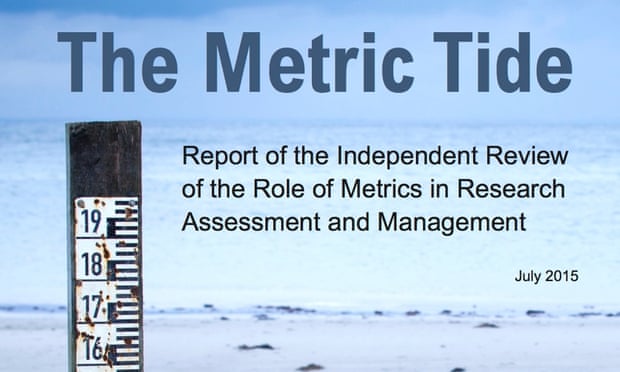
Repost> The metric tide: an agenda for responsible indicators in research
The launch of the report on the review into the role of metrics in HE over on the Gaurdian,..
The metric tide: an agenda for responsible indicators in research
Across research, the metric tide is rising. An independent report published today argues that we have the opportunity to influence how it washes through higher education and research.
Yesterday’s Budget brought good news for those vice-chancellors who have been lobbying to raise student tuition fees above the current £9,000 annual cap. But it came with a sting in the tail: George Osborne said that fees could rise in line with inflation only for those universities “that demonstrate excellence in teaching”. This will be assessed through a new Teaching Excellence Framework, or TEF, to be introduced alongside the Research Excellence Framework (REF), which is used to allocate around £1.6 billion each year on the research side of the system.
Good quote further down:
Metrics should support, not supplant, expert judgement. In our consultation with the research community, we found that peer review, despite its flaws and limitations, continues to command widespread support. We all know that peer review isn’t perfect, but it is still the least worst form of academic governance we have, and should remain the primary basis for assessing research papers, proposals and individuals, and for assessment exercises like the REF. At the same time, carefully selected and applied quantitative indicators can be a useful complement to other forms of evaluation and decision-making. A mature research system needs a variable geometry of expert judgement, quantitative and qualitative indicators. Academic quality is highly context-specific, and it is sensible to think in terms of research qualities, rather than striving for a single definition or measure of quality.
Bill Cronon on why bother studying Geography in a ‘digital age’
Over the Times Higher site there’s a write-up of the inaugural British Academy Lecture in Geography by Bill Cronon, worth a read:
Can history and geography survive the digital age?
A leading historical geographer has called on both his disciplines to find better ways of “navigating the digital world”. William Cronon, who is Frederick Jackson Turner and Vilas research professor of history, geography and environmental studies at the University of Wisconsin-Madison, was delivering the first in a new series of British Academy lectures in geography at London’s Royal Geographical Society on 7 July.
He was interested, he told the audience, in “the bridge between the academy and its many publics”. But although history and geography ranked “among the greatest synthesizing disciplines” and could help to “make the world more meaningful, more legible, for everyone”, academics had shown themselves to be far too “old media” and ran the risk of “isolating [them]selves in a pay-wall universe”.
“History has traditionally required long-form prose,” explained Professor Cronon, and it now counted as “the only academic discipline in the United States which still generally requires a monograph for tenure”. At the same time, most students no longer “read for pleasure” and “a growing number of academic administrators come from disciplines which no longer have a use for books”.
The increasing use of citation indices and impact factors, Professor Cronon went on, encouraged academics to write in the “smallest publishable units” to a specialised, elite readership. As journals have “preformed audiences”, books have essentially been left behind. And with “academics now often required to underwrite the costs of journal publication”, this put a particular burden on “underfunded disciplines”.
Technical problems only exacerbated these structural issues. “Computers are just not suitable for long-form reading,” suggested Professor Cronon. Although tablets and e-readers were more academic-friendly, the now-dominant smartphone “clearly favours content which is very brief – some students have even abandoned email”.
Furthermore, “no file format is less suitable to a smartphone than a PDF”, quite apart from the fact that PDFs often were hidden away behind paywalls, were difficult to access and were “invisible” to search engines. In the longer term, Professor Cronon reflected, academics might need to prepare for a world in which “our intellectual endeavours take place in app space”.
Despite these major challenges, however, he concluded his lecture – titled “Who reads geography or history anymore? The challenge of audience in a digital age” – on an optimistic note, suggesting that “the disciplines are better suited to the digital world than it might seem”.
He pointed, for example, to a project where he and his students had created a digital tool for interpreting a major cemetery to members of the public.
More generally, despite recurrent questions about whether they were analytical and scientific enough, historians and geographers have always relied on stories, maps and descriptions. Professor Cronon urged them to be “stalwart in refusing to let the word ‘mere’ appear in front of ‘stories’ or ‘maps'”, since “compelling stories and revelatory maps” can be deeply illuminating.
“We describe the world as richly and incisively as we can,” he added. “There’s no need to apologise. Leaning in to stories and maps is how we can navigate the digital world.”
JOB> 0.5 Research Fellow, The Automation of Everyday Life (UWE Bristol)
The Digital Cultures Research Centre is advertising for a part-time (0.5) Research Fellow to support a project led by Dr Patrick Crogan on ‘The Automation of Everyday Life’:
The Digital Cultures Research Centre is seeking a Research Fellow in Digital Cultures: The Automation of Everyday Life on a part time (50%) and fixed term basis until 31 August 2016.
From software agents, predictive systems and recommendation services, to robotics, drones, and artificial companions, automated text and design experiments, and on to the internet of things, the automation of choices, actions and production is already a crucial theme in the emergence of 21st century digital culture.
In this role you will play a key part in developing the DCRC’s research and knowledge exchange programme in the area of the automation of cultural production and practices.
You will engage with a significant expansion of DCRC activities in this rapidly emerging area. Working across the DCRC’s local community, through regional, national and international connections, the post holder will develop interdisciplinary dialogues and partnerships with researchers and digital producers on projects that address and/or experiment with critical or creative responses to the automation of everyday life. You will help to grow the DCRC network of media, arts, robotics and software researchers and practitioners around this area, supporting and initiating the development of proposals to a variety of external funding bodies.
You will assist on increased DCRC initiatives across this theme, taking a lead in co-ordination and organisational support of externally facing research and knowledge exchange activities with a view to maximising impact. In addition to developing and extending your own specific programme of research, you will be expected to publish at an international level. Acting as a member of the editorial team for the DCRC website, you will play an important part in the promotion and external communication of DCRC research.
As a candidate (I’m guessing) you should probably be theoretically informed and take a look at some of Bernard Stiegler’s recent work on automation (this is probably the impetus for the project). You should probably also take a look at the Pervasive Media Studio to get a sense of where the DCRC operates…
Here’s the full advert with the necessary instructions for application…
Reblog> Embracing interdisciplinarity
Really nice blogpost by Sam Merrill about interdisciplinarity over on his blog. I definitely identify with some of the experiences Sam relates, albeit in different institutional contexts…
Embracing interdisciplinarity
I recently read Matt Houlbrook’s excellent blog post, ‘on being a one trick historian’ (appropriately accompanied by The Smiths’ Stop Me If You Think You’ve Heard This One Before) and was struck by the particular resonance of some of his words.“It is not easy to turn new tricks in the world we inhabit. Starting from scratch is an uncomfortable experience – it means admitting our ignorance, addressing the reading we have not done, relying upon the kindness of academic strangers.
It takes time”
As Matt does elsewhere on his website, I tend to emphasise the mobility that has characterised my academic pathway to date and the benefits I believe it has brought my scholarly practice. This mobility extends beyond study and employment spells at different UK higher educations institutions, which depending on how strictly I define ‘spells’ ranges from between three and five universities, to also include periods of education and work in different national and cultural settings including at two universities in Germany and two in Australia. Most importantly, however, this mobility also pertains to the level of scholarly flexibility that I have tried to uphold through a willingness to cross academic borders and expose my research to the perspectives of new disciplines. This is reflected by the fact that in the last ten years I have spent time in archaeology and ancient history, heritage studies, cultural geography, urban studies, business, economics and tourism, and modern languages departments. I do not mean this list to sound conceited, not least because I have come across enough criticism and regularly grapple with the potential risks of this chosen path to know that it is not something that all would feel proud of or feel comfortable about.
The unacknowledged (professional) expense of books
These are just some rough thoughts…
Reading is a significant part of academic life. Staying up-to-date with debates, excavating the lineage or context for certain arguments or ideas, diving into new areas – all these things, and more, more or less require us to regularly read… journal articles, books, book reviews, and perhaps (increasingly) blogs and other online texts.
The thing is… most of those texts are free to access, for academics, through institutional access (we can login through Athens or Shibboleth). The exception (most of the time anyway) is books. While universities remain committed to stocking their libraries there are, of course, limits to what can be bought. We often want to foray into very particular areas that other colleagues or students won’t and so we cannot reasonably expect the university to pick up the tab, especially when budgets are only being reduced.
This leaves many (especially early career) academics in a quandary. Resort to the increasingly creaky inter-library loans system (and then probably have to break copyright by photocopying substantial portions of a book), or buy a book with your own money. Inter-library loans is an excellent system and I have no wish to denigrate it – it’s just sometimes you need to keep a copy of the whole book and copyright doesn’t allow for this (and photocopies can be unsatisfactory too).
Now, I know that academics are certainly not badly paid (and I do not wish to moan about that), but those of us early in our careers are not wealthy by any means. Many colleagues, I am aware, give themselves a book budget and prioritise – some simply splash out. Nevertheless, this is a professional expense – we arguably need the books to inform our research (the aspect of our jobs most highly prized by our employers and government) but we must cover it out of our ordinary remuneration. This may well be the case for other professions too(?)
Until I had a family I did not think about this. I didn’t buy every book I fancied but there were book purchases most months. Now, with a tighter belt, there isn’t the room for this in my family’s budget. I was lucky to receive a small start-up pot when appointed to my post and I have used a little bit of that to pay for some essential books (I don’t think that’s what it was for!). I have also made use of the SCONUL system to join other universities’ libraries to broaden the range of books to which I have access.
Nevertheless, and I really do not wish to whinge, but the fact remains that academic books can be really expensive (e.g. Routledge and Ashgate routinely publish hardback-only editions and they cost £60+ per book) and we have to meet that expense ourselves.
I’d be interested in what others think…
London Materialisms Reading Group
On the Crit-Geog-Forum list, David Chandler has advertised forthcoming meetings of the London Materialisms Reading Group, below. There is also more information about the group on David Chandler’s website.
This looks like an excellent opportunity to engage with some interesting ideas and hopefully meet with and talk to interesting people…
This is a notice of our forthcoming Materialisms Reading Group meetings. They are free for anyone to attend.16. Thursday 23 July 2015, we will be discussing McKenzie Wark’s ‘Molecular Red: Theory for the Anthropocene’ which will be introduced by Paul Rekret (Richmond University). For those interested, here is Zizek’s short review of the book, and Wark’s reply.
17. Thursday 10 September 2015 – Miriam Tedeschi (University IUAV, Venice) will be introducing Gilles Deleuze’s ‘Spinoza: Practical Philosophy’
18. Thursday 8 October 2015 – Elisabetta Brighi (University of Westminster) will be introducing Deborah Cowen’s ‘The Deadly Life of Logistics: Mapping Violence in Global Trade’
19. Thursday 5 November 2015 – Graham Jones will be introducing John Protevi’s ‘Political Affect: Connecting the Social and the Somatic’
20. Thursday 3 December 2015 – Nick Srnicek will be introducing Graham Harman’s ‘Bruno Latour: Reassembling the Political’
Meetings are open to all and take place Thursdays 6.30-8.00pm, Westminster Forum, Department of Politics and International Relations, 5th Floor, 32-38 Wells Street, London, W1T 3UW (5 minutes from Oxford Circus tube).
Wine and nibbles will be provided, sponsored by the Centre for the Study of Democracy, University of Westminster and the Centre for Media & Culture Research, London South Bank University.
Suggestions for meetings after Xmas that we have on the table:
- Michiel van Ingen (University of Westminster) introducing Kate Soper’s ‘What is Nature: Culture, Politics and the Non-Human’.
- Philip Cunliffe (University of Kent) introducing Alexander Wendt’s ‘Quantum Mind and Social Science: Unifying Physical and Social Ontology’.
- David Chandler (University of Westminster) introducing Louise Amoore’s ‘The Politics of Possibility: Risk and Security beyond Probability’.
If you wish to be added to the Materialisms Reading Group mailing list please contact me.
Symposium on Innovations in Ethnographic Methodology
The Centre for Ethnographic Research (UC Berkeley) is holding a symposium on innovations in ethnographic methodology, please find the CFP copied below. Looks interesting!
CFP: Symposium on Innovations in Ethnographic Methodology
On March 4, 2016, CER is hosting a one-day symposium on Innovations in Ethnographic Methodology. We invite scholars from any discipline to submit paper proposals that focus on methodological innovations in conducting ethnographic research. Exemplars to illustrate methodological contributions may be drawn from any substantive field, e.g. education, everyday life, inequality, health, migration, organizations, urban, etc. Scholars working in ethnographic traditions including Intepretivism, Symbolic Interaction, Ethnomethodology, Phenomenology, the Extended Case Method, and Behavioralism are encouraged to participate.
Those wishing to present a paper are requested to submit an abstract (up to 500 words) along with a current cv. Papers should be focused on methodology and not on findings. The abstract should include a description of the innovation and state the contribution the paper makes to the existing issues within one or more ethnographic methodological traditions. Those chosen to present their papers will have their economy airfare and two nights of lodging paid by the Center. Selected papers from the conference will be submitted for a special issue of the journal Ethnography. Abstracts for the conference are due by September 10, 2015, and notification of acceptance will be provided by October 10, 2015. Please send abstract and cv to cer2015conf@gmail.com.
Via Ethnography Matters.
New Books in Critical Theory
I’ve just come across the New Books in Critical Theory podcast, thanks to David Beer, on Twitter – who linked to the latest interview with Christian Fuchs, talking about his book Culture and Economy in the Age of Social Media.
It’s a pleasure to find that there are also recent interviews with Robin James on her book about resistance, pop music and feminism, as well as fellow geographers Deborah Cowen on her book The Deadly Life of Logistics and Amanda Rogers talking about her book Performing Asian Transnationalisms: Theatre, Identity and the Geographies of Performance. Trawling the archives one can find Bradley Garrett talking about Explore Everything and, of course, David Beer talking about his book Popular Culture and New Media.
Apparently there are other New Books in… podcast series, with one for Geography and another for Digital Culture (various series clearly cross-post), which is interesting. Worth exploring…
Reblog > CFP: “Critical Data Studies” – Big Data & Society Special Theme
Andrew Iliadis has blogged this interesting Call For Papers:
CFP: “Critical Data Studies” – Big Data & Society Special ThemeGuest Editors: Andrew Iliadis (Purdue University) and Federica Russo (Universiteit van Amsterdam)
Critical Data Studies (CDS) is a growing field of research that focuses on the unique theoretical, ethical, and epistemological challenges posed by “Big Data.” Rather than treat Big Data as a scientifically empirical, and therefore largely neutral phenomena, CDS advocates the view that data should be seen as always-already constituted within wider data assemblages. Assemblages is a concept that helps capture the multitude of ways that already-composed data structures inflect and interact with society, its organization and functioning, and the resulting impact on individuals’ daily lives. CDS questions the many assumptions about data that permeate contemporary literature on information and society by locating instances where data may be naively taken to denote objective and transparent informational entities.
CDS may be viewed as an emerging field connected to Information Ethics, Software Studies, and Critical Information Studies in that it seeks to question the ethical import of information and Big Data for society. Problems of causality, quality, security, and uncertainty concern CDS scholars. Recent articles outlining the theoretical program of CDS offer a new platform from which to question data in this manner. We seek essays for this special volume that broaden these latest commitments in CDS to include new empirical research projects on information and communication technologies (ICTs) that fall under the umbrella of Big Data, while also seeking to question their attendant epistemological shifts. Through the critical lens of ethics and morality, this special volume opens up CDS to localizations where Big Data can no longer be seen as neutral, and where an ethics of Big Data might emerge.
Issues of interest include (but are not limited to):
– Causality: how should we find causes in the era of ‘data-driven science?’ Do we need a new conception of causality to fit with new practices?
– Quality: how should we ensure that data are good enough quality for the purposes for which we use them? What should we make of the open access movement; what kind of new technologies might be needed?
– Security: how can we adequately secure data, while making it accessible to those who need it? How do we protect databases?
– Uncertainty: can Big Data help with uncertainty, or does it generate new uncertainties? What technologies are essential to reduce uncertainty elements in data-driven sciences?
Proposals of 1000 words are invited for consideration and inclusion in the Special Theme to be published in Big Data & Society (BD&S), an open access peer-reviewed scholarly journal that publishes interdisciplinary work principally in the social sciences, humanities and computing and their intersections with the arts and natural sciences about the implications of Big Data for societies.
Manuscripts should be 8,000 words for an Original Research Article, 3,000 words for a Commentary, and 1,000 words for an essay in the Early Career Research Forum section. All submissions of Original Research Articles to BD&S are double-blind, and triple peer-reviewed. Commentaries and ECR submissions are reviewed by the Guest Editors.
See the full thing on Andrew’s blog.