Reblog> Workshop: Reshaping Cities through Data and Experiments

Smart City visualisation

This looks interesting (via Programmable City):

Workshop: Reshaping Cities through Data and Experiments

When: 30th May 2017 – 9.30am to 3.30pm
Where: Maynooth University, Iontas Building, Seminar Room 2.31

The “Reshaping Cities through Data and Experiments” workshop is part of the Ulysses research exchange programme jointly funded by Irish Research Council and the Ambassade de France. It is organized in collaboration with researchers from the Centre de Sociologie de l’Innovation (i3-CSI) at the École des Mines in Paris – David Pontille, Félix Talvard, Clément Marquet and Brice Laurent – and researchers from the National Institute for Regional and Spatial Analysis (NIRSA) in Maynooth University, Ireland – Claudio Coletta, Liam Heaphy and Sung-Yueh Perng.

The aim is to initiate a transdisciplinary discussion on the theoretical, methodological and empirical issues related to experimental and data-driven approaches to urban development and living. This conversation is vital in a time when cities are increasingly turning into public-private testbeds and living labs, where urban development projects merge with the design of cyber-infrastructures to test new services and new forms of engagement for urban innovation and economic development. These new forms of interaction between algorithms, planning practices and governance processes raise crucial questions for researchers on how everyday life, civic engagement and urban change are shaped in contemporary cities.

Read the full blogpost on the Programmable City site.

Reblog> Ordinary digital humanities – event with @rodgers_scott

Another interesting event, this time with Scott Rodgers at Birkbeck.

Ordinary digital humanities: Free event at Birkbeck, 15 May 2017

Apple_II_IMG_4212In a couple of weeks’ time I am happy to be hosting an event as part of Birkbeck Arts Week on the subject of ‘Ordinary Digital Humanities’, featuring a talk from Lesley Gourlay (UCL Institute of Education). The publicity blurb below has more than enough information, I suspect, for you to get the idea. The event comes in significant part out of discussions we’ve been having through Satellite, an experimental subcommittee in the School of Arts at Birkbeck focused on exchanging information and perspectives on the critical, creative, academic and pedagogical dimensions of learning technologies.

Ordinary Digital Humanities
The everyday life of digital technologies in pedagogy

15 May 2017, 6pm, Keynes Library, 43 Gordon Square, WC1H 0PD (part of Birkbeck Arts Week)

Book your free place at: https://www.eventbrite.co.uk/e/ordinary-digital-humanities-the-everyday-life-of-digital-technologies-tickets-33211361075

When one hears the term ‘digital humanities’ what likely comes to mind are innovative applications of computational techniques and technologies to humanities research as well as pedagogy. Or, conversely, the application of concepts and philosophies rooted in the humanities toward the study of emergent digital objects.

There are reasons however to think about the digital humanities in a more ordinary sense, beyond ‘cutting edge’ research or pedagogy. In the introduction to her book How We Think, N. Katherine Hayles suggests that in order to understand the implications of digital technologies for the humanities, we must first consider the ‘low level’ implications of digital technologies for academic life. For instance, the widespread normalisation of email, department websites, software applications, web searches, social media, and much more. For Hayles, a ‘digital humanities’ is more than just innovative new approaches to research and pedagogy. It is also inherently about transformations to the cognitive and embodied environments of academic life at the level of the habitual or everyday.

This forum considers the banal dimensions of the digital humanities, focusing specifically (though not exclusively) on pedagogical practice. It begins with an opening lecture from Dr Lesley Gourlay (abstract below), followed by responses from Dr Grace Halden and Dr Tim Markham from Birkbeck, University of London. We will not only survey the everyday ways digital technologies are being used, and are asserting themselves, in academic life; but also, how humanities and other scholars might respond to the apparent opportunities and intrusions wrought by digitisation.

The event will be followed by a wine reception.

Flickering texts and the writing body: posthuman perspectives on the digital university

Dr Lesley Gourlay, Reader in Education and Technology, UCL Institute of Education

As digital technologies become increasingly central in our day-to-day lives, we see profound changes in how we search for information, communicate with others, and express ourselves. The university is also changing, as digital media becomes more central via online resources for distance learning, but also throughout the traditional campus, through the mainstream use of digital media for teaching, library provision and academic reading and writing. This has not only changed approaches to academic teaching, it has also fundamentally altered how we seek resources and how we read and generate new knowledge through writing and interaction. Drawing Hayle’s notion of ’embodied virtuality’, this talk will explore this theme, analysing data from a research project which looked in detail at how a small group of students approached their studies over a six-month period, using drawings, photography and interviews to form an in-depth understanding of their day-to-day lives as students, and how they navigate the complex digital and material landscape of the contemporary university. It looks at how texts change when they move between paper-based and the digital, how students navigate the complexities of multiple devices and formats, how they make spaces for writing and knowledge while on the move, and how they form part of ‘posthuman’ networks of digital devices and material objects in order to engage in their studies. Taking a historical perspective, the talk concludes that textual practices have always been central to how higher education is organised and how we understand ‘knowledge’, and considers how digital media might continue to change what we call ‘the university’.

Digital Everyday – conference at KCL this weekend

This looks interesting… via Tony Sampson

THE DIGITAL EVERYDAY CONFERENCE

Location
Strand Campus – King’s College London
Category
Conference/Seminar
When
06/05/2017 (10:30-18:30)
Contact
Please direct enquiries to digitalculture@kcl.ac.uk

Sign up to the CDC mailing list here

The conference is paid and registration is essential. Registration closes midday on 4 May.

The Digital Everyday: Exploration or Alienation?

This international conference aims at exploring the digital everyday, understood as the transformation of everyday life practices brought about by digital technology. From how we buy, walk around, get a cab, love, break up, go to bed, meet new people and sexual partners to the way we rate services, turn on the fridge, exercise, eat, use social media and apps, Big Data is reshaping some of the most basic activities in our lives.

The conference will explore these digitally enabled transformations by looking at a number of domains affected by these shifts, for instance: of work and leisure, of friendship and love, of habits and routines. We will also explore a number of overarching dynamics and trends in the digital world that contribute to these transformations, including: processes of digital individualisation and aggregation; the elisions of spatial and temporal barriers; trends towards quantification and datafication; and the dialectic between control and alienation.

Please click here to see the full programme 

(Please note that refreshements will be provided but delegates will need to get their own lunch)

Image

Deum ex machina? a journey into transhuminism as/via religion

Machines from the gods… or…

God in the machine: my strange journey into transhumanism – podcast

After losing her faith, a former evangelical Christian felt adrift in the world. She then found solace in a radical technological philosophy – but its promises of immortality and spiritual transcendence soon seemed unsettlingly familiar

An interesting and compelling podcast of a ‘long read’ for the Graun by Meghan O’Gieblyn that eloquently articulates the not-so-crypto-theistic nature of (some) transhumanism(s).

Here’s a paragraph to whet the appetite:

By this point I’d passed beyond idle speculation. A new, more pernicious thought had come to dominate my mind: transhumanist ideas were not merely similar to theological concepts but could in fact be the events described in the Bible. It was only a short time before my obsession reached its culmination. I got out my old study Bible and began to scan the prophetic literature for signs of the cybernetic revolution. I began to wonder whether I could pray to beings outside the simulation. I had initially been drawn to transhumanism because it was grounded in science. In the end, I became consumed with the kind of referential mania and blind longing that animates all religious belief.

A ‘new realism’ and post-truth

A glitched image of a typewriter

In a recording of a very lively double-header presentation by Maurizio Ferraris and Martin Scherzinger which has been podcast by Data & Society there’s some interesting discussion of Ferraris’ formulation of a ‘new realism‘ (which is sort of sympathetic to but perhaps distinct from speculative realisms) in relation to how we might understand ‘truth’ and truth claims and so how we might understand how ‘understanding’ works in relation digitally mediation.

Both Ferraris and Scherzinger are entertaining speakers but Scherzinger in particular offers some very incisive comments around how we can understand the sorts of manoeuvres different people are making around the constitutions and discussion of ‘theory’ (taken in its most general understanding).

Anyway… it’s an interesting listen:

Post-Truth and New Realities: Algorithms, Alternative Facts, and Digital Ethics

The history of the future of automation – lessons from ed tech

Automated taxi figure in the 1990 film Total Recall

I’ve been re-reading the excellent essay by Audrey Watters: Driverless Ed-Tech: The history of the future of automation in education. I really recommend reading it!

Following on from the vague points I made in my last post about an automative imaginary – one way of getting at this is a sort of classic (political economy) critique, which Watters very adroitly takes in relation to ed-tech and MOOCs (etc), and which she write really clearly – so, here is snippet:

“Put me out of a job.” “Put you out of a job.” “Put us all out of work.” We hear that a lot, with varying levels of glee and callousness and concern. “Robots are coming for your job.”

We hear it all the time. To be fair, of course, we have heard it, with varying frequency and urgency, for about 100 years now. “Robots are coming for your job.” And this time – this time – it’s for real.

I want to suggest – and not just because there are flaws with Uber’s autonomous vehicles (and there was just a crash of a test vehicle in Arizona last Friday) – that this is not entirely a technological proclamation. Robots don’t do anything they’re not programmed to do. They don’t have autonomy or agency or aspirations. Robots don’t just roll into the human resources department on their own accord, ready to outperform others. Robots don’t apply for jobs. Robots don’t “come for jobs.” Rather, business owners opt to automate rather than employ people. In other words, this refrain that “robots are coming for your job” is not so much a reflection of some tremendous breakthrough (or potential breakthrough) in automation, let alone artificial intelligence. Rather, it’s a proclamation about profits and politics. It’s a proclamation about labor and capital.

More specific to education, Watters highlights the logic offer by Udacity, one of the big MOOC start-ups:

“We want to be the Uber of education,” Thrun told The Financial Times, which added that, “Mr Thrun knows what he doesn’t want for his company: professors in tenure, which he claims limits the ability to react to market demands.”

In other words, “disrupt” job protections through a cheap, precarious labor force doing piecemeal work until the algorithms are sophisticated enough to perform those tasks. Universities have already taken plenty of steps towards this end, without the help of algorithms or for-profit software providers. But universities are still bound by accreditation (and by tradition). “Anyone can teach” is not a stance on labor and credentialing that many universities are ready to take.

[read all of Watters’ argument here.]

One of the areas in which what I’ve called the automative imaginary/imagination overlaps with wider stories about digital tech disruption and the widespread creed of that disruption being normatively good, if not admirable, is where automation overlaps with the ‘gig economy’. As we can see, via Thrun, one of the models in play here is not to ‘destroy’ jobs but rather to decouple them from some of the elements that make them valuable and either reallocate or automate those and then offer the remaining tasks as precarious work – which you have to sign up for through a proprietary system as a contractor, rather than an employee.

The ways we are invited to see ‘automation’ by some are over-coded with strong narratives of ‘disruption’ and the breaking down of established employment rights into a two their system in which the ‘taskers’ (as Guy Standing calls them) take the precarious work for relatively meagre earnings and the tech company owners and a few they bring along with them hoover up the profits.

An alternative to such narratives might be ‘accelerationism‘ but I remain skeptical at present (but I’ve not read enough to form an opinion really). It seems to me, we (geographers, social scientists, citizens?! … well, me anyway!) really do need to talk and think about work.

More tales of the automative imaginary

A warehouse worker and robot

Here’s some links that further sketch out some of what I’ve been thinking about as an ‘automative imaginary’. I’ve offered links with a bit of brief commentary at the bottom…

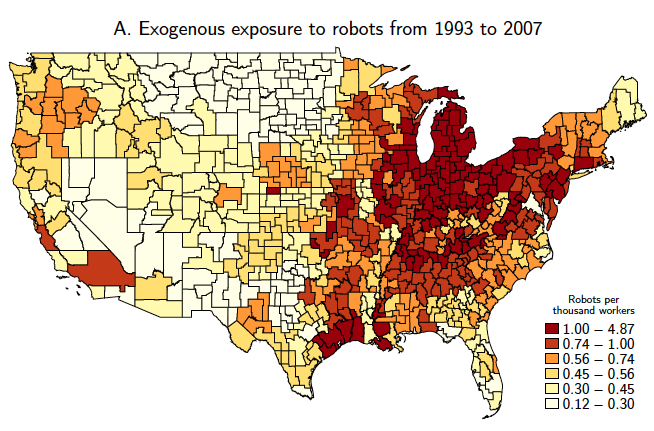
Evidence That Robots Are Winning the Race for American Jobs – in the NYT, pointing to research undertaken by two economists, Acemoglu and Restrepo, published by the (American) National Bureau of Economic Research: Robots and Jobs: Evidence from US Labor Markets (to which I have no access), with a commentary on the Centre for Economic Policy Research‘s Vox site. What is curious for me here is how one can evaluate the method of the researchers and what the assumptions they make say about how we (are invited to) understand automation. There’s some interesting geography in there too! E.g. see the choropleth map of “exogenous exposure to robots” below
How will the rise of automation and AI affect the workforce and economy moving forward? – Francis Fukuyama offers his answer to how automation and AI (interesting easy slip between those as almost a form of equivalence, which is open to significant debate/critique) may or may not “affect” the economy and, in particular, jobs – in the US.

It’s interesting how much of what we are offered in terms of a rationale for automation is a fairly simplistic robots replace workers sort of story. In this regard, it’s worth remembering what the MacDonalds CEO Ed Rensi flippantly observed as a canonical example (documented in this post on Fusion):

former McDonald’s CEO Ed Rensi made news by going on Fox Business and declaring that ongoing protests in the campaign for a $15 minimum wage were encouraging the automation of fast food jobs. The segment goes on for seven minutes, but here’s the meat of it:

I was at the National Restaurant Show yesterday and if you look at the robotic devices that are coming into the restaurant industry – it’s cheaper to buy a $35,000 robotic arm than it is to hire an employee who’s inefficient making $15 an hour bagging French fries – it’s nonsense and it’s very destructive and it’s inflationary and it’s going to cause a job loss across this country like you’re not going to believe

Nevertheless, other economists will tell you that processes of automation have, historically, created new kinds of jobs as they apparently ‘destroy’ others. For example, Deloitte, in their report “Technology and People: The great job creating machine“, suggest that while manual labour and routine jobs have been significantly automated since 1992, there has been an even larger growth in ‘care’ (and service) and ‘cognitive’ work in the UK labour market. So you see fewer people in manufacturing but more analysts, baristas and carers.

Of course, to see it as whole “jobs” that are being automated is somewhat misleading – another aspect of the automative imaginary that owes more to the depiction of automation in 1950/60s cartoons than in the actually existing forms of automation. As many commentators point out, it’s parts of jobs or tasks that become automated, which results in a need to reorganise that work. As the management consultants McKinsey point out in a report in 2016:

currently demonstrated technologies could automate 45 percent of the activities people are paid to perform and that about 60 percent of all occupations could see 30 percent or more of their constituent activities automated, again with technologies available today

What we tend to focus on is the automation full stop, not that it isn’t all of a job and may not result in an easy equivalence of “robot in = worker out”. We imagine the robots doing it all, when, in many cases, the use of robots (when they’re actually economically viable – they have a huge initial set-up cost) require a reorganisation of systems such that the work looks different.

Another illustration of this comes from the excellent Containers podcast by Alexis Madrigal. In the final episode, Madrigal talks to Karen Levy of Cornell  about the forms automation could take in relation to truck driving (upon which Uber clearly has its sights set). Of course, again, it’s not as simple as: automate the lorries, do-away with jobs. It’s more like the process of containerisation that Madrigal is exploring – automation is as much about reorganising systems of work / labour as it is about ‘replacing’ labour. So, in the example of picking in warehouses – you might get a Kiva or Fetch/Freight robot to do the donkey work of warehousing, with the worker performing the more sophisticated movements. This is not a future of people-less spaces but rather robots following people around or being tasked in order to support the worker, the argument being this leads to greater productivity. In fact, in the eighth episode of Containers, the CEO of Fetch Robotics justifies her company’s tech by saying that, in the US, there are over 600k jobs going unfilled in warehousing and manufacturing because people don’t want to do them, with a turnover rate of those who do sign-up for such work at around 25% (I don’t know the basis or veracity of those numbers – would like to though!). Again, if true, such figures are another aspect of the expectations of what work involves and how it may be performed.

So, it seems to me we need to talk about work not simply elide it by (somewhat hysterically) referring to ‘automation’ and ‘robots’. This is something I hope to research and write more about, if I ever get the time…

A few cultural geographies of tech

As it’s/they’re now a sort of trend, here’s a few recently published papers that offer some  cultural geographies of tech…

Being in a mediated world: self-tracking and the mind–body–environment

Sarah Pink, Vaike Fors

Self-tracking is an increasingly ubiquitous everyday activity and therefore is becoming implicated in the ways that everyday environments are experienced and configured. In this article, we examine theoretically and ethnographically how the digital materiality of these technologies mediates and participates in the constitution of people’s tacit ways of being in the world. We argue that accounting for the presence of such technologies as part of everyday environments in this way offers new insights for non-representational accounts of everyday life as developed in geography and anthropology and advances existing understandings of these technologies as it has emerged in sociology and media studies.

The GoPro gaze

Phillip Vannini, Lindsay M Stewart

During 2014–2015, we produced a short video documentary, titled The Art of Wild, which focused on the audiovisual practices of outdoor adventurers. This short written report reflects on an idea inspired by the video: the GoPro gaze. Enacted by increasingly sophisticated, portable and affordable recording audiovisual technologies such as the GoPro Hero camera, the ‘GoPro gaze’ entails not just the pursuit of pleasures derived from adventure and nature-based travel, but also the production and distribution of professional-quality independent videos for Internet audiences. Based on a series of ‘go-along’ interviews with adventure travelers/athletes/artists, this article and the accompanying video prompt us to reflect on how the affective pleasures and technological affordances of the ‘GoPro gaze’ trouble the established idea of the ‘tourist gaze’.

The lit world: living with everyday urban automation

Sarah Pink & Shanti Sumartojo

In this article, we develop and advance the concept of the lit world by bringing together literatures about everyday lighting, automation in everyday life and human perception, along with our ethnographic research into people’s experience of automated lighting in Melbourne, Australia. In doing so we formulate and argue for an approach to automation that situates it as part of everyday mundane worlds and acknowledges its entanglement with the emergent and experiential qualities of everyday environments as they unfold. We demonstrate this through the example of automated lighting, understood as a situated technology that has contingent effects and participates in the making of particular ways of seeing and feeling the world. We thereby argue for an account of automation that reaches beyond its potential for the management of human (and other) behaviour, to ask how the qualities and affordances of automated technologies might seep out of their intended domains, and create new perceptual and experiential opportunities. In a context where automation is increasingly prevalent in everyday life, such attention to the experience and use of automated technologies which already exist on a large scale is needed. Urban lighting is an example par excellence of automation in the world because it has a long history beyond the recent association of automated technologies with code and digital infrastructures. As scholars debate how automated technologies will become part of our future digital lives, understanding how people live in a lit world offers a starting point for considering how we might live with other anticipated algorithmic forms of automation.

An ancient twin? Facial pattern matching with ancient statues


The Musée de la Civilisation in Quebec have a exhibition about ancient ‘doubles’ or ‘twins’, as part of which you can submit your photo and a program will match your face with images of statues in the collection.

It’s been in the press and, of course, is ‘just a bit of fun’, but its also sort of interesting to submit images and try and work out how the pattern matching is working – it’s not all that obvious! There’s probably something smart to say about ‘algorithms’ here, but I’ve not had enough sleep… check it out for yourself: Mon Sosie À 2000 Ans.

Here’s me and Battataï:

Songs “written by AI” from SonyCSL

Songs written by Sony CSL’s “AI”…

From the Sony CSL “flow machines” website:

Flow Machines is a research project funded by the European Research Council (ERC) and coordinated by François Pachet (Sony CSL Paris – UMPC).

The goal of Flow Machines is to research and develop Artificial Intelligence systems able to generate music autonomously or in collaboration with human artists.
We do so by turning music style into a computational object. Musical style can come from individual composers, for example Bach or The Beatles, or a set of different artists, or, of course, the style of the musician who is using the system.

Their “Deep Bach” thing was doing the rounds at the end of last year, so I presume there will be more to come.