I am a fan of Kate Compton, creator of Tracery, here she is, last year, talking about the poetics of bots.
Kate Compton: Bot Poetics // Interrupt 4 from Digital Language Arts on Vimeo.

Spatial Machinations

I am a fan of Kate Compton, creator of Tracery, here she is, last year, talking about the poetics of bots.
Kate Compton: Bot Poetics // Interrupt 4 from Digital Language Arts on Vimeo.

Via Mark Coeckelbergh.
Organizers: Dr. Janina Loh, Prof. Dr. Mark Coeckelbergh
Date: October 25-26, 2018
Venue: University of Vienna, Department of Philosophy, Universitätsstr. 7 (NIG), 1010 Vienna
There has been little attention to feminism and gender issues in mainstream philosophy of technology and vice versa: many feminists have focused on societal matters and relationships without taking into account how technics (i.e. technologies and techniques) shape those societies and relationships. However, since the beginning of the second-wave feminism by the mid 20th century, a growing awareness of the gravity and urgency for a critical reflection of technology and the sciences within feminist discourses can be observed. But feminist thinkers have not throughout interpreted technology and science as potentially emancipatory and liberating in every respect. In the same breath, the inherent structures of dominance, marginalization, and oppression have been confronted and disqualified within the feminist paradigm. The question of defining and ascribing responsibility in science and technics – regarding for instance the technological transformation of labor, the life in the information society, and the relationship between humans and machines – is essential for this workshop. Critical posthumanism and new feminist materialism define promising examples for a reformulation of known challenges such as essentialism and relativism, a transformation of hypostatized perspectives on traditional categories and dichotomies, as well as the claim to think off the beaten paths of socialist, liberal, and radical feminism. Confirmed keynote speakers are Corinna Bath, Rick Dolphijn, Nina Lykke, Kathleen Richardson, Lucy Suchman, and Judy Wajcman. The workshop Feminist Philosophy of Technology has two main aims: It shall present and spark a dialogue between the prominent approaches within feminist philosophy of technology (first day). On the second day we would like to explore and discuss potential challenges and perspectives within current movements of feminist philosophy of technology. We welcome submissions on any – but not limited to – the following issues:
Please submit abstracts of around 500 words to janina.loh@univie.ac.at, by July 30. Acceptance notifications will be sent out by the end of August.
Interesting conference from the project led by Chris Speed.
Panel sessions include Session 1: Power, Transparency and Accountability in Blockchain for International Development, Session 2: Peer-to-Peer Economies (A): Natural Resource Governance, Session 3: Peer to Peer Economies (B): Supply Chains and Development, Session 4: Crypto-philanthropy and development: The Future of Giving? along with lunchtime demonstrations of platforms and designs.
Panel submissions are closed but there are limited spaces available to register. For more information please contact k.symons@ed.ac.uk.
Registration essential. Contact c.cooke@ed.ac.uk to register.
Updates to follow on the day!

This event looks really interesting!
Via Pip Thornton.
How might we draw on feminist critical thought to reimagine data practices and data work? Join us for a public talk with Lauren Klein (Assistant Professor, Georgia Tech) to discuss her recent work on data feminism. Hosted by Jonathan Gray at the Department for Digital Humanities at King’s College London.
With their ability to depict hundreds, thousands, and sometimes even millions of relationships at a single glance, visualizations of data can dazzle, inform, and persuade. It is precisely this power that makes it worth asking: “Visualization by whom? For whom? In whose interest? Informed by whose values?” These are some of the questions that emerge from what we call data feminism, a way of thinking about data and its visualization that is informed by the past several decades of feminist critical thought. Data feminism prompts questions about how, for instance, challenges to the male/female binary can also help challenge other binary and hierarchical classification systems. It encourages us to ask how the concept of invisible labor can help to expose the invisible forms of labor associated with data work. And it points to how an understanding of affective and embodied knowledge can help to expand the notion of what constitutes data and what does not. Using visualization as a starting point, this talk works backwards through the data-processing pipeline in order to show how a feminist approach to thinking about data not only exposes how power and privilege presently operate in visualization work, but also suggests how different design principles can help to mitigate inequality and work towards justice.
Lauren Klein is an assistant professor in the School of Literature, Media, and Communication at Georgia Tech, where she also directs the Digital Humanities Lab. With Matthew Gold, she editsDebates in the Digital Humanities (University of Minnesota Press), a hybrid print/digital publication stream that explores debates in the field as they emerge. Her literary monograph,Matters of Taste: Eating, Aesthetics, and the Early American Archive, is forthcoming from Minnesota in Spring 2019. She is also at work on two new projects: Data Feminism, co-authored with Catherine D’Ignazio, and under contract with MIT Press, which distills key lessons from feminist theory into a set of principles for the design and interpretation of data visualizations, and Data by Design, which provides an interactive history of data visualization from the eighteenth century to the present.

A video of a fairly accessible discussion of broadly ‘post-phenomenological’ theories of technology with the philosophers Don Ihde & Peter-Paul Verbeek. Via dmf.
Thursday 11 January 2018 | 19.30 – 21.15 hrs | Theater Hall C, Radboud University
“From the bow and arrow to smartphones, changes come along with every new technology. According to Don Ihde, one of the founders of North American philosophy of technology, technology does not only offer us new opportunities, it also changes our relation to the world. Come and listen as the Dutch philosopher of technology Peter-Paul Verbeek and his mentor Don Ihde talk about philosophy and technology in the past, present, and future.”
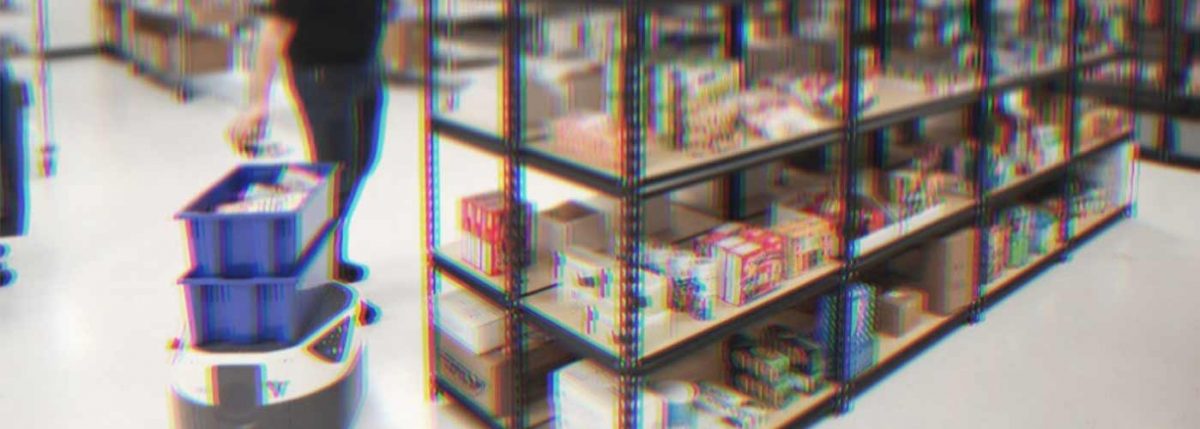
Ocado, online groceries delivery service in the UK, some time ago pivoted into providing automation solutions for other retailers. They have a division, or separate company, called Ocado Technology, which offers other retailers systems for fulfilment centre automation: “Ocado Smart Platform” [buzzwords ahoy!]. So, while the above video is interesting, insofar as it demonstrates yet another not-exactly-hospitable factory-like code/space, what is perhaps more interesting is that this system seems to have been developed not only to fulfil Ocado orders in Wiltshire/Hampshire but also as an advert for what Ocado technology does. See this report from Reuters: Ocado’s robot army courts global food retailers.
Ocado have promoted previous automated systems through videos too. The same claims about ‘machine learning’ and so on were made about a fulfilment centre system that looks a lot more like an airport baggage sorting system around five years ago.
I’ve become mildly obsessed with these videos of automated factories and fulfilment centres – they have become a sort of genre unto themselves. There are clearly ways in which promotional videos–made by the equipment/tech firms responsible for creating the systems or the firm implementing them–get translated into video news stories. Likewise, there are ways of talking about the ‘robot’ nature of these things. All of this demonstrates our ongoing negotiation of norms of understanding, describing and rationalising the technology, it’s implementation and what it may or may not portend for work and so on. If you’ve read this blog in the last year you may remember I talk about this stuff as the formation/formalisation of an ‘automative imagination‘.
As a sort of throw-away aside – the displacement of labour involved by Ocado’s, and others’, systems of automation may well be important too. If you ramp up the capacity to ‘fulfil’ orders in the distribution centre then you need to expand the capacity to get them delivered. We don’t have driverless vehicles on our roads, yet, so this possibly means fewer pickers and packers and a lot more delivery drivers.


Peter Paul Verbeek blogged this, looks good! >>
Thursday 24th of May from 4-7 pm
Location: DesignLab Universiteit Twente
The Australian performance artist Stelarc has visually probed and acoustically amplified his body and is well known for his pioneering work and ideas about extending the capabilities of the human body with technology. From 17th of May until 19th of August, Tetem is presenting the exhibition StickMan by Stelarc. During his stay in Enschede, Stelarc will give an extensive lecture in DesignLab about his pioneering performances and installations – for which he uses prosthetics, robotics, medical instruments, suspension, VR, biotechnology and internet to investigate the psychological and physical limitations of the body.
The event will be introduced by Frank Kresin (managing director of DesignLab). After Stelarc’s lecture, there will be a discussion with Stelarc, Herman van der Kooij (professor in Biomechatronics and Rehabilitation Technology and director of Wearable Robotics Lab) and Peter-Paul Verbeek (professor of Philosophy of Technology and co-director of DesignLab). During the discussion, led by moderator Wilja Jurg (director Tetem), we will explore the scientific, social and ethical implications of wearable robotics.
This event is organized in collaboration with DesignLab as part of StickMan exhibition in Tetem. DesignLab is a creative and cross-disciplinary ecosystem at the University of Twente, connecting science and society through design: https://www.utwente.nl/en/designlab/.
Short description about StickMan:
The StickMan is a minimal but full-body exoskeleton, that algorithmically actuates the artist with six degrees-of-freedom. 64 possible combinations of gestures are generated. Sensors on StickMan generate sounds that augment the pneumatic noise and register the limb movements. A ring of speakers circulates the sounds, immersing the audience in an acoustic landscape as an extension of StickMan’s body.
The StickMan is an anthropomorphized, programmable motion and sound machine which functions with not only the body connected, but also as an installation by itself. A smaller replica of StickMan enables visitors to record and play their choreography by bending the limbs into a sequence of positions, which also inadvertently composes the sounds generated.
StickMan is shown for the first time in Europe. The smaller replica of StickMan was made especially for the exhibition in Tetem.
For more information and events visit:

I’ve been listening to the City Road podcast for a little while now, since seeing a link on twitter to an excellent conversation with Desirée Fields, and I think Dallas Rogers et al. are doing a fantastic job with this podcast. It is an academic podcast but presented and delivered in, I think, a really accessible way. To that end, I really think there are episodes that make good teaching resources. In particular this episode on ‘digital cities’ with Robyn Dowling and Sophia Maalsen will feature in the next iteration of my third year option about technology – it’s excellent.

Gillian Rose has a new project, which she’s blogged about. It sounds interesting. I was sort of wondering if the analysis of a “specific way of seeing the world through digital visualising technologies emerging” might crossover with Matt Jones’ ‘sensor vernacular‘ and James Bridle‘s, and others’, conceptualisation of a ‘new aesthetic‘…
Lovely that such work is supported by an institution (Oxford). I am sure it will create all sorts of interesting linkages and conversations.
I’m very excited to announce a new project: Digital | Visual | Cultural. D|V|C is a series of events which will explore how the extensive use of digital visualising technologies creates new ways of seeing the world.

The first event will be on June 28, when Shannon Mattern will give a public lecture in Oxford. Shannon is the author of the brilliant Code and Clay, Data and Dirt as well as lots of great essays for Places Journal. ‘Fifty Eyes on a Scene’ will replay a single urban scene from the perspective of several sets of machinic and creaturely eyes. That lecture will be free to attend but you’ll need to book. Booking opens via the D|V|C website on 23 April. It will also be livestreamed.
I’m working on this with Sterling Mackinnon, and funding is coming from the School of Geography and the Environment, Oxford University, and St John’s College Oxford.
The website has more info at dvcultural.org, and you can follow D|V|C on Twitter @dvcultural and on Instagram at dvcultural. There’ll be a couple more events in 2019 so follow us to stay in touch.
So that’s the practicalities. What’s the logic?
The key questions D|V|C will be asking are: Is a specific way of seeing the world through digital visualising technologies emerging? If so, what are its conditions and consequences?