CFP> ‘The Spectre of Artificial Intelligence’

Still from George Lucas' THX1138

An interesting CFP for Spheres: Journal of Digital Culture. Heard through CDC Leuphana:

‘The Spectre of Artificial Intelligence‘

Over the last years we have been witnessing a shift in the conception of artificial intelligence, in particular with the explosion in machine learning technologies. These largely hidden systems determine how data is gathered, analyzed, and presented or used for decision-making. The data and how it is handled are not neutral, but full of ambiguity and presumptions, which implies that machine learning algorithms are constantly fed with biases that mirror our everyday culture; what we teach these algorithms ultimately reflects back on us and it is therefore no surprise when artificial neural networks start to classify and discriminate on the basis of race, class and gender. (Blockbuster news regarding that women are being less likely to get well paid job offers shown through recommendation systems, a algorithm which was marking pictures of people of color as gorillas, or the delivery service automatically cutting out neighborhoods in big US cities where mainly African Americans and Hispanics live, show how trends of algorithmic classification can relate to the restructuring of the life chances of individuals and groups in society.) However, classification is an essential component of artificial intelligence, insofar as the whole point of machine learning is to distinguish ‘valuable’ information from a given set of data. By imposing identity on input data, in order to filter, that is to differentiate signals from noise, machine learning algorithms become a highly political issue. The crucial question in relation to machine learning therefore is: how can we systematically classify without being discriminatory?In the next issue of spheres, we want to focus on current discussions around automation, robotics and machine learning, from an explicitly political perspective. Instead of invoking once more the spectre of artificial intelligence – both in its euphoric as well as apocalyptic form – we are interested in tracing human and non-human agency within automated processes, discussing the ethical implications of machine learning, and exploring the ideologies behind the imaginaries of AI. We ask for contributions that deal with new developments in artificial intelligence beyond the idiosyncratic description of specific features (e.g. symbolic versus connectionist AI, supervised versus unsupervised learning) by employing diverse perspectives from around the world, particularly the Global South. To fulfil this objective, we would like to arrange the upcoming issue around three focal points:

  1. Reflections dealing with theoretical (re-)conceptualisations of what artificial intelligence is and should be. What history do the terms artificiality, intelligence, learning, teaching and training have and what are their hidden assumptions? How can human intelligence and machine intelligence be understood and how is intelligence operationalised within AI? Is machine intelligence merely an enhanced form of pattern recognition? Why do ’human’ prejudices re-emerge in machine learning algorithms, allegedly devised to be blind to them?
  2. Implications focusing on the making of artificial intelligence. What kind of data analysis and algorithmic classification is being developed and what are its parameters? How do these decisions get made and by whom? How can we hold algorithms accountable? How can we integrate diversity, novelty and serendipity into the machines? How can we filter information out of data without reinserting racist, sexist, and classist beliefs? How is data defined in the context of specific geographies? Who becomes classified as threat according to algorithmic calculations and why?
  3. Imaginaries revealing the ideas shaping artificial intelligence. How do pop-cultural phenomena reflect the current reconfiguration of human-machine-relations? What can they tell us about the techno-capitalist unconscious? In which way can artistic practices address the current situation? What can we learn from historical examples (e.g. in computer art, gaming, music)? What would a different aesthetic of artificial intelligence look like? How can we make the largely hidden processes of algorithmic filtering visible? How to think of machine learning algorithms beyond accuracy, efficiency, and homophily?

Deadlines

If you would like to submit an article or other, in particular artistic contribution (music, sound, video, etc.) to the issue, please get in touch with the editorial collective (contact details below) as soon as possible. We would be grateful if you would submit a provisional title and short abstract (250 words, max) by 15 May, 2018. We may have questions or suggestions that we raise at this point. Otherwise, final versions of articles and other contributions should please be submitted by 31 August, 2018. They will undergo review in accordance with the peer review process (s. About spheres). Any revisions requested will need to be completed so that the issue can be published in Winter 2018.

>> Read more

Digital work and automation link dump

Charlie Chaplin in Modern Times

Ok. Whilst I was not blogging I kept finding things through twitter and reading blogs that I find interesting. I kept thinking “oh, I ought to write something about that”… the thing is, I haven’t had the time and I don’t have the time now. So… I’m going to do a sort of annotated link thingamajig so that I don’t lose these things (I have over 45 tabs open in Chrome on my phone, this is unworkable) and also to share and to maybe invite other people to comment on this stuff..?!

The future of work, a history by Kevin Baker – A relatively long piece of writing that charts a history of American worrying about the replacement of the human worker with machines. Some interesting historical details that help contextualise some of the alarmism today. What I like about this is that the piece ends by reminding us all that there are choices to be made, which are political, but it also highlights how inescapable forms of determinism are (as Sally Wyatt so expertly tells us).

Tech culture, unions and the blind spot of meritocracy by Wendy Liu in Technology and The Worker (#2) –an interesting piece by Wendy Liu that documents a conversation with Xavier Denis a former engineer at Shopify about what working in the US tech. market is like – the sorts of working conditions, norms and management practices.

Automation, skills use and training by Ljubica Nedelkoska and Glenda Quintin (OECD) — A report that builds upon and that authors claim improves assessments of the potential for the automation of particular kinds of work. “Beyond the share of jobs likely to be significantly disrupted by automation of production and services, the accent is put on characteristics of these jobs and the characteristics of the workers who hold them.” This contributes to the ongoing arguments around the likelihood or not of job/role/work automation.

What can machine learning do? Workforce implications by Erik Brynjolfsson (MIT) and Tom Mitchell (Carnegie Mellon) in Science – A short-ish “Insights” article that makes some fairly grandiose and sweeping claims about the ‘impacts’ of automation on the workforce (with an American focus). Some references are made but if you follow them up it seems to me that the statements they are used to support make fairly big leaps. This, in contrast to the OECD report, is a stoking of the now brightly burning fire of the imaginings of automation.

The Guardian view on automation: put human needs first – A Grauniad editorial that passes comment on the above OECD report. It’s interesting to see the reception, interpretation and sometimes misrepresentation (I don’t think that’s what the Graun are doing here) of these academic economic reports. This plays into the general, normative, discussions and senses of the risks and/or realities of automation (this is a part of what I want write a book about).


BBC Click offer a Twitter-length version of ‘what it’s like to work with robots’.

Dr Easy.

Shynola re-imagine/visualise the opening section of Matthew De Abaitua’s novel Red Men – a PKD-like imaginative exploration of the emergence of AI.

The Incomplete Vision of John Perry Barlow by April Glaser (Slate) – Reflecting upon Barlow’s “Declaration of the independence of cyberspace” and the rise of EFF following his death earlier this year. Fits nicely with Fred Turner’s work examining the hippy-libertarian nexus of Silicon Valley moguls. In many ways this gets at some of the ideological foundations and/or misgivings of automation talk.

Face Recognition Glasses Augment China’s Railway Cops by Bibek Bhandari (SixthTone) – An article about the alleged deployment of facial recognition through AR glasses for Chinese police. Predictable comparisons to “Black Mirror” and other forms of dystopianism.

The Ethics Advisory Group of the European Data Protection Supervisor Report on Data Ethics (2018) [PDF] – On the back of the GDPR and contemporary debates around privacy in light of perennial controversies with Facebook and others the Ethics Advisory Group published a report claiming that: “The objective of this report is thus not to generate definitive answers, nor to articulate new norms for present and future digital societies but to identify and describe the most crucial questions for the urgent conversation to come.” The report is written by J. Peter Burgess, Luciano Floridi, Aurélie Pols and Jeroen van de Hoven.

The network Uber drivers built by Alex Rosenblat – an article that addresses some of the ways that Uber drivers have collectively organised in order to manage working with a quasi-automated system in which the policies are not necessaerily in the best interests of the worker.

Artificial Intelligence Technology Strategy (Report of Strategic Council for AI Technology) ( a Japanese government report) [PDF] – A 25 page report written for the Japanese government. It’s fairly dry and dense and has some crazy Powerpoint-style diagrams but it is sort of interesting as a documenting of an apparently strategic governmental approach to “AI”.

Why the Luddites matter : Librarian Shipwreck – A good blogpost on who the Luddites really were and framing them as an interesting means of getting at how popular understandings of technology might be found wanting.

Sci-Fi doesn’t have to be depressing: welcome to Solar Punk by Tom Cassauwers – What if we don’t write dystopian science fiction but build imaginary worlds based on positive and affirmative uses of technology? That is the premise of what is called ‘Solar Punk’, as outlined here by Tom Cassauwers – who charts the movement with Sarena Ulibarri, an editor who is a key proponent of the sub-genre.

Our driverless future on CNN Money – a video feature on driverless cars with four episodes and a couple of additional videos. There’s some interesting interviews and it’s not all boosterism. It’s sort of emblematic of the current discourse on automation. If nothing else this is probably useful for teaching purposes as there are some clips that nicely sum up some of the key questions being asked.

Automating inequality – Virginia Eubanks and interlocutors [video]

Still from George Lucas' THX1138

This Data & Society talk by Virginia Eubanks on her book Automating Inequality followed by a discussion with Alondra Nelson and Julia Angwin is excellent. This seems like vital empirical analysis and insights that flesh out what is, perhaps, frequently gestured towards by ‘critical algorithm studies’ folks – ‘auditing algorithms’, analysing what’s in the black box, how systems function and what is their material and socio-economic specificity and what then can we learn about how particular forms of actually existing automation (and not simply abstract ideals) function.

Eubanks talks for the first 20-ish minutes and then there’s a discussion that follows. This is really worth watching if you’re interested in doing algorithm studies type work and in doing ‘digital geographies’ that don’t simply lapse into ontology talk.

Investigating Space(s): Current Theoretical and Methodological Approaches: Virtuality and Socio-Materiality IRS Spring Academy

Facial tracking system, showing gaze direction, emotion scores and demographic profiling

I will be a ‘keynote’ at the IRS Spring Academy this year, which is concerned with ways of addressing ‘virtuality and socio-materiality’. Other speakers and contributors to the Spring Academy include: Annett Heft, Brian J. Hracs, Gertraud Koch, Daniel Maier, Daniela Stoltenberg and Matt Zook.

I’ll be talking about ways of theorising space and spatial experience for ‘digital’ things. I’ve copied my abstract below, as well as the details of the Spring Academy.

This is a really good opportunity for PhD students – it is free (including travel and subsistence, as far as I can tell) and there are lots of interesting things going throughout the week. I encourage people to take a look, consider applying and/or sharing with others who might benefit from this opportunity.

My talk:

Worrying realities: spatial theory and digital geographies

As practitioners of a ‘spatial science’ geographers frequently espouse forms of ‘spatial’ theory, yet the ambiguities of mediation through technologies produces enduring disagreements over the nature of that mediation. While prominent geographical theorists have asserted a relational nature of space on the one hand, on the other –binaries of ‘real’/’virtual’ worlds remain common currency in the study and theorisation of ‘digital geographies’. There is a sense in which geographers concerned with ‘the digital’, or ‘the virtual’, continue to both worry and worry about the nature ‘reality’. This talk addresses forms of theorising and problematising ‘the digital’ for geographical research. Rather than asserting a ‘correct’ form of theory, the concern here is to attempt to tease out productive ways to theorise whatever it is that we variously address as ‘cyberspace’, ‘the digital’, mediation and ‘the virtual’. The aim is to think about what it means to ‘do theory’ in relation to such concerns. Thus while there is necessarily an abstract side to such discussions, the kinds of theorising addressed will be grounded in examples taken from contemporary research and popular culture.

IRS Spring Academy 2018

In the past two decades the interdisciplinary field between spatial and social sciences has undergone an extraordinarily dynamic development with a high potential for innovation. On the one hand, many social-scientific disciplines performed a “spatial turn” and became more interested in integrating spatial concepts and terminology. On the other hand, disciplines like human geography or spatial planning, understand space less as an exclusive object of analysis and instead emphasize a “spatial perspective” as a shared ontological ground. This has opened up a broad “trading zone” within which novel conceptualizations of space and spatiality are negotiated in an inter-disciplinary field. Against this background, the Leibniz Institute for Research on Society and Space (IRS) together with different academic partners and supported by the Volkswagen Foundation organizes a series of three successive Spring Academies entitled “Investigating Space(s): Current Theoretical and Methodological Approaches”.

Each event focuses on different aspects of the emergent thriving field. The opening event, on “Temporality and Procedurality”, already took place in 2017. Part 2 on “Virtuality and Socio-Materiality” is addressed with this call for applications and will take place from 22 to 25 May 2018. Part 3 on “Topologies” will follow in 2019.

The IRS Spring Academy (Part 2) is organized with the participation of the collaborative project “Weizenbaum Institute for the Networked Society”, funded by the German Federal Ministry of Education and Research.

See the full website and the call for participation (PDF).

Retooling ‘the human’ – animal constructions and technical knowledge

A crow using a stick as a tool

A really interesting review, by Emma Stamm, of what seems like an equally interesting book: Ashley Shew’s Animal Constructions and Technical Knowledge. Full review on Social Epistemology Review and Reply Collective.

In its investigation of the flaws of anthropocentrism, Animal Constructions implies a deceptively straightforward question: what work does “the human clause” do for us? —  in other words, what has led “the human” to become so inexorably central to our technological and philosophical consciousness? Shew does not address this head-on, but she does give readers plenty of material to begin answering it for themselves. And perhaps they should: while the text resists ethical statements, there is an ethos to this particular question.

Applied at the societal level, an investigation of the roots of “the human clause” could be leveraged toward democratic ends. If we do, in  fact, include tools made and used by nonhuman animals in our definition of technology, it may mar the popular image of technological knowledge as a sort of “magic” or erudite specialization only accessible to certain types of minds. There is clear potential for this epistemological position to be advanced in the name of social inclusivity.

Whether or not readers detect a social project among the conversations engaged by Animal Constructions, its relevance to future studies is undeniable. The maps provided by Animal Constructions and Technical Knowledge do not tell readers where to go, but will certainly come in useful for anybody exploring the nonhuman territories of 21st century. Indeed, Animal Construction and Technical Knowledge is not only a substantive offering to philosophy of technology, but a set of tools whose true power may only be revealed in time.

Reblog> WIAS Workshop: Academic Labour, Digital Media and Capitalism 31/01/18

Glitched screenshot of Antony Sher in Malcolm Bradbury's The History Man

Saw this via Phoebe Moore:

WIAS Workshop: Academic Labour, Digital Media and Capitalism

by Westminster Institute for Advanced Studies

This workshop marks the publication of the special issue “Academic Labour, Digital Media and Capitalism” in tripleC: Communication, Capitalism & Critique. We will hear presentations by experts who have contributed to the issue: guest editor Thomas Allmer (University of Stirling), Karen Gregory (University of Edinburgh) and Jamie Woodcock (LSE).

Modern universities have always been embedded in capitalism in political, economic and cultural terms. In 1971, at the culmination of the Vietnam War, a young student pointed a question towards Noam Chomsky: “How can you, with your very courageous attitude towards the war in Vietnam, survive in an institution like MIT, which is known here as one of the great war contractors and intellectual makers of this war?” Chomsky had to admit that his workplace was a major organisation conducting war research, thereby strengthening the political contradictions and inequalities in capitalist societies.

Today, universities are positioning themselves as active agents of global capital, transforming urban spaces into venues for capital accumulation and competing for international student populations for profit. Steep tuition fees are paid for precarious futures. Increasingly, we see that the value of academic labour is measured in capitalist terms and therefore subject to new forms of control, surveillance and productivity measures. Situated in this economic and political context, the new special issue of tripleC (edited by Thomas Allmer and Ergin Bulut) is a collection of critical contributions that examine universities, academic labour, digital media and capitalism.


Workshop presentations:

Anger in Academic Twitter: Sharing, Caring, and Getting Mad Online
Karen Gregory, University of Edinburgh

Digital Labour in the University: Understanding the Transformations of Academic Work in the UK
Jamie Woodcock, LSE

Theorising and Analysing Academic Labour
Thomas Allmer, University of Stirling

The workshop will be chaired by WIAS Director and tripleC co-editor Christian Fuchs. WIAS invites everybody interested to attend this afternoon of talks and discussions tackling the question of academic labour in the age of digital capitalism. A coffee break is provided.

Thomas Allmer is Lecturer in Digital Media at the University of Stirling, Scotland, UK, and a member of the Unified Theory of Information Research Group, Austria. His publications include Towards a Critical Theory of Surveillance in Informational Capitalism (Peter Lang, 2012) and Critical Theory and Social Media: Between Emancipation and Commodification (Routledge, 2015). For more information, see Thomas’ website.

Karen Gregory is a Lecturer in Digital Sociology at the University of Edinburgh, a digital sociologist and ethnographer. She researches the relationship between work, technology, and emerging forms of labour, exploring the intersection of work and labor, social media use, and contemporary spirituality. She is the co-editor of the book Digital Sociologies (Policy Press, 2017).

Jamie Woodcock is a fellow at the LSE and author of Working The Phones. His current research focuses on digital labour, the sociology of work, the gig economy, resistance, and videogames. He has previously worked as a postdoc on a research project about videogames, as well as another on the crowdsourcing of citizen science. Jamie completed his PhD in sociology at Goldsmiths, University of London and has held positions at Goldsmiths, University of Leeds, University of Manchester, Queen Mary, NYU London, and Cass Business School.

Christian Fuchs is Professor at the University of Westminster. He is the Director of the Communication and Media Research Institute (CAMRI) and Westminster Institute for Advanced Studies (WIAS). His fields of expertise are critical digital & social media studies, Internet & society, political economy of media and communication, information society theory, social theory and critical theory. He co-edits the open-access journal triple:Communication, Capitalism & Critique with Marisol Sandoval.

CFP – Beyond measure, ephemera journal

Generative Artwork Forkbomb, by Alex McLean, glitched

This looks interesting…

Beyond measure

submission deadline 1 March 2018

PDF icon CfP Beyond measure.pdf

Issue editors: Nick Butler, Helen Delaney, Emilie Hesselbo and Sverre Spoelstra

Measurement is a central task of capitalist organization. From the days of the industrial factory, when labour first came to be measured in hours, through to the time-motion studies under Taylorist regimes, measurement has involved the optimization of surplus value extraction from labour. During the 20th century, these techniques of measurement were complemented by more intrusive forms of quantification such as the use of psychological testing in the human relations school.

The will to quantify continues today with balanced scorecards and activity-based costing (Power, 2004), the discourse of employability (Chertkovskaya, et al., 2013), the monitoring of work in the service economy (Dowling, 2007), and the performativity of economics (Callon, 1998). At the same time, others point to the impossibility of measuring affective work and immaterial labour (Hardt and Negri, 2000). More generally, ‘trust in numbers’ (Porter, 1995) – based on a longstanding infatuation with the ideal of objectivity (Stengers, 2000) – is becoming characteristic of a totally quantified society in which we keep track of our diet, fitness, sleeping habits, and menstrual cycles via digital tracking technologies (Charitsis, 2016).

Quantification also lies at the heart of knowledge production in the business school (Zyphur et al., 2016). Ever since the early influence of Paul Lazarsfeld (1993) in the post-war years, management science has been preoccupied with the measurement of ‘objects’, ranging from things that are straightforwardly measurable (e.g. the height of employees in leadership positions) to things that are difficult, if not impossible, to quantify (e.g. charisma, authenticity, ethics). Despite a half-century of criticism directed at the positivist tradition in the social sciences, management science still holds to the McNamara fallacy: ‘If it can’t be measured, it doesn’t exist’. The politics of measurement in management theory and practice – and its link to the logic of capitalist exploitation – therefore deserve sustained critical scrutiny.

For this ephemera special issue, we invite papers that explore the stakes of measuring organizations and their members – especially in contested zones of quantification. For instance, what happens when employees are measured not just in terms of productivity but also their health and well-being (Cederström and Spicer, 2015)? What happens when leaders are measured not just in terms of bottom-line performance but also their authenticity or spirituality (Ford and Harding, 2011)? Closer to home, what happens when academics are measured not just in terms of the quality of their scholarship but also their citation rate and H-index (Nkomo, 2009)?

But we are also interested in what is beyond measure – that is, the relation between organizing and the immeasurable. Here, religion and spirituality come into view. One may think of themes such as the call for a ‘higher purpose’ in work, the role of faith and spirituality in business, and the presence of organizational figures who defy measurement (idols, spirits, ghosts, monsters, etc.). Deleuze (1995: 181) famously said that the idea that organizations have a soul is ‘the most terrifying news in the world’. For us, this is no longer news but perhaps all the more terrifying for it.

Efforts to quantify aspects of our organizational lives give rise to new and complex ethical questions around work, identity and politics. We therefore invite submissions that may include, but are not limited to, the following themes:

  • Measuring organizations, management and leadership
  • The excessive, the limitless and the infinite
  • Big data and algorithmic management
  • The quantified self and digital measurement technologies
  • The turn to ‘objectivity’ in the social sciences
  • Zero and nothingness
  • The performativity of measures
  • Value theory and the immeasurability of labour
  • The reevaluation of values
  • Faith and spirituality in business
  • Time-motion studies and their contemporary equivalents
  • Death and ‘the great beyond’ in organization
  • The use of psychometric instruments in management theory and practice
  • Commensuration and incommensurability in organizational theory and practice
  • The politics of performance audits
  • Measuring the immeasurable

Deadline and further information

The deadline for submissions is 1st March 2018. All submissions should be sent to one of the special issue editors: Nick Butler (nick.butler@sbs.su.se), Helen Delaney (h.delaney@auckland.ac.nz), Emilie Hesselbo (emilie.hesselbo@fek.lu.se) or Sverre Spoelstra (sverre.spoelstra@fek.lu.se). ephemeraencourages contributions in a variety of formats including articles, notes, interviews, book reviews, photo essays and other experimental modes of representation. The submissions will undergo a double-blind review process. All submissions should follow ephemera’s submission guidelines, which are available at: http://www.ephemerajournal.org/how-submit (see ‘Abc of formatting’ guide). For further information, please contact one of the special issue editors.

Reblog> Celebrating 25 years of Gender, Place and Culture

Via the Gender, Place and Culture blog.

Celebrating 25 years of Gender, Place and Culture: a note on our celebrations and the ’25 blogs’ series, by Editor Pamela Moss

It is wonderful that Gender, Place and Culture is celebrating 25 years of publication. As part of this celebration, throughout the year, Gender, Place and Culture will be a sponsor for lectures and sessions at multiple conferences. There will be a series of reviews of some of the influential books within the discipline that give some insight into how feminist geographies came to be. We will also publish a number of journal articles that show how they have transformed the wider discipline of geography, what issues are important to feminist geographies now, and what the future may hold. If this is something that appeals to you, you can find out more about it here.

The introduction of this website for Gender, Place and Culture has also opened up a new venue for publishing. In addition to announcements and calls associated with the journal, the blog has been an opportunity to write about the things feminist geographers immerse themselves in every day – what is done well and what can be done better!

In celebration of turning 25 and in honouring our commitment to showcasing the contributions of feminist geographers in the field, Anna Tarrant and Lisa Dam have commissioned a new set of blogs to be published throughout the year that speak to the interests of feminist geographers – whether it be a reflection on the ethics of research practice, on a moment in the history of the discipline, or on how to survive the challenging times we live in. We invite you to keep up with us as we post a new blog (hopefully more!) roughly every month.

We know that the field is flourishing. And it has been mostly about you – your research, your scholarship, your reviews, your commitment, your feminism, and your interest in feminist geographies! If you have an idea that you want to blog about this year in order to contribute to our celebrations – let Anna and Lisa know at gpcat25@gmail.com.

A reminder: CFP > New Geographies of Automation? RGS-IBG 2018, Cardiff

Still from the video for All is Love by Bjork

A friendly reminder and invitation to submit ideas for the below proposed session for the RGS-IBG annual conference in late August in Cardiff.

My aim with this session is to convene a conversation about as wide a range of tropes about automation as possible. Papers needn’t be empirical per se or about actually existing automation, they could equally be about the rationales, promises or visions for automation. Likewise, automation has been about for a while, so historical geographies of automation, in agriculture for example, or policies for automation that have been tried and failed would be also welcome.

There all sorts of ways that ‘automation’ has been packaged in other rubrics, such as ‘smart’ things, cities and so on, or perhaps become a ‘fig leaf’ or ‘red herring’ to cover for unscrupulous activities, such as iniquitous labour practices.

I guess what I’m driving at is – I welcome any and all ideas relevant to the broad theme!

New Geographies of Automation?

Please send submissions (titles, abstracts (250 words) and author details) to me by 31st January 2018.

This session invites papers that respond to the variously promoted or forewarned explosion of automation and the apparent transformations of culture, economy, labour and workplace we are told will ensue. Papers are sought from any and all branches of geography to investigate what contemporary geographies of automation may or should look like, how we are/could/should be doing them and to perhaps question the grandiose rhetoric of alarmism/boosterism of current debates.

Automation has been the recent focus of hyperbolic commentary in print and online. We are warned by some of the ‘rise of the robots’ (Ford 2015) sweeping away whole sectors of employment or by others exhorted to strive towards ‘fully automated luxury communism’ (Srnicek & Williams 2015). Beyond the hyperbole it is possible to trace longer lineages of geographies of automation. Studies of the industrialisation of agriculture (Goodman & Watts 1997); Fordist/post-Fordist systems of production (Harvey 1989); shifts to globalisation (Dicken 1986) and (some) post-industrial societies (Clement & Myles 1994) stand testament to the range of work that has addressed the theme of automation in geography. Indeed, in the last decade geographers have begun to draw out specific geographical contributions to debates surrounding ‘digital’ automation. From a closer attention to labour and workplaces (Bissell & Del Casino 2017) to the interrogation of automation in governance and surveillance across a range of scales (Amoore 2013, Kitchin & Dodge 2011) – the processes and experiences of automation have (again) become a significant concern for geographical research.

The invitation of this session is for papers that consider contemporary discussions, movements and propositions of automation from a geographical perspective (in the broadest sense).

Examples of topics might include (but are certainly not limited to):

  • Promises of ‘smart’ and ‘intelligent environments
  • Identity, difference and machines
  • ‘Algorithmic’ places/spaces
  • Activism for/against automation
  • Autonomous weapons systems
  • Robotics and the everyday
  • Techno-bodily relations of automation
  • Working with robots
  • AI, machine learning and cognitive work
  • Automation and bias
  • Sovereignty, law-making and automated systems
  • Automated governance and policing
  • Boosterism and tales of automation
  • The economics of automation
  • Material cultures of robots
  • Mobilities and materialities of ‘driver-less’ vehicles

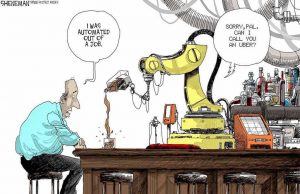
Cartoon about automation by Drew Sheneman

Reblog> Call for papers: “Human-technology relations: postphenomenology and philosophy of technology”

Via Peter-Paul Verbeek.

Call for papers: “Human-technology relations: postphenomenology and philosophy of technology”

The international conference “Human-Technology Relations: Postphenomenology and Philosophy of Technology” will take place on July 11-13, 2018 at the University of Twente, the Netherlands. The conference intends to bring together philosophers, scholars, artists, designers, and engineers in order to foster dialogue and creative collaborations around the interactions between humans, technologies, and society. As has been emphasized by several authors (e.g. Ihde, Haraway, Feenberg, Vallor, Latour, Verbeek), we cannot uphold strict distinctions between humans and technologies. As human beings, we are always interwoven with technologies in our daily practices. This conference aims to reflect on the consequences of this idea in philosophy, ethics, science, sociology, design, art, politics, anthropology, engineering, etc.

We welcome abstract submissions for posters, papers, panels, and workshops:

* Papers – abstract 250 words, and up to three keywords [20 minutes talk, 10 minutes for discussion].

* Panel proposals – can consist of up to 4 abstracts (see above), should include a general description (200 words) and the CV of participants and organiser.

* Posters – abstract 250 words, and up to three keywords. (Master students only, there will be a poster competition) .

* Workshops – description of 250 words, specific requirements.

Abstracts, along with a short CV, should be sent to phtr2018@gmail.com.

For an extended call for papers and description of the conference, please, visit https://www.utwente.nl/en/phtr/Call%20for%20Papers/

The conference is organized and financially supported by The Netherlands Organisation for Scientific Research (NWO) Project Theorizing Technological Mediation.