Review of Andrea Bardin’s Epistemology and Political Philosophy in Gilbert Simondon by @benturner91

On the website for the new journal La Deleuziana there’s an interesting review of Andrea Bardin’s Epistemology and Political Philosophy in Gilbert Simondon by Ben Turner.

I’ve not read Bardin’s book but probably should(!)…

Check out the review below:

BEN TURNER REVIEWS BARDIN’S SIMONDON

Andrea Bardin. Epistemology and Political Philosophy in Gilbert Simondon: Individuation, Technics, Social Systems. Dordrecht, Heidelberg, New York, London: Springer, 2014. 251pp. £90.00/€103.99, 978-9401798303.

 Review by Ben Turner (University of Kent, UK)

For the English reader, published works on and by Simondon are out of step. Despite several monographs, journal issues, and an edited collection of essays on his work, translations are severely limited. Given its length, it is productive to assess Bardin’s book with regards to the problem of this absence of primary texts for the English speaking world. In this respect, Bardin has made three achievements. The first is the breadth of primary material that Bardin draws on. Not content with limiting himself to what might be considered the central thesis of Simondon’s work – the relationship between structure and individuation – Bardin makes connections across all of Simondon’s published material, simultaneously charting the transformations in terminology and the continuity of problems across his work. Second, Bardin does not isolate these texts. He situates the problems that Simondon attempted to address in the context of the work he inherited. This context is extensive, covering Simondon’s tutors Georges Canguilhem and Maurice Merleau-Ponty, Henri Bergson, the cybernetics of Norbert Wiener, Emile Durkheim and positivism, the anthropologies of Marcel Mauss and Andre Leroi-Gourhan, as well as the physical and biological sciences. Discussion of these influences is woven into three thematic sections: ‘Nature and Knowledge’ (2-66), ‘Organism and Society’ (67-142), and ‘Technicity, Sacredness, and Politics’ (143-241). The last is dedicated to what can be seen to be Bardin’s third contribution. This is an account of Simondon’s politics on their own terms, rather than through the interpretations and re-readings of other authors. This ground has been addressed to some extent by the translation of Muriel Combes’ Gilbert Simondon and the Philosophy of the Trans-Individual (2012)1, but without the in depth work on Simondon’s transformation of his influences. I will discuss the success of his connection of Simondon’s work to its scientific and philosophical precursors, and conclude by assessing Bardin’s claim on what a Simondonian politics would consist of.

The scientific developments of importance for Simondon are quantum physics, thermodynamics, and biology read from the perspective of the cybernetic theory of information. Bardin shows that appropriating findings from these realms does not signal scientism, but the use of scientific developments within philosophy in order to fold this advance reflexively upon science itself. The aim of this folding is to complement sciences of structure with one of the processes that constitute individuals within these structures; an analysis of individuation across different domains of being (5-6; 16-17). Structure and process are rendered inextricable, and in an indeterminate relation through the adoption of three scientific concepts. Structures are considered as ‘phase-shifts’, a complex set of simultaneous parallel and divergent processes that make up a system (4). Individuals are defined in reference to transduction, a sequence emerging from a structure that is characterised by indeterminacy (4, 10). Lastly, a system is a ‘metastable’ relationship between a distribution of potentials that make up a structure, and the relationship between these potentials which are determined by an operation that distributes them (6). On this definition, there appears to be a tautological relationship between the terms structure and process. However, this is only apparent: Simondon applies scientific findings to show that they emerge together, transductively in complex processes of individuation, irreducible to structure, mechanism, or determinism (31). The cybernetic theory of information is transformed to complement this combination of structure and operation (a synonym for individuation), splitting the term information into a distinction between itself, and signal. The latter refers to the metastable operation of a system, whereas information is an aleatory interruption which can induce a phase shift, transforming this metastability and causing a new transductive process to emerge (27-31). As a result all systems are opened up to the outside, given the necessity of a piece of information to allow a relationship between structure and operation (73). The metastability between structure and operation traverses different domains of being, the physical, the vital and the psycho-social. The transition from one to another is a transformation of this logic, rather than the emergence of a new one.

Bardin’s summary of Simondon’s complex reading of this scienfic literature is erudite, and he provides a clear presentation of how concepts from physics, biology and cybernetics are used to construct a general understanding of structure and operation. There are three shortcomings that must be flagged up however. First, despite the crucial role they play, non-specialists are left somewhat in the dark as to the original meaning, content and development of these concepts. The re-construction of scientific theory is generally in deferral to Simondon’s usage of a particular concept, rather than their contribution to the field. Bardin’s choice appears to be motivated by fidelity to Simondon’s texts, but the lack of more than a minimal reconstruction of the scientific fields is a barrier to understanding the real innovation of Simondon’s reading. Second, the lasting validity of scientific research used by Simondon leaves one wondering if Simondon’s work could be outdated or outstripped at the scientific level? Lastly, and connected to the previous point, since Simondon’s claim is at heart an epistemological one, the real ramifications for science of a theory of structures and operations is left without conclusions beyond the field of philosophy (61-66). The possibility of a truly ‘ontogenetic’ practice of science is left open. Given the title, Bardin’s book is clearly not aimed at answering these questions. Nevertheless, pertinent questions are made possible not just for the English speaking audience, but all readers of Simondon, which may have been better served by a stronger presentation of the scientific background and contemporary state of affairs in science.

Contrastingly, Simondon’s relation to his philosophical precursors, in particular his tutors Canguilhem and Merleau-Ponty receive an exemplary treatment. Simondon’s extension of their thinking into his own is clearly set against the background of his use of scientific work. The critique of structure in the sciences is simultaneously a critique of hylomorphism in philosophy; the assumption that substance and form can be separated. Simondon assumes the anteriority of the pre-individual, which is not a substance to be formed, but a set of potentials that do not pre-exist individuation temporally, but logically (37). It is never exhausted by any process, accompanying it as latent potential for further transformation by new information. Bardin shows how the pre-individual furthers the work of Merleau-Ponty and Canguilhem. Merleau-Ponty’s lecture course on nature is claimed to influence Simondon here (40-41)2. He radicalises the vision of an unstable, primordial reality with the cybernetic concept of information to restrict the phenomenological assumption of sense to the psychic and collective level of individuation (41-3). The ramifications of such a move are clearly shown by Bardin to differentiate Simondon from phenomenology, without forgetting Simondon’s own debt to phenomenology (43-7).

Bardin shows that from a phenomenological perspective, Simondon’s concept of the pre-individual assumes an understanding of ‘nature’ that seeks to go beyond the horizon of sense that limits thought. Drawing on Canguilhem, Simondon avoids this pitfall, as the pre-individual is not assumed to be a homogenous substance. The dynamic intertwinement of pathology and normativity that Canguilhem uses to define life as error, is applied by Simondon to all individuation (76-7). The pre-individual is not anterior to processes of individuation, but rather emerges as a metastability within a regime of transductive individuation, at the same time as knowledge of these processes. The individual must emerge within a milieu, but this milieu emerges at the same time and in a transductive relation (58-9). This insight is utilised by Simondon to criticise the assumption of the possibility of closure at the level of both vital, and psychic and collective individuation. While structure is important, individuation transforms the pre-individual, animating structure. Canguilhem’s introduction of the intertwinement of normativity and milieu thwarts the closure relied upon by the cybernetic theory of systems, complementing Simondon’s introduction of the signal/information distinction (113-116). Bardin also shows how Simondon moves beyond Canguilhem’s assumption of the exteriority of regulation to the organism, as an individual is always a phase shift in a complex transductive relation between inside and outside, and various domains of being (117-18).

This complex leads to a presentation of a Simondonian politics. This begins from the distinction between open and closed societies, or society and community, that Simondon adopts from Bergson (91-2; 108-9). These two tendencies within psychic and collective individuation refer to its amenability to new forms of individuation (society), and an attempted move towards closure (community) (97-8). The condition of possibility of any group is a transductive relation between transformation and the upkeep of identity. This precludes anthropology imposing itself upon the study of societies from above, because the forms of opening and closure that Simondon describes (belief, work, language) are a phase shift of the relationship between individual and milieu at the vital, non-human level. For example, work is a tendency that exists at the level of the biological community of animals, as a tendency towards closure. At the level of psychic and collective individuation, community phase shifts an existing tension into a new one (101-2). Following the critique of determinism, and the notion of the pre-individual that only exists insofar as it is transformed, these individuations of societies are seen as singularities. The structuring capacities of community and the ways these are opened by society are limited to the process they are involved in. So while structural limits play a role in determining these processes, Bardin demonstrates how Simondon’s assumption of the singularity of process moves him beyond the Structuralist paradigm that was establishing its hegemony in France at the time (158-9).

The first aspect of Simondon’s political thought derives directly from this re-thinking of the epistemological problem of structure and individuation. It can be analysed using an onto-genetic method, investigating the singular processes in which a pre-individual set of potentials is transformed through the tendency towards society, and the way in which these processes are closed in upon themselves by community. Bardin provides the insight that this distinction cannot be mapped onto the ‘political difference’ put forward in recent thought, between ‘politics’ as governance and ‘the political’ as an ontological field of contestation that is both the condition of, and what disrupts politics3. Simondon’s political project is closer to mapping the intersections between these two realms, between communal regulation and societal invention, in accordance with his theory of individuation at physical and biological levels (220-21). There is no political force outside of structure that can be appealed to in and of itself; the political is a mobile concept that must be traced through these processes of individuation.

The second key aspect of Simondon’s political thought is an extra term that must be taken into account in this onto-genetic exploration of the political dynamic between openness and closure. This is the one for which Simondon first became known for: technics. While the dynamic between openness and closure depends upon the first two sections of the book, Bardin devotes extended time to the issue of technics in the last section. This continues the understanding of the political as the product of a mobile relationship between structure and operation, it is technics that structures the norms of community, and simultaneously opens it up to the re-evaluation of these norms by society (136-9). Culture finds its source in technics as the envelope in which social systems encounter the world, founding an external milieu that filters interaction with the environmental milieu (129-30). This includes, as Bardin summarises, distinctions between phase shifts across human history that differentiate the way in which forms of organisation such as magic, the sacred, and religion interact with technics. What makes Bardin’s summary particularly insightful is a balance between showing how these terms (culture, magic, the sacred, technics) transform their meaning within Simondon’s work, and establishing a coherent reading. He claims that that there is a complex intertwinement between environment, biological individuation, psychic and collective individuation enabled by technics, which makes the latter political (148-9, 165). Tracing the individuation of the relationship between invention and regulation in social systems, requires the investigation of how this ontogenetic political dynamic is sutured by technics.

Bardin provides two political strategies that emerge from this understanding of the political. The first is pedagogical. Technics is taken to possess a form of universality that transcends the universals of any individual social system (199). The insertion of technical schemas into social groupings is not taken to be universal in a teleological sense, as it can only determine the transformation of groups under the conditions of relative compatibility and indeterminacy. A pedagogy of the technician would understand and institute technical schemas, not in order to reduce their effects to the logic of identity as the ‘same’, but to allow the potential of technics to render the openness of society and revalue the norms of community. This pedagogy of technics appears as a drive towards a politics of the reflexive understanding of how technics conditions and transforms the cultural milieus in which it emerges and can be placed into (200-202). The second political strategy derives from the ambiguity of the meaning of the political in the paradigm of individuation (232-3). A propensity towards both universality and incalculability is possessed by technics. (226-27). This is, therefore, a form of universality without origin or end, open to aleatory transformations (232-3), rather than immobilisation in the case of the sacred (183-4). Technical universality is therefore the enveloping, transformative, and political potential it has for psychic and collective individuation. According to Bardin, the transformation of scientific concepts and his use of the paradigm of information allows Simondon to put forward this non-technocratic pedagogical politics of technics, for it relies on openness and transformation inherent to processes of individuation (236-7).

Bardin does not make extensive comparison to others use of Simondon’s work (Agamben, Deleuze & Guattari, Stiegler, for example), but he gives a convincing account of Simondon’s politics on its own terms. A mobile concept of the political is derived from the analysis of regimes of individuation, and technics is what intertwines psychic and collective individuation with the physical and the biological. Such a theory that simultaneously provides a mode of analysis of processes, and a politics to navigate them, is crucial today, particular when one considers the most urgent example of our intertwinement with biological and physical forces: climate change. Under the stresses of a rapidly changing relationship between climate and humanity, returning to Simondon’s work can move us beyond a politics that derives its principles from the mere fact of our ‘non-anthropocentric’ entanglement with matter (the worst excesses of new materialism). Instead, it impels us to begin from the necessity of thinking how specific human organisations emerge, and provides a paradigm for studying, and implementing technical strategies to deal with their problematic elements. In this sense, Bardin has made a valuable contribution not just to the study of Simondon, but to research on the relationship between the political and the material, in a way that does not privilege either.


  1. Muriel Combes (2014), Gilbert Simondon and the Philosophy of the Trans-Individual, trans. T. LaMarre, Cambridge: The MIT Press. â†©
  2. Maurice Merleau-Ponty (2000), Nature: Course Notes from the Collège de France, ed. , trans. R. Vallier, Evanston: Northwestern University Press. â†©
  3. Oliver Marchart’s Post-Foundational Political Thought (Edinburgh University Press, 2007) is a key text for analysing many thinkers through this heuristic. â†©

Theorising Bioart encounters after Simondon – paper by Andy Lapworth

Alba the transgenic rabbit – bioart by Eduardo Kac

Andrew Lapworth, who recently finished a PhD in Geography at Bristol, has written a really interesting and accomplished article that has just come out as ‘Early Online‘ in Theory Culture & Society. I recommend reading it if you have any interest in the philosophy or sociological studies of science, technology and bioart. Sadly, its behind the paywall…

Here’s the abstract:

In recent years ‘bioart’ has been lauded in the social sciences for its creative engagements with the ontological stakes of new forms of biotechnical life in-the-making. In this paper I push further to explore the ontogenetic potentials of bioart-encounters to generate new capacities for thinking and perceiving the nonhuman agencies imbricated in the becoming of subjects. To explore this potential I stage an encounter with Gilbert Simondon’s philosophy of individuation, highlighting three implications for theorizations of the constitution and transformation of subjects. First, Simondon forces us to rethink the subject in terms of its transductive emergence from pre-individual processes, and its metastable susceptibility to ongoing transformations. Second, he substitutes voluntarist conceptions of thought with an involuntarist primacy of material encounters as the conditions for novel individuations. Finally, I argue that Simondon enables a thinking of the politics of the (bio)art-encounter in terms of its ontogenetic capacity to materially produce, rather than merely represent, new subjects and worlds.

Amazon as the exemplar of authoritarian employment..?

Just a quick post to park two related things here on the blog in order to return to them…

First: this story on Fusion:

The Amazon Way: Why the data-driven workplace is a nightmare  which describes a corporate culture driven by personal and collective analytics that overrule any consideration of hard-to-measure or qualitative considerations… and how that is prosecuted through a hellish kind of managerialism.

Second: This list/story on The Grauniad:

Why the workplace of 2016 could echo Orwell’s 1984 which essentially lists any and all kinds of personal surveillance technologies–currently marketed as ‘quantified self’ and other kinds of self-knowledge tools–and packages them up into some kind of nightmare version of the Amazon managerialism explored above.

What’s interesting? I think its interesting how a particular version/vision of the future of work plays out between these stories that strays close to a form of technological determinism and exemplifies an influential way that ideas about work, and how it may change, are being discussed.

Reblog> CounterText: call for papers

Interesting CFP via Edinburgh Press blog...

CounterText
Call for Papers
Special Issue: Explorations in Electronic Literature
Edited by Mario Aquilina and Ivan Callus

An entire epoch of so-called literature, if not all of it cannot survive a certain technological regime of telecommunications.
– Jacques Derrida, The Post Card

Is literature surviving? Is it not still electrifying? Might electronic literature be one form of its survival? Does electronic literature mark another stage in the evolution of literature or does it open a new, unprecedented paradigm for the concept of the ‘literary’? This special issue investigates electronic literature’s challenges to established conceptions of literature and literariness. The following will be irrepressible questions. How should authorship, creation and originality be rethought? Can we still speak of ‘literature’ when the letter becomes only one element in works which are characterised by kinetic, visual, ludic, and sensory dynamics? Can we think of the electronic (post-)literary also as an electronic post-letter? And how might this be countertextual?

The apocalyptic threat to literature implied in Derrida’s comment on ‘a certain technological regime of telecommunications’ has not come to pass, nor might we be expecting it to. There can be no doubt, however, that computing technologies and code (the digital affordances enabling electronic literature) can prompt fevered speculation on literature’s evolving futures and platforms. As a result literary criticism, too, changes. Long traditions of aesthetic, thematic and formal discussions of literature are brought into question by electronic literature, as is the meaning of reading more generally (never mind close reading).

However, discussions of electronic literature countenancing technological determinism risk ignoring genealogies of electronic literature founded in long traditions of combinatorics and generative (not quite algorithmic) rules. Is electronic literature, then, a manifestation of a potential always already within the literary rather than simply a technology-determined transformation in the literary? And if it is so, how do we conceive the temporal relation and notional continuities between electronic literature and print literature, for example? Do we speak of supplementation, supplantation, renovation, complementarity, convergence? All these terms seem unsatisfying – but why?

The editors of this special issue of CounterText welcome articles with a focus related to these and related points that explore the connections between electronic literature and the concepts of ‘literature’ and ‘literariness’. The following list indicates some other possible points of discussion:

  • E-lit and new understandings of literary ‘value’.
  • The humanist affinities of e-lit.
  • E-lit and communal understanding of the literary.
  • E-Lit and the expectation of originality.
  • E-lit as a literature of the fragment.
  • E-lit and the problem of the total work.
  • Precursors of the electronic post-literary.
  • The space of e-lit: where does e-lit happen?
  • E-lit and literary criticism and theory.
  • E-lit as literary criticism and theory.
  • The role of the letter in e-lit.
  • Code and literariness.
  • Literariness and digital affordances.
  • E-lit as a space where literature meets other art forms.

Potential contributors to the special issue may email the Guest editor, Mario Aquilina (mario.aquilina@um.edu.mt), or Ivan Callus (ivan.callus@um.edu.mt) for further information. They may also wish to refer to the journal’s site for information about CounterText‘s style sheet (http://www.euppublishing.com/journal/count).

Submissions are to be sent as an email attachment to countertext@um.edu.mt by 14thDecember 2015. Notice of acceptance/refusal will be given by February 2016. Final manuscripts incorporating editorial suggestions and changes will then have to be submitted by 28th March 2016.

Some thoughts about how ‘algorithms’ are talked about & what it might mean to study them

A while ago, in a grump, I tweeted something along the lines of “I’m fairly convinced that most social scientists who write about algorithms do not understand what that term means”… Provocative I know, but I was, like I said, in a grump. Rob Kitchin tweeted me back saying that he looked forward to the blogpost – well here it is – finally.

I’m afraid its not going to be a well-structured and in-depth analysis of what one may or may not mean by the word algorithm because, well, other people have already done that. What I want to offer here is an expression of the anxiety that lay behind my grumpy tweet and means of mitigating that. So, this is a post that uses other people’s work to address:

  • what is an algorithm?
  • how/should we analyse/study them?

To be totally open from the start, my principle sources here are:

So, what do we mean when we use the word ‘algorithm’?

To begin with a straight-forward answer from Paul Ford:

“Algorithm” is a word writers invoke to sound smart about technology. Journalists tend to talk about “Facebook’s algorithm” or a “Google algorithm,” which is usually inaccurate. They mean “software.”

Algorithms don’t require computers any more than geometry does. An algorithm solves a problem, and a great algorithm gets a name. Dijkstra’s algorithm, after the famed computer scientist Edsger Dijkstra, finds the shortest path in a graph. By the way, “graph” here doesn’t mean  but rather 

Or, as Rob Kitchin notes in his working paper it is (following Kowalski) “logic+control“, such that (citing Miyazaki) the term denotes a form of:

specific step-by-step method of performing written elementary arithmetic… [and] came to describe any method of systematic or automatic calculation.

This answers a simple definitional question: “what is an algorithm?” but doesn’t quite answer the question I’ve posed: “what do we mean when we use the word algorithm?”, which Ford gestures towards when suggesting journos (and one might include a lot of academics here) use the word ‘algorithm’ when they mean ‘software’. As Gillespie notes

there is a sense that the technical communities, the social scientists, and the broader public are using the word in different ways

There isn’t a single/singular meaning of the word then (of course!) and after decades of post-structuralism that really shouldn’t be a surprise… nevertheless there is a kind of discursive politics being performed when we (geographers, social scientists etc etc) invoke the term and idea of an ‘algorithm’, and we perhaps need to reflect upon that a little more than we do. I may be wrong, perhaps we just need to let the signifier/signified relation flex and evolve – my main motivation for addressing this question is that I think we do already have useful words that address what is being suggested in the use of the word ‘algorithm’ – amongst these words are: code, function (as in software function), policy, programme, protocol (e.g. Ã  la Alexander Galloway), rule and software.

What is salient about the technical definition of an algorithm to how we might use the word more broadly is the sense of a (logical) model of inferred relations between things formally defined in code that is developed through iteration towards a particular end. As Gillespie notes:

Engineers choose between them based on values such as how quickly they return the result, the load they impose on the system’s available memory, perhaps their computational elegance. The embedded values that make a sociological difference are probably more about the problem being solved, the way it has been modeled, the goal chosen, and the way that goal has been operationalised.

What quickly takes us away from simply thinking about a function defined in code is that the programmes or scripts upon which the algorithms are founded need to be validated in some way – to test their effectiveness, and this involves using test data (another word that has become fashionable). The selection of the data also necessarily has embedded assumptions, values and workarounds which, as Gillespie goes on to suggest: “may also be of much more importance to our sociological concerns than the algorithm learning from it.” The code that represents the algorithm is instantiated either within a software programme – a collection of instructions, operations, functions etc. etc. – that is bundled together as what we used to call an ‘application’ or it might exist in a ‘script’ of code that gets pulled into use as and when – for example: in the context of a website. As Gillespie argues:

these exhaustively trained and finely tuned algorithms are instantiated inside of what we might call an application, which actually performs the functions we’re concerned with. For algorithm designers, the algorithm is the conceptual sequence of steps, which should be expressible in any computer language, or in human or logical language. They are instantiated in code, running on servers somewhere, attended to by other helper applications (Geiger 2014), triggered when a query comes in or an image is scanned. I find it easiest the think about the difference between the “book” in your hand and the “story” within it. These applications embody values as well, outside of their reliance on a particular algorithm.

This is often missed when algorithms are invoked, all-too-quickly, in the discussion of contemporary phenomena that involve the use of computing in some way. Like Kitchin says in his working paper:

As a consequence, how algorithms are most often understood is very narrowly framed and lacking in critical reflection.

Indeed, I’d go further, there’s a weird sense in which some discussions of ‘algorithms’ connote the dystopian sci-fi of The Matrix, or The Terminator. Ian Bogost has gone so far as to suggest that this is a form of ‘worship’ of the idea of an ‘algorithm’, suggesting

algorithms hold a special station in the new technological temple because computers have become our favorite idols.


And as Gillespie noted in an earlier piece:

there is an important tension emerging between what we expect these algorithms to be, and what they in fact are

Yet, as with production of religious texts, there are people making decisions every step of the way in the production of software. On top of that, there were decisions made by people in all of the steps of the development and production of the other technologies and infrastructures upon which that software rely.

What we mean when we use the word ‘algorithm’ is, as Gillespie argues (much better than I), a synecdoche: “when we settle uncritically on this shiny, alluring term, we risk reifying the processes that constitute it. All the classic problems we face when trying to unpack a technology, the term packs for us”.

Calling the complex sociotechnical assemblage an “algorithm” avoids the need for the kind of expertise that could parse and understand the different elements; a reporter may not need to know the relationship between model, training data, thresholds, and application in order to call into question the impact of that “algorithm” in a specific instance. It also acknowledges that, when designed well, an algorithm is meant to function seamlessly as a tool; perhaps it can, in practice, be understood as a singular entity. Even algorithm designers, in their own discourse, shift between the more precise meaning, and using the term more broadly in this way.

How should we study algorithms?

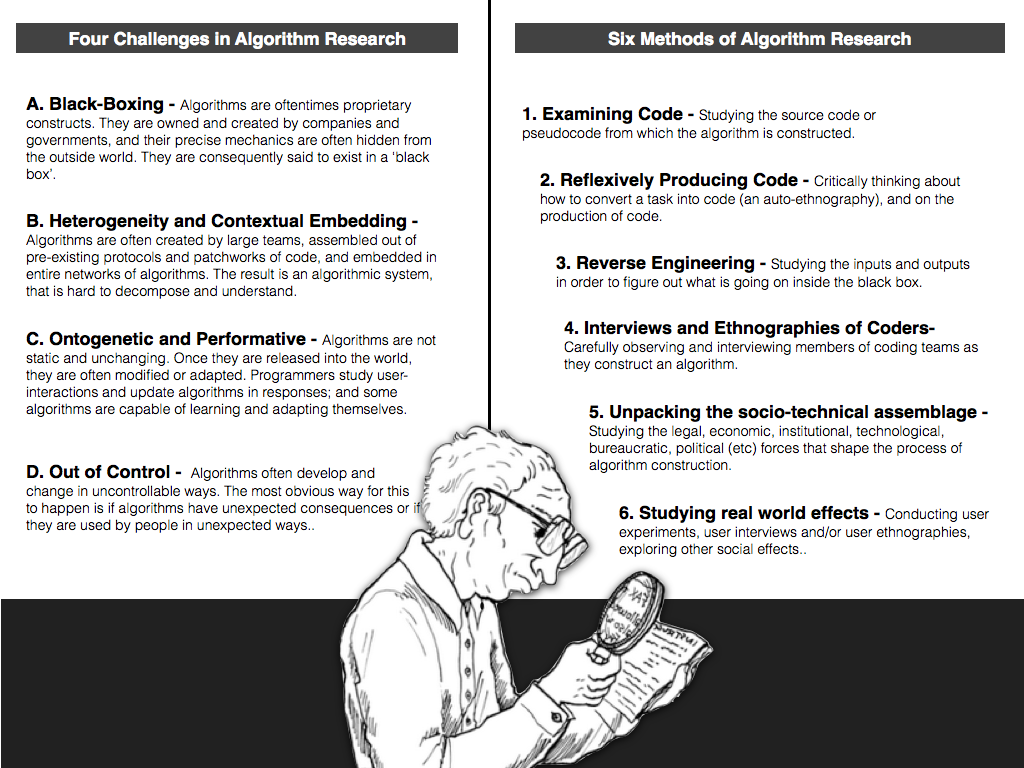
Here, I’m not totally sure I can add much to what Kitchin has written in his working paper. This has been adroitly summarised by John Danaher on his blog, and he produced this brilliant graphic:

The challenges and methods for studying algorithms


We need to be alive to the challenge that most software we may be interested in is proprietary, although not always and we can look to repositories like GitHub for plenty of open source code, and so it may actually prove impossible to gain access to the code itself –– and here we’d really want the code of the whole programme, and perhaps the training data too. Likewise, software like any complex endeavour may well be the result of collective authorship and maintained by lots of different people. So there are complex sets of relations between people, laws, protocols, standards and many other considerations to negotiate – they are contextually embedded. Furthermore, the programmes we’re calling algorithms here actually have a hand in producing the world within which they exist –– they may bring new kinds of entities and relationships into existence, they may formulate new and different forms of spatial relation and understanding. In this sense they are ontogenetic and performative. Added to this, once ‘in the wild’ this performativity can render the kinds of outcomes of a programme unexpected and peculiar, especially once it is fed all sorts of data, adapted and adopted in unexpected ways.

How can we go about studying these kinds of socio-technical systems then? Well, rather than treat as discrete the six techniques offered by Kitchin (summarised above) – I’d argue we need to combine most of these. Even so, it may prove extremely difficult to actually gain access to code. Further, even if one might reflexively produce code and/or attempt to reverse engineer software –– some systems are the product of companies with such extensive resources that it may well prove near-impossible to do so. Where social scientists might find more traction and actually be able to make a more valuable contribution is, as Kitchin suggests, looking t the full sociotechnical assemblage. We can look at the wider institutional, legal and political apparatuses (the dispositifs) and we can certainly look at the various kinds of relation the assemblages make and how they are enrolled in performing the world they inhabit.

Make no mistake – this kinds of research is necessarily hard. I’m not sure I can imagine papers in geography journals that tie the a/b testing logs of experiments in how a given system works and commit logs to version control systems (even if you could access them!) to particular forms of experience and/or their political consequences… but it might be worth a go. Perhaps this difficulty is why we see (and I am as guilty as any of this) papers written in abstract terms, focusing on the (social) theoretical ways we can talk about these sociotechnical systems in broad terms.

Like Bogost, I can see a kind of pseudo-theological romancing of the ‘algorithm’ and the agency of software in much of what is written about it, and its sort of easy to see why – it is so abundant and yet relatively hidden. We see effects but do not see the systems that produce them:

Algorithms aren’t gods. We need not believe that they rule the world in order to admit that they influence it, sometimes profoundly. Let’s bring algorithms down to earth again.

The algorithm as synecdoche is a kind of ‘talisman’, as Gillespie argues, that reveals something of what Stiegler calls our ‘originary technicity’ – the sense in which we (humans) have always already been bound up in technology and its the forgetting and then remembering of this that forges our ongoing reconstitution (transindividuation) of ourselves.

So, I’d like to end with Kitchin’s argument:

it is clear that much more critical thinking and empirical research needs to be conducted with respect to algorithms [and the software and sociotechnical systems in which they are necessarily embedded] and their work.

Addendum:

It is worth noting that both Gillespie and Kitchin draw on another paper that is very much worth reading by Nick Seaver, who reminded me of this on Twitter, take a look:

“Knowing Algorithms“, presented at Media in Transition 8, Cambridge, MA, April 2013 [revised 2014].

Reblog> Gilbert Simondon and the Philosophy of Information: An Interview with Jean-Hugues Barthélémy

Andrew Iliadis blogs that an interview he conducted with Jean-Hughes Barthélémy has been published. This is a really valuable contribution to anglophone scholarship on the work of Simondon and Andrew should be congratulated (well I do anyway!). This is well worth a look if you are interested in the philosophy of technology or in how we understand the idea of ‘information’.

GILBERT SIMONDON AND THE PHILOSOPHY OF INFORMATION: AN INTERVIEW WITH JEAN-HUGUES BARTHÉLÉMY

homeHeaderTitleImage_en_USThe new issue of Journal of French and Francophone Philosophy is out. It includes an interview that I conducted with Jean-Hugues Barthélémy entitled “Gilbert Simondon and the Philosophy of Information.” For those of you who don’t know, Barthélémy is a leading expert on Simondon as well as director of Centre international des études simondoniennes.

LINK: http://jffp.org/ojs/index.php/jffp/article/view/679/679

Computing the human – biometrics and our dividual selves

Over on the excellent Aeon website there’s a beta section called ‘Ideas‘ that poses questions and solicits responses. One such question is: “How will biometrics transform surveillance culture?“. To which Kelly Gates (UCSD) offers an adroit response in the form of a short essay entitled ‘Computerising Humans‘.

Gates unpicks the technological deterministic fatalism of the expectation that the widespread deployment of biometric technologies is a foregone conclusion. She argues:

There’s also an assumption that in the very near future, these technologies will be capable of automatically identifying us with near-perfect accuracy, free of the messy cultural baggage that muddles the way humans identify one another. Human perception is inherently biased and flawed, according to this logic, while computers are inherently objective, free from error and prejudice.

It follows that, and as Gates goes on to argue, to invent the technology, be the owner of the data upon which it operates and then verify the ‘accuracy’ of that technology (as Facebook do with their facial recognition systems) means that one necessarily invents the accuracy of that technology as well. Likewise, in creating such systems and the parameters in which they (must) operate (to be effective) we necessarily circumscribe and predetermine their uses, and thus also invent their usefulness. Therefore, in this sense, by inventing the technology and its usefulness we invent the future in which it is necessary:

In other words, inventing the accuracy of biometric technologies involves making bigger claims about what they can do than their limited experimental results can support.

Of course, such a process of invention is also, necessarily, a (re)invention of our ‘selves’, in multiple. It is a kind of ontogenetic (and more specifically here, technogenetic process, as Gates highlights – although I prefer Simondon to Hayles on this point). The multiple nature of the data representations of our ‘selves’ convenes the various ways in which we are conceived as entities, in data and in flesh, and thus the multiple ways our identities are performed. We are reinvented by looking back at our-selves through  the ‘eyes’ of the technology: the surveillant relation between the unblinking gaze of the technology and our performance of identity is co-constituted.

Understanding ourselves as fully enmeshed with technologies might help us get a better sense of what biometrics portend for our already surveillant culture. We already conceive of ourselves as people with official identities composed of disembodied aggregates of transaction-generated data–digital representations of ourselves that circulate over networks. In fact, it is a necessary precondition of biometric system development that we conceive of ourselves in this way. In short, if computers are getting better at recognizing humans, it’s because humans are getting much better at looking at, and seeing themselves, much like computers.

A helpful way of understanding this is through the brief exposition of the ‘dividual’ Deleuze makes in his Postscript on the Societies of Control: “a physically embodied human […] that is endlessly divisible and reducible to data representations via the modern technologies of control, like computer-based systems” (as Robert Williams has it). If we look at the production and performance of our selves, as ‘dividuals’, we are, I would argue, confronting the necessity to un-think “the subject” (following J-D Dewsbury’s Deleuzian reading of Badiou). We accordingly consume our selves by trusting in the apparatuses of multiple surveillance (Facebook etc.) and are invited to deny what is incalculable.

Stiegler would perhaps argue that to combat our rendering as biometric surveillant subjects we must take care of our selves, of our incalculability; believe in that incalculability, and make that care a basis of our political economic relations. Of course, that is far easier said than done. Biometric technology does not necessitate the rendering of ‘dividuals’, that future is not a forgone conclusion, but it will take a lot of work to invent an alternative.

Robot-caused death

A robot has tragically caused the death of a VW worker, we learn in today’s news coverage. According to Wikipedia (yes, I know…) this is, quite remarkably, only the third reported industrial robot-caused fatality.

The first two reported deaths of workers caused by manufacturing robots happened in the late 1970s and early 1980s:

Robert Williams was killed in Detroit by a parts recovery robot in the Ford Flatrock Casting Plant (Michigan) in January 1979. A circuit judge in the US found the manufacturer of the equipment criminally liable and ordered Unit Handling Systems USD$10m to the Williams family.

Kenji Urada was killed in Akashi (near Kobe) by an industrial robot in a Kawasaki Heavy Industries plant in July 1981.

There is a temptation to think about some kind of intentionality (however weak) or malign tendency by the machine here, largely because of the word ‘robot’ and because of the detailed imagination of what constitutes the entities we might commonly understand to be referred to by that term. The chatter on Twitter about the sad VW incident certainly seems to invoke the kind of Asimov-style Sci-Fi robotics of I, Robot and the Terminator.

The corollary to this is, of course, that we have become very used to seeking blame located in a single figure of a ‘wrong-doer’. Indeed, we have sought (in the UK) to enshrine this in law after a fashion by holding senior manager personally to account in corporate manslaughter cases. Thus it is unsurprising that TIME magazine report that:

Prosecutors are still deciding whether to bring charges and whom they would pursue.

One can argue, however, that a desire for singular culpability is misconceived. The workers tragically killed in all three of cases were involved in complex assemblages or systems that, even with contemporary safety systems, have contingencies that might lead to undesirable ends. In this way, while the contexts are very different, the worker in today’s robotically enable factory is a distant relation of the 19th century mill worker powerfully described by Friedrich Engels.

Workers both in the 19th century and today have to be alive to the operation of a complex and continent manufacturing system, with many kinds of rules and procedures that circumscribe a place for the human body and its function within industrial manufacturing. If one places their body outside of that circumscribed place, or if the rules of circumscription shift (by accident or design) then the body is at risk of harm.

There may all sorts of factors that lead to a manufacturing accident, but I would hazard that they are more often than not a condition of what it means to work and how that work is designed: how the body fits within the system, or how that system is programmed to accommodate the body, rather than a malign or supernatural robotic agency.

For example: Urada was trapped by the work arm of the robot which pinned him against a machine which cuts gears and was killed. He had entered a prohibited area around the robot to repair it. According to factory officials, a mesh fence around the robot would have shut off the power when unhooked, but instead of opening it, Urada had apparently jumped over the fence. He set the machine on manual control but accidentally brushed against the on-switch, and the claw of the robot pushed him against the machine tooling device.

A grizzly story and one might look at the safety procedures and equipment. There are of course standards and codes of practice for safe working with robots (by the ANSI and the HSE for example). Nevertheless, it remains the case that Urada transgressed those procedures putting himself at risk. We can only speculate about why he did so, but again that is a condition of work, not of robots as such.

All three of the deaths caused by manufacturing robots are tragic and all three have and will no doubt prompt questions about how complex systems of manufacture that may be hazardous to the human body can be made as safe as possible. They could, and perhaps should, also prompt questions about how we work (see, for example, this article in the FT).

Reblog> Book Symposium on Le concept d’information dans la science contemporaine

On his blog Andrew Iliadis shares an excellent book symposium article published in Philosophy and Technology (paywall), for those interested in the philosophy of technology and in the work of Gilbert Simondon this is a really valuable addition to the scant material in English. It also includes a stellar cast of interlocutors, so kudos to Andrew!

13347I’m happy to announce that our Book Symposium on Le concept d’information dans la science contemporaine has just been published online at the journal homepage of Philosophy & Technology. Many thanks to Nandita Biswas Mellamphy, Jean-Hugues Barthélémy, Marc J. de Vries, and especially Nathalie Simondon for contributing to the volume.Link: http://link.springer.com/article/10.1007/s13347-015-0205-z

PDF: Book Symposium on Le concept d’information dans la science contemporaine

Bernard Stiegler – Digital shadows and (en)light(enment)

The translation below is the second half of the “Net Blues” interview with Bernard Stiegler conducted by the Le Monde blog “Lois des réseaux” [Laws of the networks].

In this second-half of the interview Stiegler discusses how the web should evolve developing the trope of ‘enlightenment’ (which he has significantly discussed in Taking care of youth and the generations), drawing out the play on words between light and shadow and ‘the Enlightenment’. Highlighting the web as the latest stage in publishing technologies (which have historically been central to political movements), Stiegler argues a new industrial politics must be developed, by Europe, as the ‘curative’ counter to the ‘toxic’ trend towards automation and homogeneity brought about by computation. This is the ‘pharmacological’ character of the internet Stiegler discusses in the ‘Net Blues‘. The new industrial politics Stiegler argues for has universities and the production of knowledge at its heart.

As usual clarifications or questions over the translation of a particular word are in square brackets and all emphasis is in the original text.

Digital shadows and (en)light(enment)

What do you think needs to be happen for the web to evolve?

Bernard Stiegler: I think that the web today is an entropic system. It first appeared, for most of us, not least for myself, as a negentropic opportunity, that is, as a new capacity for diversification, especially because it has allowed people to begin to differentiate between different kinds and uses of media [parce qu’il a permis de démassifier les médias]. Today, major newspapers, such as Le Monde and many others, allow all kinds of actors to convene around the newspaper, collecting together a very diverse range of views. This is an opportunity and it has given the sense of a kind of renaissance, following the development of an extreme consumerism within the mass media and the culture industries becoming an undifferentiated mass [qui avait été une sorte de laminoir] – especially in the last twenty years. Media such as television deteriorated terribly. All of which was related to an economic and industrial model that is now in decline.

Nevertheless, the web initially appeared as an opportunity for negentropy, that is to say of diversification. However, what we’ve discovered in recent years, in particular since we began to speak of the ‘Big Four‘, is the extraordinary hegemony of global giants who have gained an unprecedented prescriptive power over behaviour.

Only the United States takes full advantage of this economy of data. The data economy, which is destroying European national taxation and increasingly deprives public authorities of their capabilities to act, is based on a generalized calculability which is at odds with the negentropic promise of the web. This calculability tends towards the reintroduction of the law of the audience ratings. The page ranking performed by Google’s algorithm is a very specific, surgical form of audience rating, which is very efficient and very refined, but like television audience rating leads to the transformation of singularities into peculiarities, i.e. computable items, because it homogenises and de-singularises. Unlike the individual, the singular is incalculable. In this case, we have a new entropy process that we feel threatens languages. This is how I interpret Frederic Kaplan’s analysis of what he calls “linguistic capitalism.”

However, this predicament is not legislated, and it could be entirely different: the web in the service of an intensification of “individuation”, in other words singularities, is the future–and it is the future of Europe. Given the present circumstances, the web would totally horizontalise and level out information, because it requires processes of computation based on the removal of any lack of transparency.

As I said earlier, the web and the internet are publishing techonologies. Publishing technologies are the origin of what Plato calls πολιτεία (Politeia, Ed.) that we translate as res publica in Latin. Why do we translate it as res publica? Because Politeia constitutes a “public good”, as we discussed earlier. And the establishment of public goods requires publication technologies, which for the Greeks was writing. Marcel Detienne has shown that the Athenian city is like a vast typewriter that has wrote into the marbel of the walls of the city. After each decision of the Βουλή (boulè [parliament], Ed.) the publishers of the law wield the hammer and chisel to carve the decision in stone. This process of publication created the public right of citizens to criticise the law. One enters the politeia, citizenship, and [so] paves the way to democracy. Today, with digital computation, a whole new publication system is in place.

However, we always claim that the state of political rights, and the accompanying reason, is what the Greeks called λόγος (logos, Ed.). However, this assumes that such processes of publication enables disagreement, the publication of contradictory arguments, which we call public debate, and which is a fundamental rule of all rational knowledge. The promise of the web was to revive public, political, scientific or aesthetic debate. But this promise has not been kept. From the moment Google, Amazon and such companies had to make a profit from all of this, they became totally interested in equalising and levelling out data in order to exploit it with algorithms, crushing disagreement rather than enabling traceability and widespread intelligibility. I do not think this situation can last. The basis of knowledge, in all its forms – I’m not just talking about theoretical knowledge, its also true of ‘know how’ [savoir-faire] and life skills [savoir-vivre] – is grounded in a fundamental diversification, which when [knowledge] ceases, leaves behind dead knowledge – like dead languages and towns transformed into museums [villes muséifiées]. If the sciences and knowledge are founded on publication processes, the development of the digital is a radical transformation of knowledge, and in particular of academic knowledge. The power of Europe and the West is founded on power over knowledge. The emperor Frederic Barberousse, who, in opposition to the Pope, granted freedom to the University of Bologna in the 13th Century, initiated a process followed by Oxford, the Sorbonne and Cambridge. It is not the Conquistadors and the caravels that are the primary origin of the centuries-long global domination of the West: it is the reliance upon universities. This clearly evolves in new directions with the appearance of new devices for printing – and the cognitive as well as spiritual revolution brought about by Luther is clearly a consequence of such publishing technologies, by which Luther makes reading the scriptures for oneself the heart of his struggle. Along with the Counter Reformation, this leads to the foundation of the Jesuit Schools and the Jesuits evangelising around the world through their missions, which constitutes a fundamental aspect of the Enlightenment project, and this, with Condorcet[1] and the French Revolution, leads to Jules Ferry[2] via Guizot[3].

Obviously, the web, and the digital more generally, totally reconfigures these maps from top to bottom – not only the maps for teaching but the conditions of scientific research and the life of the mind in all its forms. Europe should not fear this, even less so since it is the origin of the concepts of the web and HTML, in which, in France, CNET [The National Centre for Telecommunication Studies] (which has been destroyed by irresponsible policies) played an important role in the design of the ATM and GSM networks. Europe has played an extremely important role in the configuration of all technical systems, but has failed to make this common knowledge [? elle n’a pas su le socialiser] because European political and economic actors are often blind to such issues. Thus, when researchers and scientists are daring and inventive they have found themselves confined to an imitation of the ‘American model’, which is a disaster for a Europe that is totally devoid of an industrial strategy, and condemned to a ‘downgrading’, at the height of the challenges of our times.

What we call the Enlightenment emerged in Europe, and it was produced by the republic of letters resulting from the printing press. We are no longer in the era of pure Enlightenment: we have entered an era of Shadow and Enlightenment [the word “Lumières” here is used as a play on words between light and enlightenment]. It is an era of a pharmacological consciousness of what pushes the speed of technology, the speed of light, also causes the shadows of the ‘toxicity’ of the digital, which necessarily accompany their own ‘cure’ [sa «curativité»]. A new industrial politics should be supported by Europe and must be based on a curative politics and economics of the digital, deliberatively and rationally battling against its toxicity. After Edward Snowden’s revelations [discussed in more detail in ‘the Net Blues‘] every citizen is aware of this huge problem that puts the future gravely at risk [un immense problème qui hypothèque très gravement l’avenir].

Europe should unite around a project for a new Enlightenment that is at once scientific, philosophical, industrial, and economic; which fully seizes the immense challenges brought by computation [la numérique]. Such a politics should be based upon an unprecedented use of universities and research organisations. The very nature of knowledge is destabilised by the digital. For example, to work in the nanosciences today means working with digital artifacts to produce nanoscale phenomena, that is to say, at the quantum level. These are not actually digital phenomena, i.e. objects of intuition, but what Kant called the “noumena”, that is to say the objects of understanding and reason. However, these are objects that are, at the same time, completely constituted in nanophysics, and are the objects of scientific experiments, by being simulated and mathematically modelled using computers. Genetic biology is made possible today by biostations, that is: by informational calculations made on very large amounts of data. The digital alters the practices of mathematicians, but Frederic Kaplan has shown it also modifies the development of languages. [Furthermore] geography has become fundamentally linked to geographical information systems, as the GPS standard has been socialised within our everyday lives. The structures of digitisation are transforming all knowledge, including know-how [les savoir faires] and life skills [les savoir vivre].

Faced with such a universal upheaval it is essential to reconfigure all academic research and to organise new links between universities and school curriculums [les pratiques scolaires] so that the digital enters schools on a rational basis, not through the stories told [storytelling] by economic actors advocating a legitimation of their own models [of the digital]. This model [of working] should be analysed, critiqued and continuously improved, for that is [the practice of] reason. Taking such a critique to the global level, Europe could reconstruct a digital industry which is currently tragically lacking. It is not only children but also parents, and elected officials, that need to be acculturated [to such changes] through schools, so that European society can be deeply reconfigured, and take with it a new model of the web.

Notes

1. In the 18th century, the Marquis de Condorcet developed a voting tally system to select the candidate who would beat each of the other candidates in a run-off election.

2. Jules Ferry was a 19th century republican who promoted laicism and French colonial expansion.

3. François Guizot was a prominent 19th century statesman who significantly promoted education.