Video> Imagining automation – public talk

I gave a talk for the SW Futurists meet up group this week and they’ve recorded the talks. There are two speakers: Lucas Godfrey (Edinburgh) talked about the challenges of creating models of phenomena in the world so that you can automate things. I talked about the politics of the kinds of stories we tell about automation and how they orient our understandings of how automation might function. Both are included in the video but I’ve skipped to the start of my talk below.

Feel free to leave comments, ask questions etc. using the “Comments” function below… this presentation is sort of based on two bits of work about automation that have been developing as academic presentations. The first is about how we tell stories about work in relation to automation, and way we use ‘algorithm’ as a proxy for that idea. The second is about how we imagine what apparently automated/automatic technologies are doing and what they can do. I think both of these things constitute what I’ve come to call an “automative imaginary”… I started out calling this “algorithmic–“, but I don’t think that ‘s what I have ever really meant. I also don’t think, another fashionable term, “robots” is a particularly helpful way to frame the ideas I’m interested in. Anyway, I’m hoping to develop this into a journal article.

“At play on the field of ghosts” – James Bridle on code/spaces of competitive sport

Reflecting upon the increasing instrumentation of the sporting field off play, for spectating, e.g. the ‘Hanwha chickens‘, and for the judgement of rules, e.g. ‘HawkEye’, James Bridle has written a nice piece on Medium about how the idea/ideal of ‘sport’ may be getting translated into something else…

This distinction between the actuality of the event and the fidelity of its recreation is narrow and could easily be dismissed as just another conjuration of spectacular TV coverage, were its remit limited to mere representation. But in the hyper-competitive domain of sports, lubricated with broadcasting and gambling dollars, recreation turns into prediction, and representation into judgement. The distinction between what is seen and what occurs becomes crucial.

More and more, the practice of human adjudication in sports is being crowded out by the supposed superiority of machine perception; a perception which is based on the recreation and prediction of real events, rather than their explicit witnessing. Since 2001, the Hawk-Eye computer system has become increasingly ubiquitous in major sporting competitions, combining machine vision with motion analysis to not only declare where precisely a ball touched or crossed a line, but where the ball would have gone if it were not rudely interrupted.

CFP for AAG 2017 – Robotic Futures

Forbidden-Planet-Reboot-Robby-Robot.jpg

Saw this on Jeremy Crampton’s blog and thought it might be of interest to the few people who follow this blog.

I confess I have some reservations about the sheer amount of ‘key’ terms that seem to be becoming interchangeable (algorithm, cloud, code, digital, virtual etc.) as the trend for geographical research into computation and mediation forges on but these wide ranging sessions look like a genuine and interesting attempt to convene a conversation (if you can afford to attend the conference!)

I am curious at the break with the fashion for ‘As’ though… not ‘automation’ but ‘robots’, hah…

I do hope that these sessions attract a diverse range of papers and an audience beyond those already invested in this kind of work. It seems to me that there’s plenty of room for some interesting and potentially valuable conversations. Sadly, I suspect I cannot go… so probably won’t be able to attend to find out.

CFP: Robotic futures (AAG)

Please see below or here (pdf) for a call for papers on “robotic futures” at the 2017 American Association of Geographers (AAG) conference. Along with Vinny Del Casino I’m organizing one of the sessions on “algorithmic subjectivities.”

ROBOTIC FUTURES
Call For Papers
AAG 2017 Boston (April 5-8, 2017)

This Call for Papers seeks to organize four independent but related sessions on the examination of robotic futures across the discipline of geography. Each session has an organizer to which contributors are encouraged to send prospective papers.

Please send paper titles and abstracts (200 words) to the appropriate corresponding session organizer(s) by September 15, 2016 (see below for details):
“¢ Robotic Futures I: Nature/Environment & Technology: Lily House-Peters (Lily.HousePeters(at)csulb.edu)
“¢ Robotic Futures II: Algorithmic Subjectivities: Vincent Del Casino (vdelcasino(at)email.arizona.edu) & Jeremy Crampton (jcrampton(at)uky.edu)
“¢ Robotic Futures III: Urban Life & Technological Sovereignties: Casey Lynch (caseylynch(at)email.arizona.edu)
“¢ Robotic Futures IV: The Politics of Security: Ian Shaw (Ian.Shaw.2(at)glasgow.ac.uk)

Robotic Futures Sessions Summary
Recently, geographers have taken up the question of robots and robotic technologies within the confines of a broadly engaged human and environmental geography. From the rise of robotic warfare to the development of smart cities and borders to the reliance on code, big data analytics, and autonomous sensing systems in environmental management, geographers are interrogating what robots and robotic technologies mean not only for discipline, surveillance, and security, but for making and remaking everyday life and the socio-natural environment.

This call seeks papers organized around a series of four sessions focused on a number of key empirical nodal points through which geographers might further investigate the central proposition:

What does the growing integration of robots and robotic technologies into everyday life do and/or mean for the theorization of sociospatial relations?

The four themed sessions will conclude with a fifth session consisting of a panel discussion of the session organizers to examine the broader questions and overlapping concerns related to reorganizations in social, political, and environmental relations and the interventions that robots and robotic technologies are playing today.

1. Robotic Futures I: Nature/Environment & Technology (Organizer: Lily House-Peters)

Advances in technology and robotic system design are targeting the environment producing new encounters with and understandings of nature. For example, environmental monitoring is increasingly carried out via UAVs/drones, autonomous sensor networks, and mobile robotic platforms. The ability of these systems to collect and wirelessly transmit data at continuous time scales, reach remote locations, and carry out panoramic measurements is shifting the temporal and spatial dimensions of environmental perception. Analysis of big data sets and ever-growing emphasis on models and algorithms transform not only how we know nature, but also the types of discursive formations that emerge and the kinds of interventions that become possible. Yet, attention in the geographical literature to these processes remains extremely limited. The focus of this session is to examine and attempt to theorize how the rise of robots (ie. drones, sensor networks, autonomous monitoring platforms) and robotic technologies (ie. computer code, algorithms, big data, models) are reorganizing ways of knowing, seeing, and talking about nature and the environment. This session seeks papers that engage with the following broad questions: How does the virtual world of autonomous sensor readings, computer code, algorithms, and models make and remake the material dimensions of nature? And vice versa, how do the material dimensions of nature serve to challenge robot(ic) logics? How are robotic technologies reorganizing the spatial and temporal dimensions of our perceptions of nature and the environment? What are the discursive shifts taking place as a result of the increased reliance on robots and robotics in environmental monitoring and how are these affecting decision-making, interventions, and the production of nature?
2. Robotic Futures II: Algorithmic Subjectivities (Organizers: Vincent Del Casino & Jeremy Crampton)
Robots are often imagined as material objects with bodies and form. Robots are also invoked in software, code, and algorithms. This is not to suggest an either/or ontology of robots but a both/and whereby geographers think about the theoretical and political implications of the hardware/software matrix and what it means for human and more-than-human bodies and relations. Picking up on the themes of assemblage theory and other theories of power and performance, this session seeks papers that empirically and theoretically interrogate robotic futures, human cyborg relations, and other robotic possibilities. Key questions to be addressed in this session include: How are more decisions being taken by algorithmic objects in fields across education, insurance, policing, and health? What are the attendant anxieties around algorithms and their failures, gaps or uncertainties? Can we identify algorithmic spaces that expand our notion of robotic capabilities? What sorts of human and nonhuman subjectivities are made possible and/or closed off by the emergence of new robots and robotic technologies? How might we theorize robots in the context of our historically anthropocentric human geographies? And, what role might robots play in our understanding of the spatialities of key concepts in human geography, including labor and labor politics, health and health care, or geospatial technologies and relations of power, to name a few?

3. Robotic Futures III: Urban Life & Technological Sovereignties(Organizer: Casey Lynch)
Innovations in robotic and information and communication technology (ICT) are increasingly impacting practices of urban planning, management, and politics. “Smart city” programs and the “internet of things” have allowed for the proliferation of a variety of sensors and other miniaturized computing technologies throughout the urban form, producing massive amounts of urban data to be stored, processed and exploited by municipal governments, private corporations, and other entities. In some cities, these developments are increasingly giving rise to oppositional movements interested in rearticulating the role of emerging technologies in urban life. For instance, competing discourses within a fledgling “technological sovereignty” movement in Europe seek to challenge “technological fetishism.” Borrowing from theorizations of “food sovereignty,” the idea of technological sovereignty calls for a critical analysis and radical restructuring of the existing political economic models through which technology is developed, produced, and controlled. This session seeks papers that: employ critical approaches to the role of emerging robotic technology and ICT in urban life; examine the work of urban actors or collectives that critically reconceptualize the potential role of technology in creating alternative urban economies or political framework; offer new ways of methodologically approaching or theorizing the role of technical objects in complex urban assemblage; critically explore the notion of “technological sovereignty” as a theoretical concept and/or political project; and/or consider questions of privacy, surveillance, or data security within the urban context.
4. Robotics Futures IV: The Politics of Security (Organizer: Ian Shaw)
This session seeks to explore how robots are transforming the spaces, politics, and subjects of security. Robotics are already emerging as vital actors in our security-worlds. From biometric borders, automated gun turrets, to mobile sea mines, a new class of robotic apparatuses are being developed, each of which embodies (and mobilizes) a future geography. The rise of U.S. drone warfare has received a great deal of media and academic discussion. Yet, paradoxically, this has tended to mask the wider robotic revolution in security: the banal and everyday deployment of robots by state and non-state actors. Accordingly, this session aims to consider a number of broad theoretical and empirical questions on the politics of security: How will robots transform the spaces of war and conflict? In what ways will robots transform the spaces and architectures of policing? How will robots transform the established logics of state sovereignty and governance? What potentials are there for resistance and subversion?

Critical and Creative Ethnography After Human Exceptionalism. Brilliant new publication from @annegalloway

Amidst the slog of marking a shining jewel-like piece of inspiration appeared in my inbox – one of my academic heroes Anne Galloway shared a draft of what is a fantastic chapter for a brilliant book, which is set to be published later this year (what a great editorial team too!). Anne has posted about this on her lab’s blog, so I am reposting some of that post… however, go and read it on the More-than-human Lab blog!

I’m pleased to announce that The Routledge Companion to Digital Ethnography, edited by Larissa Hjorth, Heather Horst, myself & Genevieve Bell, will be published later this year.

For the companion I also contributed a chapter called “More-Than-Human Lab: Critical and Creative Ethnography After Human Exceptionalism.”

Anne shares the introductory paragraph, which I think wonderfully performs precisely the ethos of praxis she explores in the chapter:

Haere mai. Welcome. This story starts with an introduction so that the reader can know who I am, and how I have come to know what I know. My name is Anne Galloway. My mother’s family is Canadian and my father’s family is British. Born and raised outside both places, for the past seven years I have been tauiwi, or non-Māori, a settler in Aotearoa-New Zealand. I have always lived between cultures and have had to forge my own sense of belonging. Today I am in my home, on a small rural block in the Akatarawa Valley of the Tararua ranges, at the headwaters of the Waikanae River, on the ancestral lands of MuaÅ«poko (Ngāi Tara) & Ngāti Toa, with my partner, a cat, seven ducks, five sheep–four of whom I hope are pregnant–and a multitude of extraordinary wildlife. The only way I know how to understand myself is in relation to others, and my academic career has been dedicated to understanding vital relationships between things in the world. Most recently, I founded and lead the More-Than-Human Lab, an experimental research initiative at Victoria University of Wellington. Everything I have done has led me to this point, but for the purposes of this chapter I want to pull on a single thread. This is a love story for an injured world, and it begins with broken bones”¦

Anne offers more excerpts and explanation in her blogpost and her full reference list (so please do read it!).

I did however want to share a brief snippet of one of the many bits I love from the chapter:

As more technological devices connect people to things in the world, and as more data are collected about people and things, digital ethnography stands to make an important contribution to our understanding of constantly shifting relations. When combined with speculative design that translates realist narratives into fantastic stories, I also believe we can inject hope into spaces, times and relations where it seems most unlikely.

For me,  Anne’s reading of a feminist ethics of care: for knowledge for our ‘selves’ and for our decentred place in the vital soup of our (transindividuated) becoming, as a part of contemporary ethnographic praxis is really valuable and we would all do well to involve ourselves in the conversation which Anne invites.

The image at the top comes from Anne’s twitter feed, it’s one of her own sheep:

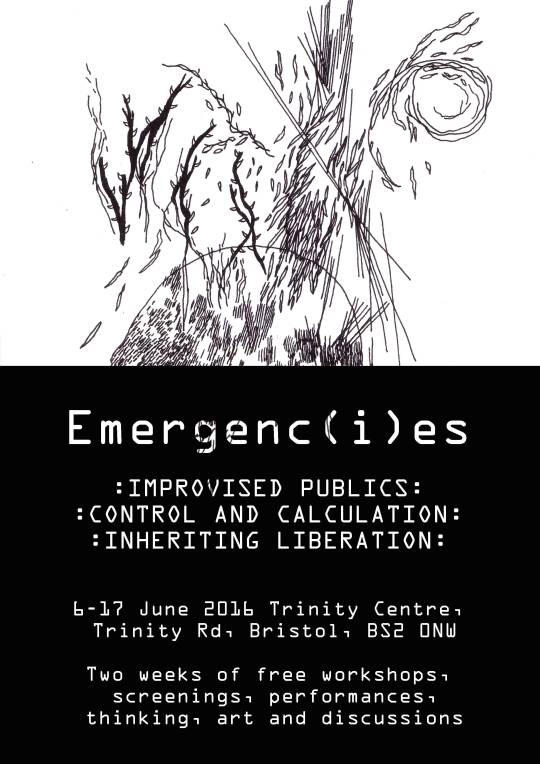
Reblog> Improvised Publics :: Control and Calculation :: Inheriting Liberation :: 6-17 June 2016

This event looks really interesting, check out the website for more information…

Emergenc(i)es – an event in Bristol between 6th and 17th June

Emergenc(i)es is an invitation to consider the emergency of the current historical moment.

The exhibition will dwell in the question of emergence within emergency.

Performance, education activities, visual art, screenings, installations, workshops and a library-cum-pharmacy will create time and space to diagnose, explore and understand the world we live in.

Enter – Relate – Improvise – Diagnose – Inherit – Public – Liberate – Gather

All activities are free to attend, thanks to generous funding from Awards for All.

Artefacts for generations growing up with robots

I’ve had this open in one of my tabs for ages with the intention of writing something about it here but I’ve sort of run out of time on that, so…

Here’s an interesting student project (I’d be delighted to have students like this!!) It’s a sort of deliberately controversial speculative design/ prototyping exercise to provoke thought and conversation about what it might mean to live with actually existing robots (not sci-fi androids).

The creators are: Stephan Bogner, Phillipp Schmitt and Jonas Voigt.

It’s worth a look…

RAISING ROBOTIC NATIVES

RaisingRoboticNatives-All.jpg

Artefacts for generations growing up with robots

Why do future visions of robotics incite discomfort in our generation? Could robots truly render us obsolete or is it our fear of losing control? And are these fears conditioned or instinctive?

Raising Robotic Natives explores interactions between children and robots that could raise them as the first generation of robotic natives.

Just like digital natives grow up in the digital world, robotic natives are born into an environment that is adapting to robots. As a result of unbiased, childlike enthusiasm, they are socialized with the technology early on. Through constant robotic interactions and formalized education, robotic natives get to think differently about robots than we do. It will be their responsibility to shape the future of robotics, not ours–besides we’re robotic immigrants, after all.

See the full details of the project here.

Reblog> Postcapitalist Futures: Talk at Bristol

Via Mark Purcell…

The University of Bristol’s School of Geographical Sciences will host the 6th annual Bassett lecture on Tuesday 3rd May 2016 at 4pm.This year’s speaker is Nick Srnicek, who will be presenting under the title ‘Postcapitalist Futures’ (details below).

The lecture will take place in the Peel Lecture Theatre, School of Geographical Sciences, University Road, Bristol, BS8 1SS

Abstract:
What does the future of work hold? This talk will examine the current capitalist conjuncture, outlining the changing technological and economic conditions of work. The social democratic era of good jobs, it will be shown, is over – and the left must grapple with this shift. In place of full employment, we should be arguing for full unemployment. This talk will try and show both why this is necessary, and how this is possible.

Biography

Nick Srnicek is the co-author, with Alex Williams, of both Inventing the Future: Postcapitalism and a World Without Work (Verso, 2015) & “#ACCELERATE MANIFESTO for an Accelerationist Politics” (2013). He is the co-editor of The Speculative Turn (Re.press, 2011 with Levi Bryant and Graham Harman) and is currently working on a new book entitled Postcapitalist Technologies (Polity, forthcoming).

The Bassett Lecture:

The Bassett Lecture is held every year in honour of Dr. Keith Bassett, a critical geographer and long-time Senior Lecturer in the School of Geographical Sciences. Though formally retired, Dr. Bassett continues to write, teach, and contribute to the intellectual life of the School and University. The lecture series recognizes Dr. Bassett’s work and contributions in the fields of social and geographical theory, critical geographies of political economy, urbanism, social movements and social justice, political ecology, and critical socio-legal studies.

All Welcome!

No booking required, for enquiries contact: tom.keating [at] bristol.ac.uk

Apps & affect – Fibreculture 25

This issue of Fibreculture on “apps and affect” from last year (2015), stemming from a conference of the same name,  has some fairly substantial looking contributions from interesting people. These include a conversation between Alexander Galloway & Patricia Ticineto Clough, the ‘algorithmic agartha‘ paper by Nandita Biswas Mellamphy & Dan Mellamphy I’ve linked to before and (of particular interest to me at the mo) a paper by Melissa Gregg on speculative labour & app development. It’s edited by Svitlana Matviyenko, Nandita Biswas Mellamphy, Nick Dyer-Witheford, Alison Hearn, and Andrew Murphie.

Introduction

In William Gibson’s recent futurist novel The Peripheral, the planet has been devastated by a massive eco-techno-political catastrophe (‘the jackpot’) but remaining inhabitants are still able to enjoy the luxury of activating digital devices simply by tapping their tongues on the roof of their mouths. This touch is sufficient to set into play systems that communicate across space and time – enabling the establishment of connections back in time, for example, to people closer to our own present-day, for whom mobiles are still (somewhat) separate from the body. Thirty years ago, in his first novel Neuromancer, Gibson immortalised cyberspace with the account of what now sounds like an amazingly clunky process whereby the hero ‘jacks-in’ to virtual reality. But in The Peripheral the process of translation and transition into networks is streamlined – occluded, internal, intimate and implanted – right at the tip of the tongue.

This issue of the Fibreculture Journal explores a moment along this hypothetical trajectory by investigating the contemporary intersection of ‘Apps and Affect’, publishing papers from a conference of that name organised in October 2013 by faculty and students at Western University (specifically from its Faculty of Information and Media Studies and Center for the Study of Theory and Criticism). By recognising apps as objects that are related to the constitution of subjects, as a component of biopolitical assemblages, and as a means of digital production and consumption, our conference aimed to make an intervention in what had – since the announcements of the App-Store and the iPhone3 in 2008 – been a largely technical and rather technophiliac public discussion of apps.

Isn’t it paradoxical, we asked, that instead of becoming ‘transparent’ and ‘invisible’ – as envisioned by the thinkers of ubiquitous computing decades ago – the app-ecosystem manifests itself as permanent excess: excessive downloads, excessive connections, excessive proximity, excessive ‘friends’-qua-‘contacts’, excessive speeds and excessive amounts of information? How does the app as ‘technique’ (Tenner), indeed as ‘cultural technique’ (Siegert) and as ‘technics’ (Stiegler), channel our ways of maintaining relations with/in the media environment? Do the specific and circumscribed operations of individual applications foster or foreclose what media theorists call the transformative and transductive potential of collective technological individuation (Simondon)? How might we think about the social, political and technical implications of this movement away from open-ended networks like the internet towards specific, focused, and individualised modes of computing? Do apps represent ‘a new reticular condition of trans-individuation grammatising new forms of social relations’ (Stiegler) or do they signal instead the triumph of ‘regulatory’ networks over ‘generative’ ones (Zittrain)? If apps are micro-programs residing by the hundreds and thousands on cell-phones, mobile-devices and tablets, and affects are corporeal excitements (and depressions) running beneath and beyond cognition, what is the relation of apps to affects?

– See more at: http://twentyfive.fibreculturejournal.org/#sthash.6y9K3uyP.dpuf