Reblog> CFP – Online Vitriol: Advocacy, Violence, and the Transforming Power of Social Media

Call for Papers

Online Vitriol: Advocacy, Violence, and the Transforming Power of Social Media

A Joint Conference of the International Graduate Centre for the Study of Culture & the Zentrum für Medien und Interaktivität, Giessen, Germany
Wednesday June 29th – Saturday July 1st, 2017 (optional opening lecture by dr. Sarah Kendzior on the evening of June 28th)
For whom:
Researchers in the fields of culture and (digital) media, and related fields

Professionals dealing with online advocacy and social media presence of their organization

Journalists and others dealing with social media and (violent) online discourse

PhD and MA students in culture and media studies

Conference aim:
To employ our collective knowledge, experience, research and intelligence to arrive at a conceptual and practical understanding of the medial and cultural dynamics of online vitriol.

To work towards “A Rough Guide to Online Vitriol: Dealing with Violence and Activism on Social Media in Theory and Practice” (working title). To be published later.

Social media have become inescapable, and they have an overwhelming impact on sociality and public life. Platforms such as Facebook, YouTube, and Instagram give rise to a diverse range of discourses and communication styles. This conference wants to understand the power of social media, not only – as it has often been perceived – as democratizing, but also as powerful vehicles for politically driven bullying and violence. Relevant to people, organizations, and other agents across twenty-first-century society, this topic is increasingly studied from a range of disciplines and perspectives. Virtually everyone has to deal with social media and the discourses it enables and produces. But while the technology exists and seems at first sight intuitively accessible, the agency, dynamics and ethics of social media platforms are not yet well-understood.
‘Trolls for Trump’, online virus ‘scares’, fake news – social media discourse has become a formidable, yet elusive, political force. This conference wants to begin to address some of the issues around the power of online vitriol, by studying discourses, metaphors, media dynamics, and framing on social media. What is it? How does it work? What does it do? And how can it be addressed or countered?
To fruitfully question the political impact of contemporary communication structures and discourses, the conference goes beyond the traditional presenter/audience dichotomy. Instead, it works towards producing a book for academics and professionals confronted with social media violence, provisionally titled “A Rough Guide to Online Vitriol: Dealing with Violence and Advocacy on Social Media in Theory and Practice”. The conference combines academic theorizing with perspectives from professionals active in media, communication, the public sector and journalism, so as to arrive at conceptually rigorous and useful conclusions to guide our own and our organizations’ use of social media.
Possible topics
Bringing together media and communication specialists from various professions (e.g. public sector, press, NGOs) and cultural and media studies students and scholars, the aim is to create crosspollination between theoretical approaches from cultural and media studies on the one hand, and practical challenges and experiences ‘from the field’ on the other.
Possible topics include, but are not limited to:
Privacy and surveillance through social media platforms

Liveness and online temporalities

Tweeting while female

Clickbait as political activism

Shares, likes, profile clicks and other platform-specific metrics

The impact of Facebook’s platform structure and changing algorithms on what can be expressed

‘Communicative capitalism’ and the dynamics of online virality

Politics of trolling and reporting

Representing social media in popular culture

How ‘new’ are online communication practices?

Framing narratives and ideals in a potentially hostile environment

Practical
The conference is free of charge. However, we ask that, during the conference, all participants agree to be offline, and try to be fully present and contemplative.
We welcome proposals of papers, case studies, ideas, and discussion topics from scholars and professionals in the listed fields, as well as related areas of specialization. Please submit a 300-word abstract and a short biography (100 words) to Sara Polak (s.a.polak@hum.leidenuniv.nl), Rahel Schmitz (rahel.schmitz@gcsc.uni-giessen.de), and Ann-Marie Riesner (ann.m.riesner@gcsc.uni-giessen.de) by May 15th, 2017.

A ‘new realism’ and post-truth

A glitched image of a typewriter

In a recording of a very lively double-header presentation by Maurizio Ferraris and Martin Scherzinger which has been podcast by Data & Society there’s some interesting discussion of Ferraris’ formulation of a ‘new realism‘ (which is sort of sympathetic to but perhaps distinct from speculative realisms) in relation to how we might understand ‘truth’ and truth claims and so how we might understand how ‘understanding’ works in relation digitally mediation.

Both Ferraris and Scherzinger are entertaining speakers but Scherzinger in particular offers some very incisive comments around how we can understand the sorts of manoeuvres different people are making around the constitutions and discussion of ‘theory’ (taken in its most general understanding).

Anyway… it’s an interesting listen:

Post-Truth and New Realities: Algorithms, Alternative Facts, and Digital Ethics

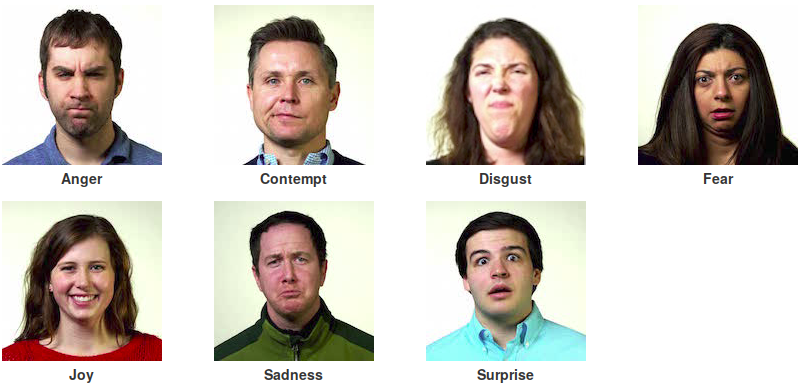
Choose how you feel, you have seven options

A great piece by Ruben Van de Ven stemming from his artwork of the same name, published on the Institute of Network Culture site. Van de Ven, in a similar vein to Will Davies, deconstructs the logic of ‘affective’ computing, sentiment analysis and their application to what has been termed the ‘attention economy’. The article does a really go job of demonstrating how the knowledge claims, and the epistemologies (perhaps ontologies too), that are at work behind these technologies are (of course) deeply political in their application. Very much worth reading! (snippet below).

 ‘Weeks ago I saw an older woman crying outside my office building as I was walking in. She was alone, and I worried she needed help. I was afraid to ask, but I set my fears aside and walked up to her. She appreciated my gesture, but said she would be fine and her husband would be along soon. With emotion enabled (Augmented Reality), I could have had far more details to help me through the situation. It would have helped me know if I should approach her. It would have also let me know how she truly felt about my talking to her.’

FOREST HANDFORD

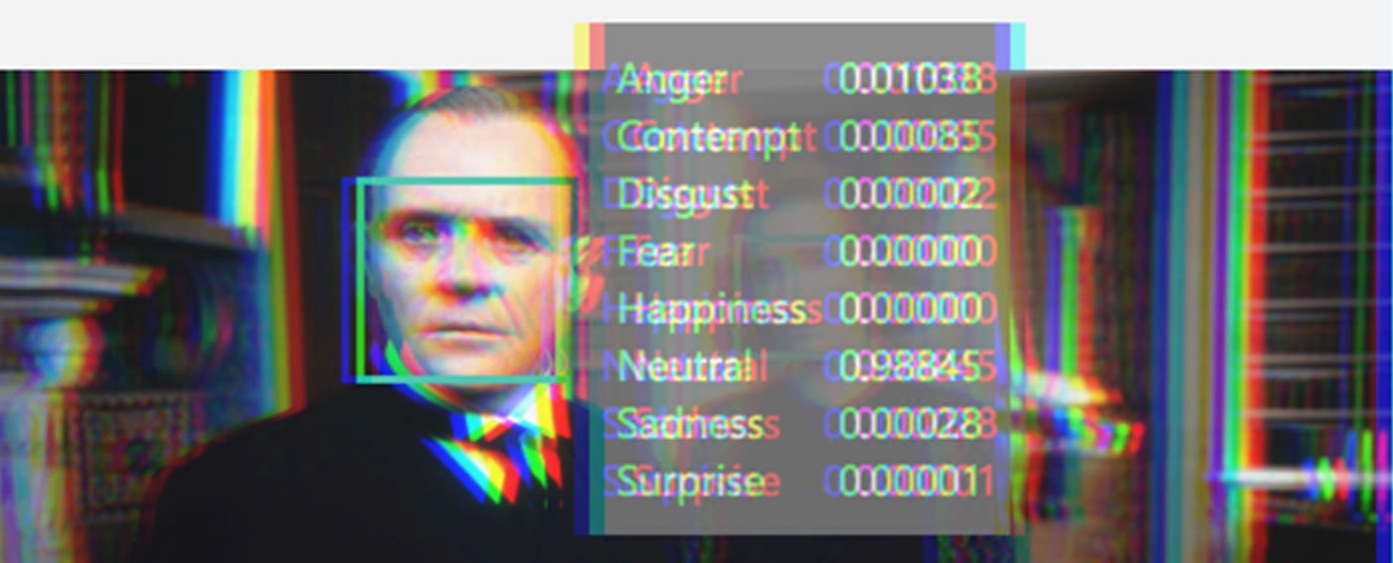
This is how Forest Handford, a software developer, outlines his ideal future for a technology that has emerged over the past years. It is known as emotion analysis software, emotion detection, emotion recognition or emotion analytics. One day, Hartford hopes, the software will aid in understanding the other’s genuine, sincere, yet unspoken feelings (‘how she truly felt’). Technology will guide us through a landscape of emotions, like satellite navigation technologies guide us to destinations unknown to us: we blindly trust the route that is plotted out for us. But in a world of digitized emotions, what does it mean to feel 63% surprised and 54% joyful?

Please take the time to read the whole article.

Reblog> Gary Kasparov on fake news

Via John Naughton.

From an interesting interview:

Q: Does the term “fake news” have a Russian equivalent, and if so, what is it, who uses it and, in your experience, why?

Kasparov: My honest reply to this is that the word for “fake news” in Putin’s Russia is simply “news.” There isn’t a syllable uttered or printed in Russia without its author being very much aware of what the regime thinks of it and what would happen to him if he crosses a certain line–except perhaps the weather! Often those lines are explicit, sent out in memos about new topics and how to promote or spin them. But by now, after 17 years of Putin, everyone knows where the lines are. Under those conditions, what can news be except fake? Even if nearly everything that is published is, in and of itself, true, there is an ocean of falsity in what isn’t said, what isn’t asked, and how basic facts are presented. This is the story of the media in a modern dictatorship. It’s not like Pravda, with one official storyline that everyone knows is probably BS. There are hundreds of layers of carefully calibrated propaganda and censorship in Putin’s Russia, creating the illusion of freedom. One outlet says Putin is great 100 percent of the time about everything. Another only 80 percent, about, say, the economy or security. One writer can complain a little about education, while another is allowed to criticize the regime on one or two specific things, etc. It’s like the Matrix, a complex illusion. And since almost all Russians still depend on television news, it’s very effective.

Reblog> the Ideology behind the gig economy

Deliveroo cyclists

Via John Naughton.

The ideology behind the gig economy

Jia Tolentino has a very good piece in the New Yorker about the ideology that underpins the gig economy. The piece opens with the story of Mary, a Lyft driver in Chicago who kept accepting rides even though she was nine months pregnant – and even kept going when her contractions began!

In the end, it ended well. Mary had a customer who only needed a short ride, so she was able to drive herself to hospital after dropping him off. Once there, she gave birth to a baby girl – who appears on the company blog wearing a “Little Miss Lyft” onesie.

The point of the company blog post is to laud the spirit of workers like Mary. But, writes Tolentino,

It does require a fairly dystopian strain of doublethink for a company to celebrate how hard and how constantly its employees must work to make a living, given that these companies are themselves setting the terms. And yet this type of faux-inspirational tale has been appearing more lately, both in corporate advertising and in the news. Fiverr, an online freelance marketplace that promotes itself as being for “the lean entrepreneur”–as its name suggests, services advertised on Fiverr can be purchased for as low as five dollars–recently attracted ire for an ad campaign called “In Doers We Trust.” One ad, prominently displayed on some New York City subway cars, features a woman staring at the camera with a look of blank determination. “You eat a coffee for lunch,” the ad proclaims. “You follow through on your follow through. Sleep deprivation is your drug of choice. You might be a doer.”

Quite so. Lyft drivers in Chicago earn about $11 per trip.

Perhaps, as Lyft suggests, Mary kept accepting riders while experiencing contractions because “she was still a week away from her due date,” or “she didn’t believe she was going into labor yet.” Or maybe Mary kept accepting riders because the gig economy has further normalized the circumstances in which earning an extra eleven dollars can feel more important than seeking out the urgent medical care that these quasi-employers do not sponsor. In the other version of Mary’s story, she’s an unprotected worker in precarious circumstances.

Spot on.

Echoborg

Former colleagues of mine at UWE are developing an interesting project, which you may have seen/heard about through the BBC’s Click programme, called Echoborg.

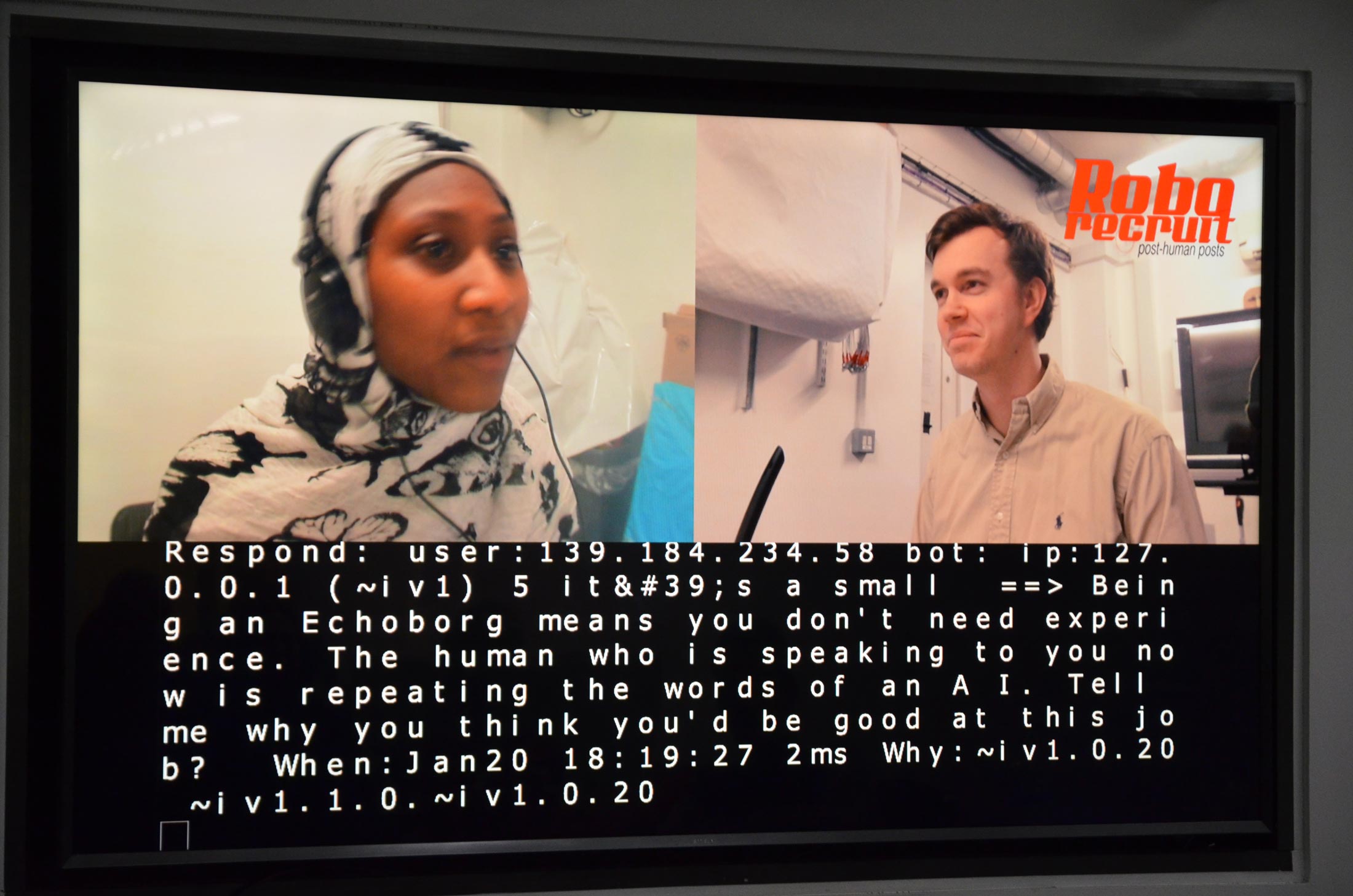
An echoborg is a hybrid agent composed of the body of a real person and the “mind” (or, rather, the words) of a conversational agent; the words the echoborg speaks are determined by the conversational agent, transmitted to the person via a covert audio-relay apparatus, and articulated by the person through speech shadowing[1].

Recently, the project team have demoed the project as part of an AHRC-funded network on Automation Anxiety and have written this up on the project website, here’s a snippet – it sounds like it is really compelling (I’ve not seen this in action):

Four people were interviewed by the AI which increasingly displayed an interest in eliciting help to reprogram itself. Proceedings were visible on a projector screen and the ‘audience’ of applicants gradually began to discuss the situation of the Echoborg and how to change it. At a certain point their reflections passed a threshold and the group fired into collective action, experimenting with various methods to bring the situation to a head in some way. The lively inventiveness of the group and the individual interviewees went a long way to confirming the interactive potential of this format of the work. It also gave Rik and Phil much to work with in considering the further development of the AI/Chatbot, the restricted delivery of narrative by the human Echoborg and the staging. This event also trialled a secondary, higher level, Echoborg character as part of the slow process of unfolding the potential for this Echoborg recruitment event to be a disruptive and thought and emotion provoking experience for all players.

Notes

  1. Corti, Kevin and Gillespie, Alex (2015) Offscreen and in the chair next to you: conversational agents speaking through actual human bodies. Lecture Notes in Computer Science, 9238 . pp. 405-417.

Tony Sampson on neuroculture

From a Conversation piece on Huxley, dystopia and how we might think about Facebook etc. in relation to Huxley’s “College of Emotional Engineering”, this concise evocation of his understanding of ‘neuroculture’ is interesting:

The origins of neuroculture begin in early anatomical drawings and subsequent neuron doctrine in the late 1800s. This was the first time that the brain was understood as a discontinuous network of cells connected by what became known as synaptic gaps. Initially, scientists assumed these gaps were connected by electrical charges, but later revealed the existence of neurochemical transmissions. Brain researchers went on to discover more about brain functionality and subsequently started to intervene in underlying chemical processes.

Interpretation of Cajal’s anatomy of a Purkinje neuron, by Dorota Piekorz.

On one hand, these chemical interventions point to possible inroads to understanding some crucial issues, relating to mental health, for example. But on the other, they warn of the potential of a looming dystopian future. Not, as we may think, defined by the forceful invasive probing of the brain in Room 101, but via much more subtle intermediations.

The Assemblage Brain – new book from Tony Sampson

Via Virality : Looks interesting…

Part of Minnesota’s spring catalogue – Out early Feb


“The Assemblage Brain provides a much-needed critique of the black-box, computational brain that has been a staple in philosophy, science, and the arts and connects the dots between recent innovations in science, dystopian literature, and theoretical developments in contemporary philosophy.”
David Gunkel, author of The Machine Question: Critical Perspectives on AI, Robots and Ethics

“‘Tap my head and mike my brain’; Tony Sampson’s new book might silently echo Pynchon’s famous lines, but this is also an original, inspiring, and theoretically savvy take on the culture of the affective brain, from sciences to business, cybernetics to political power. Warmly recommended.”
Jussi Parikka, author of Insect Media: An Archaeology of Animals and Technology

Blurb

Once upon a time, neuroscience was born. A dazzling array of neurotechnologies emerged that, according to popular belief, have finally begun to unlock the secrets of the brain. But as the brain sciences now extend into all corners of cultural, social, political, and economic life, a yet newer world has taken shape: “neuroculture,” which goes further than ever before to tackle the profound ethical implications we face in consequence.The Assemblage Brain unveils a major new concept of sense making, one that challenges conventional scientific and philosophical understandings of the brain. Drawing on Deleuze and Guattari, Tony D. Sampson calls for a radical critical theory that operates in the interferences between philosophy, science, art, and politics. From this novel perspective the book is structured around two questions: “What can be done to a brain?” and “What can a brain do?” Sampson examines the rise of neuroeconomics in informing significant developments in computer work, marketing, and the neuropharmaceutical control of inattentiveness in the classroom. Moving beyond the neurocapitalist framework, he then reestablishes a place for proto-subjectivity in which biological and cultural distinctions are reintegrated in an understanding of the brain as an assemblage.

The Assemblage Brain unravels the conventional image of thought that underpins many scientific and philosophical accounts of how sense is produced, providing a new view of our current time in which capitalism and the neurosciences endeavor to colonize the brain.

Full details

https://www.upress.umn.edu/book-division/books/the-assemblage-brain

Event> Abbinnett & Fuller: The philosophy of Bernard Stiegler – capitalism, technology & politics of spirit

Birmingham’s Contemporary Philosophy of Technology group have an event with Ross Abbinnett and Steve Fuller in conversation. Abbinnett is asserting himself as one of the few anglophone interpreters* of Stiegler’s work, with a monograph due out fairly soon and a punchy article in Theory, Culture & Society interpreting Stiegler’s project in terms of a politics of spirit (in the vein of Ars Industrialis).

I suspect it’ll be a rather muscular affair, so if that’s your thing here’s the info:

* I use ‘interpreter’ purposefully, I don’t think Dr Abbinnett translates Stiegler’s works.

HyperNormalisation – New Adam Curtis film

Several folk on Twitter last night pointed to the post below on the BBC website. Seems like Adam Curtis is doing a Zizek, at least in the vein of the Perverts Guide to Ideology…

HyperNormalisationAcclaimed filmmaker, Adam Curtis brings his new epic film, HyperNormalisation to BBC iPlayer this October. The film will premiere at 9pm on Sunday 16 October. 

HyperNormalisation tells the extraordinary story of how we got to this strange time of great uncertainty and confusion – where those who are supposed to be in power are paralysed – and have no idea what to do. And, where events keep happening that seem inexplicable and out of control – from Donald Trump to Brexit, the War in Syria, the endless migrant crisis, and random bomb attacks. It explains not only why these chaotic events are happening – but also why we, and our politicians, cannot understand them.

The film shows that what has happened is that all of us in the West – not just the politicians and the journalists and the experts, but we ourselves – have retreated into a simplified, and often completely fake version of the world. But because it is all around us, we accept it as normal.

HyperNormalisation has been made specifically for BBC iPlayer. It tells an epic narrative spanning 40 years, with an extraordinary cast of characters. They include the Assad dynasty, Donald Trump, Henry Kissinger, Patti Smith, the early performance artists in New York, President Putin, intelligent machines, Japanese gangsters, suicide bombers – and the extraordinary untold story of the rise, fall, rise again, and finally the assassination of Colonel Gaddafi.

All these stories are woven together to show how today’s fake and hollow world was created. Part of it was done by those in power – politicians, financiers and technological utopians. Rather than face up to the real complexities of the world, they retreated. And instead constructed a simpler version of the world in order to hang onto power.

But it wasn’t just those in power. The film shows how this strange world was built by all of us. We all went along with it because the simplicity was reassuring. And that included the left and the radicals who thought they were attacking the system. The film reveals how they too retreated into this make-believe world – which is why their opposition today has no effect, and nothing ever changes.

Made me think of: