CFP> Feminist Media Studies Special issue on Online Misogyny: Call for papers

I saw this on Twitter via Huw Davies last night. Looks like a really interesting call:

Feminist Media StudiesSpecial issue on Online Misogyny: Call for papers

Deadline: 1 October 2016

Edited by Debbie Ging and Eugenia Siapera

In recent years, online misogyny has become a major concern for women. As a new wave of feminist / female bloggers, journalists, activists and gamers have attempted to assert their presence on the internet, there has been a concerted backlash against both feminism and women generally. This special issue of Feminist Media Studies seeks to identify and theorise the complex relationships between online culture, technology and misogyny. How have the internet’s anti-woman spaces and discourses been transformed by the technological affordances of the internet and social media? How are they being articulated and reproduced in diverse cultural contexts and / or transnationally? Are they borne of the same types of discontents articulated in older forms of anti-feminism or to what extent do they articulate a different constellation of social, cultural and gender-political factors?

Despite growing social concern about online misogyny, discussion and debate of this issue has been primarily journalistic to date. Moreover, the focus has been strongly western-/anglo-centric, and has tended to revolve around certain ‘flashpoint’ events. There is a need, therefore, for greater representation of how this phenomenon operates globally across contexts from non-anglophone, technologically advanced cultures to countries in the Global South. It is important to ask, for example, how internet access and local gender landscapes complicate our understanding of this subject. In addition to the more high-profile, anonymous attacks covered by the western media, there are also reports of intimate partner and acquaintance abuse online, which often takes the form of ‘revenge porn’ or unauthorized distribution of sexts by men known to their victims. Moreover, misogyny can and does operate in the more formal contexts of the technology sector. All of these examples should alert us to the importance of progressing academic inquiry on this issue not from a point at which we assume online misogyny to be a stable, recognisable phenomenon but rather by inviting contributions that will expand current knowledge and understanding beyond western experiences, gender-political contexts and epistemological frameworks.

What is significant about all of these phenomena is their very real impact on the lives and safety of real women, as well as their success in deterring women from expressing their opinions or putting their work online. Despite this, online misogyny remains under-researched in academia (Jane, 2014). There have, however, been important activist interventions such as #everydaysexism and #freethenipple as well as a raft of feminist groups organizing online to highlight and challenge misogyny. Given that activists, journalists, gamers and filmmakers have effectively led this charge, we consider it important to ask whether these new, more popular expressions of digital feminism are reaching new audiences and shaping new publics, and what impact this might have on theoretical understandings of feminism. Moreover, while it is important to consider the new misogyny in relation to older theorisations of anti-feminism (Faludi, 1991; Kimmel, 1995; Messner, 1997), it is also crucial to build reflexive criticism into narratives that have hitherto excluded non-western cultures as well as other, related forms of online hate speech such as racism, homophobia and transphobia.

Online Misogyny aims to give this increasingly important area of enquiry the impetus, attention and theoretical cohesion it requires. The increasingly amorphous and anonymous nature of online misogyny and the fluid and dynamic nature of online communication pose considerable challenges for data capture and analysis, and we expect methodological innovation to be a key element of this special issue. We also hope to publish at least one contribution from an activist, artist or non-academic.

Possible topics in relation to this theme may include (but are not limited to):

  • Online misogyny and feminist media theorisations
  • Forms of online misogyny  (including threats, abuse, ‘revenge porn’, creepshots, sexting, slut-shaming, technology-enabled intimate partner and acquaintance violence, and others)
  • Sites and contexts of online misogyny
  • Discourses and visuality of online misogyny
  • Global contexts and online misogyny
  • Transnational travel / global pathways of misogyny
  • Online misogyny’s articulations with racism, homophobia and transphobia
  • Technological affordances: the role of algorithims, anonymity, governance, technical design, platform politics, etc.
  • Social, political and personal impact of online misogyny
  • Women’s / feminist responses to online misogyny
  • Performative responses to online misogyny
  • The role of social media corporations and community managers
  • Workplace and institutional misogyny: misogyny in the technology / gaming / journalism sectors
  • Legislation and corporate policy
  • Digitally networked publics: the impact of online misogyny on democracy and the public sphere
  • Online misogyny and the post-feminist context

Aims & Scope
Feminist Media Studies provides a transdisciplinary, transnational forum for researchers pursuing feminist approaches to the field of media and communication studies, with attention to the historical, philosophical, cultural, social, political, and economic dimensions and analysis of sites including print and electronic media, film and the arts, and new media technologies. The journal invites contributions from feminist researchers working across a range of disciplines and conceptual perspectives.

Peer Review Policy
All research articles in this journal undergo rigorous peer review, based on initial editor screening and anonymous refereeing by at least two scholars.
Submission Instructions

Please submit a 350-word abstract as well as a short (1-page) CV to Debbie Ging (debbie.ging(at)dcu.ie) and Eugenia Siapera (eugenia.siapera(at)dcu.ie) by 1st October 2016. Authors whose abstracts are selected will be notified by 15th January 2017 and asked to submit complete manuscripts by 15th June 2017. Acceptance of the abstract does not guarantee publication of the paper, which will be subject to peer review.
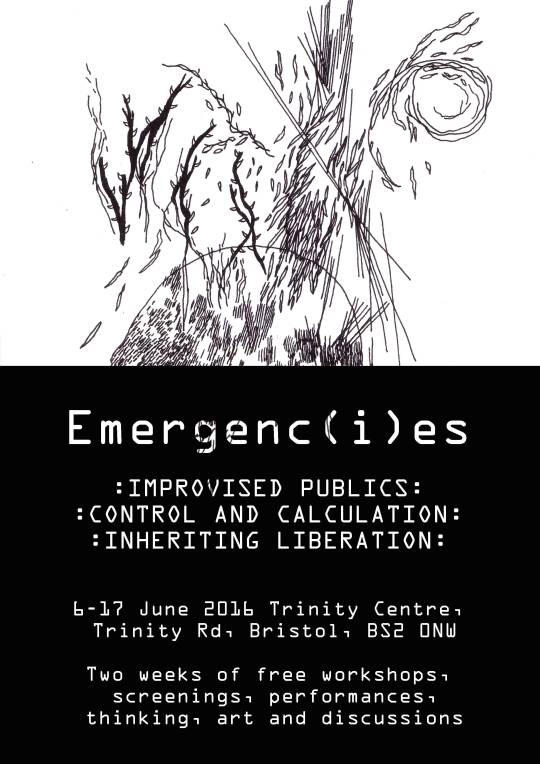
Reblog> Improvised Publics :: Control and Calculation :: Inheriting Liberation :: 6-17 June 2016

This event looks really interesting, check out the website for more information…

Emergenc(i)es – an event in Bristol between 6th and 17th June

Emergenc(i)es is an invitation to consider the emergency of the current historical moment.

The exhibition will dwell in the question of emergence within emergency.

Performance, education activities, visual art, screenings, installations, workshops and a library-cum-pharmacy will create time and space to diagnose, explore and understand the world we live in.

Enter – Relate – Improvise – Diagnose – Inherit – Public – Liberate – Gather

All activities are free to attend, thanks to generous funding from Awards for All.

VR… ‘das opium des volkes’? Adam Greenfield on Oculus

Nice blogpost by Adam a short-while ago reflecting on VR as a means of keeping the precariat/proletariat sated with simulation:

As VR’s leading developers straight-up admit in the piece, its function is to camouflage the inequities and insults of an unjust world, by offering the masses high-fidelity simulations of the things their betters get to experience for real. Here’s the money quote, no pun intended: “[S]ome fraction of the desirable experiences of the wealthy can be synthesized and replicated for a much broader range of people.” (That’s John Carmack speaking, for future reference.)

[…]

The idea that all we can do is accede to a world of permanent, vertiginous inequity – inequity so entrenched and so unchallengeable that the best thing we can do with our technology is use it as a palliative and a pacifier

All reminiscent of William Gibson’s rendering of the “Sim/Stim” industry in the Neuromancer trilogy… for example, this passage from the 23rd chapter of Count Zero (the 2nd book):

The interior of the JAL shuttle vanished in a burst of Aegean blue, and she watched the words TALLY ISHAM’S TOP PEOPLE expand across the cloudless sky in elegant sans-serif capitals.

Tally Isham had been a constant in the stim industry for as long as Marly remembered, an ageless Golden Girl who’d
come in on the first wave of the new medium. Now Marly
found herself locked into Tally’s tanned, lithe, tremendously comfortable sensorium. Tally Isham glowed, breathed deeply
and easily, her elegant bones riding in the embrace of a musculature that seemed never to have known tension. Ac- cessing her stim recordings was like falling into a bath of
perfect health, feeling the spring in the star’s high arches and
the jut of her breasts against the silky white Egyptian cotton
of her simple blouse. She was leaning against a pocked white balustrade above the tiny harbor of a Greek island town, a cascade of flowering trees falling away below her down a
hillside built from whitewashed stone and narrow, twisting
stairs A boat sounded in the harbor

“The tourists are hurrying back to their cruise ship now,” Tally said, and smiled; when she smiled, Marly could feel the smoothness of the star’s white teeth, taste the freshness of her mouth, and the stone of the balustrade was pleasantly rough against her bare forearms.

I continue to be surprised by the return to and rehabilitation of the Modernist vision of VR… perhaps I’m not cynical enough?!

Reblog> Programme for Streams of Consciousness, Warwick, 21-22 April

Via Tony Sampson. All the names you’d expect/want to see and a few more… (can’t help finding it amusing that Thrift is opening the event).

It’d be interesting to hear what Rouvroy has to say…

Streams of Consciousness: Data, Cognition and Intelligent Devices

Download here short and full draft pdf versions of the programme

Register for the conference here 

Thursday 21st April


9.00 to 9.45: REGISTRATION AND COFFEE
9.45 to 10.00: OPENING ADDRESS
Nathaniel Tkacz, Centre for Interdisciplinary Methodologies, University of Warwick
10.00 TO 10.45: KEYNOTE SPEAKER 
Professor Nigel Thrift

10.45 to 13.00: PLENARY SESSION
Tony Sampson, University of East London 
Understanding Neurocapitalism or What Happens When Gramsci Does Human Computer Interaction
Nick Srnicek, Independent Researcher
The Eyes of the State
Antoinette Rouvroy, University of Namour (Video Conference)
Title TBC

13.00 to 14.00: LUNCH

14.00 to 16.00: BREAK OUT SESSIONS 
SESSION A: DATIFIED SELF
Sun-Ha Hong, University of Pennsylvania 
Data’s Intimacy: Machinic Sensibility and the Quantified Self
Elpida Prasopoulou, Coventry University 
The Body in the Internet of Things: An Auto-ethnography on Wearables
Aleksandra K. Przegalinska, Kozminski University 
Productivity 3.0: Mindtracking and the New Transparent Labour
Ana Viseu, Universidade Euroepia (TBC) 
Bodies, Data and the Question of Physiological Narcissism
SESSION B: ALGORITHMS, MODELS AND CALCULATIVE DEVICES
 
Nathan Coombs, University of Edinburgh 
Intractable Algorithms: Representational Uncertainty in the German High-Frequency Trading Act
Tyler Reigeluth, Université Libre de Bruxelles 
“Let’s misbehave!”: The politics of Behaving with Algorithm
Jérémy Grosman, University of Namour 
A Prediction, not an Oracle – Neural Network, between Algorithms and Metaphors
Charalampos Fytros, Lancaster University 
Mediating Solvency
SESSION C: EXPERIENCE, AFFECT, ATTENTION, INTERACTION
Miguel Prado, University of West England
Noise and Cognition in the Age of Big Data
Darshana Jayemanne, University of Melbourne
The Body Eclectic: Massively Multiplayer Mimesis
John McManus, Oxford University
Football Fans, Mimesis and the Enchanting Properties of Smartphone Use
Craig Hamilton, Birmingham City University 
Can Algorithms Make You Cry?: Popular Music and Machine-Derived Curation

16.00 to 16.15: COFFEE BREAK

16.15 to 18.30: PLENARY SESSION
Steve Fuller, University of Warwick 
Neuroscience as the Mind Instrumentalised: Telescope vs. Microscope
Michael Wheeler, University of Stirling 
The Knowledge Ecology: Epistemic Credit and the Technologically Extended Mind
Caroline Bassett, University of Sussex 
The Hubris of the ‘Artificial Intelligentsia’: Eliza and the Simulation of Smart

19.30: CONFERENCE DINNER

Friday 22nd April


09.00 to 11.00: PLENARY SESSION
Louise Amoore, Durham University 
Title TBC
David Berry, University of Sussex
Human Reason and Algorithmic Judgement
James Ash, Newcastle University 
The Interface Envelope: Power, Cognition and Gaming

11.15 to 11.30: COFFEE BREAK

11.30 to 13.10: BREAK OUT SESSIONS
SESSION A: PLATFORMS, INTERFACES AND SENSORS
Jacob Johanssen, University of Westminster 
Not Belonging to One’s Self: Affect and Alienation on Facebook’s Site Governance Page
Alex Gekker, Utrecht University
Numbers are Magic: Numerical User Interfaces and Disconnect
Heather Ford – Oxford Internet Institute
Ode to the Infobox
Alison Powell – London School of Economics and Political Science
A Goose in The Stream: Animals, ‘Accidents’ and Sensing Citizenships beyond the Calculative
SESSION B: ROBOTS, DRONES AND AI 
Tero Karppi, Marc Böhlen and Yvette Granata, SUNY Buffalo
Killer Robots and Cultural Techniques
Ramon Bloomberg, Goldsmiths College
Becoming Platform
Beatrice Fazi, University of Sussex
Can a Machine Think Anything New?
Marc Böhlen (Video Conference), Tero Karppi and Yvette Granata – SUNY Buffalo
Robot Control
SESSION C: AESTHETICS AND VISUALISATIONS
Roxana Fabius, Barad College
Business Intelligence and Aesthetic Criticality
Jonathan Gray, University of Amsterdam; Liliana Bounegru, University of Amsterdam, University of Groningen, University of Ghent; Stefania Milan, Amsterdam University; and Paolo Ciuccarelli Density Design, Politecnico di Milano 
Ways of Seeing Data
Lukasz Mirocha, University of Warsaw 
Challenging Technology Obfuscation Through Aesthetics of Real-time Visual Media: An Analysis of Glitches in Post-digital Consumer Mapping and Navigation Systems

13.10 to 14.00: LUNCH

PLENARY SESSION 14.00 to 16.15
Natasha Dow-Schüll, NYU (Video Conference)
From Mood Ring to MuseTM: Digital Sensor Technology and the Mediation of Sentience
Satinder Gill – Cambridge University 
Performing Knowledge: The Mediating Body
Will Davies – Goldsmiths College 
How Are We Now?: Mood as a Real-Time Indicator

16.15 to 16.30: COFFEE BREAK


PLENARY SESSION 16.30 to 17.15
Michael Dieter, University of Warwick
Title TBC
Jennifer Gabrys, Goldsmiths College
Digital Infrastructures of Withness: Constructing a Speculative “Smart” City

18.00 to 18.15: DISCUSSION AND CLOSING REMARKS

Reblog> Raising the Bar: The Metric Tide that Sinks All Boats

boat

This post by Liz Morrish is an excellent if dismal reflection upon the kinds of performance management we labour under in universities. The expectations for the ‘exeter academic’ are not dissimilar to those discussed in the post. Saw this via Julie Cupples.

Raising the Bar: The Metric Tide that Sinks All Boats

Liz Morrish writes: A longer post than usual, but very relevant if your working life in academia is governed by the insanity of metrics – grant income, PhD students, impact, REf 4* ‘outputs’. You know it is insanity, so read on”¦..

James Wilsdon may as well not have inveighed against the ‘metric tide’, and Jo Johnson could have saved printers’ ink asking vice-chancellors not to waste academics’ time, and students’ fee money by operating multiple ‘mock’ REFs (BIS Green Paper November 2015 Chapter 2, para 7).

It is time for a critical conversation to take place about the use and abuse of metrics. In July 2015, Hefce published The Metric Tide, the report of a review body chaired by James Wilsdon, professor of science and democracy at the University of Sussex.

Despite the report’s chilling preface, announcing a “new barbarity” in our universities, we continue to witness the misuse of metrics as a tool of management in UK higher education. “Metrics hold real power: they are constitutive of values, identities and livelihoods”, wrote Wilsdon. Universities should proceed with caution, then, lest metrics should spread like a digital Himalayan Balsam and undermine the ethical architecture of universities.

It is ironic, but perhaps fortunate, that students find universities a very different experience than the academic staff who labour in them. For students, the intrusive scrutiny of metrics can at least claim to betoken a therapeutic and supportive institution. Generally speaking, the student ‘dashboard’ does not harbour the disciplinary function of its academic equivalent. 

Read the full post.

Reblog> Space, Power and the Commons: new book in Place, Space and Politics series

Clive Barnett on a new book out edited by Samuel Kirwan, Leila Dawney & Julian Brigstocke… all smart people so well worth a look!

Space, Power and the Commons: new book in Place, Space and Politics series

9781138841680The latest book in the Routledge Research in Place, Space and Politics series is now published (technically it is a 2016 book) – Space, Power and the Commons: The struggle for alternative futures is edited by Sam Kirwan, Leila Dawney and Julian Brigstocke, and is associated with the Authority Research Network. It’s an important addition to the literature on the theme of ‘the commons’, not least because it draws together discussions of high theory on this topic (Hardt, Nancy, Ranciere, etc) with empirical analyses of practices of ‘commoning’.

This is the second title to appear in the Place, Space and Politics series, after the collection on Urban Refugees. There are more titles in the pipeline. More details on the series, including guidelines for submitting proposals, can be found here and here.

Stiegler on Daesh and ‘the age of disruption”

I offer a here a quick translation of an interview for Le Monde published past week with Bernard Stiegler, following the attacks in Paris in which he addresses Daesh/ISIS within the context of his conceptualisation of ‘disruption’, which is the context of his forthcoming book [Dans la Dusruption ~ “In the Age of Disruption”].

Only by planning a genuine future can we fight Daesh

The philosopher Bernard Stiegler develops this thesis in his forthcoming book: “In the Age of Disruption”.

Interview by Margherita Nasi.

For the philosopher Bernard Stiegler “war is economic”. The collapose of employment egenders a dispair that in turn leads to violence. “There is no future without a fundamental reversal of economic value”, he explains.

Since the attacks of the 13th of November the President of the Republic insists” “We are at war”, do you recognise yourself in such a war?

No. What is this “we”? They are at war, not me. War is economic, it is theirs and it creates casualties, including me, who cannot sleep at night, not because of terrorists but because of a lack of future for my children. This is not a war against Daesh, as they suggest, but a global economic war, which takes us into civil war if we do not combat it.

Employment will collapse, especially amongst young people, and dispair breeds violence. We no longer produce reasons for hope today. The attacks of the 13th of November were suicide attacks, which is not insignificant – suicide is developing around the world, especially amongst those young people who know they will not work for a long time.

Both Sarkozy and Hollande failed to provide any kind of prospects for these young people. It is against this stupidity, this madness, that I am at war. A war within myself as well: we are all subject to this tendency to find scapegoats, not to think and not to care. This is barbarism, and that is exactly what Daesh wants: to create civil war. There will be more attacks if we do not change our politics. This is the context of my next book ” In the Age of Disruption”.

What do you mean by disruption?

Disruption is a phenomenon of accelerating inovation which is the foundation of a strategy developed in Silicon Valley: it is a drive to go faster than societies in order to impose upon them models for the destruction of social structures, rendering public powers powerless It is a strategy that tetanises the opponent. In my book, I analyse a text signed by Abu Bakr Al-Naji, as summarised by Ignance Leverrier [former diplomat and journalist], that defines a collective, including former officers of Saddam Hussein that became Islamists. It is a sort of Daesh manual, in the image of corporate bibles that detail the rules to set up a franchise. This book explains how Daesh actors should seize power. One must create chaos and thus exploit the need for some kind of authority.

I compare this strategy with that of the website “Les Barbares attaquent” [The barbarians are coming], founded by Nicolas Colin, a former tax inspector known for his report on the tax system and the digital economy, in which hie highlighted the inadequacy of the tax system for dealing with digital companies, which he describes as the ‘four horsemen of the apocalypse’, in this case GAFA [acronym for: Google, Amazon, Facebook and Apple]. He has since moved to the other side, from public service into the economy which he described as so damaging, to create an investment fund that raises money to practice disruption on the French. Yet, repeating the strategy of GAFA, he can only extend their ecosystem and intensify the colonisation of Europe, wrecking transport, housing, education–all sectors–through new models such as Uber. However, such disruptive practices destroy the social balance, what [German Philosopher] Theodor W. Adorno anticipated by speaking in 1944 of a “new form of barbarism” in relation to the cultural industries.

It is not by declaring war on Daesh that this takes place. This declaration is one way of absolving oneself of one’s own responsibilities by scapegoating people that have become extremely dangerous and who we have co-produced with Daesh.

This radicalisation is thus built on the ruins of ultraliberalism?

Yes. We turn radicalism into a question of religion, and this is outrageous, Most recruits of radical Islam have no religious culture. It is not religion in question but despair. Richard Dur, the murderer of eight members of the Nanterre Council in March 2002, prefigures his actions by speaking about his feelings not existing: he wanted to become somebody by these actions.

In 2012 you launched a call for a global economic peace treaty, is this still a possible contemporary solution for eradicating barbarism?

We need to open out a debate in Europe, take things head-on, since the birth of the web we have all been losing. Exploited by the kinds of disruption practised by GAFA, digital technologies have accentuated the environmental toxicity that has been growing since the beginning of the anthropocene – an era in which humans have become the major geological factor – in terms of the climate, the atmosphere and in mental terms.

There is no future without a fundamental reversal of economic value: only the transition to an economy producing sustainable forms of value will overcome the challenges that are the subject of the COP21 next week.

We must launch a new European policy rather than aligning ourselves with the American model that is disruptive and suicidal/ We must invent a new Web in the service of viable marcoeconomic model, rather than developing a completely ruinous economy of data. These are the themes of the “Conversations about a new industrial world”, orgainsed at the Pompidou Centre on the 14th and 15th of December. Only by planning [projetant] a genuine [véritable] future for the planet can we combat Daesh, in other words to combat despair.

Event> The Politics and Economics of Attention (14/12)

Both Clive Barnett and I will be speaking at the sixth seminar in the Behaviour Change & Psychological Governance series (funded by the ESRC) which is being held at the University of Bristol on the 14th of December.

I’ll be revisiting some of the things Patrick Crogan and I wrote about back in 2012 in the themed issue of Culture Machine we co-edited following an ESF-funded conference on attention in 2010. My move forward is probably being a little more critical in my thinking about what constitutes the process of valuing attention (critically reflecting on why a Labour Theory of Value might not quite fit) and thinking (with the work of Bernard Stiegler) about how the socio-technical systems that attempt to economise (something that gets called) attention are a kind of pharmakon (an indeterminacy, originating from the idea of a drug as both poison and cure). By looking at some examples I hope to offer some suggestions about how we might understand what’s going on (in networked technology systems in particular) when an attempt is made to place a financial value on ‘attention’.

Character assassinations? There’s an app for that…

Interesting article on the Washington Post  site, tweeted by David Murakami Wood (above), that talks about a service/app called “Peeple” that seeks to be a “Yelp for people” – to enable us to ‘rate’ and ‘review’ one another… A market-driven death-knell for treating one another like ‘people’ (rendering the name rather ironic) and another attempt to pull a further aspect of ‘ordinary’ life into the attention economy. This is an attempted renegotiation of the ‘normative’, what Daniel Miller and Sophie Woodward, in their book Blue Jeans, describe as the sense in which “the expectation that actions within a social field are likely to be judged as right or wrong, appropriate or inappropriate, proper or transgressive”. What if reviewing one another became ‘normal’..?(!!) *sigh*

Reblog> I am not here to satisfy you: the NSS and our institutional knickers

Hester Parr tweeted this post by Julie Cupples from a few months ago. As an early career academic on probation it’s difficult to stick your head above the parapet, and os it’s great when you read someone else doing it. This post really does resonate with my feelings about teaching in a university and how that can or should be valued…

There are also some good comments, so take a look.

I am not here to satisfy you: the NSS and our institutional knickers

The neoliberal endeavour to convert university students into consumers is underpinned by a survey culture that is constantly attempting to measure a thing called ‘student satisfaction’. It’s part of the way universities compete with one another and manufacture what is termed the ‘student experience’. In the neoliberal academy, students, faculty and staff are constantly surveyed, a phenomenon that a New Zealand academic has recently described as a tyranny that may “degrade student achievement” and “harm staff” (Heinemann 2015). If you borrow an interloan, ask IT to fix a software issue on your computer, or order sandwiches for a meeting from the preferred corporate supplier, you’re then likely to be sent a survey to assess the level of customer satisfaction with the service. It’s tedious but fortunately most of them can be quickly ignored and deleted. But the survey that seems to produce a bizarre level of managerial emphasis and concern that is quite hard to ignore is the National Student Survey (NSS). In my view, NSS obsession is producing quite pernicious and pedogogically impoverishing outcomes. For those outside the UK, the NSS began in 2005. It is commissioned by HEFCE and carried out by Ipsos Mori. Students are asked 23 questions which relate to student satisfaction and the learning experience (see thestudentsurvey.com for more detail). It then produces scores and rankings to add to the dozens of other league tables in which contemporary universities jostle for position and which get deployed in a highly selective manner in university spin.

The biggest problem with the idea of student satisfaction is that our principal aim as educators should not be to satisfy students. My teaching philosophy is composed in part of the following ideas:

I am not here to satisfy you. I am here to encourage you to interrogate your existing knowledges and possibly your own privilege. This is likely to be a deeply unsettling and uncomfortable process, especially if your class, race or gender location has never required you to interrogate your worldview and how it harms and excludes. I will however do my best to inspire you and encourage you to think. 

In fact, our aim should be to unsettle our students, especially the most privileged ones, not to satisfy them. It can often be satisfying to have your pre-existing values and worldviews endorsed (which is why people with right-wing views tend to watch Fox News for example rather than MSNBC or Democracy Now). While it might be energizing to have them challenged, and sometimes clearly is, for some students it can be deeply and profoundly dissatisfying. Some students react negatively when they are exposed to explicitly feminist perspectives or are forced to confront how they continue to benefit from the legacies of colonialism or white privilege. Engagement with these issues starts at university but is probably not resolved if ever until much later in a student’s life. By the time I graduated after four years of study, I had begun to rethink my worldviews. It wasn’t until much later than I gained a much deeper insight into my own politics and cultural assumptions and began to reformulate them. So if students are dissatisfied, it could be because we are doing our jobs properly, not because we are failing.

Read the rest of the post.