Reblog> Three new OHP books from: Brian Massumi; Steven Connor; and Érik Bordeleau, Toni Pape, Ronald Rose-Antoinette and Adam Szymanski

open access spelled out with books

Via Gary Hall. All of the books are available for free download. Follow links below.
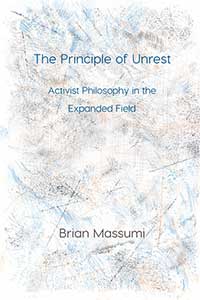
We are pleased to announce the release this month of two new titles in Open Humanities Press’ Immediations series:***

Brian Massumi’s The Principle of Unrest explores the contemporary implications of an activist philosophy, pivoting on the issue of movement. Movement is understood not simply in spatial terms but as qualitative transformation: becoming, emergence, event.

Available for free download at:

http://www.openhumanitiespress.org/books/titles/the-principle-of-unrest/


***

Nocturnal Fabulations/Fabulations nocturnes by Érik Bordeleau, Toni Pape, Ronald Rose-Antoinette and Adam Szymanski with an Introduction by Erin Manning.

This collective, bi-lingual project is animated by a shared curiosity in the pragmatics of fabulation and its speculative gesture of bringing forth a people to come. In an encounter with Apichatpong’s cinematic dreamscape, the concepts of ecology, vitality and opacity emerge to articulate an ethos of fabulation that deframes experience, recomposes subjectivity and unfixes time.Available for free download at:

English: http://www.openhumanitiespress.org/books/titles/nocturnal-fabulations/

French: http://www.openhumanitiespress.org/books/titles/fabulations-nocturnes/

***

We are also pleased to announce the latest book in the Technographies series:

Steven Connor’s Dream Machines

Dream Machines is a history of imaginary machines and the ways in which machines come to be imagined. It considers seven different kinds of speculative, projected or impossible machines: machines for teleportation, dream-production, sexual pleasure and medical treatment and cure, along with ‘influencing machines’, invisibility machines and perpetual motion machines.

“This is an engaging and imaginative exploration of various forms of writing, thinking, and fantasizing about dream machines, an endlessly fertile topic probed here from just about every possible angle “¦ a major intervention into current understandings of technology, literature, and identity.”

Matthew Rubery – Queen Mary University of London

“”¦ a deeply original contribution to the history and philosophy of technology and the cultural history of the imagination “¦”Laura Salisbury – University of Exeter

Available for free download at:

http://www.openhumanitiespress.org/books/titles/dream-machines/

With our best wishes,

Sigi, David, Gary

(Not) Getting Paid to Do What You Love: Gender, Social Media, and Aspirational Work – Brooke Erin Duffy

Via Culture Digitally.

This looks like an interesting read by Brooke Erin Duffy. Although I know what Duffy calls here “aspirational work” is popular, I have been a bit surprised by how many of our students at Exeter actively do this kind of work – mostly fashion vlogging. I have had at least one dissertation on the topic for each of the last three years and many of the videos produced for my final year option module draw on these themes. Those I’ve spoken to are acutely aware of the nuances of the negotiations of different norms and values – ‘authenticity’ and getting paid don’t always sit well together it seems.

I hope I have the chance to check out this book so I can actually learn more about what I can only vaguely sketch (perhaps wrongly) at the moment, I hope some of those who read this will too…

Book Announcement: (Not) Getting Paid to Do What You Love: Gender, Social Media, and Aspirational Work

Fashion bloggers and Instagrammers seem to enjoy a coveted lifestyle–one replete with international jet-setting, designer-comped fetes, and countless other caption-worthy moments. Yet the attention lavished on these so-called “influencers” draws attention away from a much larger class of social media content creators: those aspiring to “make it” amid a precarious, hyper-competitive creative economy.

I tell their story in my new book (Not) Getting Paid to Do What You Love: Gender, Social Media, and Aspirational Work, and I’m grateful to my publisher Yale University Press for allowing me to share the first chapter with you.

The book focuses on female content creators and draws upon in-depth interviews with bloggers, vloggers, designers, and more. I learned that, often, these young women were motivated by the wider culture’s siren call to “get paid to do what you love.” But their experiences often fell short of the promise: only a few rise above the din to achieve major success. The rest are un(der)- paid, remunerated with deferred promises of “exposure” or “visibility”–even as they work long hours to satisfy brands and project authenticity to observant audiences.

A grueling balancing act is required, one that I explore through the lens of “aspirational labor.” As both a practice and a worker ideology, aspirational labor shifts content creators’ focus from the present to the future, dangling the prospect of a career where labor and leisure coexist.

Despite the book’s emphasis on gendered work, the concept of “aspirational labor” offers a framework for understanding, critiquing, and anticipating larger transformations in the social media economy. Indeed, the book closes by exploring the striking parallels between social media aspirants’ self-branding labor and the work so many of us undertake in contemporary academe.

CFP> “VIRAL/GLOBAL Popular Culture and Social Media: An International Perspective” 13th Sept 17 CAMRI

Via Tony Sampson.

“VIRAL/GLOBAL Popular Culture and Social Media: An International Perspective” The University of Westminster Communication and Media Research Institute (CAMRI), Sept 13th 2017

Date:
13 September 2017
Time: 9:00am to 7:00pm
Location: 309 Regent Street Regent Campus, 309 Regent Street, London W1B 2HW – View map

Gone-Viral-event-main-photo

Conference organised by the Communication and Media Research Institute (CAMRI)

Keynote Panel

  • Nancy Baym 
  • Emily Keightley
  • Dave Morley (TBC)
  • Tony D Sampson
  • Paddy Scannell

This interdisciplinary conference aims to examine how and why everyday popular culture is produced and consumed on digital platforms. There is increasing interest in studying and discussing the linkages between popular cultural and social media, yet there exist important gaps when comparing such cultural phenomena and modes of consumption in a global, non-west-centric context. The conference addresses a significant gap in theoretical and empirical work on social media by focusing on the politics of digital cultures from below and in the context of everyday life. To use Raymond Williams’s phrase, we seek to rethink digital viral cultures as ‘a whole way of life’; how ‘ordinary’, everyday digital acts can amount to forms of ‘politicity’ that can redefine experience and what is possible.

The conference will examine how social media users engage with cultural products in digital platforms. We will also be assessing how the relationship between social media and popular cultural phenomena generate different meanings and experiences.

The conference engages with the following key questions:

  • How do online users in different global contexts engage with viral/popular cultures?
  • How can the comparative analysis of different global contexts help us contribute to theorising emergent viral cultures in the age of social media?
  • How do viral digital cultures redefine our experience of self and the world?

We welcome papers from scholars that will engage critically with particular aspects of online popular cultures. Themes may include, but are not limited to, the following:

  • Analysing viral media texts: method and theory
  • Theorising virality: new/old concepts
  • Rethinking popular culture in the age of social media
  • Social media, politicity and the viral
  • The political economy of viral cultures
  • Memes, appropriation, collage, virality and trash aesthetics
  • Making/doing/being/consuming viral texts
  • Hybrid strategies of anti-politics in digital media
  • Viral news/Fake news
  • Non-mainstream music, protest, and political discussion
  • Capitalism and viral marketing

PROGRAMME AND REGISTRATION

This one-day conference, taking place on Wednesday, 13th of September 2017, will consist of a keynote panel and panel sessions. The fee for registration for all participants, including presenters, will be £40, with a concessionary rate of £15 for students, to cover all conference documentation, refreshments and administration costs.

DEADLINE FOR ABSTRACTS

The deadline for abstracts is Monday 10 July 2017. Successful applicants will be notified by Monday 17 July of 2017. Abstracts should be 250 words. They must include the presenter’s name, affiliation, email and postal address, together with the title of the paper and a 150-word biographical note on the presenter. Please send all these items together in a single Word file, not as pdf, and entitle the file and message with ‘CAMRI 2017’ followed by your surname. The file should be sent by email to Events Coordinator Karen Foster at har-events@westminster.ac.uk

Original: https://www.westminster.ac.uk/call-for-papers-viral-global-popular-cultures-and-social-media-an-international-perspective

Reblog> Job opening: 2-year postdoc position in philosophy and ethics of technology and design

Glitched image of a mural of Prometheus giving humans' fire in Freiberg

Looks like an interesting opportunity…

From Peter-Paul Verbeek:

Technologies are increasingly designed to influence people’s behavior in directions that are seen as desirable, as approaches like ‘nudging’ and ‘persuasive technology’ show. At the same time, this development raises ethical concerns. The postdoc project ‘Designing Moral Mediation’ will develop both a philosophical and an ethical approach to behavior-influencing technologies.

The postdoc will become a member of the research team of the 5-year research project ‘Theorizing Technological Mediation’, which investigates human-technology relations in the domains of science, ethics, and religion. Within this context, the postdoc project focuses on ‘moral mediation’: the ways in which technologies mediate moral actions and decisions, and help to shape moral frameworks. We are looking for someone with expertise in philosophy of technology, human-technology relations, and /or ethics of technology.
More information: https://www.utwente.nl/en/organization/careers/vacancies/!/vacature/1049731

How and why is children’s digital data being harvested?

A large number of CCTV cameras

Nice post by Huw Davies, which is worth a quick read (its fairly short)…

We need to ask what would data capture and management look like if it is guided by a children’s framework such as this one developed here by Sonia Livingstone and endorsed by the Children’s Commissioner here. Perhaps only companies that complied with strong security and anonymisation procedures would be licenced to trade in UK? Given the financial drivers at work, an ideal solution would possibly make better regulation a commerical incentive. We will be exploring these and other similar questions that emerge over the coming months.

Through a data broker darkly…

Here’s an exercise to do, as a non-specialist, for yourself or maybe as part of a classroom activity: discuss what Facebook (data brokers, credit checkers etc etc.) might know about me/us/you, how accurate the data/information might be, and what that means to our lives.

One of the persistent themes of how we tell stories about the ‘information society’, ‘big data’, corporate surveillance and so on is the extent of the data held about each and every one of us. Lots of stories are told on the back of that and there are, of course, real life consequences to inaccuracies.

Nevertheless, an interesting way of starting the exercise above is to compare and contrast the following two articles:

Corporate Surveillance in Everyday Life:

The exploitation of personal information has become a multi-billion industry. Yet only the tip of the iceberg of today’s pervasive digital tracking is visible; much of it occurs in the background and remains opaque to most of us.

I Bought a Report on Everything That’s Known About Me Online:

If you like percentages, nearly 50 percent of the data in the report about me was incorrect. Even the zip code listed does not match that of my permanent address in the U.S.; it shows instead the zip code of an apartment where I lived several years ago. Many data points were so out of date as to be useless for marketing–or nefarious–purposes: My occupation is listed as “student”; my net worth does not take into account my really rather impressive student loan debt. And the information that is accurate, including my age and aforementioned net worth (when adjusted for the student debt), is presented in wide ranges.

Of course, it does not matter if the data is correct – those inaccuracies have real-world consequences, and the granularity of the accuracy only matters in certain circumstances. So, thinking about how and why the data captured about us matters, what it might facilitate – allow or prevent us or those around us doing seems like an interesting activity to occupy thirty minutes or so…

The Mundane Afrofuturist Manifesto

Via dmf. Definitely worth watching >>


“This dream of utopia can encourage us to forget that outer space will not save us from injustice and that cyberspace was prefigured upon a “master/slave” relationship.

While we are often Othered, we are not aliens.

Though our ancestors were mutilated, we are not mutants.

Post-black is a misnomer.

Post-colonialism is too.

The most likely future is one in which we only have ourselves and this planet.”

The rest is here: http://martinesyms.com/the-mundane-afrofuturist-manifesto/

See also: http://blackradicalimagination.com

The Priority of Injustice – Almost ready…

The Priority of Injustice – BarnettMy colleague Clive Barnett has blogged an update concerning his latest book The Priority of Injustice, with the blurb – see below.

“This original and ambitious work looks anew at a series of intellectual debates about the meaning of democracy. Clive Barnett engages with key thinkers in various traditions of democratic theory and demonstrates the importance of a geographical imagination in interpreting contemporary political change.

Debates about radical democracy, Barnett argues, have become trapped around a set of oppositions between deliberative and agonistic theories–contrasting thinkers who promote the possibility of rational agreement and those who seek to unmask the role of power or violence or difference in shaping human affairs. While these debates are often framed in terms of consensus versus contestation, Barnett unpacks the assumptions about space and time that underlie different understandings of the sources of political conflict and shows how these differences reflect deeper philosophical commitments to theories of creative action or revived ontologies of “the political.” Rather than developing ideal theories of democracy or models of proper politics, he argues that attention should turn toward the practices of claims-making through which political movements express experiences of injustice and make demands for recognition, redress, and repair. By rethinking the spatial grammar of discussions of public space, democratic inclusion, and globalization, Barnett develops a conceptual framework for analyzing the crucial roles played by geographical processes in generating and processing contentious politics.”