Reblog> Yuk Hui @digital_objects at Birkbeck on ‘For a Realism of Relations: The Case of Digital Objects’

via Scott Rodgers –

Yuk Hui – For a Realism of Relations: The Case of Digital ObjectsThe Vasari Research Centre for Art and Technology at Birkbeck is pleased to welcome Yuk Hui on 17 June, 2016 (3pm to 4pm in the Birkbeck Cinema)

In this talk, Yuk Hui will discuss his recent book On the Existence of Digital Objects, which is an investigation of digital objects in light of the proliferation of computational ontologies, and situates this phenomenon within both the history of philosophy and computation. This central thesis of the book is to develop a theory of relations in order to understand objects and to politicize the existence of digital objects, by drawing from Simondon, Heidegger and Husserl.

The talk will be followed by a response from Vasari Research Centre director Joel McKim and a Q&A with the audience.

Yuk Hui is currently research associate at the Institute of Culture and Aesthetics of Digital Media of Leuphana University Lüneburg; previous to that, he was postdoctoral researcher at the Institute for Research and Innovation of the Centre Pompidou in Paris. He is editor (with Andreas Broeckmann) of 30 Years after Les Immatériaux: Art, Science and Theory (2015), and author of On the Existence of Digital Objects (prefaced by Bernard Stiegler, University of Minnesota Press, 2016).

Registration: https://www.eventbrite.co.uk/e/yuk-hui-for-a-realism-of-relations-the-case-of-digital-objects-tickets-25647236575

Reflecting on a great paper on care-ful education by @JenniferJLea ~ self-discipline, devotion and the negotiation of authority

In between the marking I’ve been (at least) trying to catch up on all of the great work by colleagues in Geography at Exeter. One paper I’ve enjoyed reading is this by Jen Lea and Louise Cadman:

“It’s a fine line between “¦ self-discipline, devotion and dedication”: negotiating authority in the teaching and learning of Ashtanga yoga.

The article is for Cultural Geographies. Using empirical work on the learning and teaching of Ashtanga yoga Jen and Louise reflect on the kinds of (non-traditional?) authority that are practised in the re-shaping of selves that takes place.

Jen and Louise use Foucault’s later lectures at the Collège de France and the History of Sexuality to position understandings of authority in a few ways (they also draw on work produced by the Authority Research Network, which is worth checking out). The folding of ‘internal’ and ‘external’ authorities, that somewhat relate to logos and tekne, in the learning and teaching of yoga is a really interesting trope. Cultivating inner authority as forms of techniques of the self is negotiated with the formal positions and gestures that are a form of discipline. This is not (or does not have to be) a relation of ‘domination’. The negotiation of different forms of authority, in a pedagogical praxis, can be a form of care [in the vein of epimeleia]. Of course, and as Jen and Louise point out, there is potential that

[t]he application here of the self on the self is a potentially problematic process, as the self is not necessarily malleable and compliant, and the possibility of  failing  to become an expert of the self, and the consequences of this failure, are interesting future questions to ask (p. 14).
I think the most striking element of the paper for me, having recently returned to reading Stiegler again, is the resonance between Jen and Louise’s interpretation of Foucault, through their empirical case study, and Stiegler’s reading of Foucault in relation to care. This comes through most forcefully in Jen and Louise’s conclusion and I think this is great:
‘Regardless of the expense, let’s seek out new teachers.’ (Foucault, p.151)
Towards the close of his very last lecture course, Foucault urged the value of teachers, not necessarily because of special authority lodged in the figure of any one individual teacher, but because of the external authority residing in the
logos which the (good) teacher will teach. It is a Socratic move, passing beyond ‘a teacher of tekne who can pass on his teaching to students’ (Foucault, p.152) – as in the educator who goes through the motions of transmitting ‘technical’, repeated, rote knowledge – towards the model of a teacher who communicates the logos (‘the missing teacher’) as arguably deeper truths about the care of the self. Such a teacher ‘will have to take care of himself [sic] by listening to the language of mastery (maîtrise) that comes from the logos itself’ (Foucault, p.152). In short, both teacher and taught are here positioned in relation to the external authority of a broader accumulated, guiding wisdom, and as such we vacate the more conventional (top-down) picturing of authority’s educational geographies […]. Yet, we perhaps shift even further from Heelas’s self-absorbed account of authority, with its individualistic (bottom-up) picturing of authority’s new-spiritual geographies […]. The key relation – of how educators educate, or how maybe they ought best to educate – becomes more firmly about a negotiated stance with respect to an overall ‘armature for life’ (Foucault, p.152), externally anchored and derived. (Lea & Cadman, 2016 p. 14)
Care is thus mnemotechnical, folding logos and tekne. Anyway – read the full paper! It’s good stuff.
The Foucault refs in the second extended quote are from The Courage of Truth.

Critical and Creative Ethnography After Human Exceptionalism. Brilliant new publication from @annegalloway

Amidst the slog of marking a shining jewel-like piece of inspiration appeared in my inbox – one of my academic heroes Anne Galloway shared a draft of what is a fantastic chapter for a brilliant book, which is set to be published later this year (what a great editorial team too!). Anne has posted about this on her lab’s blog, so I am reposting some of that post… however, go and read it on the More-than-human Lab blog!

I’m pleased to announce that The Routledge Companion to Digital Ethnography, edited by Larissa Hjorth, Heather Horst, myself & Genevieve Bell, will be published later this year.

For the companion I also contributed a chapter called “More-Than-Human Lab: Critical and Creative Ethnography After Human Exceptionalism.”

Anne shares the introductory paragraph, which I think wonderfully performs precisely the ethos of praxis she explores in the chapter:

Haere mai. Welcome. This story starts with an introduction so that the reader can know who I am, and how I have come to know what I know. My name is Anne Galloway. My mother’s family is Canadian and my father’s family is British. Born and raised outside both places, for the past seven years I have been tauiwi, or non-Māori, a settler in Aotearoa-New Zealand. I have always lived between cultures and have had to forge my own sense of belonging. Today I am in my home, on a small rural block in the Akatarawa Valley of the Tararua ranges, at the headwaters of the Waikanae River, on the ancestral lands of MuaÅ«poko (Ngāi Tara) & Ngāti Toa, with my partner, a cat, seven ducks, five sheep–four of whom I hope are pregnant–and a multitude of extraordinary wildlife. The only way I know how to understand myself is in relation to others, and my academic career has been dedicated to understanding vital relationships between things in the world. Most recently, I founded and lead the More-Than-Human Lab, an experimental research initiative at Victoria University of Wellington. Everything I have done has led me to this point, but for the purposes of this chapter I want to pull on a single thread. This is a love story for an injured world, and it begins with broken bones”¦

Anne offers more excerpts and explanation in her blogpost and her full reference list (so please do read it!).

I did however want to share a brief snippet of one of the many bits I love from the chapter:

As more technological devices connect people to things in the world, and as more data are collected about people and things, digital ethnography stands to make an important contribution to our understanding of constantly shifting relations. When combined with speculative design that translates realist narratives into fantastic stories, I also believe we can inject hope into spaces, times and relations where it seems most unlikely.

For me,  Anne’s reading of a feminist ethics of care: for knowledge for our ‘selves’ and for our decentred place in the vital soup of our (transindividuated) becoming, as a part of contemporary ethnographic praxis is really valuable and we would all do well to involve ourselves in the conversation which Anne invites.

The image at the top comes from Anne’s twitter feed, it’s one of her own sheep:

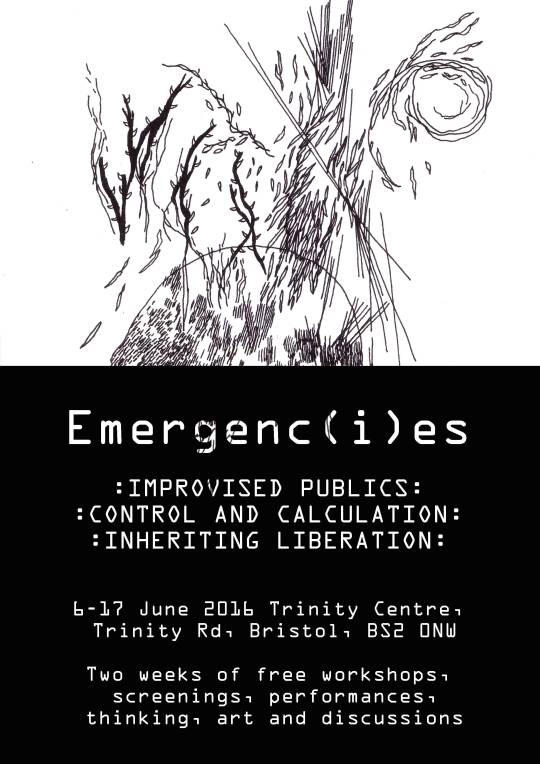
Reblog> Improvised Publics :: Control and Calculation :: Inheriting Liberation :: 6-17 June 2016

This event looks really interesting, check out the website for more information…

Emergenc(i)es – an event in Bristol between 6th and 17th June

Emergenc(i)es is an invitation to consider the emergency of the current historical moment.

The exhibition will dwell in the question of emergence within emergency.

Performance, education activities, visual art, screenings, installations, workshops and a library-cum-pharmacy will create time and space to diagnose, explore and understand the world we live in.

Enter – Relate – Improvise – Diagnose – Inherit – Public – Liberate – Gather

All activities are free to attend, thanks to generous funding from Awards for All.

Feminism, Digital Culture and the Politics of Transmission – Deborah Withers

I don’t really know why I haven’t seen this before today(?!) but just wanted to flag this really interesting book by Deborah Withers, which I will be ordering ASAP…

Feminism, Digital Culture and the Politics of Transmission argues that despite the prevalence of generational narratives within feminism, the technical processes through which knowledge is transmitted across generations remain unexplored. Taking Bernard Stiegler’s concept of the already-there as its starting point the book considers how the politics of transmission operates within digital culture. It argues that it is necessary to re-orient feminism’s political project within what is already-there so that it may respond to an emergent feminist tradition.Grounded in the author’s work collecting and interpreting the music-making heritage of the UK Women’s Liberation Movement, it explores how digital technologies have enabled empassioned amateurs to make ‘archives’ within the first decade of the 21st century. The book reflects on what is technically and politically at stake in the organization and transmission of digital artifacts, and explores what happens to feminist cultural heritage when circuits shut down, stall or become diverted.

And here’s some praise from Patrick Crogan, whose opinion I trust:

A substantial, judicious, and highly effective mobilisation of key tenets of Stiegler’s work pertaining to memory, technology, and cultural transmission. Withers develops a cogent political reformulation of questions of memory, heritage, and archival matters of preservation and access in the digital age in this book project. Her use of Stiegler is central to this, and indeed represents an important introduction to his philosophical critique of the digital mediated world to an area where his ideas have particular relevance but are under-represented.

Patrick Crogan, Associate Professor of Digital Cultures, University of the West of England

Compositional thinking, or ‘deconstruction as composition’

I’ve been re-reading Dan Ross’ excellent chapter in the edited collection Stiegler and Technics entitled “Pharmacology and Critique after Deconstruction” and wanted to post an excerpt because it seems to me one of the clearest interpretations of one of the foundations of Bernard Stiegler’s thought: “composition”. This is a brief excerpt but I thoroughly recommend reading Dan’s chapter, and indeed the whole book – which is really good!


Stiegler inherits more from Derrida than from any other thinker: ‘deconstructive’ thinking is translated in Stieglerian terms into ‘compositional’ thinking:

Deconstruction is a thinking of composition in the sense that composition is ‘older’ than opposition (what Simondon would have called a ‘transductive relation’: that is, a relation that constitutes its terms, the terms not existing outside the relation). It is a relation that is the vehicle of a process (that of différance), one very close, I would argue, to what Simondon elaborates in terms of a ‘process of individuation’ (Stiegler 2001: 249-250).

Deconstruction, pursuing the complex genesis of oppositional pairs, amounts to the elaboration of s process of becoming. It is therefore more consistent than first appearances might indicate with the theories of Gilbert Simondon, for whom the key was not to begin with terms or individuals and then think their ‘relation’; rather, it is the process itself that ‘has the status of being’ (Simondon 1992: 306).

[…]

To this relation of differance to individuation should be added the influence of Nitetzsche, for whom existence must be understood as a play of forces, or, better, of tendencies. The formation of oppositions from prior compositions is an expression of this play of tendencies…

And it may turn out that where compositional thought is superior to deconstructive thought is in making it possible to think de-composition […] Deconstruction thus tends, perhaps, to perceive less clearly the pharmacological dangers of the deconstruction of ‘oppositions’, and the possibility that distinctions may on occasion be precisely what need to be preserved, that is, saved.

Ross, D 2015 “Pharmacology and Critiques after Deconstruction”, in  Howells, C and Moore, G eds. Stiegler and Technics, Edinburgh University Press, Edinburgh, pp. 245-246.

Other references:

Simondon, G. 1992 [1964] “The genesis of the individual”, in Crary, J. and Kwinter, S. Eds. Incorporations, Zone, New York.

Stiegler, B. 2001 “Deconstruction and technology: Fidelity at the limits of deconstruction and the prosthesis of faith”, trans. Beardsworth, R,, in Cohen, T. Ed. Jacques Derrida and the Humanities: A Critical Reader, Cambridge University Press, Cambridge.

In Disruption – new book by Bernard Stiegler

Yet another new book by Bernard Stiegler has been published in French recently: Dans la Disruption – Comment ne pas devenir fou?

One might translate this as: “In Disruption – How do we not go mad?”

Here’s the front and back covers, and I offer a quick translation of the back cover blurb…


For the lords of economic war disruption is “a phenomenon of the acceleration of innovation (…) which is going to happen more quickly in societies that allow them to impose programmes that destroy social structures and render public power impotent. This is a kind of strategy of tetanising one’s adversary”.

Facing the disruption thus imposed, social systems always arrive too late to seize technological evolution, now thundering ahead in the digital revolution. Faced with this state of affairs, which requires countless legal and theoretical loopholes establishing a lawlessness which is a kind of techonlogical Wild-West, individuals and groups are totally lost, often to the point of going mad, individually or collectively, and therefore becoming dangerous. The concretisation of what Nietzsche described as a growing desert of nihilism leaves 21st Century humans with no other perspective than facing the next of the limits of the Anthropocene.

What can be done with such madness, in such madness? It is by starting with this question, that Bernard Stiegler rereads Michel Foucault (Madness and civilisation: A history of insanity in the Age of Reason) and Jacques Derrida (Cogito and the History of Madness) while confronting Peter Sloterdijk and Jean-Baptise Fressoz’s analyses of capitalism as above all a process of disinhibition.

The author conducts these readings or re-readings starting from the forms of madness which reflects his own course, opening out the question of a new moral philosophy – in an age without age [l’époque sans époque], which he calls the “Strauss-Kahn generation”, that is a “lack of age” [“absence d’époque”], which imposes a general demoralisation that cannot last.

Stiegler: Stop the uberisation of society!

Posted below is a translation of a piece co-authored by Bernard Stiegler with Ariel Kyrou (journo),  Yann Moulier-Boutang (writer) and Bruno Teboul (Director of innovation at Keyrus) and published in Libération on the 10th April.

I suppose it doesn’t really propose anything especially novel, if you’re familiar with others involved in debates around “postcapitalism”, automation, worklessness and universal income (e.g. Srnicek and Williams, or Mason). What is perhaps novel is an application of the ideas in a distinctly European flavour, with examples in France and in the context of a much more robust unionised response to Uber (and the task/gig economy).

Anyway, it’s an interesting read I think…

The piece is rather conversational in tone and uses idioms I have only been able to infer (not being a fluent and native speaker) so it was quite difficult to translate, and so I’m pretty sure there are errors. As usual clarifications or original French are in [square brackets].

Stop the uberisation of society!

Libération, 10th April

The war by taxi companies against an Uber society cannot be reduced to the storyline of a film depicting an ancient evil battling benevolent forces of modernity. If on the one hand the participatory economy threatens our social structures, it can also, on the other, make possible a society with greater solidarity.

Since the first moves towards the draft Thévenoud law in June 2014[1], the urban transport soap opera has generated multiple variations on the theme of the standard storyline. On one side are the taxi federations, which have been labelled a horde of grumpy medieval malthusians by Uber, who in the opening of the second act of the performance of the trial of the 11th February demanded a whopping €100m in damages from Uber, on the other the ‘white knight’ of the new economic order, the high-tech Robin Hood of its pleb users whose UberPop service enables simple fellows in search of employment the opportunity to offer at cut-price their talents for automotive locomotion, between February 2014 and July 2015. This tale of jokers against modernisers is more attractive than the G7, queen of opaque rentier sorcery, who could not turn themselves with the wave of a magic wand into the cinderella of Parisian Transport.

Except that the movie script of the ancient evil against the benevolent ‘disruptors’ rings as hollow as any Hollywood blockbuster: seen quickly, soon forgotten. It works in the short-term, like the groan of the indefinite vigil for a taxi at 3 o’clock in the morning in the banlieue, but it hardly takes us any distance towards solving the questions about the future of our society and the search for sustainable solutions to the crisis we are experiencing.

Let’s not misunderstand this scenario: the agonism presented by this contemporary drama [série du moment] is neither the ardent need to pit global start-ups against French corporatism [corporatismes franchouillards] nor its exact opposite, namely the obligation to defend the capitalism of tired old barons against the hyper-capitalism of the rulers of the digital future. No, the issue that should be obvious to everyone with a stake in the debate is the urgent need to think about the society we want, and then act in order to build it.

For why should we anoint an ‘uberisation of the economy’ without interrogating its ideology and long-term deleterious effects? Uber, which declares only a fraction of its profits in France thanks to a complex form of tax evasion through the Netherlands, Bermuda and Delaware, is participating in the liquidation of our social structures. It embodies a short circuit that threatens the fragile economic balance between taxation, social law, transport policy, infrastructure investment at the local level and the pensions system. Worse still: its social and economic logic foreshadows the advent of a futuristic no-man’s land in which the a priori ideal of liberty becomes monetised against an a posteriori generalised casualisation throughout society. Indeed, the rictus predatory behaviour of platforms like Uber, Lyft and others such as Amazon’s Mechanical Turk is founded upon a low intensity of capital, little infrastructure, a minimum of salaried employees with more independent or self-employed workers.

The uberisation process forms the first wave in the tsunami of automation. Its primary consequence will be a net loss of five million jobs in industrialised countries by 2020, according to a report published on the 18th of January by the oracles of the World Economic Forum in Davos, the shameless apostles of the “fourth industrial revolution”. This deeply unappealing assertion has been amplified by several studies in the last three years (by Oxford, MIT, the Breugel Institute and Roland Berger) which predict around 47% fewer people in employment by 2025. This slow but inexorable extinction of of the salaried world effects not only warehouse workers, supermarket cashiers and lorry drivers but also barristers, solicitors, journalists, those working in medicine, and so on. Why should it remain necessary to use human beings for tasks that are reducible to systematic procedures? Which in our data economy robots and algorithms will soon perform much more efficiently. The combination of robotics and ‘big data’, algorithms and network effects, is already transforming us into the involuntary gravediggers for salaried employment. Welcome to a world that is ultimately ‘flexible’, boosted by robotic automation [robotisation] and work on the meter. A world where users and customers constantly account for themselves, where each becomes their own big brother and where most of the activity in every market, like with car insurance, will increasingly play out more in an automated big data-driven fashion than according to laws or to forms of trust that are not based in calculation.

Nevertheless we should beware skewed perspectives: such a world is not inevitable. The digital gives us an opportunity to reconsider work not only in terms of jobs doomed to become ever more precarious, provoking anxiety about self-exploitation, but also as a part of a project for a contributory society in which salaried employment would be one means amongst many, rather than an end in itself. A company like TaskRabbit certainly creates use value through its platform of small on-demand jobs, but it keeps for itself and its shareholders the [accompanying] exchange value in the form of profit. In contrast, Loconomics is a co-operative owned by those who use it to advertise their services. Against the platforms of the so-called sharing economy (which it is in name only) Trebor Scholz endorses a ‘platform cooperativism’ [2] to build a society of commons that operates beyond solely economic and financial dimensions.

This shambles needs to be urgently addressed. Thinking in the long-term, this is political in the principal sense of the word. To buckle down to the future of work equally concerns: expertise in data to use and liberate ourselves from algorithms and a care for people without the need for machines; to classify work in a way that is both protective of our ways of life and much less administrative than today; to examine the establishment of an adequate basic income, structurally justified by massive unemployment due to automation and the coming slow death of employment; to experiment with the extension of the regime of casual work in the context of a true society of contribution, with the acquisition and sharing of knowledge by and between everyone; to study tax reform based upon the principles of a financial transactions tax [la taxe pollen], beginning with the establishment of a European tax on the flows of High Frequency Trading, to finance a universal income.

Rather than the two opposing and yet complimentary nightmares that are the integral uberisation of society and the sovereignist protection of the capitalism of yesteryear we prefer the realisation of a dream: to imagine, to experiment, to build, step by step, a freer society with greater solidarity; preferring disagreement to the brainwashing that has played out, historically, through the carrot and the stick, or, in our high-tech times, through a blind obedience to shiny artificial devices [l’obéissance aveugle à de rutilantes mécaniques artificielles et augmentées].

1. For more information on the Thévenoud law see this article – Sam.

2. See this article on Medium by Scholz.

‘Vulgar’ cultural geographies and technology (new article online) and other ‘provocations for cultural geography today’

I have a short article/commentary recently published online in Social & Cultural Geography:

Vulgar geographies? Popular cultural geographies and technology

The article is one of several from a forthcoming theme issue that is the result of the OU Open Space Centre’s 2014 Doreen Massey annual event themed on ‘provocations of the present’. The theme issue Provocations for Cultural Geography Today has some great papers in it, including:

I strongly encourage having a read of these articles!